


 |
市場調查報告書
商品編碼
2124684
倉儲自動化:市場佔有率分析、產業趨勢與統計、成長預測(2026-2031)Warehouse Automation - Market Share Analysis, Industry Trends & Statistics, Growth Forecasts (2026 - 2031) |
||||||

※ 本網頁內容可能與最新版本有所差異。詳細情況請與我們聯繫。
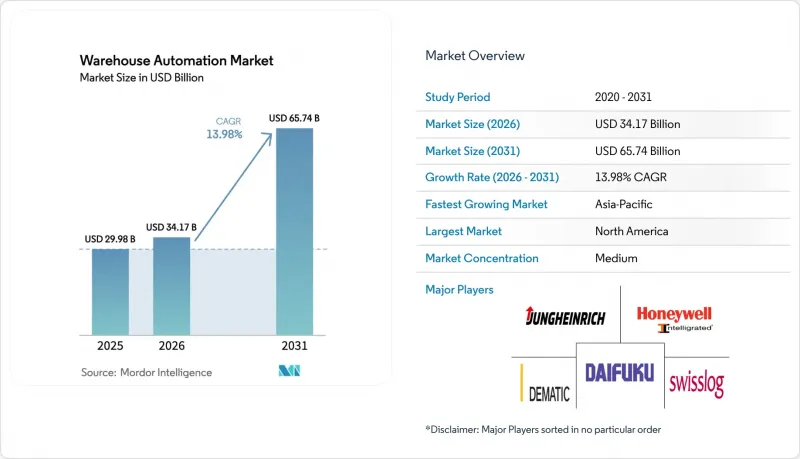
根據 Mordor Intelligence 預測,倉庫自動化市場預計將從 2025 年的 299.8 億美元成長到 2026 年的 341.7 億美元,到 2031 年達到 657.4 億美元,2026 年至 2031 年的複合年預計成長率為 13.98%。
本報告按組件(硬體、軟體、服務)、技術(行動機器人、自動化立體倉庫等)、終端用戶產業(食品飲料、郵政小包裹等)、倉庫規模(小規模、中型等)、應用(收貨和處理等)、所有權類型(例如,純電器公司)和地區進行細分。市場預測以美元計價。
全球倉儲自動化市場趨勢與洞察
電子商務的快速發展以及人們對最後一公里配送的期望。
預計到2025年第三季度,美國電商銷售額將達到3,103億美元,其關鍵策略在於將訂單到交貨時間縮短至兩小時以內。零售商目前正將庫存設置在距離高需求區域10英里以內,並將配送網路分散到無法安裝傳統輸送機網格的微型倉配中心。垂直穿梭車陣列和周轉箱收集機器人能夠有效利用占地面積,在用地面積小於2萬平方英尺的配送中心每小時處理500至1000份訂單。因此,在最後一公里配送的經濟效益中,資本密集度正變得比勞動力柔軟性更為重要,這顛覆了以往低自動化模式的主導地位。雜貨店和快餐店正在引領這項變革,他們將零售店的地下室和停車場改造成自動化中心,從而規避了新工業建築的區域規劃法規。
人手不足和薪資通膨加速
截至2025年9月的12個月裡,北美物流業的薪資上漲了3.8%,高於所有私部門員工3.6%的平均漲幅。同時,員工自願離職率維持在2%以下。每月每台成本在2,000美元至4,000美元之間的自主移動機器人,最快可在12個月內收回投資,每台機器人相當於取代了2.5至3名全職員工。由於勞動力短缺帶來的機會成本超過了資本風險,越庫作業和套件組裝自動化正在斯堪的斯堪地那維亞、瑞士和日本的都市區發展。薪資成長推動的自動化正在抵消美國中型城市曾經享有的人事費用優勢,並使各地區的履約成本趨於平衡。
固定式系統初始資本投入高,投資回收期長。
一座基於單巷起重機的自動化倉庫造價可能超過200萬美元,如果處理量比設計目標低15-20%,投資回收期可能長達五年或更久。這種高資本投入使得市場兩極化:一方面是能夠投資待開發區倉庫的成熟企業,另一方面是只能使用移動機器人的新興企業。在服裝和消費性電子產業,SKU(庫存單位)的高波動性意味著調整起重機高度可能需要數週的停機時間,而固定系統缺乏柔軟性也增加了風險。因此,中型企業往往更傾向於選擇模組化解決方案,即使其長期效率低於客製化設計的輸送機系統。
細分市場分析
儘管硬體支出在2025年佔比高達55.12%,但軟體銷售額預計將在2026年至2031年間以14.87%的複合年成長率成長。營運商正在採用雲端原生執行層,與現有輸送機相比,吞吐量可提高15%至25%。他們更傾向於每週進行程式碼更新,而不是進行可能導致碼頭停工數日的實體維修。訂閱定價模式將維護和分析功能包含在許可範圍內,可減少30%的意外運作,並減少服務車輛的調度次數。創業投資正密切關注這一利潤率趨勢,並敦促軟體公司收購細分領域的流程應用程式,並將其整合到統一的編配套件中。
在面積超過50萬平方英尺的新建設中,硬體仍然至關重要。在這些設施中,客製化輸送機和高層倉庫起重機可以透過20年的租賃期有效攤提成本。業務收益主要集中在現有設施的維修項目中,這些項目的安裝工人必須輪班工作,並避免因訂單截止日期而造成任何干擾。移動機器人供應商現在會預先安裝車隊軟體,該軟體可在機器人到達時自動進行校準,從而減少整合商的工作時間,並將利潤來源從機器調整工作轉移到資訊服務。因此,支出正逐漸轉向軟體,而硬體在高吞吐量設施中仍佔據核心地位,從而維持了整個倉庫自動化市場的平衡。
由於採用新型機械手臂和視覺技術的進步,揀貨機器人的誤揀率已降至0.5%以下,預計其複合年成長率將達到15.27%。這使得傳統機器人不再局限於揀選銷售前20%的商品,從而實現了服裝、化妝品和混合食品訂單的自動化揀選。預計到2025年,自主移動機器人將佔總支出的41.36%,目前這些機器人已與揀選臂整合,形成端到端的「產品到機器人」循環,並將行走距離縮短了70%。
在對度C精度要求極高的冷鏈設施中,自動化倉儲系統仍佔據主導地位;而在每小時處理量達1萬件的小包裹中心,輸送機和分揀設備則佔據主導地位。自動識別和數據採集(AIDC)技術可為所有技術層級提供即時、準確的庫存信息,並將數據傳輸至編配引擎,由引擎為每個任務選擇最佳機器人。這些技術的進步共同推動了先進機器人技術在多技術系統銷售的倉儲自動化市場中的佔有率不斷擴大。
區域分析
到2025年,北美將佔全球銷售額的35.51%,這主要得益於美國和墨西哥近岸外包的蓬勃發展。儘管2020年至2024年間,該地區新增了5億平方英尺的倉儲空間,但隨著大規模設施部署達到峰值,成長速度正在放緩。墨西哥在2024年至2025年間吸引了200億美元的近岸外包投資,並在蒙特雷和巴希奧地區建立自動化樞紐,以連接製造業與美國市場需求。加拿大則專注於多倫多和溫哥華周邊地區的冷鏈自動化建設,以支援藥品和食品的履約。
亞太地區預計將以15.91%的複合年成長率成長,成為全球成長最快的地區。中國計畫到2030年,根據智慧物流指南,在一線城市物流園區實現70%的自動化滲透率。在日本,儘管由於符合抗震標準導致成本增加15-20%,但政府仍透過津貼機器人技術來解決勞動力短缺問題。印度的商品和服務稅(GST)改革正在加速大型物流中心的形成,而澳洲則正在推動出口冷鏈的自動化。
歐洲市場仍然成熟,但由於監管規定,資本投資難以轉移,因為《建築能源性能指令》要求在設備升級前必須維修。中東和非洲的部署正在推進,主要集中在阿拉伯聯合大公國和沙烏地阿拉伯的自由區,但南美洲則受到外匯波動的影響,導致進口設備成本飆升達50%。
其他好處:
- Excel格式的市場預測(ME)表
- 3個月的分析師支持
目錄
第1章:引言
- 研究假設和市場定義
- 調查範圍
第2章:調查方法
第3章執行摘要
第4章 市場狀況
- 市場概覽
- 市場促進因素
- 電子商務的快速發展以及人們對最後一公里配送的期望。
- 勞動力短缺和薪資通膨加速
- 即插即用的AMR和AGV車隊可快速實現投資回報
- 「機器人即服務」降低了資本投資的門檻。
- 與ESG(環境、社會和治理)相關的強制性能源效率改進
- 受製造業回流驅動,大型樞紐需要高密度自動化。
- 市場限制因素
- 固定式系統初始資本投入大,投資回收期長。
- 將傳統IT系統與WMS系統整合的複雜性
- 連網型設備中的網路安全漏洞
- 加強對自主移動機器人(AMR)中使用的鋰離子電池的防火安全規定。
- 產業價值鏈分析
- 監理情勢
- 技術展望
- 宏觀經濟因素對市場的影響
- 波特五力分析
- 倉庫投資方案
第5章 市場規模與成長預測
- 按組件
- 硬體
- 軟體
- 服務
- 透過技術
- 移動機器人(AGV、AMR)
- 自動化倉庫系統(AS/RS)
- 傳送和分類系統
- 碼垛/卸垛機器人
- 揀貨機器人
- 自動識別和數據採集(AIDC)
- 按最終用戶行業分類
- 食品/飲料
- 郵件和小包裹
- 零售與電子商務
- 服裝和鞋類
- 製造業(耐久性消費品和非耐久性消費品)
- 藥品和醫療保健
- 第三方物流/合約物流
- 其他終端用戶產業
- 倉庫規模
- 小規模(小於50,000平方英尺)
- 中型(50,000 至 200,000 平方英尺)
- 大型(20萬至50萬平方英尺)
- 巨型(超過50萬平方英尺)
- 透過用途和功能
- 到貨處理
- 保存和緩衝
- 揀貨和包裝
- 分類和合併
- 出站裝載
- 退貨處理
- 自有車型
- 公司自有倉庫
- 第三方物流/合約倉庫
- 電子商務專業公司
- 政府/國防
- 按地區
- 北美洲
- 美國
- 加拿大
- 墨西哥
- 南美洲
- 巴西
- 阿根廷
- 智利
- 其他南美國家
- 歐洲
- 德國
- 英國
- 法國
- 義大利
- 西班牙
- 荷蘭
- 俄羅斯
- 其他歐洲國家
- 亞太地區
- 中國
- 日本
- 韓國
- 印度
- ASEAN
- 澳洲
- 紐西蘭
- 其他亞太國家
- 中東
- GCC
- 土耳其
- 以色列
- 其他中東國家
- 非洲
- 南非
- 奈及利亞
- 肯亞
- 其他非洲國家
- 北美洲
第6章 競爭情勢
- 市場集中度
- 策略趨勢
- 市佔率分析
- 公司簡介
- Dematic Group(Kion Group AG)
- Daifuku Co. Ltd
- Swisslog Holding AG(KUKA AG)
- Jungheinrich AG
- Honeywell Intelligrated
- Murata Machinery
- KNAPP AG
- TGW Logistics Group GmbH
- Kardex Group
- Mecalux SA
- BEUMER Group
- SSI Schaefer AG
- Vanderlande BV
- WITRON Logistik+Informatik GmbH & Co. KG
- Boston Dynamics
- Zebra Technologies
- Exotec
- Geek+
- Symbotic
- AutoStore
- Locus Robotics
- GreyOrange
- Berkshire Grey
- Element Logic
- Ocado Group
- Fetch Robotics(Zebra)
- Magazino
第7章 市場機會與未來展望
According to Mordor Intelligence, the warehouse automation market size is expected to increase from USD 29.98 billion in 2025 to USD 34.17 billion in 2026 and reach USD 65.74 billion by 2031, growing at a CAGR of 13.98% over 2026-2031.
This report is Segmented by Component (Hardware, Software, and Services), Technology (Mobile Robots, AS/RS, and More), End-User Industry (Food and Beverage, Post and Parcel, and More), Warehouse Size (Small, Medium, and More), Application Function (Inbound Handling, and More), Ownership Model (E-Commerce Pure-Plays, and More), and Geography. The Market Forecasts are Provided in Terms of Value (USD).
Global Warehouse Automation Market Trends and Insights
E-commerce Boom And Last-Mile Expectations
Quarterly U.S. e-commerce sales reached USD 310.3 billion in Q3 2025, but the strategic hinge lies in compressing order-to-door intervals to two hours or less. Retailers now locate inventory within 10 miles of demand clusters, fragmenting networks into micro-fulfillment nodes that cannot house traditional conveyor grids. Vertical shuttle arrays and tote-retrieval robots reclaim floor area, processing 500-1,000 orders per hour from footprints under 20,000 square feet. Last-mile economics therefore reward capital intensity over labor flexibility, reversing the historic low-automation model. Grocery and quick-commerce operators lead adoption by repurposing retail basements and parking decks into automated hubs that bypass zoning constraints on new industrial builds.
Labour Shortages And Rising Wage Inflation
Logistics wages in North America advanced 3.8% over the twelve months ending September 2025, eclipsing the 3.6% average for all civilian workers, while voluntary turnover slid below 2%. Autonomous mobile robot fleets priced at USD 2,000-4,000 per unit per month reach payback in as little as 12 months, effectively replacing 2.5-3 full-time equivalents per robot. Operators in Scandinavia, Switzerland, and urban Japan now automate cross-docking and kitting because the opportunity cost of unfilled jobs outweighs capital risk. Wage-driven automation also neutralizes the labor cost edge once enjoyed by mid-tier U.S. cities, homogenizing fulfillment economics regionally.
High Upfront Capex And Long Pay-Back For Fixed Systems
A single aisle of crane-based automated storage can exceed USD 2 million, with payback stretching beyond five years if throughput misses design targets by 15%-20%. Such capital intensity bifurcates the market into incumbents able to finance greenfield mega-hubs and challengers confined to mobile robots. The risk rises in apparel and consumer electronics, where SKU volatility renders fixed systems inflexible because re-configuring crane heights may require multi-week shutdowns. Consequently, mid-tier operators favor modular solutions that preserve optionality, even when long-run efficiency is lower than purpose-built conveyor grids.
Other drivers and restraints analyzed in the detailed report include:
- Rapid ROI From Plug-And-Play AMR And AGV Fleets
- Robotics-As-A-Service Lowering Cap-Ex Hurdles
- Legacy IT And WMS Integration Complexity
For complete list of drivers and restraints, kindly check the Table Of Contents.
Segment Analysis
Software revenue is projected to post a 14.87% CAGR between 2026 and 2031, even though hardware controlled 55.12% of spending in 2025. Operators deploy cloud-native execution layers that lift throughput by 15% to 25% from existing conveyors, favoring code updates that arrive weekly over physical retrofits that can idle docks for days. Subscription pricing folds maintenance and analytics into the license, cutting unscheduled downtime 30% and trimming service truck rolls. Venture capital follows the margin profile, pushing software firms to acquire niche workflow applications and bundle them into unified orchestration suites.
Hardware remains vital for greenfield mega-hubs exceeding 500,000 square feet, where custom conveyors and high-bay cranes amortize efficiently across 20-year leases. Services revenue concentrates in brownfield projects that need installers to work overnight shifts and avoid order-cutoff disruption. Mobile robot suppliers now preload fleet software that self-calibrates on arrival, limiting integrator hours and shifting profit pools from wrench work to data services. The net result is a gradual migration of spending toward software while hardware remains the anchor in high-throughput facilities, preserving balance within the overall warehouse automation market.
Piece-picking robots are forecast to grow at 15.27% CAGR because new grippers and vision reduce mis-pick rates below 0.5%. This removes the historical need to restrict robots to the top 20% of fast movers, unlocking automation for apparel, cosmetics, and mixed grocery orders. Autonomous mobile robots, which captured 41.36% of 2025 spend, now integrate with pick arms to create end-to-end goods-to-robot loops that shrink travel by 70%.
Automated storage and retrieval systems retain a stronghold in cold chain sites where +-2°C accuracy is mandatory, while conveyor and sortation equipment dominates parcel hubs running 10,000 units per hour. Automatic identification and data capture equips every technology layer with real-time inventory truth, feeding orchestration engines that choose the optimal robot for each task. Together these advances expand the warehouse automation market share held by advanced robotics within multi-technology system sales.
Complete Report Scope:
- By Component
- Hardware
- Software
- Services
- By Technology
- Mobile Robots (AGV, AMR)
- Automated Storage and Retrieval Systems (AS/RS)
- Conveyor and Sortation Systems
- Palletizing / Depalletizing Robotics
- Piece-Picking Robots
- Automatic Identification and Data Collection (AIDC)
- By End-User Industry
- Food and Beverage
- Post and Parcel
- Retail and E-commerce
- Apparel and Footwear
- Manufacturing (Durable and Non-Durable)
- Pharmaceuticals and Healthcare
- 3PL / Contract Logistics
- Other End-User Industries
- By Warehouse Size
- Small (Less than 50 k sq ft)
- Medium (50-200 k sq ft)
- Large (200-500 k sq ft)
- Mega (More than 500 k sq ft)
- By Application Function
- Inbound Handling
- Storage and Buffering
- Picking and Packing
- Sorting and Consolidation
- Outbound Loading
- Returns Processing
- By Ownership Model
- Company-Owned Warehouses
- 3PL / Contract Warehouses
- E-commerce Pure-Plays
- Government / Defence
- By Geography
- North America
- United States
- Canada
- Mexico
- South America
- Brazil
- Argentina
- Chile
- Rest of South America
- Europe
- Germany
- United Kingdom
- France
- Italy
- Spain
- Netherlands
- Russia
- Rest of Europe
- Asia Pacific
- China
- Japan
- South Korea
- India
- ASEAN
- Australia
- New Zealand
- Rest of Asia Pacific
- Middle East
- GCC
- Turkey
- Israel
- Rest of Middle East
- Africa
- South Africa
- Nigeria
- Kenya
- Rest of Africa
- North America
Geography Analysis
North America held 35.51% of revenue in 2025, anchored by the United States and Mexico's nearshoring boom. The region added 500 million square feet of warehouses from 2020-2024, but growth cools as large-site penetration peaks. Mexico attracted USD 20 billion in nearshoring investment during 2024-2025, spawning automated hubs in Monterrey and the Bajio region to synchronize manufacturing with U.S. demand. Canada focuses on cold-chain automation around Toronto and Vancouver to support pharmaceutical and grocery fulfillment.
Asia-Pacific will expand at a 15.91% CAGR, the fastest globally. China targets 70% automation penetration in tier-one city logistics parks by 2030 under its smart-logistics guidelines. Japan counters a shrinking labor pool by subsidizing robotics, despite 15%-20% higher costs for seismic compliance. India's GST reforms foster mega-hubs, while Australia automates export-oriented cold chains.
Europe remains a mature stronghold yet faces regulatory capex diversion as the Energy Performance of Buildings Directive mandates retrofits before capacity additions. Middle East and Africa adoption centers on UAE and Saudi Arabia free zones, whereas South America battles currency volatility that inflates imported equipment costs by up to 50%.
- Dematic Group (Kion Group AG)
- Daifuku Co. Ltd
- Swisslog Holding AG (KUKA AG)
- Jungheinrich AG
- Honeywell Intelligrated
- Murata Machinery
- KNAPP AG
- TGW Logistics Group GmbH
- Kardex Group
- Mecalux SA
- BEUMER Group
- SSI Schaefer AG
- Vanderlande BV
- WITRON Logistik + Informatik GmbH & Co. KG
- Boston Dynamics
- Zebra Technologies
- Exotec
- Geek+
- Symbotic
- AutoStore
- Locus Robotics
- GreyOrange
- Berkshire Grey
- Element Logic
- Ocado Group
- Fetch Robotics (Zebra)
- Magazino
Additional Benefits:
- The market estimate (ME) sheet in Excel format
- 3 months of analyst support
TABLE OF CONTENTS
1 INTRODUCTION
- 1.1 Study Assumptions and Market Definition
- 1.2 Scope of the Study
2 RESEARCH METHODOLOGY
3 EXECUTIVE SUMMARY
4 MARKET LANDSCAPE
- 4.1 Market Overview
- 4.2 Market Drivers
- 4.2.1 E-commerce Boom and Last-Mile Expectations
- 4.2.2 Labour Shortages and Rising Wage Inflation
- 4.2.3 Rapid ROI from Plug-and-Play AMR and AGV Fleets
- 4.2.4 Robotics-as-a-Service Lowering Cap-Ex Hurdles
- 4.2.5 ESG-Linked Energy-Efficiency Mandates
- 4.2.6 Reshoring-Driven Mega-Hubs Needing High-Density Automation
- 4.3 Market Restraints
- 4.3.1 High Upfront Capex and Long Pay-Back for Fixed Systems
- 4.3.2 Legacy IT and WMS Integration Complexity
- 4.3.3 Cyber-Security Vulnerabilities of Connected Devices
- 4.3.4 Stricter Li-ion Battery Fire-Safety Regulations for AMRs
- 4.4 Industry Value Chain Analysis
- 4.5 Regulatory Landscape
- 4.6 Technological Outlook
- 4.7 Impact of Macroeconomic Factors on the Market
- 4.8 Porter's Five Forces Analysis
- 4.8.1 Bargaining Power of Buyers
- 4.8.2 Bargaining Power of Suppliers
- 4.8.3 Threat of New Entrants
- 4.8.4 Threat of Substitutes
- 4.8.5 Intensity of Competitive Rivalry
- 4.9 Warehouse Investment Scenario
5 MARKET SIZE AND GROWTH FORECASTS (VALUE)
- 5.1 By Component
- 5.1.1 Hardware
- 5.1.2 Software
- 5.1.3 Services
- 5.2 By Technology
- 5.2.1 Mobile Robots (AGV, AMR)
- 5.2.2 Automated Storage and Retrieval Systems (AS/RS)
- 5.2.3 Conveyor and Sortation Systems
- 5.2.4 Palletizing / Depalletizing Robotics
- 5.2.5 Piece-Picking Robots
- 5.2.6 Automatic Identification and Data Collection (AIDC)
- 5.3 By End-User Industry
- 5.3.1 Food and Beverage
- 5.3.2 Post and Parcel
- 5.3.3 Retail and E-commerce
- 5.3.4 Apparel and Footwear
- 5.3.5 Manufacturing (Durable and Non-Durable)
- 5.3.6 Pharmaceuticals and Healthcare
- 5.3.7 3PL / Contract Logistics
- 5.3.8 Other End-User Industries
- 5.4 By Warehouse Size
- 5.4.1 Small (Less than 50 k sq ft)
- 5.4.2 Medium (50-200 k sq ft)
- 5.4.3 Large (200-500 k sq ft)
- 5.4.4 Mega (More than 500 k sq ft)
- 5.5 By Application Function
- 5.5.1 Inbound Handling
- 5.5.2 Storage and Buffering
- 5.5.3 Picking and Packing
- 5.5.4 Sorting and Consolidation
- 5.5.5 Outbound Loading
- 5.5.6 Returns Processing
- 5.6 By Ownership Model
- 5.6.1 Company-Owned Warehouses
- 5.6.2 3PL / Contract Warehouses
- 5.6.3 E-commerce Pure-Plays
- 5.6.4 Government / Defence
- 5.7 By Geography
- 5.7.1 North America
- 5.7.1.1 United States
- 5.7.1.2 Canada
- 5.7.1.3 Mexico
- 5.7.2 South America
- 5.7.2.1 Brazil
- 5.7.2.2 Argentina
- 5.7.2.3 Chile
- 5.7.2.4 Rest of South America
- 5.7.3 Europe
- 5.7.3.1 Germany
- 5.7.3.2 United Kingdom
- 5.7.3.3 France
- 5.7.3.4 Italy
- 5.7.3.5 Spain
- 5.7.3.6 Netherlands
- 5.7.3.7 Russia
- 5.7.3.8 Rest of Europe
- 5.7.4 Asia Pacific
- 5.7.4.1 China
- 5.7.4.2 Japan
- 5.7.4.3 South Korea
- 5.7.4.4 India
- 5.7.4.5 ASEAN
- 5.7.4.6 Australia
- 5.7.4.7 New Zealand
- 5.7.4.8 Rest of Asia Pacific
- 5.7.5 Middle East
- 5.7.5.1 GCC
- 5.7.5.2 Turkey
- 5.7.5.3 Israel
- 5.7.5.4 Rest of Middle East
- 5.7.6 Africa
- 5.7.6.1 South Africa
- 5.7.6.2 Nigeria
- 5.7.6.3 Kenya
- 5.7.6.4 Rest of Africa
- 5.7.1 North America
6 COMPETITIVE LANDSCAPE
- 6.1 Market Concentration
- 6.2 Strategic Moves
- 6.3 Market Share Analysis
- 6.4 Company Profiles (includes Global Level Overview, Market Level Overview, Core Segments, Financials as Available, Strategic Information, Market Rank/Share for Key Companies, Products and Services, Recent Developments)
- 6.4.1 Dematic Group (Kion Group AG)
- 6.4.2 Daifuku Co. Ltd
- 6.4.3 Swisslog Holding AG (KUKA AG)
- 6.4.4 Jungheinrich AG
- 6.4.5 Honeywell Intelligrated
- 6.4.6 Murata Machinery
- 6.4.7 KNAPP AG
- 6.4.8 TGW Logistics Group GmbH
- 6.4.9 Kardex Group
- 6.4.10 Mecalux SA
- 6.4.11 BEUMER Group
- 6.4.12 SSI Schaefer AG
- 6.4.13 Vanderlande BV
- 6.4.14 WITRON Logistik + Informatik GmbH & Co. KG
- 6.4.15 Boston Dynamics
- 6.4.16 Zebra Technologies
- 6.4.17 Exotec
- 6.4.18 Geek+
- 6.4.19 Symbotic
- 6.4.20 AutoStore
- 6.4.21 Locus Robotics
- 6.4.22 GreyOrange
- 6.4.23 Berkshire Grey
- 6.4.24 Element Logic
- 6.4.25 Ocado Group
- 6.4.26 Fetch Robotics (Zebra)
- 6.4.27 Magazino
7 MARKET OPPORTUNITIES AND FUTURE OUTLOOK
- 7.1 White-Space and Unmet-Need Assessment

 亞太地區倉儲自動化:市場佔有率分析、產業趨勢與統計及成長預測(2026-2031)北美倉儲自動化:市場佔有率分析、產業趨勢與統計及成長預測(2026-2031 年)歐洲倉儲自動化:市場佔有率分析、產業趨勢與統計及成長預測(2026-2031 年)
 自主倉庫揀選智慧市場預測至2034年-全球產品、組件、技術、揀選方法、應用、最終使用者和區域分析
 自動化倉庫揀貨市場-2026-2032年全球市場預測倉儲自動化市場:按自動化類型、類別、組件、功能、應用和最終用戶分類-2026-2032年全球市場預測倉儲自動化分析市場:預測至 2034 年 - 按組件、分析類型、部署模式、應用、最終用戶和地區分類的全球分析倉儲自動化市場預測至2034年—按組件、功能、技術、應用、最終用戶和地區分類的全球分析
 倉儲自動化市場(物流自動化)-預計到 2032 年將達到 640 億美元:按技術(AGV/AMR、ASRS、輸送機、分類、揀貨、AIDC、碼垛、ATLS、WMS/WES/WCS)、產業和地區/國家分類(版本 6)印度倉儲自動化:市場佔有率分析、產業趨勢與統計及成長預測(2026-2031)