


 |
市場調查報告書
商品編碼
2124942
歐洲倉儲自動化:市場佔有率分析、產業趨勢與統計及成長預測(2026-2031 年)Europe Warehouse Automation - Market Share Analysis, Industry Trends & Statistics, Growth Forecasts (2026 - 2031) |
||||||

※ 本網頁內容可能與最新版本有所差異。詳細情況請與我們聯繫。
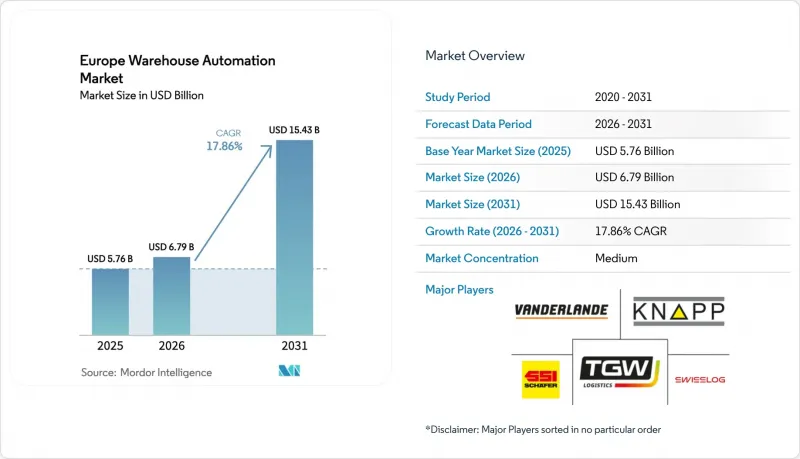
根據 Mordor Intelligence 預測,歐洲倉庫自動化市場規模將從 2025 年的 57.6 億美元成長到 2026 年的 67.9 億美元,然後在 2031 年達到 154.3 億美元,2026 年至 2031 年的複合年成長率為 17.86%。
本報告按組件(硬體、軟體、服務)、終端用戶行業(食品飲料、郵政小包裹、其他)、技術類型(自主移動機器人 (AMR)、自動導引車 (AGV)、立方體用戶型自動化立體倉庫 (AS/RS)、穿梭式自動化立體倉庫 (AS/RS)、混合箱碼垛機器人、倉庫管理軟體套件、倉庫規模(小規模國家/地區細分)。市場預測以美元 (USD) 為單位。
歐洲倉儲自動化市場趨勢與洞察
電子商務訂單量快速成長
預計到2025年,七個市場將佔據整個歐洲大陸70%的電子商務佔有率,其中羅馬尼亞和匈牙利的年成長率已達到約15%。 DHL波蘭電子商務公司指出,成功的關鍵在於先進的路線最佳化、即時小包裹追蹤和無縫退貨處理,而這些是人工作業無法實現的。因此,企業正在將庫存分散到多個區域樞紐,從而使訂單只需跨越一到兩個國界,而不是四個。先進的訂單調整引擎可在幾毫秒內根據關稅成本、運輸時間和庫存新鮮度確定應由哪個地點處理訂單。該自動化平台透過提供跨所有國家/地區的統一使用者介面和備件清單,簡化了多地點部署流程,從而成功贏得了眾多合約。
工業4.0在歐洲製造業的快速普及
德國的機器人密度(每萬名員工擁有429台機器人)凸顯了其在工廠自動化領域的領先地位,但MHP和路德維希-馬克西米利安大學的研究表明,就工業4.0成熟度而言,整個德語區(德國、奧地利和瑞士)落後於中國和美國。製造商們正在將數位化擴展到相鄰的倉庫,從而創建一個集生產、套件組裝和運輸於一體的同步循環。 MULTIVAC在沃爾費爾德施文登投資1億歐元(1.1億美元)的擴建項目將自動化物流與靈活的生產單位結合,以確保運作。弗勞恩霍夫IML研究所投資1,800萬歐元(1,980萬美元)的「數位航空貨運測試平台」計畫展示了公私合作實驗室如何彌合研發差距。由於大多數營運商更傾向於在現有設施中安裝穿梭通道和自主移動機器人(AMR)通道,而不是新建築,因此棕地維修佔據了大部分投資。
大量初始資本支出(CAPEX)
「人貨一體化」系統的起價通常為每個地點100萬美元,導致許多中小企業推遲實施。雖然機器人即服務 (RaaS) 模式透過將資本支出 (CAPEX) 轉化為月費,將實施成本降低到約10萬美元,但銀行仍要求提供抵押品或母公司擔保。 TGW建議從早期階段就讓財務團隊參與進來,根據內部報酬率 (IRR) 指標來確定實施範圍。 DLL的預融資計劃將機器人、軟體和整合成本打包在一起,表明貸款機構正在為物流客製化產品。最後,像TGW SmartPocket這樣的口袋分類機可以在六個月內運作,與傳統分類機相比,可降低建造成本和利息支出。
細分市場分析
到2025年,硬體將佔歐洲倉庫自動化市場規模的69.60%,其中自動化立體倉庫(AS/RS)通道、輸送機和自主移動機器人(AMR)車隊是核心組件。像AutoStore這樣的立方體式儲存系統,在提高庫存密度的同時,還能降低每次揀貨的耗電量,這解釋了其在租金高昂的都市區迅速普及的原因。隨著全方位服務合約保障運作,以及預測性維護分析提前數週通知用戶何時需要更換零件,業務收益也穩定成長。 TGW與Betty Berkeley簽訂的20年終身服務契約,正是整合商如何在初始部署後確保持續收入來源的絕佳例證。
同時,軟體領域以18.6%的複合年成長率位居榜首,並開始利用人工智慧編配引擎從現有機器中提取更多處理週期,從而蠶食硬體預算。倉庫執行系統現在利用邊緣GPU在微秒內協調數百台機器人,證明價值正在像鋼鐵一樣轉移到程式碼上。
在德國、法國和英國,隔天送達已成為標準服務,到2025年,電子商務和食品雜貨將佔銷售額的32.45%。 「暗店」和常溫到冷凍的穿梭通道使食品零售商能夠一次性揀選需要不同溫度等級的混合訂單商品,無需人工操作。
同時,製造業預計將以19.15%的複合年成長率成長,其在歐洲倉儲自動化市場佔有率不斷擴大,主要得益於現有棕地的維修,這些改造將製造執行系統(MES)與工廠車間的倉庫管理系統整合在一起。汽車和家電工廠現在直接將組件箱按順序供應到組裝,從而消除了緩衝庫存並縮短了前置作業時間。食品飲料業者正在-25 度C區域內部署托盤穿梭車,以符合歐盟冷鏈法規。像貝朗這樣的製藥公司正在整合符合GxP規範的機器人技術,以最大限度地降低污染風險。
其他好處
- Excel格式的市場預測(ME)表
- 3個月的分析師支持
目錄
第1章:引言
- 研究假設和市場定義
- 調查範圍
第2章:調查方法
第3章執行摘要
第4章 市場狀況
- 市場概覽
- 市場促進因素
- 電子商務訂單量快速成長
- 工業4.0在歐洲製造業的快速普及
- 倉庫工人面臨嚴重的人手不足和工資上漲問題
- 歐盟內部跨境貿易的擴張導致對履約的需求增加。
- 加強生鮮食品冷鏈監管
- 邊緣AI編配可降低延遲和能源成本。
- 市場限制因素
- 大額初始資本支出(CAPEX)
- 網路安全和資料主權問題
- 整合人員短缺和專案前置作業時間過長
- 舊有系統互通性差距
- 產業價值鏈分析
- 監理情勢
- 技術展望
- 波特五力分析
- 倉庫投資方案
- 宏觀經濟趨勢對市場的影響
第5章 市場規模與成長預測
- 按組件
- 硬體
- 移動機器人(AGV、AMR)
- 自動化倉庫系統(AS/RS)
- 輸送機和分類系統
- 碼垛和卸垛系統
- 自動識別資料收集(AIDC)
- 揀貨機器人
- 軟體
- 倉庫管理系統(WMS)
- 倉庫營運管理系統(WES)
- 服務
- 硬體
- 按最終用戶行業分類
- 飲食
- 郵件和小包裹
- 電子商務和食品雜貨
- 一般產品/第三方物流
- 服裝和鞋類
- 製造業(耐久性消費品/非耐久性消費品)
- 其他
- 依技術類型
- 自主移動機器人(AMR)
- 自動導引運輸車(AGV)
- 立方體型自動化儲存和檢索系統(例如,AutoStore)
- 穿梭式自動化立體倉庫
- 用於混合箱堆疊的機器人
- 倉庫管理軟體套件(WMS/WES/WCS)
- 倉庫規模
- 小規模(小於10,000平方公尺)
- 中等規模(10,000 至 40,000 平方米)
- 大型(超過40000平方米)
- 國家
- 德國
- 英國
- 法國
- 義大利
- 西班牙
- 荷蘭
- 其他歐洲國家
第6章 競爭情勢
- 市場集中度
- 策略趨勢
- 市佔率分析
- 公司簡介
- Swisslog Holding AG(KUKA AG)
- SSI Schaefer AG
- TGW Logistics Group GmbH
- KNAPP AG
- Vanderlande Industries BV
- Dematic GmbH(KION Group AG)
- WITRON Logistik+Informatik GmbH
- AutoStore Holdings Ltd.
- Ocado Group plc
- Exotec SAS
- Mecalux SA
- Korber Supply Chain GmbH
- Geekplus Technology Co. Ltd.
- Locus Robotics Inc.
- GreyOrange Pte. Ltd.
- Jungheinrich AG
- Honeywell Intelligrated
- Bastian Solutions LLC
- BEUMER Group GmbH and Co. KG
- Kardex Holding AG
- HAI Robotics Co. Ltd.
- Cimcorp Oy
第7章 市場機會與未來展望
According to Mordor Intelligence, the Europe warehouse automation market size is expected to grow from USD 5.76 billion in 2025 to USD 6.79 billion in 2026 and is forecast to reach USD 15.43 billion by 2031 at 17.86% CAGR over 2026-2031.
This report is Segmented by Component (Hardware, Software, and Services), End-User Industry (Food and Beverage, Post and Parcel, and More), Technology Type (AMR, AGV, Cube-Based AS/RS, Shuttle-Based AS/RS, Mixed-Case Palletizing Robotics, and Warehouse Software Suites), Warehouse Size (Small-Scale, Mid-Scale, and Large-Scale), and Country. The Market Forecasts are Provided in Terms of Value (USD).
Europe Warehouse Automation Market Trends and Insights
Exponential growth in e-commerce order volumes
Seven markets will account for 70% of continental e-commerce by 2025, yet Romania and Hungary already post around 15% annual growth. DHL eCommerce Poland notes that success hinges on advanced route optimization, live parcel tracking, and seamless returns that manual setups cannot match. Operators are therefore dispersing inventory into numerous regional hubs so orders can cross one or two borders instead of four. Sophisticated order-orchestration engines decide in milliseconds which node should fulfill a basket based on duty costs, transit time, and stock freshness. Automation platforms win deals when they offer the same user interface and spare parts lists in every country, simplifying multi-site roll-outs.
Rapid Industry 4.0 adoption across manufacturing
Germany's robot density of 429 units per 10,000 employees underscores leadership in factory automation, yet studies from MHP and Ludwig-Maximilian University flag that the wider DACH region trails China and the U.S. in Industry 4.0 maturity. Manufacturers now extend digitization to adjoining warehouses so production, kitting, and dispatch flow in one synchronized loop. MULTIVAC's EUR 100 million (USD 110 million) expansion in Wolfertschwenden couples automated logistics with flexible production cells to guard uptime. Fraunhofer IML's EUR 18 million (USD 19.8 million) Digital Testbed Air Cargo shows public-private labs filling R&D gaps. Brownfield retrofits dominate spending since most operators prefer installing shuttle aisles and AMR lanes in existing facilities instead of building new shells.
High upfront CAPEX requirements
A person-to-goods system often starts at USD 1 million per site, keeping many SMEs on the sidelines. Robotics-as-a-Service models now cut the entry ticket to roughly USD 100,000 by converting CAPEX into monthly fees, yet banks still demand collateral or parent guarantees. TGW advises involving finance teams from day one so internal rate-of-return metrics shape the scope. DLL's pre-financing packages that bundle robots, software, and integration costs show lenders tailoring products to intralogistics. Finally, pocket sorters like TGW SmartPocket can go live in six months, reducing construction spend and interest costs compared with conventional sorters.
Other drivers and restraints analyzed in the detailed report include:
- Acute warehouse-labor shortages and wage inflation
- EU cross-border trade expansion
- Cyber-security and data-sovereignty concerns
For complete list of drivers and restraints, kindly check the Table Of Contents.
Segment Analysis
Hardware accounted for 69.60% of the European warehouse automation market size in 2025, anchored by AS/RS aisles, conveyors, and AMR fleets. Cube-based storage such as AutoStore achieves four-fold inventory density while trimming kilowatt hours per pick, explaining its rapid uptake in high-rent urban hubs. Services revenue grows steadily as full-service contracts guarantee uptime and predictive-maintenance analytics signal part replacements weeks in advance. TGW's 20-year lifetime-service deal with Betty Barclay illustrates how integrators lock in annuity streams beyond initial installs.
Meanwhile, software recorded the fastest 18.6% CAGR and is starting to eat into hardware budgets by extracting more cycles from existing machines using AI orchestration engines. Warehouse execution systems now tap edge GPUs to orchestrate hundreds of bots in microseconds, proving that value is tilting toward code as much as steel.
E-commerce and groceries held a 32.45% revenue share in 2025 as next-day delivery became the norm in Germany, France, and the UK. Dark stores and ambient-to-frozen shuttle lanes enable grocers to batch-pick mixed-temperature baskets without manual handling.
Manufacturing, however, is projected to grow at a 19.15% CAGR, with Europe warehouse automation market share gains driven by brownfield retrofits that mesh shop-floor MES with warehouse management systems. Automotive and white-goods plants now sequence kitting totes straight to assembly positions, eliminating buffer stock and shrinking lead times. Food-and-beverage operators deploy pallet shuttles inside -25 °C zones to comply with EU cold-chain rules, while pharma players such as B. Braun integrate GxP-compliant robotics to minimize contamination risk.
Complete Report Scope:
- By Component
- Hardware
- Mobile Robots (AGV, AMR)
- Automated Storage and Retrieval Systems (AS/RS)
- Conveyors and Sortation Systems
- Palletizing and Depalletizing Systems
- Automatic ID and Data Capture (AIDC)
- Piece-Picking Robots
- Software
- Warehouse Management Systems (WMS)
- Warehouse Execution Systems (WES)
- Services
- Hardware
- By End-User Industry
- Food and Beverage
- Post and Parcel
- E-commerce and Groceries
- General Merchandise and 3PL
- Apparel and Footwear
- Manufacturing (Durable/Non-Durable)
- Other End-User Industries
- By Technology Type
- Autonomous Mobile Robots (AMR)
- Automated Guided Vehicles (AGV)
- Cube-Based AS/RS (e.g., AutoStore)
- Shuttle-Based AS/RS
- Mixed-Case Palletizing Robotics
- Warehouse Software Suites (WMS/WES/WCS)
- By Warehouse Size
- Small-Scale (<10,000 m2)
- Mid-Scale (10,000-40,000 m2)
- Large-Scale (>40,000 m2)
- By Country
- Germany
- United Kingdom
- France
- Italy
- Spain
- Netherlands
- Rest of Europe
List of Companies Covered in this Report:
- Swisslog Holding AG (KUKA AG)
- SSI Schaefer AG
- TGW Logistics Group GmbH
- KNAPP AG
- Vanderlande Industries B.V.
- Dematic GmbH (KION Group AG)
- WITRON Logistik + Informatik GmbH
- AutoStore Holdings Ltd.
- Ocado Group plc
- Exotec SAS
- Mecalux S.A.
- Korber Supply Chain GmbH
- Geekplus Technology Co. Ltd.
- Locus Robotics Inc.
- GreyOrange Pte. Ltd.
- Jungheinrich AG
- Honeywell Intelligrated
- Bastian Solutions LLC
- BEUMER Group GmbH and Co. KG
- Kardex Holding AG
- HAI Robotics Co. Ltd.
- Cimcorp Oy
Additional Benefits:
- The market estimate (ME) sheet in Excel format
- 3 months of analyst support
TABLE OF CONTENTS
1 INTRODUCTION
- 1.1 Study assumptions and market definition
- 1.2 Scope of the Study
2 RESEARCH METHODOLOGY
3 EXECUTIVE SUMMARY
4 MARKET LANDSCAPE
- 4.1 Market Overview
- 4.2 Market Drivers
- 4.2.1 Exponential growth in e-commerce order volumes
- 4.2.2 Rapid Industry-4.0 adoption across European manufacturing
- 4.2.3 Acute warehouse-labor shortages and wage inflation
- 4.2.4 EU cross-border trade expansion boosting fulfillment demand
- 4.2.5 Stricter cold-chain regulations for perishable goods
- 4.2.6 Edge-AI orchestration cutting latency and energy costs
- 4.3 Market Restraints
- 4.3.1 High upfront CAPEX requirements
- 4.3.2 Cyber-security and data-sovereignty concerns
- 4.3.3 Scarcity of integration talent and long project lead-times
- 4.3.4 Legacy-system interoperability gaps
- 4.4 Industry Value Chain Analysis
- 4.5 Regulatory Landscape
- 4.6 Technological Outlook
- 4.7 Porter's Five Forces Analysis
- 4.7.1 Threat of New Entrants
- 4.7.2 Bargaining Power of Buyers
- 4.7.3 Bargaining Power of Suppliers
- 4.7.4 Threat of Substitutes
- 4.7.5 Intensity of Competitive Rivalry
- 4.8 Warehouse Investment Scenario
- 4.9 Impact of Macroeconomic Trends on the Market
5 MARKET SIZE AND GROWTH FORECASTS (VALUES)
- 5.1 By Component
- 5.1.1 Hardware
- 5.1.1.1 Mobile Robots (AGV, AMR)
- 5.1.1.2 Automated Storage and Retrieval Systems (AS/RS)
- 5.1.1.3 Conveyors and Sortation Systems
- 5.1.1.4 Palletizing and Depalletizing Systems
- 5.1.1.5 Automatic ID and Data Capture (AIDC)
- 5.1.1.6 Piece-Picking Robots
- 5.1.2 Software
- 5.1.2.1 Warehouse Management Systems (WMS)
- 5.1.2.2 Warehouse Execution Systems (WES)
- 5.1.3 Services
- 5.1.1 Hardware
- 5.2 By End-User Industry
- 5.2.1 Food and Beverage
- 5.2.2 Post and Parcel
- 5.2.3 E-commerce and Groceries
- 5.2.4 General Merchandise and 3PL
- 5.2.5 Apparel and Footwear
- 5.2.6 Manufacturing (Durable/Non-Durable)
- 5.2.7 Other End-User Industries
- 5.3 By Technology Type
- 5.3.1 Autonomous Mobile Robots (AMR)
- 5.3.2 Automated Guided Vehicles (AGV)
- 5.3.3 Cube-Based AS/RS (e.g., AutoStore)
- 5.3.4 Shuttle-Based AS/RS
- 5.3.5 Mixed-Case Palletizing Robotics
- 5.3.6 Warehouse Software Suites (WMS/WES/WCS)
- 5.4 By Warehouse Size
- 5.4.1 Small-Scale (<10,000 m2)
- 5.4.2 Mid-Scale (10,000-40,000 m2)
- 5.4.3 Large-Scale (>40,000 m2)
- 5.5 By Country
- 5.5.1 Germany
- 5.5.2 United Kingdom
- 5.5.3 France
- 5.5.4 Italy
- 5.5.5 Spain
- 5.5.6 Netherlands
- 5.5.7 Rest of Europe
6 COMPETITIVE LANDSCAPE
- 6.1 Market Concentration
- 6.2 Strategic Moves
- 6.3 Market Share Analysis
- 6.4 Company Profiles (includes Global-level Overview, Market-level Overview, Core Segments, Financials as available, Strategic Information, Market Rank/Share, Products and Services, Recent Developments)
- 6.4.1 Swisslog Holding AG (KUKA AG)
- 6.4.2 SSI Schaefer AG
- 6.4.3 TGW Logistics Group GmbH
- 6.4.4 KNAPP AG
- 6.4.5 Vanderlande Industries B.V.
- 6.4.6 Dematic GmbH (KION Group AG)
- 6.4.7 WITRON Logistik + Informatik GmbH
- 6.4.8 AutoStore Holdings Ltd.
- 6.4.9 Ocado Group plc
- 6.4.10 Exotec SAS
- 6.4.11 Mecalux S.A.
- 6.4.12 Korber Supply Chain GmbH
- 6.4.13 Geekplus Technology Co. Ltd.
- 6.4.14 Locus Robotics Inc.
- 6.4.15 GreyOrange Pte. Ltd.
- 6.4.16 Jungheinrich AG
- 6.4.17 Honeywell Intelligrated
- 6.4.18 Bastian Solutions LLC
- 6.4.19 BEUMER Group GmbH and Co. KG
- 6.4.20 Kardex Holding AG
- 6.4.21 HAI Robotics Co. Ltd.
- 6.4.22 Cimcorp Oy
7 MARKET OPPORTUNITIES AND FUTURE OUTLOOK
- 7.1 White-space and unmet-need assessment

 亞太地區倉儲自動化:市場佔有率分析、產業趨勢與統計及成長預測(2026-2031)北美倉儲自動化:市場佔有率分析、產業趨勢與統計及成長預測(2026-2031 年)倉儲自動化:市場佔有率分析、產業趨勢與統計、成長預測(2026-2031)
 自主倉庫揀選智慧市場預測至2034年-全球產品、組件、技術、揀選方法、應用、最終使用者和區域分析
 自動化倉庫揀貨市場-2026-2032年全球市場預測倉儲自動化市場:按自動化類型、類別、組件、功能、應用和最終用戶分類-2026-2032年全球市場預測倉儲自動化分析市場:預測至 2034 年 - 按組件、分析類型、部署模式、應用、最終用戶和地區分類的全球分析倉儲自動化市場預測至2034年—按組件、功能、技術、應用、最終用戶和地區分類的全球分析
 倉儲自動化市場(物流自動化)-預計到 2032 年將達到 640 億美元:按技術(AGV/AMR、ASRS、輸送機、分類、揀貨、AIDC、碼垛、ATLS、WMS/WES/WCS)、產業和地區/國家分類(版本 6)印度倉儲自動化:市場佔有率分析、產業趨勢與統計及成長預測(2026-2031)