


 |
市場調查報告書
商品編碼
2124930
北美倉儲自動化:市場佔有率分析、產業趨勢與統計及成長預測(2026-2031 年)North America Warehouse Automation - Market Share Analysis, Industry Trends & Statistics, Growth Forecasts (2026 - 2031) |
||||||

※ 本網頁內容可能與最新版本有所差異。詳細情況請與我們聯繫。
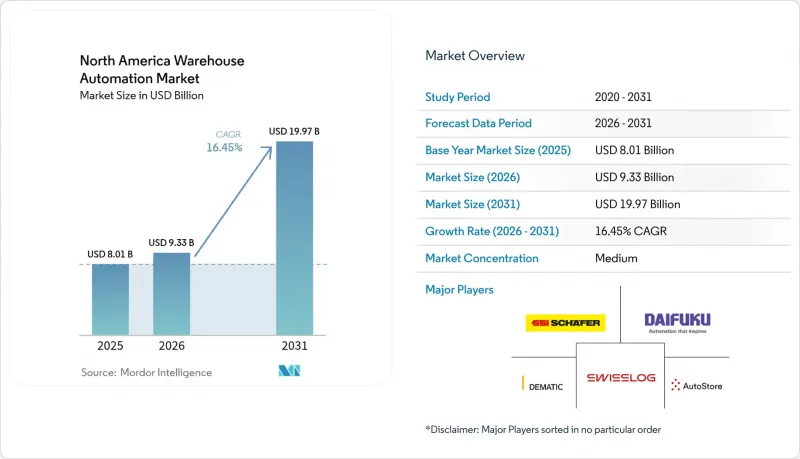
根據 Mordor Intelligence 預測,北美倉庫自動化市場規模將從 2025 年的 80.1 億美元成長到 2026 年的 93.3 億美元,然後在 2031 年達到 199.7 億美元,2026 年至 2031 年的複合年成長率為 16.45%。
本報告按組件(硬體、軟體、服務)、技術(例如,自動化倉儲系統)、終端用戶行業(例如,食品飲料、汽車)、功能(例如,儲存、包裝和運輸、碼垛和拆垛、分類)以及地區(例如,美國、加拿大、墨西哥)進行細分。市場預測以美元計價。
北美倉儲自動化市場趨勢與洞察
電子商務履約自動化的激增
零售商正將訂單到出貨週期縮短至數小時,並投資於高速分揀、貨到人揀選和機器人碼垛。沃爾瑪已撥款2億美元用於2024年的自動堆高機,顯示其對機器人技術能夠抵消線上訂單帶來的利潤壓力充滿信心。線上訂單的毛利率比實體店銷售低400至600個基點。亞馬遜位於什里夫波特和底特律的履約中心分別部署了超過1000台自主移動機器人(AMR),在假期季節需求激增期間,其處理能力尖峰時段提升了三倍。為Shopify平台上多家店鋪提供服務的第三方物流供應商正在採用模組化自動化,以便在客戶之間分攤成本,並根據合約量的變化重新部署機器人。不斷上漲的城市房地產價格正促使庫存轉移到大規模的區域中心,在那裡,高密度、軟體主導的自動化系統可以在不增加用地面積的情況下實現規模化運作。隨著當日送達成為必需品,物流履約速度正成為北美倉儲自動化市場中日益關鍵的競爭因素。
倉儲業勞動力短缺和薪資上漲問題日益嚴重
2024年第三季度,倉儲業薪資較去年同期成長4.1%。同時,區域中心人手不足依然嚴峻,迫使業者支付夜班津貼。認證機器人技術人員的匱乏,要麼進一步推高了人事費用,要麼迫使營運商與特定供應商簽訂服務合約。供應商目前正將預測性維護功能整合到其控制軟體中,以減少意外停機時間,並引入遠距離診斷功能,使一名工程師能夠覆蓋多個地點。由於薪資年增率超過3%,高吞吐量設施中自主移動機器人(AMR)的投資回收期不到24個月,這進一步強化了勞動力經濟與自動化投資計畫之間的結構性連結。因此,提供硬體和車隊最佳化軟體的AMR供應商在北美倉儲自動化市場中佔據有利地位。
中小企業需要大量初始投資。
每個倉庫的自動化系統造價可能在 500 萬美元到 2000 萬美元之間,這與通常每三年續約一次的第三方物流(3PL) 合約不匹配。 「機器人即服務 (RaaS)」模式透過按揀貨或託盤搬運次數收費,將設備購置成本轉化為營運成本,同時將運轉率的風險轉移給供應商。由於缺乏標準化的績效指標,小規模企業難以比較不同的提案,導致銷售週期延長。這種差異導致自動化系統的採用主要集中在擁有多個倉庫的大型零售商和 3PL 營運商身上,因為他們可以將工程和整合成本分攤到其分散式網路中。因此,儘管硬體價格不斷下降,北美倉庫自動化市場中中型企業的採用率仍然很低。
細分市場分析
2025年,硬體將維持68.73%的市場佔有率,凸顯了輸送機和自動化立體倉庫系統(ASRS)等設備在北美整體倉庫自動化市場中的資本密集特性。這些設備是自動化設施的核心。軟體預計將以16.85%的複合年成長率成長,因為編配、勞動力規劃和庫存最佳化正成為在無需大規模建設的情況下提高吞吐量的最有效手段。隨著訂閱模式逐漸取代永久授權模式,營運商能夠以無線方式部署增強功能,從而將功能更新周期與硬體更新周期解耦。
不斷擴大的自主移動機器人 (AMR) 車隊融合了獨特的車隊管理功能,能夠根據訂單量動態地將機器人重新分配到訂單量不斷成長的區域,從而減少閒置時間並進一步提高資產利用率。數位孿生模型允許在工人進入現場之前模擬貨架重新定位和通道寬度調整,從而顯著降低專案風險。安裝、維護和營運管理的業務收益正轉向基於結果的契約,整合商不再僅僅保證設備正常運行運作,而是保證“每小時處理線數”,從而使供應商的獎勵與運營商的服務水平目標保持一致。
預計到2025年,自動化倉儲系統(AS/RS)將佔銷售額的33.15%,其在零件和飲料配送方面的高垂直密度優勢備受青睞。同時,自主移動機器人(AMR)和自動導引車(AGV)正以每年17.35%的速度快速成長,營運商優先考慮的是以數十台而非數百台為單位柔軟性擴展車隊。在處理可預測貨量的小包裹樞紐中,輸送機和分類設備仍然必不可少,但維修擴大採用與AMR協同工作的分流器,以實現最後一米的精準配送。
AutoStore的立方體儲存系統體現了一種混合模式,它將高密度固定網格與在其上運行的移動機器人相結合,從而實現從貨箱中快速取貨。 2024年,Locus Robotics在北美部署的協作機器人數量突破1萬台,證明了「按揀貨收費」模式在電子商務領域,尤其是在商品種類繁多的情況下,能夠發揮顯著的效用。越來越多的企業開始採用混合型設施,其中自動化立體倉庫(ASRS)儲存A類庫存,而自主移動機器人(AMR)則將B類和C類SKU運送到符合人體工學設計的工作站,從而確保即使需求趨勢發生變化,業務永續營運。
其他好處:
- Excel格式的市場預測(ME)表
- 3個月的分析師支持
目錄
第1章:引言
- 研究假設和市場定義
- 調查範圍
第2章:調查方法
第3章執行摘要
第4章 市場狀況
- 市場概覽
- 市場促進因素
- 電子商務履約自動化的激增
- 倉儲業勞動力短缺和薪資上漲問題日益嚴重
- 根據美國《通膨控制法》,國產自動化硬體享有優惠待遇。
- 整合人工智慧驅動的倉庫編配平台
- 冷鏈合規性和溫控自動化的需求
- 2025年美國加徵關稅將加速自動化供應鏈向近岸外包的進程。
- 市場限制因素
- 對中小企業的大額初始資本投資
- 與傳統WMS和ERP系統整合的複雜性。
- 區域物流中心缺乏熟練的機器人工程師
- 網路連接倉庫管理系統的網路安全風險
- 產業價值鏈分析
- 監理情勢
- 技術展望
- 宏觀經濟因素的影響
- 波特五力分析
第5章 市場規模與成長預測
- 按組件
- 硬體
- 軟體
- 服務
- 透過技術
- 自動化倉庫系統
- 自主移動機器人與AGV
- 傳送和分類系統
- 揀貨和包裝自動化
- 倉庫管理和執行軟體
- 按最終用戶行業分類
- 電子商務和零售商
- 第三方物流
- 食品/飲料
- 車
- 醫療和藥品
- 電子與電機工程
- 按功能
- 貯存
- 揀貨
- 包裝和運輸
- 碼垛和卸垛
- 排序
- 國家
- 美國
- 加拿大
- 墨西哥
第6章 競爭情勢
- 市場集中度
- 策略趨勢
- 市佔率分析
- 公司簡介
- Daifuku Co., Ltd.
- SSI Schaefer AG
- Dematic Corp.
- Swisslog Holding AG
- AutoStore Holdings Ltd.
- TGW Logistics Group GmbH
- Honeywell Intelligrated Inc.
- Bastian Solutions LLC
- MHS Holdings, LLC
- Murata Machinery, Ltd.
- KNAPP AG
- Kardex Holding AG
- Vanderlande Industries BV
- Geekplus Technology Co., Ltd.
- Locus Robotics Corp.
- Fetch Robotics, Inc.(Zebra Technologies Corp.)
- GreyOrange Pte. Ltd.
- Seegrid Corporation
- Ocado Group plc
- Exotec SAS
第7章 市場機會與未來展望
According to Mordor Intelligence, the North America warehouse automation market size is expected to grow from USD 8.01 billion in 2025 to USD 9.33 billion in 2026 and is forecast to reach USD 19.97 billion by 2031 at 16.45% CAGR over 2026-2031.
This report is Segmented by Component (Hardware, Software, Services), Technology (Automated Storage and Retrieval Systems, and More), End-User Industry (Food and Beverage, Automotive, and More), Function (Storage, Packing and Dispatch, Palletizing and Depalletizing, Sortation, and More), and Geography (United States, Canada, Mexico). The Market Forecasts are Provided in Terms of Value (USD).
North America Warehouse Automation Market Trends and Insights
Surge in E-Commerce Fulfillment Automation
Retailers are compressing order-to-ship cycles to hours, pushing capital toward high-speed sortation, goods-to-person picking, and robotic palletizing. Walmart allocated USD 200 million to autonomous forklifts in 2024, evidencing confidence that robotics offset margin pressure from online orders that carry 400-600 basis-point lower gross margins than stores. Amazon's Shreveport and Detroit fulfillment centers each deployed more than 1,000 AMRs to triple peak throughput during holiday surges. Third-party logistics operators serving multiple storefronts on Shopify are embracing modular automation so they can amortize costs across clients and redeploy robots as contract volumes shift. Real-estate premiums in urban cores are steering inventory toward larger regional hubs where dense, software-defined automation scales without expanding footprints. As same-day delivery becomes table stakes, the North America warehouse automation market embeds fulfillment speed as an existential competitive variable.
Rising Labor Shortages and Wage Inflation in Warehousing
Warehouse pay grew 4.1% year-over-year in Q3 2024, while vacancy rates in rural hubs remain acute, forcing operators to pay shift differentials for overnight coverage. Shortfalls in certified robotics technicians further elevate compensation costs or push operators into vendor-locked service contracts. Vendors now embed predictive maintenance into control software to cut unplanned downtime and remote diagnostics that let a single engineer cover multiple sites. When wage growth exceeds 3% annually, autonomous mobile robots show sub-24-month paybacks in high-volume facilities, strengthening the structural ties between labor economics and automation capital plans. Consequently, AMR vendors that package hardware with fleet-optimization software are well positioned inside the North America warehouse automation market.
High Upfront Capital Expenditure for SMEs
Automated storage and retrieval systems can demand USD 5-20 million per site, a misalignment for third-party logistics contracts that often renew every three years. Robotics-as-a-service models convert equipment purchases into operating costs by charging per pick or pallet move, but they also shift utilization risk to the vendor. Lacking standardized performance benchmarks, smaller operators struggle to compare proposals, elongating sales cycles. This disparity concentrates automation adoption among big-box retailers and multi-site 3PLs that can amortize engineering and integration across distributed networks. Consequently, the North America warehouse automation market still shows under-penetration among mid-market operators despite falling hardware prices.
Other drivers and restraints analyzed in the detailed report include:
- US Inflation Reduction Act Incentives for Domestic Automation Hardware
- Integration of AI-Driven Warehouse Orchestration Platforms
- Integration Complexity with Legacy WMS and ERP Systems
For complete list of drivers and restraints, kindly check the Table Of Contents.
Segment Analysis
Hardware retained 68.73% share in 2025, underscoring the capital intensity of conveyors and ASRS that anchor automated facilities across the North America warehouse automation market. Software is tracking a 16.85% CAGR because orchestration, labor planning, and inventory optimization are now the fastest levers to raise throughput without heavy construction. As subscription models replace perpetual licenses, operators can roll out feature enhancements over-the-air, decoupling capability from physical refresh cycles.
Expanding fleets of AMRs embed their own fleet-management layers that dynamically reassign robots to zones with rising order depth, cutting idle time and squeezing higher asset utilization. Digital-twin models simulate rack redeployments or aisle-width tweaks before crews step on the floor, slashing project risk. Service revenues installation, maintenance, managed operations are pivoting toward outcome-based contracts where integrators guarantee lines per hour rather than equipment uptime, aligning vendor incentives with the operator's service-level goals.
Automated storage and retrieval systems delivered 33.15% revenue in 2025, prized for vertical density in parts and beverage distribution. Meanwhile, AMRs and AGVs are advancing at 17.35% annually as operators prioritize flexibility that lets fleets scale in increments of tens rather than hundreds. Conveyor and sortation assets remain indispensable for parcel hubs handling predictable volumes, but retrofits frequently embed diverters that interact with AMRs for last-meter routing.
AutoStore's cube-based storage underscores a hybrid trend: dense static grids coupled with mobile robots on top to liberate bin content quickly. Locus Robotics surpassed 10,000 collaborative units across North America in 2024, validating the pay-per-pick model in high-mix e-commerce. Operators increasingly deploy hybrid estates where ASRS stores A-class inventory and AMRs ferry B- and C-class SKUs to ergonomic workstations, ensuring resilience when demand profiles shift.
Complete Report Scope:
- By Component
- Hardware
- Software
- Services
- By Technology
- Automated Storage and Retrieval Systems
- Autonomous Mobile Robots and AGVs
- Conveyor and Sortation Systems
- Picking and Packing Automation
- Warehouse Management and Execution Software
- By End-User Industry
- E-Commerce and Retailers
- Third-Party Logistics
- Food and Beverage
- Automotive
- Healthcare and Pharmaceuticals
- Electronics and Electrical
- By Function
- Storage
- Order Picking
- Packing and Dispatch
- Palletizing and Depalletizing
- Sortation
- By Country
- United States
- Canada
- Mexico
List of Companies Covered in this Report:
- Daifuku Co., Ltd.
- SSI Schaefer AG
- Dematic Corp.
- Swisslog Holding AG
- AutoStore Holdings Ltd.
- TGW Logistics Group GmbH
- Honeywell Intelligrated Inc.
- Bastian Solutions LLC
- MHS Holdings, LLC
- Murata Machinery, Ltd.
- KNAPP AG
- Kardex Holding AG
- Vanderlande Industries B.V.
- Geekplus Technology Co., Ltd.
- Locus Robotics Corp.
- Fetch Robotics, Inc. (Zebra Technologies Corp.)
- GreyOrange Pte. Ltd.
- Seegrid Corporation
- Ocado Group plc
- Exotec SAS
Additional Benefits:
- The market estimate (ME) sheet in Excel format
- 3 months of analyst support
TABLE OF CONTENTS
1 INTRODUCTION
- 1.1 Study Assumptions and Market Definition
- 1.2 Scope of the Study
2 RESEARCH METHODOLOGY
3 EXECUTIVE SUMMARY
4 MARKET LANDSCAPE
- 4.1 Market Overview
- 4.2 Market Drivers
- 4.2.1 Surge in E-Commerce Fulfillment Automation
- 4.2.2 Rising Labor Shortages and Wage Inflation in Warehousing
- 4.2.3 US Inflation Reduction Act Incentives for Domestic Automation Hardware
- 4.2.4 Integration of AI-Driven Warehouse Orchestration Platforms
- 4.2.5 Demand for Cold-Chain Compliance and Temperature-Controlled Automation
- 4.2.6 2025 US Tariffs Accelerating Nearshoring of Automation Supply Chains
- 4.3 Market Restraints
- 4.3.1 High Upfront Capital Expenditure for SMEs
- 4.3.2 Integration Complexity with Legacy WMS and ERP Systems
- 4.3.3 Shortage of Skilled Robotics Technicians in Rural Distribution Hubs
- 4.3.4 Cybersecurity Risks to Connected Warehouse Control Systems
- 4.4 Industry Value Chain Analysis
- 4.5 Regulatory Landscape
- 4.6 Technological Outlook
- 4.7 Impact of Macroeconomic Factors
- 4.8 Porter's Five Forces Analysis
- 4.8.1 Threat of New Entrants
- 4.8.2 Bargaining Power of Suppliers
- 4.8.3 Bargaining Power of Buyers
- 4.8.4 Threat of Substitutes
- 4.8.5 Industry Rivalry
5 MARKET SIZE AND GROWTH FORECASTS (VALUE)
- 5.1 By Component
- 5.1.1 Hardware
- 5.1.2 Software
- 5.1.3 Services
- 5.2 By Technology
- 5.2.1 Automated Storage and Retrieval Systems
- 5.2.2 Autonomous Mobile Robots and AGVs
- 5.2.3 Conveyor and Sortation Systems
- 5.2.4 Picking and Packing Automation
- 5.2.5 Warehouse Management and Execution Software
- 5.3 By End-User Industry
- 5.3.1 E-Commerce and Retailers
- 5.3.2 Third-Party Logistics
- 5.3.3 Food and Beverage
- 5.3.4 Automotive
- 5.3.5 Healthcare and Pharmaceuticals
- 5.3.6 Electronics and Electrical
- 5.4 By Function
- 5.4.1 Storage
- 5.4.2 Order Picking
- 5.4.3 Packing and Dispatch
- 5.4.4 Palletizing and Depalletizing
- 5.4.5 Sortation
- 5.5 By Country
- 5.5.1 United States
- 5.5.2 Canada
- 5.5.3 Mexico
6 COMPETITIVE LANDSCAPE
- 6.1 Market Concentration
- 6.2 Strategic Moves
- 6.3 Market Share Analysis
- 6.4 Company Profiles (includes Global Level Overview, Market Level Overview, Core Segments, Financials as available, Strategic Information, Market Rank/Share for key companies, Products and Services, and Recent Developments)
- 6.4.1 Daifuku Co., Ltd.
- 6.4.2 SSI Schaefer AG
- 6.4.3 Dematic Corp.
- 6.4.4 Swisslog Holding AG
- 6.4.5 AutoStore Holdings Ltd.
- 6.4.6 TGW Logistics Group GmbH
- 6.4.7 Honeywell Intelligrated Inc.
- 6.4.8 Bastian Solutions LLC
- 6.4.9 MHS Holdings, LLC
- 6.4.10 Murata Machinery, Ltd.
- 6.4.11 KNAPP AG
- 6.4.12 Kardex Holding AG
- 6.4.13 Vanderlande Industries B.V.
- 6.4.14 Geekplus Technology Co., Ltd.
- 6.4.15 Locus Robotics Corp.
- 6.4.16 Fetch Robotics, Inc. (Zebra Technologies Corp.)
- 6.4.17 GreyOrange Pte. Ltd.
- 6.4.18 Seegrid Corporation
- 6.4.19 Ocado Group plc
- 6.4.20 Exotec SAS
7 MARKET OPPORTUNITIES AND FUTURE OUTLOOK
- 7.1 White-Space and Unmet-Need Assessment

 亞太地區倉儲自動化:市場佔有率分析、產業趨勢與統計及成長預測(2026-2031)歐洲倉儲自動化:市場佔有率分析、產業趨勢與統計及成長預測(2026-2031 年)倉儲自動化:市場佔有率分析、產業趨勢與統計、成長預測(2026-2031)
 自主倉庫揀選智慧市場預測至2034年-全球產品、組件、技術、揀選方法、應用、最終使用者和區域分析
 自動化倉庫揀貨市場-2026-2032年全球市場預測倉儲自動化市場:按自動化類型、類別、組件、功能、應用和最終用戶分類-2026-2032年全球市場預測倉儲自動化分析市場:預測至 2034 年 - 按組件、分析類型、部署模式、應用、最終用戶和地區分類的全球分析倉儲自動化市場預測至2034年—按組件、功能、技術、應用、最終用戶和地區分類的全球分析
 倉儲自動化市場(物流自動化)-預計到 2032 年將達到 640 億美元:按技術(AGV/AMR、ASRS、輸送機、分類、揀貨、AIDC、碼垛、ATLS、WMS/WES/WCS)、產業和地區/國家分類(版本 6)印度倉儲自動化:市場佔有率分析、產業趨勢與統計及成長預測(2026-2031)