

 |
市場調查報告書
商品編碼
2124677
美國印刷標籤:市場佔有率分析、行業趨勢和統計數據、成長預測(2026-2031 年)United States Print Label - Market Share Analysis, Industry Trends & Statistics, Growth Forecasts (2026 - 2031) |
||||||

※ 本網頁內容可能與最新版本有所差異。詳細情況請與我們聯繫。
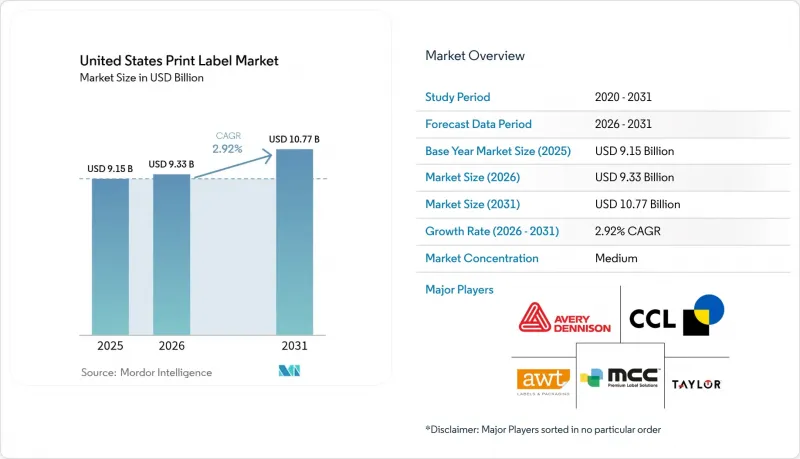
根據 Mordor Intelligence 預測,美國印刷標籤市場規模將從 2025 年的 91.5 億美元和 2026 年的 93.3 億美元成長到 2031 年的 107.7 億美元,2026 年至 2031 年的複合年成長率為 2.92%。
本報告按基材(紙/紙板、PET、PVC、生物基和可堆肥薄膜等)、印刷技術(膠印、柔版印刷、網版印刷、數位印刷等)、標籤類型(濕膠、壓敏膠、無底紙、套模貼、收縮套標等)和終端用戶行業(食品、細分飲料、工業等)進行細分。市場預測以美元計價。
美國印刷標籤市場的趨勢與洞察
數位印刷技術的應用現狀
儘管數位印刷的銷售量僅占美國印刷標籤市場總銷量的不到十分之一,但其價值已占美國印刷標籤市場總值的約五分之一。據加工商稱,大多數位印刷訂單的標籤數量都在5000張以下,並且能在48小時內出貨。這對於需要製版的柔版印刷來說是難以企及的,因此品牌所有者需要支付更高的價格,才能在生產流程的最後階段實現SKU的快速擴展和客製化。混合印刷機結合了柔版印刷的白色和專色以及數位套印技術,使加工商能夠在攤銷現有窄幅捲筒紙設備成本的同時,確保獲得高利潤、短交貨期的訂單。線上完工(模切、覆膜、燙金)無需二次加工,顯著減少了設定過程中的廢棄物,並有助於提高永續性指標。設備供應商正在推出支援更寬幅的數位印刷機,這將降低每平方公尺的成本,並有望在中期內擴大數位印刷在美國印刷標籤市場的佔有率。
數位印刷技術在醫療保健和化妝品標籤領域的普及
根據《藥品供應鏈安全法案》的序列化截止日期,製藥廠必須在2024年11月之前,在所有可銷售藥品上標註國家藥品代碼(NDC)、批號和有效期等資訊。這持續推動了可容納大量可變資訊的感壓標籤和小冊子標籤的需求成長。同時,美國食品藥物管理局(FDA)加強了對II類和III類醫療設備唯一醫療設備識別碼(UDI)的監管,增加了對能夠承受高壓釜和伽馬射線滅菌環境的耐用標籤的需求。化妝品品牌正面臨《化妝品監管現代化法案》和加州《知情權法案》下新的成分標籤法規,導致SKU的修訂和小批量生產的出現。此外,生物療法研發管線需要低溫黏合劑和防篡改密封,從而提升了透過該管道銷售的每個標籤的價值。這些因素共同推動了美國印刷標籤市場終端用戶領域最高的複合年成長率。
紙張和樹脂原料成本的波動
漂白牛皮紙漿價格在2024年中期達到峰值,即使到了2025年初,仍比2023年的平均價格高出18%。同時,丙烯酸樹脂和熱熔樹脂的指數比價格飆升前的水平高出12%,這給固定價格合約下的加工商利潤率帶來了壓力。前置作業時間。庫存緩衝佔據了資金,限制了資本支出,並減緩了向永續材料的轉型,導致美國印刷標籤市場的預期複合年成長率下降了0.3個百分點。
細分市場分析
預計到2025年,聚對苯二甲酸乙二醇酯(PET)將保持37.83%的市場佔有率,繼續作為飲料、個人護理和製藥等應用領域的主要基材,這些領域對透明度和可回收性要求極高。這一主導地位確保PET在美國印刷標籤市場繼續佔據價值和銷售的最大佔有率。然而,生產者延伸責任制(EPR)收費系統和零售商評估標準正推動市場逐步向符合ASTM D6400堆肥標準的聚乳酸(PLA)和纖維素薄膜發展。預計到2031年,生物基產品的年成長率將達到3.57%,超過所有傳統聚合物。由於這些產品的價格比標準PET高出40-60%,加工商正被促使在不影響主流生產線的情況下,建立專門的生產單位。從中長期來看,地方政府擴大堆肥基礎設施的速度將決定這些新材料在美國印刷標籤市場從試點訂單過渡到標準規格的速度。
對可回收標籤技術的投資正在加速成長。清潔片狀黏合劑系統使感壓標籤在鹼性清洗過程中能夠輕鬆剝離,從而在瓶到瓶循環中實現與原生PET相當的樹脂品質。此類創新不僅鞏固了PET的主導地位,還有助於保護其市場佔有率免受聚丙烯的衝擊,因為聚丙烯從生活垃圾中的回收率較低。未來,如果聯邦政府強制要求使用再生材料,原生原料的價格可能會重新調整,從而加速品牌向消費後再生PET和生物基替代品的轉型,並有可能重塑美國印刷標籤市場的材料優先順序。
預計到2025年,柔版印刷將佔據45.63%的市場。這主要歸功於加工商數十年來對窄幅印刷機、網紋轆庫存和線上完工設備的持續投資。這些成本的持續下降使得訂單量超過1萬張標籤時,每千張標籤的成本保持在較低水平,從而鞏固了柔版印刷在美國印刷標籤市場主導的大批量食品飲料項目中的地位。然而,數位印刷預計3.21%的複合年成長率表明,市場正明顯轉向小批量生產和可變數據需求。混合印刷機透過將柔版印刷用於實色背景和白色底印,與數位印刷用於版本控制相結合,有效地模糊了這兩種技術之間的界限。
隨著噴墨印表機製造商推出更寬的機型並提高最大線速度,柔版印刷和數位印刷之間的經濟損益平衡點持續逐步提高。同時,LED固化油墨的應用提高了新型柔版印刷機的能源效率,縮小了整體成本差距。如今,投資於工作流程自動化和色彩管理軟體的加工商將能夠從這兩種技術中獲益。然而,隨著美國印刷標籤市場的演變,落後的企業將面臨高價值業務被數位印刷參與企業搶佔的風險。
其他好處:
- Excel格式的市場預測(ME)表
- 3個月的分析師支持
目錄
第1章:引言
- 研究假設和市場定義
- 調查範圍
第2章:調查方法
第3章執行摘要
第4章 市場狀況
- 市場概覽
- 市場促進因素
- 數位印刷技術的普及
- 醫療保健和化妝品行業的標籤採用情況
- 電子商務和物流標籤處理量
- 過渡到採用生產者責任延伸制度 (EPR) 的無底紙可回收標籤。
- 智慧標籤和物聯網標籤可實現供應鏈可追溯性
- 近岸外包正在推動短期可變數據列印。
- 市場限制因素
- 惡劣條件下的耐久性極限
- 紙張和塑膠原料價格波動劇烈
- 窄幅卷材業技術純熟勞工短缺
- 回收流的分割
- 產業價值鏈分析
- 監理情勢
- 技術展望
- 波特五力分析
- 宏觀經濟因素對市場的影響
第5章 市場規模與成長預測
- 按基板
- 紙張和紙板
- 聚對苯二甲酸乙二醇酯(PET)
- 聚丙烯(PP 和 BOPP)
- 聚氯乙烯(PVC)
- 生物基可堆肥薄膜
- 其他基板
- 透過印刷技術
- 抵銷
- 柔版印刷
- 螢幕
- 數位印刷
- 其他印刷技術
- 標籤類型
- 濕膠標籤
- 感壓標籤
- 無底紙標籤
- 套模標籤
- 收縮套筒標籤
- 其他標籤類型
- 按最終用戶行業分類
- 食物
- 飲料
- 醫療和藥品
- 化妝品和個人護理
- 產業
- 其他終端用戶產業
第6章 競爭情勢
- 市場集中度
- 策略趨勢
- 市佔率分析
- 公司簡介
- Avery Dennison Corporation
- Multi-Color Corporation
- Fort Dearborn Company LLC
- AWT Labels and Packaging
- Brady Corporation
- RR Donnelley and Sons Company
- Taylor Corporation
- Weber Packaging Solutions
- Grand Rapids Label
- DRG Technologies Inc.
- CCL Industries Inc.
- Constantia Flexibles Group GmbH
- Label Masters LLC
- 3M Company
- Resource Label Group LLC
- Fortis Solutions Group LLC
- Brook and Whittle Holdings Corp.
- Inland Label and Marketing Services LLC
第7章 市場機會與未來展望
According to Mordor Intelligence, the United States print label market size is projected to expand from USD 9.15 billion in 2025 and USD 9.33 billion in 2026 to USD 10.77 billion by 2031, registering a CAGR of 2.92% between 2026 to 2031.
This report is Segmented by Substrate Material (Paper and Paperboard, PET, PVC, Biobased and Compostable Films, and More), Print Technology (Offset, Flexography, Screen, Digital Printing, and More), Label Type (Wet-Glued, Pressure-Sensitive, Liner-Less, In-Mold, Shrink Sleeve, and More), End-User Industry (Food, Beverage, Industrial, and More). Market Forecasts are Provided in Terms of Value (USD).
United States Print Label Market Trends and Insights
Digital Print Technology Penetration
Digital printing already accounts for roughly one-fifth of United States print label market value even though it represents less than one-tenth of unit volume. Converters report that most digital orders run below 5,000 pieces and ship within 48 hours, metrics unattainable for plate-based flexography, so brand owners pay a premium for rapid SKU proliferation and late-stage customization. Hybrid presses that combine flexographic white or spot colors with digital overprints allow converters to amortize their existing narrow-web infrastructure while capturing high-margin short runs. Inline finishing die-cutting, lamination, and foil stamping eliminates secondary steps, slashing makeready waste and supporting sustainability scorecards. Equipment vendors are responding with wider-web digital units, which should lower the cost per square meter and lift digital's share of the United States print label market over the medium term.
Healthcare and Cosmetics Label Uptake
Serialization deadlines under the Drug Supply Chain Security Act forced pharmaceutical plants to encode National Drug Code, lot, and expiration data on every saleable unit by November 2024, providing a durable tailwind for pressure-sensitive and booklet labels that can carry significant variable information. Parallel FDA enforcement of Unique Device Identification for Class II and III medical devices expanded demand for durable labels resistant to autoclave and gamma-sterilization environments. Cosmetics brands faced new ingredient-disclosure rules under the Modernization of Cosmetics Regulation Act and California's Right to Know statute, triggering SKU revisions and smaller-batch production. The biological therapeutics pipeline also calls for cryogenic adhesives and tamper-evident seals, lifting the value density of each label sold into this channel. Collectively these factors support the fastest end-user CAGR inside the United States print label market.
Volatile Paper and Resin Input Costs
Bleached-kraft pulp prices peaked in mid-2024 and were still 18% above 2023 averages in early 2025, while acrylic and hot-melt resin indices held 12% higher than pre-spike levels, compressing converter margins on fixed-price contracts. Smaller converters without hedging programs endure working-capital swings when specialty film lead times triple and post-consumer recycled PET trades at premiums of USD 200-400 per metric ton. Inventory buffers tie up cash, limit capital upgrades, and slow the shift to sustainable materials, shaving 0.3 percentage points off the forecast CAGR for the United States print label market.
Other drivers and restraints analyzed in the detailed report include:
- E-commerce and Logistics Label Volumes
- EPR-Driven Shift to Linerless and Recyclable Labels
- Skilled Narrow-Web Labor Shortages
For complete list of drivers and restraints, kindly check the Table Of Contents.
Segment Analysis
Polyethylene terephthalate sustained a 37.83% market share in 2025, making it the anchor substrate for beverage, personal-care, and pharmaceutical applications that value clarity and recyclability. That prominence keeps PET as the single largest slice of the United States print label market size at both dollar and volume levels. Yet EPR fee structures and retailer scorecards are steering incremental growth toward polylactic-acid and cellulose-based films that meet ASTM D6400 compostability criteria. Biobased offerings are set to grow 3.57% per year to 2031, outpacing every legacy polymer. The premium they command, often 40%-60% higher than standard PET, encourages converters to carve out specialized production cells rather than cannibalize mainstream lines. Over the medium term, broader municipal composting infrastructure will determine how fast these new materials convert trial orders into baseline specifications in the United States print label market.
Investments in recyclable label technologies are picking up. Clean-flake adhesive systems now allow pressure-sensitive labels to float off during caustic washing, unlocking equivalent resin quality to virgin PET for bottle-to-bottle loops. Such innovations not only reinforce PET leadership but also protect its share against polypropylene, which suffers from lower curbside recovery rates. Looking ahead, federal recycled-content mandates, if enacted, could reprice virgin inputs and accelerate brand migration toward both post-consumer recycled PET and bio-based substitutes, reshaping the material hierarchy inside the United States print label market.
Flexography generated 45.63% of market share in 2025 because converters retain decades of investment in narrow-web presses, anilox inventories, and inline finishing assets. These sunk costs keep cost-per-thousand labels low on jobs beyond 10,000 units, anchoring flexo's role in high-volume food and beverage programs that dominate the United States print label market share figure. However, digital printing's 3.21% forecast CAGR demonstrates a clear pivot toward short runs and variable data requirements. Hybrid presses now marry flexo for solid backgrounds and white underprints with digital heads for versioning, effectively blurring the boundary between the two technologies.
The economic breakeven between flexo and digital continues to creep upward as inkjet manufacturers release wider-web models and raise maximum linear speed. Concurrently, LED-curable inks improve energy efficiency on newer flexo units, narrowing the total-cost gap. Converters that invest today in workflow automation and color-management software will capture margin from both halves of the technology split, but laggards risk ceding premium work to digitally native entrants as the United States print label market evolves.
Complete Report Scope:
- By Substrate Material
- Paper and Paperboard
- Polyethylene Terephthalate (PET)
- Polypropylene (PP and BOPP)
- Polyvinyl Chloride (PVC)
- Biobased and Compostable Films
- Other Substrate Materials
- By Print Technology
- Offset
- Flexography
- Screen
- Digital Printing
- Other Print Technologies
- By Label Type
- Wet-glued Labels
- Pressure-Sensitive Labels
- Liner-less Labels
- In-mold Labels
- Shrink Sleeve Labels
- Other Label Types
- By End-user Industry
- Food
- Beverage
- Healthcare and Pharmaceutical
- Cosmetics and Personal Care
- Industrial
- Other End-user Industries
List of Companies Covered in this Report:
- Avery Dennison Corporation
- Multi-Color Corporation
- Fort Dearborn Company LLC
- AWT Labels and Packaging
- Brady Corporation
- RR Donnelley and Sons Company
- Taylor Corporation
- Weber Packaging Solutions
- Grand Rapids Label
- DRG Technologies Inc.
- CCL Industries Inc.
- Constantia Flexibles Group GmbH
- Label Masters LLC
- 3M Company
- Resource Label Group LLC
- Fortis Solutions Group LLC
- Brook and Whittle Holdings Corp.
- Inland Label and Marketing Services LLC
Additional Benefits:
- The market estimate (ME) sheet in Excel format
- 3 months of analyst support
TABLE OF CONTENTS
1 INTRODUCTION
- 1.1 Study Assumptions and Market Definition
- 1.2 Scope of the Study
2 RESEARCH METHODOLOGY
3 EXECUTIVE SUMMARY
4 MARKET LANDSCAPE
- 4.1 Market Overview
- 4.2 Market Drivers
- 4.2.1 Digital Print Technology Penetration
- 4.2.2 Healthcare and Cosmetics Label Uptake
- 4.2.3 E-commerce and Logistics Label Volumes
- 4.2.4 EPR-Driven Shift to Linerless and Recyclable Labels
- 4.2.5 Smart and IoT Labels for Supply-Chain Traceability
- 4.2.6 Near-Shoring Driving Short-Run Variable-Data Print
- 4.3 Market Restraints
- 4.3.1 Durability Limits in Harsh Conditions
- 4.3.2 Volatile Paper and Resin Input Costs
- 4.3.3 Skilled Narrow-Web Labor Shortages
- 4.3.4 Recycling-Stream Fragmentation
- 4.4 Industry Value Chain Analysis
- 4.5 Regulatory Landscape
- 4.6 Technological Outlook
- 4.7 Porter's Five Forces Analysis
- 4.7.1 Threat of New Entrants
- 4.7.2 Bargaining Power of Buyers
- 4.7.3 Bargaining Power of Suppliers
- 4.7.4 Threat of Substitute Products
- 4.7.5 Intensity of Competitive Rivalry
- 4.8 Impact of Macroeconomic Factors on the Market
5 MARKET SIZE AND GROWTH FORECASTS (VALUE)
- 5.1 By Substrate Material
- 5.1.1 Paper and Paperboard
- 5.1.2 Polyethylene Terephthalate (PET)
- 5.1.3 Polypropylene (PP and BOPP)
- 5.1.4 Polyvinyl Chloride (PVC)
- 5.1.5 Biobased and Compostable Films
- 5.1.6 Other Substrate Materials
- 5.2 By Print Technology
- 5.2.1 Offset
- 5.2.2 Flexography
- 5.2.3 Screen
- 5.2.4 Digital Printing
- 5.2.5 Other Print Technologies
- 5.3 By Label Type
- 5.3.1 Wet-glued Labels
- 5.3.2 Pressure-Sensitive Labels
- 5.3.3 Liner-less Labels
- 5.3.4 In-mold Labels
- 5.3.5 Shrink Sleeve Labels
- 5.3.6 Other Label Types
- 5.4 By End-user Industry
- 5.4.1 Food
- 5.4.2 Beverage
- 5.4.3 Healthcare and Pharmaceutical
- 5.4.4 Cosmetics and Personal Care
- 5.4.5 Industrial
- 5.4.6 Other End-user Industries
6 COMPETITIVE LANDSCAPE
- 6.1 Market Concentration
- 6.2 Strategic Moves
- 6.3 Market Share Analysis
- 6.4 Company Profiles (Includes Global Level Overview, Market Level Overview, Core Segments, Financials as Available, Strategic Information, Market Rank/Share, Products and Services, and Recent Developments)
- 6.4.1 Avery Dennison Corporation
- 6.4.2 Multi-Color Corporation
- 6.4.3 Fort Dearborn Company LLC
- 6.4.4 AWT Labels and Packaging
- 6.4.5 Brady Corporation
- 6.4.6 RR Donnelley and Sons Company
- 6.4.7 Taylor Corporation
- 6.4.8 Weber Packaging Solutions
- 6.4.9 Grand Rapids Label
- 6.4.10 DRG Technologies Inc.
- 6.4.11 CCL Industries Inc.
- 6.4.12 Constantia Flexibles Group GmbH
- 6.4.13 Label Masters LLC
- 6.4.14 3M Company
- 6.4.15 Resource Label Group LLC
- 6.4.16 Fortis Solutions Group LLC
- 6.4.17 Brook and Whittle Holdings Corp.
- 6.4.18 Inland Label and Marketing Services LLC
7 MARKET OPPORTUNITIES AND FUTURE OUTLOOK
- 7.1 White-Space and Unmet-Need Assessment

 北美印刷標籤:市場佔有率分析、產業趨勢與統計、成長預測(2026-2031 年)網版印刷標籤:市場佔有率分析、產業趨勢與統計、成長預測(2026-2031)印刷標籤:市場佔有率分析、產業趨勢與統計、成長預測(2026-2031)
 標籤印刷市場:按標籤格式、印刷過程、終端用戶產業和地區分類列印貼標及貼標設備:市場佔有率分析、產業趨勢與統計、成長預測(2026-2031)
 印刷標籤市場報告:按原料、印刷過程、標籤格式、最終用途行業和地區分類(2026-2034年)
 2026年全球印刷標籤市場報告
 印刷組件和標籤(熱轉印、數位印刷、網版印刷):全球市場佔有率和排名、總收入和需求預測(2025-2031 年)日本印刷標籤市場規模、佔有率、趨勢及預測(按原料、印刷過程、標籤格式、最終用途行業和地區),2025 年至 2033 年
 印刷標籤市場規模、佔有率及成長分析(依印刷製程、標籤格式、原料、最終用途產業、地區及細分市場預測),2025 年至 2032 年