


 |
市場調查報告書
商品編碼
2124026
網版印刷標籤:市場佔有率分析、產業趨勢與統計、成長預測(2026-2031)Screen Print Label - Market Share Analysis, Industry Trends & Statistics, Growth Forecasts (2026 - 2031) |
||||||

※ 本網頁內容可能與最新版本有所差異。詳細情況請與我們聯繫。
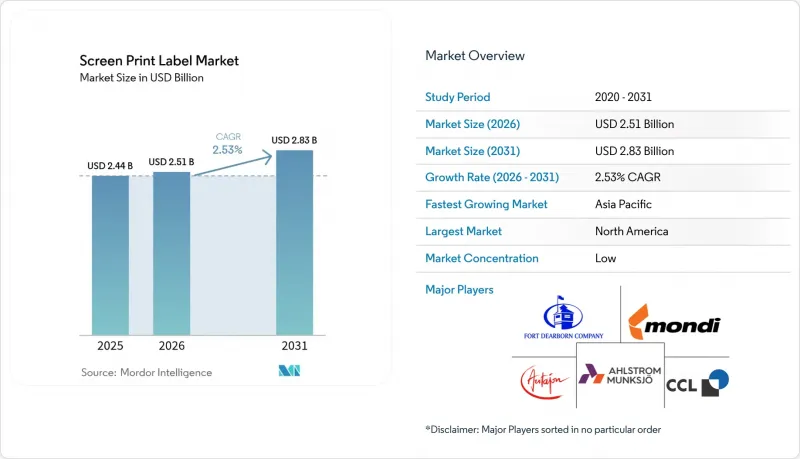
據 Mordor Intelligence 稱,網版印刷標籤市場預計到 2026 年價值 25.1 億美元,高於 2025 年的 24.4 億美元,預計到 2031 年將達到 28.3 億美元。
預計 2026 年至 2031 年的複合年成長率為 2.53%。
本報告按類型(收縮套筒標籤、無底紙標籤等)、最終用戶(服裝、食品飲料等)、印刷油墨類型(溶劑型、水性、UV固化型等)、承印物(紙張、塑膠薄膜、玻璃、金屬等)和地區進行細分。市場預測以美元計價。
全球網版印刷標籤市場趨勢及洞察
日常消費品的持久品牌形象
品牌擁有者要求標籤能夠承受氙弧燈照射、反覆磨損和多次填充循環。聯合利華要求標籤即使在經過 2000 小時的光老化後,色差仍保持在 Delta E 2.0 以內,這可以透過高濃度二氧化鈦的水性網版印刷油墨來實現。溶劑型數位油墨由於其在寶潔公司 ASTM D5264 標準中規定的 50 次雙實驗室測試閾值,因此被排除在認證範圍之外。隨著歐洲向可重複填充包裝轉型,標籤還必須能夠承受 15 至 20 次高溫洗滌循環而不脫落。
用於電子商務履約的堅固標籤
亞馬遜2024年的包裝法規要求標籤在水中浸泡48小時後仍保持完好無損,這促使履約中心擴大採用帶有丙烯酸黏合劑的聚酯絲網標籤。由於ISTA 3L跌落測試施加40-60G的衝擊負荷,加工商正在將黏合劑面積提高到標籤面積的85%。聯邦快遞規定標籤在72小時後的最低剝離強度為16盎司/英寸,但溶劑型丙烯酸絲網油墨的剝離強度比此標準高出35%。
多色網版印刷設備的建造成本很高。
旋轉印刷機的初始投資額為 80 萬至 120 萬美元,是入門級數位印刷機價格的四到五倍。此外,準備工作仍需 45 至 90 分鐘,導致小批量生產延誤和廢棄物增加。因此,新興市場的加工商紛紛推遲產能擴張計劃,直到利率下降或訂單週期延長。
細分市場分析
預計到2025年,收縮套標將佔總銷售額的38.12%,複合年成長率達3.38%,這將推動網版印刷標籤市場中通用壓敏標籤市場的成長。此細分市場具有許多優勢,例如360度全方位圖形覆蓋、高達78%的蒸氣隧道收縮率以及對不規則容器設計的適應性。節能薄膜,例如“Pentalabel Boost”,可減少30%的蒸氣用量,從而為每個容器節省0.008至0.012美元的成本。無底紙解決方案的市佔率雖然落後,但正逐漸受到物流業客戶的青睞,他們尋求的是廢棄物的工作流程。在啤酒業,傳統的玻璃瓶生產線仍然使用濕黏標籤,但隨著易拉罐的普及,這個細分市場正在萎縮。用於服裝的熱轉印貼紙和用於耐用消費品的套模成型方案也在豐富產品線,每種方案都滿足特定的要求,從而保持了較高的價格溢價。
確保永續性和真實性正為進一步成長鋪平道路。網版印刷的全像箔有助於防止酒類和化妝品行業的假冒偽劣產品,而可水洗油墨的使用則實現了可回收包裝的循環利用。精釀飲品品牌正在利用壓花清漆和觸感效果,這些效果是數位印刷無法複製的,同時也能保持生產速度。雖然收縮膜的回收仍然面臨挑戰,但單層聚乙烯套管和離型黏合劑有望改善廢棄產品的處理方式,從而符合零售商的目標。
受過敏原和防篡改法規的推動,食品品牌銷售量,預計到2025年將佔總銷售額的28.10%。然而,化妝品和個人護理行業預計將以4.38%的複合年成長率位居榜首。高階產品線需要金屬油墨、觸感柔滑的清漆以及只有UV絲網印刷才能提供的耐化學腐蝕性。歐萊雅目前要求油墨交聯密度超過85%,才能在油基配方中浸泡30天。即將實施的FDA健康標籤法規將增加可變數據,但混合絲網-數位工作流程可以應對這項挑戰,而不會造成顏色偏差。
在飲料業,紋理標籤佔了十幾個百分點的市場佔有率,這主要得益於精釀啤酒廠訂購此類標籤以凸顯其手工釀造的形象。雖然藥品序列化通常使用 600 dpi 的2D條碼,但工業應用需要能夠耐受礦物油腐蝕的標籤。在時尚產業,隨著快時尚品牌採用直噴印花 (DTG) 技術,標籤需求穩定成長。然而,奢侈品牌仍然珍視其傳統,更傾向於使用帶有網版印刷標誌的緞紋織嘜標籤。
區域分析
預計到2025年,北美將佔全球銷售額的39.70%,主要得益於《藥品供應鏈安全法案》下序列化政策帶來的兩位數重印需求成長。美國加工商正投資高達2.2億美元擴大其UV-LED標籤的產能,並已與需要金屬油墨和觸感塗層的精釀飲料和特色食品公司簽訂了合約。加拿大的雙語標籤法提高了資訊密度,這對不透明絲網印刷油墨的發展起到了積極作用。在墨西哥的電子產品加工廠(出口加工區),符合260 度C回流焊接要求的聚醯亞胺標籤的指定進一步提升了該地區的需求。
歐洲約佔總銷售額的四分之一。 《包裝和包裝廢棄物法規》規定,到2030年,65%的標籤必須由回收材料製成,加工商也正朝著單一材料結構的方向發展。德國的《包裝法》(VerpackG)對不可可再生材料附加稅,以及英國向UKCA標誌的過渡,都活性化,而絲網印刷在這些訂單中更受歡迎。用於認證橄欖油和葡萄酒原產地的安全全像圖仍然是一個強勁的小眾市場。
在亞太地區,中國即將於2025年下半年實施QR碼,這將影響數十億件包裝食品,預計到2031年將實現4.98%的年複合成長率(CAGR)。印度的IS 17142:2024黏合劑標準正在加速濕黏合劑在潮濕沿海地區的應用。日本對無溶劑印刷機的稅額扣抵抵免、韓國的標籤廢棄物押金制度以及澳洲的ISO 22000出口標準,都在進一步擴大該地區的應用。中東和非洲的成長處於中等個位數水平,沙烏地阿拉伯的本地化法規和南非在地採購標準推動了印刷機在當地的普及。
其他好處:
- Excel格式的市場預測(ME)表
- 3個月的分析師支持
目錄
第1章:引言
- 研究假設和市場定義
- 調查範圍
第2章:調查方法
第3章執行摘要
第4章 市場狀況
- 市場概覽
- 市場促進因素
- 快速消費品 (FMCG) 產業對持久品牌解決方案的需求不斷成長。
- 隨著電子商務的發展,對堅固耐用的包裝標籤的需求也日益成長。
- UV-LED網版印刷設備的技術進步
- 整合RFID和QR碼。
- 對永續性的承諾正在推動無溶劑網版印刷油墨的普及。
- 電動車電池中耐熱標籤的應用日益廣泛
- 市場限制因素
- 多色網版印刷設備建置高成本
- 透過數位噴墨標籤印刷展開競爭
- 油墨用石油化工原料價格波動
- 嚴格的環境法規限制揮發性有機化合物(VOCs)的排放
- 產業價值鏈分析
- 宏觀經濟因素對市場的影響
- 監理情勢
- 技術展望
- 波特五力分析
第5章 市場規模與成長預測
- 按類型
- 收縮套筒標籤
- 無底紙標籤
- 濕膠標籤
- 其他類型
- 最終用戶
- 時尚與服裝
- 食物
- 飲料
- 化妝品和個人護理
- 其他最終用戶
- 按印刷油墨類型
- 溶劑型
- 水溶液
- 紫外線固化型
- 矽膠墨水
- 其他類型的印刷油墨
- 按基礎材料
- 紙
- 塑膠薄膜
- 玻璃
- 金屬
- 織物
- 其他基質
- 按地區
- 北美洲
- 美國
- 加拿大
- 墨西哥
- 南美洲
- 巴西
- 阿根廷
- 其他南美國家
- 歐洲
- 德國
- 英國
- 法國
- 義大利
- 西班牙
- 其他歐洲國家
- 亞太地區
- 中國
- 日本
- 印度
- 韓國
- 澳洲和紐西蘭
- 其他亞太國家
- 中東和非洲
- 中東
- 沙烏地阿拉伯
- 阿拉伯聯合大公國
- 土耳其
- 其他中東國家
- 非洲
- 南非
- 埃及
- 奈及利亞
- 其他非洲國家
- 中東
- 北美洲
第6章 競爭情勢
- 市場集中度
- 策略趨勢
- 市佔率分析
- 公司簡介
- 3M Company
- Ahlstrom-Munksjo Oyj
- Autajon Group
- Avery Dennison Corporation
- Brady Corporation
- CCL Industries Inc.
- Constantia Flexibles Group GmbH
- Coveris Group
- Fort Dearborn Company
- Fuji Seal International Inc.
- Gallus Ferd. Ruesch AG
- Huhtamaki Oyj
- Inland Label and Marketing Services LLC
- Lintec Corporation
- Mondi plc
- Multi-Color Corporation
- RR Donnelley and Sons Company
- SATO Holdings Corporation
- TSC Auto ID Technology Co. Ltd.
- UPM Raflatac(UPM-Kymmene Corporation)
- Xeikon(Flint Group)
第7章 市場機會與未來展望
According to Mordor Intelligence, screen print label market size in 2026 is estimated at USD 2.51 billion, growing from 2025 value of USD 2.44 billion with 2031 projections showing USD 2.83 billion, growing at 2.53% CAGR over 2026-2031.
This report is Segmented by Type (Shrink Sleeves Label, Linerless Label, and More), End User (Fashion and Apparels, Food, Beverages, and More), Printing Ink Type (Solvent-Based, Water-Based, UV-Curable, and More), Substrate Material (Paper, Plastic Films, Glass, Metal, and More), and Geography. The Market Forecasts are Provided in Terms of Value (USD).
Global Screen Print Label Market Trends and Insights
Durable Branding for Fast-Moving Consumer Goods
Brand owners mandate labels that survive xenon-arc exposure, repeated abrasion, and refill-pack cycles. Unilever requires color stability within Delta E 2.0 after 2,000 hours of light aging, which water-based screen inks achieve through high titanium dioxide loading. Procter and Gamble's 50-double-rub threshold under ASTM D5264 keeps solvent-based digital inks off qualified lists. As Europe shifts to refillable packs, labels must also withstand 15-20 hot-wash cycles without delaminating.
Robust Labels for E-Commerce Fulfillment
Amazon's 2024 packaging rules require labels that remain intact after 48 hours of water immersion, directing fulfillment centers toward polyester screen constructions with acrylic adhesives. ISTA 3L drop tests add 40-60 G shock loads, so converters raise adhesive coverage to 85% of the footprint. FedEx specifies a minimum peel adhesion of 16 oz/in after 72 hours, which solvent-acrylic screen inks exceed by up to 35%.
High Cost of Multicolor Screen-Printing Setups
Rotary equipment needs USD 800,000-1.2 million upfront, four to five times the ticket price of an entry-level digital press. Make-ready still takes 45-90 minutes, delaying short runs and increasing scrap. Emerging-market converters, therefore, delay capacity additions until interest rates ease or orders shift to longer repeats.
Other drivers and restraints analyzed in the detailed report include:
- Advancements in UV-LED Screen Printing Equipment
- Smart-Label Integration with RFID and QR Codes
- Competition from Digital Inkjet Label Printing
For complete list of drivers and restraints, kindly check the Table Of Contents.
Segment Analysis
Shrink sleeves accounted for 38.12% of 2025 revenue and are expected to advance at a 3.38% CAGR, helping the screen print label market outpace commodity pressure-sensitive formats. The segment benefits from 360-degree graphic coverage, steam tunnel shrinkage of up to 78%, and compatibility with irregular container designs. Energy-efficient films such as Pentalabel Boost cut steam use by 30%, shaving USD 0.008-0.012 per container. Linerless solutions lag in share but appeal to logistics customers seeking waste-free workflows. Wet-glued labels cling to legacy glass-bottle lines in beer, yet this niche is shrinking as cans gain traction. Heat-transfer decals for apparel and in-mold options for durable goods complete the mix, each serving specialized requirements that sustain price premiums.
Sustainability and authentication extend the growth runway. Screen-printed holographic foils deter counterfeiters in the spirits and cosmetics industries, while washable inks enable the use of returnable packaging loops. Craft beverage brands exploit raised varnish and tactile effects that digital cannot replicate at production speed. Although shrink-film recycling remains a hurdle, mono-material polyethylene sleeves and delaminating adhesives promise end-of-life gains that align with retailer targets.
Food brands held 28.10% of 2025 sales as allergen and tamper-evidence rules kept volumes high, but cosmetics and personal care is set for the fastest 4.38% CAGR. Prestige lines demand metallic inks, soft-touch varnish, and chemical endurance that only UV-screen builds provide. L'Oreal now specifies ink cross-link density above 85% to survive 30-day immersion in oily formulations. Upcoming FDA healthy-claim labels add more variable data, a task that hybrid screen-digital workflows solve without color drift.
Beverage applications enjoy mid-teens share as craft breweries order textured labels that reinforce artisanal cues. Pharmaceutical serialization utilizes two-dimensional codes at 600 dpi, whereas industrial applications require labels that withstand exposure to mineral spirits. Fashion labels grow modestly as fast-fashion brands adopt direct-to-garment printing; yet, luxury houses still favor woven satin with screen-printed logos for their brand heritage.
Complete Report Scope:
- By Type
- Shrink Sleeves Label
- Linerless Label
- Wet-Glued Label
- Other Types
- By End User
- Fashion and Apparels
- Food
- Beverages
- Cosmetics and Personal Care
- Other End Users
- By Printing Ink Type
- Solvent-Based
- Water-Based
- UV-Curable
- Silicone Ink
- Other Printing Ink Types
- By Substrate Material
- Paper
- Plastic Films
- Glass
- Metal
- Fabric
- Other Substrates
- By Geography
- North America
- United States
- Canada
- Mexico
- South America
- Brazil
- Argentina
- Rest of South America
- Europe
- Germany
- United Kingdom
- France
- Italy
- Spain
- Rest of Europe
- Asia Pacific
- China
- Japan
- India
- South Korea
- Australia and New Zealand
- Rest of Asia Pacific
- Middle East and Africa
- Middle East
- Saudi Arabia
- United Arab Emirates
- Turkey
- Rest of Middle East
- Africa
- South Africa
- Egypt
- Nigeria
- Rest of Africa
- Middle East
- North America
Geography Analysis
North America accounted for 39.70% of 2025 revenue, driven by the Drug Supply Chain Security Act serialization, which spurred double-digit reprint demand. United States converters invested up to USD 220 million in UV-LED capacity, winning craft beverage and specialty food contracts that crave metallic inks and tactile finishes. Canada's bilingual label law increased information density, a benefit for opaque screen inks. Mexico's electronics maquiladoras specified polyimide labels rated for 260 °C reflow, reinforcing regional demand.
Europe accounted for roughly one-quarter of sales. The Packaging and Packaging Waste Regulation mandates 65% recycled content in labels by 2030, prompting converters to shift toward mono-material builds. Germany's VerpackG fees on non-recyclables and the United Kingdom's UKCA symbol changeover fueled short-run orders that favored screen printing. Security holograms for authenticating the origin of olive oil and wine remain a resilient niche.
The Asia-Pacific region is expected to post a 4.98% CAGR through 2031 due to China's late-2025 QR-code deadline, which will affect billions of packaged food units. India's IS 17142:2024 adhesion rule accelerates the adoption of wet glue in humid coastal corridors. Japanese tax credits for solvent-free presses, South Korean deposit fees on label waste, and Australian ISO 22000 export standards further expand regional uptake. Middle East and African growth hovers near mid-single digits, with Saudi localization rules and South African local-content thresholds prompting domestic press installations.
- 3M Company
- Ahlstrom-Munksjo Oyj
- Autajon Group
- Avery Dennison Corporation
- Brady Corporation
- CCL Industries Inc.
- Constantia Flexibles Group GmbH
- Coveris Group
- Fort Dearborn Company
- Fuji Seal International Inc.
- Gallus Ferd. Ruesch AG
- Huhtamaki Oyj
- Inland Label and Marketing Services LLC
- Lintec Corporation
- Mondi plc
- Multi-Color Corporation
- R.R. Donnelley and Sons Company
- SATO Holdings Corporation
- TSC Auto ID Technology Co. Ltd.
- UPM Raflatac (UPM-Kymmene Corporation)
- Xeikon (Flint Group)
Additional Benefits:
- The market estimate (ME) sheet in Excel format
- 3 months of analyst support
TABLE OF CONTENTS
1 INTRODUCTION
- 1.1 Study Assumptions and Market Definition
- 1.2 Scope of the Study
2 RESEARCH METHODOLOGY
3 EXECUTIVE SUMMARY
4 MARKET LANDSCAPE
- 4.1 Market Overview
- 4.2 Market Drivers
- 4.2.1 Rising Demand for Durable Branding Solutions in Fast-Moving Consumer Goods
- 4.2.2 Growth of E-Commerce Requiring Robust Packaging Labels
- 4.2.3 Advancements in UV-LED Screen Printing Equipment
- 4.2.4 Proliferation of Smart Label Features Integrating RFID and QR Codes
- 4.2.5 Sustainability Push Toward Solvent-Free Screen Printing Inks
- 4.2.6 Increasing Adoption of Heat-Resistant Labels in Electric Vehicle Batteries
- 4.3 Market Restraints
- 4.3.1 High Cost of Multicolor Screen Printing Setups
- 4.3.2 Competition from Digital Inkjet Label Printing
- 4.3.3 Volatility in Petrochemical Raw Material Prices for Inks
- 4.3.4 Stringent Environmental Regulations on Volatile Organic Compound Emissions
- 4.4 Industry Value Chain Analysis
- 4.5 Impact of Macroeconomic Factors on the Market
- 4.6 Regulatory Landscape
- 4.7 Technological Outlook
- 4.8 Porter's Five Forces Analysis
- 4.8.1 Threat of New Entrants
- 4.8.2 Bargaining Power of Buyers or Consumers
- 4.8.3 Bargaining Power of Suppliers
- 4.8.4 Threat of Substitute Products
- 4.8.5 Intensity of Competitive Rivalry
5 MARKET SIZE AND GROWTH FORECASTS (VALUE)
- 5.1 By Type
- 5.1.1 Shrink Sleeves Label
- 5.1.2 Linerless Label
- 5.1.3 Wet-Glued Label
- 5.1.4 Other Types
- 5.2 By End User
- 5.2.1 Fashion and Apparels
- 5.2.2 Food
- 5.2.3 Beverages
- 5.2.4 Cosmetics and Personal Care
- 5.2.5 Other End Users
- 5.3 By Printing Ink Type
- 5.3.1 Solvent-Based
- 5.3.2 Water-Based
- 5.3.3 UV-Curable
- 5.3.4 Silicone Ink
- 5.3.5 Other Printing Ink Types
- 5.4 By Substrate Material
- 5.4.1 Paper
- 5.4.2 Plastic Films
- 5.4.3 Glass
- 5.4.4 Metal
- 5.4.5 Fabric
- 5.4.6 Other Substrates
- 5.5 By Geography
- 5.5.1 North America
- 5.5.1.1 United States
- 5.5.1.2 Canada
- 5.5.1.3 Mexico
- 5.5.2 South America
- 5.5.2.1 Brazil
- 5.5.2.2 Argentina
- 5.5.2.3 Rest of South America
- 5.5.3 Europe
- 5.5.3.1 Germany
- 5.5.3.2 United Kingdom
- 5.5.3.3 France
- 5.5.3.4 Italy
- 5.5.3.5 Spain
- 5.5.3.6 Rest of Europe
- 5.5.4 Asia Pacific
- 5.5.4.1 China
- 5.5.4.2 Japan
- 5.5.4.3 India
- 5.5.4.4 South Korea
- 5.5.4.5 Australia and New Zealand
- 5.5.4.6 Rest of Asia Pacific
- 5.5.5 Middle East and Africa
- 5.5.5.1 Middle East
- 5.5.5.1.1 Saudi Arabia
- 5.5.5.1.2 United Arab Emirates
- 5.5.5.1.3 Turkey
- 5.5.5.1.4 Rest of Middle East
- 5.5.5.2 Africa
- 5.5.5.2.1 South Africa
- 5.5.5.2.2 Egypt
- 5.5.5.2.3 Nigeria
- 5.5.5.2.4 Rest of Africa
- 5.5.5.1 Middle East
- 5.5.1 North America
6 COMPETITIVE LANDSCAPE
- 6.1 Market Concentration
- 6.2 Strategic Moves
- 6.3 Market Share Analysis
- 6.4 Company Profiles (includes Global Level Overview, Market Level Overview, Core Segments, Financials as Available, Strategic Information, Market Rank or Share for Key Companies, Products and Services, and Recent Developments)
- 6.4.1 3M Company
- 6.4.2 Ahlstrom-Munksjo Oyj
- 6.4.3 Autajon Group
- 6.4.4 Avery Dennison Corporation
- 6.4.5 Brady Corporation
- 6.4.6 CCL Industries Inc.
- 6.4.7 Constantia Flexibles Group GmbH
- 6.4.8 Coveris Group
- 6.4.9 Fort Dearborn Company
- 6.4.10 Fuji Seal International Inc.
- 6.4.11 Gallus Ferd. Ruesch AG
- 6.4.12 Huhtamaki Oyj
- 6.4.13 Inland Label and Marketing Services LLC
- 6.4.14 Lintec Corporation
- 6.4.15 Mondi plc
- 6.4.16 Multi-Color Corporation
- 6.4.17 R.R. Donnelley and Sons Company
- 6.4.18 SATO Holdings Corporation
- 6.4.19 TSC Auto ID Technology Co. Ltd.
- 6.4.20 UPM Raflatac (UPM-Kymmene Corporation)
- 6.4.21 Xeikon (Flint Group)
7 MARKET OPPORTUNITIES AND FUTURE OUTLOOK
- 7.1 White-Space and Unmet-Need Assessment

 北美印刷標籤:市場佔有率分析、產業趨勢與統計、成長預測(2026-2031 年)美國印刷標籤:市場佔有率分析、行業趨勢和統計數據、成長預測(2026-2031 年)印刷標籤:市場佔有率分析、產業趨勢與統計、成長預測(2026-2031)
 標籤印刷市場:按標籤格式、印刷過程、終端用戶產業和地區分類列印貼標及貼標設備:市場佔有率分析、產業趨勢與統計、成長預測(2026-2031)
 印刷標籤市場報告:按原料、印刷過程、標籤格式、最終用途行業和地區分類(2026-2034年)
 2026年全球印刷標籤市場報告
 印刷組件和標籤(熱轉印、數位印刷、網版印刷):全球市場佔有率和排名、總收入和需求預測(2025-2031 年)日本印刷標籤市場規模、佔有率、趨勢及預測(按原料、印刷過程、標籤格式、最終用途行業和地區),2025 年至 2033 年
 印刷標籤市場規模、佔有率及成長分析(依印刷製程、標籤格式、原料、最終用途產業、地區及細分市場預測),2025 年至 2032 年