


 |
市場調查報告書
商品編碼
2124537
北美印刷標籤:市場佔有率分析、產業趨勢與統計、成長預測(2026-2031 年)North America Print Label - Market Share Analysis, Industry Trends & Statistics, Growth Forecasts (2026 - 2031) |
||||||

※ 本網頁內容可能與最新版本有所差異。詳細情況請與我們聯繫。
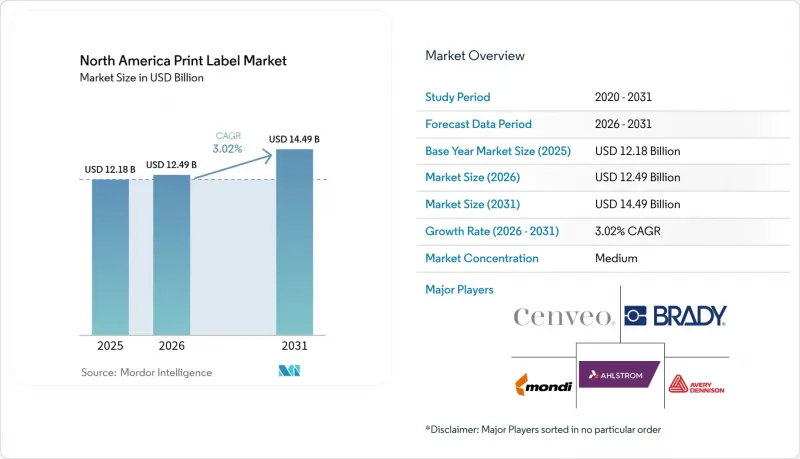
根據 Mordor Intelligence 預測,北美印刷標籤市場規模將從 2025 年的 121.8 億美元成長到 2026 年的 124.9 億美元,到 2031 年達到 144.9 億美元,2026 年至 2031 年的複合年成長率為 3.02%。
本報告按基材(紙/紙板、聚對苯二甲酸乙二醇酯等)、印刷技術(柔版印刷、網版印刷等)、標籤類型(濕黏標籤、壓敏標籤、無底紙標籤等)、終端用戶產業(食品、飲料、醫療/製藥等)和國家/地區進行細分。市場預測以美元(USD)為單位。
北美印刷標籤市場趨勢與洞察
對數位印刷技術的需求日益成長
數位印刷機正在改變北美印刷標籤市場的經濟結構,使5000英尺以下的小批量生產在經濟上成為可能。 2025年6月,RR Donnelley部署了一台HP Indigo 120K印刷機,並配備了機器人物料搬運系統,以簡化小批量生產流程。 2025年5月,Cimpress決定在其網路中增設多達20台HP Indigo印刷機,這顯示該公司對2027年之前個人化包裝的需求充滿信心。根據Taylor Corporation的內部數據,數位印刷相對於柔版印刷的損益平衡點約為3000英尺,而五年前這一數字為8000英尺。這一經濟優勢使得即使是小規模加工商也能與全國零售商日益成長的48小時交貨期要求競爭。此外,數位平台的柔軟性支持類比生產線難以實現的功能,例如序列化、獨特的QR碼和擴增實境(AR)觸發。
電子商務物流中可變數據印刷的激增。
隨著線上零售的快速發展,需要包含唯一條碼、退貨數據和品牌訊息的運輸標籤數量急劇增加。美國領先的第三方物流供應商目前正指定使用支援RFID技術的標籤進行托盤自動分揀,而亞馬遜自2025年起強制要求所有入庫托盤貼有RFID標籤的政策加速了這一趨勢。艾利丹尼森於2025年6月推出的APR認證單材質RFID標籤,展現了加工商如何將永續性。同時,履約中心傾向於使用無底紙標籤,以減少高速貼標機的廢棄物,這進一步推動了對直接捲繞式標籤結構的需求成長。
低溫冷鏈應用的耐久性不足
在北美印刷標籤市場,傳訊RNA疫苗和細胞療法在超低溫運輸過程中,黏合劑和麵材的失效問題日益凸顯。 RxSource公司發現,標籤在凍融循環過程中會出現剝落和條碼褪色現象,並建議使用玻璃化轉變溫度低於40 度C的丙烯酸樹脂體係以及抗脆性聚丙烯面材。美國食品藥物管理局(FDA)的良好生產規範(GMP)要求標籤在整個保存期限內保持清晰可讀,這意味著如果出現材料失效,加工商將承擔重大責任。百健公司正在透過在-80 度C下進行10次加速凍融測試檢驗標籤,而這項方案正逐漸被生物技術產業的客戶所接受。黏合劑的重組使材料成本增加了高達25%,進一步壓縮了原本就價格競標激烈的合約的利潤空間。能夠獲得低溫結構認證的專業加工商正在這一特殊需求領域佔據越來越大的市場佔有率。
細分市場分析
2025年,聚對苯二甲酸乙二醇酯(PET)憑藉其韌性、透明度和適用於高速填充的特性,在北美印刷標籤市場保持了36.98%的佔有率。追求循環經濟目標的品牌所有者正擴大採用生物基和可堆肥薄膜,其年複合成長率(CAGR)為4.56%,但目前的高昂成本限制了其應用範圍,使其主要集中在高階有機和健康產品線。紙張在葡萄酒和手工食品行業中仍然扮演著重要角色,因為這些行業對產品的天然外觀要求很高;而聚丙烯在需要形狀適應性的擠壓包裝領域佔據主導地位。聚氯乙烯(PVC)由於環境方面的批評而持續失去市場佔有率,但它仍然在工業化學品領域得到應用,其耐溶劑性能仍然無可匹敵。塑膠塑膠回收再利用協會制定的設計規範正在影響相關標準,敦促加工商避免使用會污染聚乙烯回收流程的表面材料。
供應鏈緊張使得基材的選擇更加困難。 Pixel造紙廠的關閉迫使加工商爭相採購特種塗佈紙,一些葡萄酒品牌也開始測試紋理聚丙烯表面材料,這種材料既能模仿紙張的美觀,又能避免供應鏈風險。 UPM在北卡羅來納州的擴張提高了離型紙的產量,部分抵消了歐洲產量的下降,但市場擔憂仍然存在。 Beontag投資4000萬美元在俄亥俄州建立了一條專用生產線,實現了高階黏合劑的在地化生產。智慧標籤的成長是另一個驅動力,RFID天線需要能夠最大限度減少訊號衰減的基材。艾利丹尼森的單材料聚乙烯結構既滿足了這項需求,也符合回收商的驗收標準。
柔版印刷單次印刷量可超過10,000英尺,且相容於低VOC水性油墨,預計到2025年將佔據44.96%的市場佔有率。以HP Indigo、Xeikon和噴墨混合印刷機為代表的數位印刷系統,在2026年至2031年間將以年均4.32%的速度成長,因為加工商們正積極爭取本地精釀啤酒、限量版化妝品和消費者直接灌裝包裝的訂單。 RR Donnelley位於喬治亞的工廠,將一台全新的HP Indigo 120K印刷機與自動化表面處理工程相結合,便是模擬和數位大規模共存的典範。 Cimpress計劃擴大其印刷機數量,這凸顯了市場對個人化印刷品的持續需求,尤其是在其大規模客製化入口網站。
在金屬油墨和大批量印刷至關重要的領域,平版印刷和網版印刷仍然佔據著一定的市場地位。同時,美國環保署 (EPA) 計畫於 2026 年收緊《聯邦法規》第 40 篇第 60 部分 RR 子部分的相關規定,迫使依賴溶劑型油墨的加工商轉型使用 UV 固化或水性油墨系統。加州空氣品質控制區已經制定了嚴格的標準,有效地加速了向數位印刷機和環保低排放平台的轉型。然而,成本壁壘依然存在。入門級噴墨印表機的售價接近 50 萬美元,而用於大批量生產的碳粉生產線則超過 100 萬美元,因此,為了實現規模經濟,印刷企業之間的合併正在增加。
其他好處:
- Excel格式的市場預測(ME)表
- 3個月的分析師支持
目錄
第1章:引言
- 市場分析與定義的前提條件
- 分析範圍
第2章 分析方法
第3章執行摘要
第4章 市場狀況
- 市場概覽
- 市場促進因素
- 對數位印刷技術的需求日益成長
- 電子商務物流中可變資料印刷的激增。
- 受永續性驅動,向無襯紙收縮套標形式過渡。
- 醫療設備的強制性UDI標籤
- 利用人工智慧驅動的列印工作流程自動化,縮短交付時間。
- 品牌保護與防偽功能的整合
- 市場限制因素
- 在極寒環境下,其耐久性不足以滿足冷鏈應用的需求。
- 特種標籤紙的供應波動
- 由於從類比印刷機向數位印刷機過渡,導致資本密集化。
- 2026年,有關揮發性有機化合物和油墨遷移的法規將更加嚴格。
- 產業價值鏈分析
- 監理情勢
- 技術展望
- 波特五力分析
- 宏觀經濟因素對市場的影響
第5章:預測市場規模與成長率
- 按基礎材料
- 紙張和紙板
- 聚對苯二甲酸乙二醇酯(PET)
- 聚丙烯(PP/BOPP)
- 聚氯乙烯(PVC)
- 生物基可堆肥薄膜
- 其他基質
- 透過印刷技術
- 平版印刷
- 柔版印刷
- 網版印刷
- 數位印刷
- 其他印刷技術
- 標籤類型
- 濕膠標籤
- 壓敏膠標籤
- 無底紙標籤
- 套模標籤
- 收縮套筒標籤
- 其他標籤維修
- 按最終用戶行業分類
- 食物
- 飲料
- 醫療和藥品
- 化妝品和個人護理
- 產業
- 其他終端用戶產業
- 國家
- 美國
- 加拿大
- 墨西哥
第6章 競爭情勢
- 市場集中度
- 策略趨勢
- 市佔率分析
- 公司簡介
- Avery Dennison Corporation
- CCL Industries Inc.
- Multi-Color Corporation
- Brady Corporation
- Smurfit Westrock
- Mondi plc
- Ahlstrom-Munksjo Oyj
- Cenveo Worldwide Limited
- Resource Label Group, LLC
- Blue Label Packaging Company
- OMNI Systems Inc.
- Inovar Packaging Group
- Fort Dearborn Company
- RR Donnelley and Sons Company
- Fortis Solutions Group, LLC
- Traco Manufacturing, Inc.
- UPM-Raflatac Oy
- Brook+Whittle Holdings, LLC
- Lux Global Label Company
- Consolidated Label Co.
第7章 市場機會與未來展望
According to Mordor Intelligence, the North America print label market size is expected to increase from USD 12.18 billion in 2025 to USD 12.49 billion in 2026 and reach USD 14.49 billion by 2031, growing at a CAGR of 3.02% over 2026-2031.
This report is Segmented by Substrate Material (Paper and Paperboard, Polyethylene Terephthalate, and More), Print Technology (Flexography, Screen, and More), Label Type (Wet-Glued Labels, Pressure-Sensitive Labels, Liner-Less Labels, and More), End-User Industry (Food, Beverage, Healthcare and Pharmaceutical, and More), and Country. The Market Forecasts are Provided in Terms of Value (USD).
North America Print Label Market Trends and Insights
Growing Demand for Digital Print Technologies
Digital presses are changing the economics of the North America print label market by making runs under 5 000 linear feet financially viable. RR Donnelley installed an HP Indigo 120K press in June 2025, pairing it with robotic material handling to streamline short-run production. Cimpress committed in May 2025 to add up to 20 more HP Indigo units across its network, signaling confidence in personalized packaging demand through 2027. Taylor Corporation's in-house data pegs the digital break-even point versus flexography at roughly 3 000 feet, down from 8 000 feet five years ago. These economics allow smaller converters to compete on 48-hour turnaround times that national retailers increasingly expect. The flexibility of digital platforms also supports serialization, unique QR codes, and augmented-reality triggers that are impractical on analog lines.
Surge in Variable Data Printing for E-commerce Logistics
Rapid expansion of online retail has multiplied the number of shipping labels that require unique barcodes, return data, and branded messaging. Major U.S. third-party logistics operators now specify radio-frequency identification (RFID)- enabled labels to automate pallet sortation, a requirement accelerated by Amazon's mandate that inbound pallets carry RFID tags from 2025. Avery Dennison's APR-recognized mono-material RFID label, introduced in June 2025, demonstrates how converters are merging sustainability with smart-label functionality. The boom in serialized labels obliges converters to deploy digital front-end software capable of ingesting high-volume data streams directly from customer enterprise systems. In parallel, fulfillment centers prefer liner-less formats that reduce waste on high-speed applicators, reinforcing volume growth for direct-wound constructions.
Inadequate Durability in Extreme Cold-Chain Applications
Messenger RNA vaccines and cell therapies shipped at ultra-low temperatures have exposed adhesive and facestock failures within the North America print label market. RxSource identified delamination and barcode fading during freeze-thaw cycles and recommends acrylic systems with sub-40 °C glass-transition points plus polypropylene facestocks that resist embrittlement. FDA good manufacturing practice rules obligate labels to remain legible throughout shelf life, elevating converters' liability when materials fail. Biogen validates labels through 10 accelerated freeze-thaw tests at -80 °C, a protocol spreading across biotech customers. Reformulating adhesives increases material cost by up to 25%, squeezing margins on contracts already tendered at tight pricing. Niche converters able to certify cryogenic constructions capture a share in this specialized pocket of demand.
Other drivers and restraints analyzed in the detailed report include:
- Sustainability-Driven Switch to Liner-Less and Shrink-Sleeve Formats
- Healthcare UDI-Labeling Mandates
- Supply Volatility of Specialty Label-Stock Papers
For complete list of drivers and restraints, kindly check the Table Of Contents.
Segment Analysis
Polyethylene terephthalate maintained a 36.98% share of the North America print label market in 2025, supported by its toughness, transparency, and suitability for high-speed bottling. Brand owners pursuing circular-economy goals are adding biobased and compostable films that are advancing at a 4.56% CAGR, though current cost premiums confine adoption to premium organic and wellness lines. Paper retains relevance for wine and artisanal food where a natural look matters, while polypropylene dominates squeezable packaging that demands conformability. Polyvinyl chloride continues to retreat under environmental scrutiny, yet it persists in industrial chemicals where its solvent resistance remains unmatched. Association of Plastic Recyclers design protocols now influence specification sheets, encouraging converters to avoid facestocks that contaminate polyethylene recycling streams.
Supply shocks exacerbate substrate decisions. Pixelle's mill shutdown left converters scrambling for specialty coated papers, pushing some wine brands to test textured polypropylene facestocks that mimic paper aesthetics without supply-chain risk. UPM's expansion in North Carolina added release-liner output that partly offsets lost European tonnage, but market anxiety lingers. Beontag invested USD 40 million to install a specialty line in Ohio that localizes high-end self-adhesive materials. Smart-label growth is another driver, as RFID antennas demand substrates that limit signal attenuation; Avery Dennison's mono-material polyethylene construction meets this need while aligning with recycler acceptance criteria.
Flexography held 44.96% of the market share in 2025, thanks to its productivity on runs exceeding 10,000 feet and its compatibility with low-VOC water-based inks. Digital systems, led by HP Indigo, Xeikon, and inkjet hybrids, are expanding at 4.32% across 2026-2031 as converters chase orders for regional craft beer, limited-edition cosmetics, and direct-to-consumer replenishment packs. RR Donnelley's Georgia facility integrates a new HP Indigo 120K with automated finishing, an illustration of analog and digital coexistence at scale. Cimpress's planned fleet expansion confirms sustained appetite for personalized prints, especially across mass-customization web portals.
Offset and screen retain niche roles where metallic inks or heavy lay-downs are critical. Meanwhile, the U.S. Environmental Protection Agency will tighten 40 CFR Part 60 Subpart RR limits in 2026, pushing converters reliant on solvent inks toward UV-curable or aqueous systems. California air districts have already enacted stricter thresholds, effectively accelerating the pivot to lower-emission platforms that naturally align with digital presses. Capital remains a barrier: entry-level inkjet models cost near USD 500 000 and high-volume toner lines exceed USD 1 million, driving mergers among printers seeking economies of scale.
Complete Report Scope:
- By Substrate Material
- Paper and Paperboard
- Polyethylene Terephthalate (PET)
- Polypropylene (PP and BOPP)
- Polyvinyl Chloride (PVC)
- Biobased and Compostable Films
- Other Substrate Materials
- By Print Technology
- Offset
- Flexography
- Screen
- Digital Printing
- Other Print Technologies
- By Label Type
- Wet-glued Labels
- Pressure-Sensitive Labels
- Liner-less Labels
- In-mold Labels
- Shrink Sleeve Labels
- Other Label Types
- By End-user Industry
- Food
- Beverage
- Healthcare and Pharmaceutical
- Cosmetics and Personal Care
- Industrial
- Other End-user Industries
- By Country
- United States
- Canada
- Mexico
List of Companies Covered in this Report:
- Avery Dennison Corporation
- CCL Industries Inc.
- Multi-Color Corporation
- Brady Corporation
- Smurfit Westrock
- Mondi plc
- Ahlstrom-Munksjo Oyj
- Cenveo Worldwide Limited
- Resource Label Group, LLC
- Blue Label Packaging Company
- OMNI Systems Inc.
- Inovar Packaging Group
- Fort Dearborn Company
- RR Donnelley and Sons Company
- Fortis Solutions Group, LLC
- Traco Manufacturing, Inc.
- UPM-Raflatac Oy
- Brook + Whittle Holdings, LLC
- Lux Global Label Company
- Consolidated Label Co.
Additional Benefits:
- The market estimate (ME) sheet in Excel format
- 3 months of analyst support
TABLE OF CONTENTS
1 INTRODUCTION
- 1.1 Study Assumptions and Market Definition
- 1.2 Scope of the Study
2 RESEARCH METHODOLOGY
3 EXECUTIVE SUMMARY
4 MARKET LANDSCAPE
- 4.1 Market Overview
- 4.2 Market Drivers
- 4.2.1 Growing Demand for Digital Print Technologies
- 4.2.2 Surge in Variable Data Printing for E-commerce Logistics
- 4.2.3 Sustainability-Driven Switch to Linerless and Shrink-Sleeve Formats
- 4.2.4 Healthcare UDI-Labeling Mandates
- 4.2.5 AI-Enabled Print Workflow Automation Reducing Turnaround Time
- 4.2.6 Brand Protection and Anti-Counterfeit Features Integration
- 4.3 Market Restraints
- 4.3.1 Inadequate Durability in Extreme Cold-Chain Applications
- 4.3.2 Supply Volatility of Specialty Label-Stock Papers
- 4.3.3 Capital-Intensive Transition from Analog to Digital Presses
- 4.3.4 Stringent VOC and Ink-Migration Regulations Tightening in 2026
- 4.4 Industry Value Chain Analysis
- 4.5 Regulatory Landscape
- 4.6 Technological Outlook
- 4.7 Porter's Five Forces Analysis
- 4.7.1 Bargaining Power of Suppliers
- 4.7.2 Bargaining Power of Buyers
- 4.7.3 Threat of New Entrants
- 4.7.4 Threat of Substitutes
- 4.7.5 Competitive Rivalry
- 4.8 Impact of Macroeconomic Factors on the Market
5 MARKET SIZE AND GROWTH FORECASTS (VALUE)
- 5.1 By Substrate Material
- 5.1.1 Paper and Paperboard
- 5.1.2 Polyethylene Terephthalate (PET)
- 5.1.3 Polypropylene (PP and BOPP)
- 5.1.4 Polyvinyl Chloride (PVC)
- 5.1.5 Biobased and Compostable Films
- 5.1.6 Other Substrate Materials
- 5.2 By Print Technology
- 5.2.1 Offset
- 5.2.2 Flexography
- 5.2.3 Screen
- 5.2.4 Digital Printing
- 5.2.5 Other Print Technologies
- 5.3 By Label Type
- 5.3.1 Wet-glued Labels
- 5.3.2 Pressure-Sensitive Labels
- 5.3.3 Liner-less Labels
- 5.3.4 In-mold Labels
- 5.3.5 Shrink Sleeve Labels
- 5.3.6 Other Label Types
- 5.4 By End-user Industry
- 5.4.1 Food
- 5.4.2 Beverage
- 5.4.3 Healthcare and Pharmaceutical
- 5.4.4 Cosmetics and Personal Care
- 5.4.5 Industrial
- 5.4.6 Other End-user Industries
- 5.5 By Country
- 5.5.1 United States
- 5.5.2 Canada
- 5.5.3 Mexico
6 COMPETITIVE LANDSCAPE
- 6.1 Market Concentration
- 6.2 Strategic Moves
- 6.3 Market Share Analysis
- 6.4 Company Profiles (Includes Global Level Overview, Market Level Overview, Core Segments, Financials as Available, Strategic Information, Market Rank/Share, Products and Services, and Recent Developments)
- 6.4.1 Avery Dennison Corporation
- 6.4.2 CCL Industries Inc.
- 6.4.3 Multi-Color Corporation
- 6.4.4 Brady Corporation
- 6.4.5 Smurfit Westrock
- 6.4.6 Mondi plc
- 6.4.7 Ahlstrom-Munksjo Oyj
- 6.4.8 Cenveo Worldwide Limited
- 6.4.9 Resource Label Group, LLC
- 6.4.10 Blue Label Packaging Company
- 6.4.11 OMNI Systems Inc.
- 6.4.12 Inovar Packaging Group
- 6.4.13 Fort Dearborn Company
- 6.4.14 RR Donnelley and Sons Company
- 6.4.15 Fortis Solutions Group, LLC
- 6.4.16 Traco Manufacturing, Inc.
- 6.4.17 UPM-Raflatac Oy
- 6.4.18 Brook + Whittle Holdings, LLC
- 6.4.19 Lux Global Label Company
- 6.4.20 Consolidated Label Co.
7 MARKET OPPORTUNITIES AND FUTURE OUTLOOK
- 7.1 White-Space and Unmet-Need Assessment

 美國印刷標籤:市場佔有率分析、行業趨勢和統計數據、成長預測(2026-2031 年)網版印刷標籤:市場佔有率分析、產業趨勢與統計、成長預測(2026-2031)印刷標籤:市場佔有率分析、產業趨勢與統計、成長預測(2026-2031)
 標籤印刷市場:按標籤格式、印刷過程、終端用戶產業和地區分類列印貼標及貼標設備:市場佔有率分析、產業趨勢與統計、成長預測(2026-2031)
 印刷標籤市場報告:按原料、印刷過程、標籤格式、最終用途行業和地區分類(2026-2034年)
 2026年全球印刷標籤市場報告
 印刷組件和標籤(熱轉印、數位印刷、網版印刷):全球市場佔有率和排名、總收入和需求預測(2025-2031 年)日本印刷標籤市場規模、佔有率、趨勢及預測(按原料、印刷過程、標籤格式、最終用途行業和地區),2025 年至 2033 年
 印刷標籤市場規模、佔有率及成長分析(依印刷製程、標籤格式、原料、最終用途產業、地區及細分市場預測),2025 年至 2032 年