


 |
市場調查報告書
商品編碼
2124442
北美汽車物流:市場佔有率分析、產業趨勢與統計及成長預測(2026-2031 年)North America Automotive Logistics - Market Share Analysis, Industry Trends & Statistics, Growth Forecasts (2026 - 2031) |
||||||

※ 本網頁內容可能與最新版本有所差異。詳細情況請與我們聯繫。
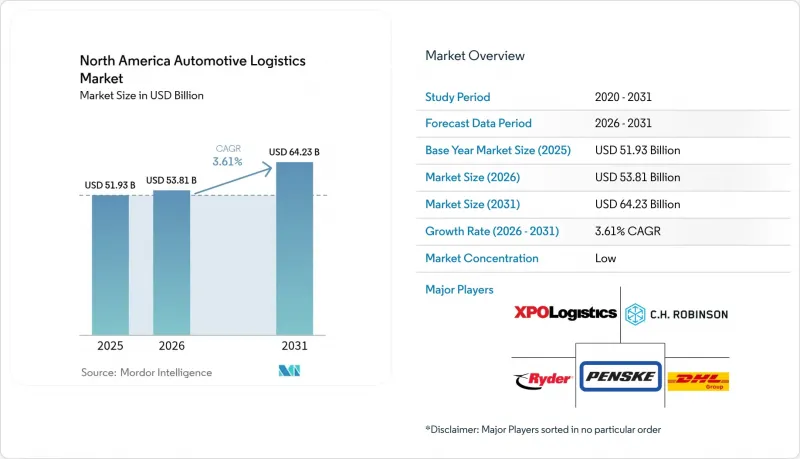
據 Mordor Intelligence 稱,2025 年北美汽車物流市場價值為 519.3 億美元,預計到 2031 年將達到 642.3 億美元,而 2026 年為 538.1 億美元,預測期(2026-2031 年)的複合年成長率為 3.61%。
本報告按服務(運輸、倉儲、配送和庫存管理、附加價值服務)、類型(OEM 和售後市場)、貨物類型(整車、汽車零件、電動汽車電池和電力電子產品、其他貨物)以及國家(美國、加拿大、墨西哥)進行細分。市場預測以美元 (USD) 為單位。
北美汽車物流市場趨勢與洞察
加強環境法規(2025-2030年)
美國環保署第三階段溫室氣體排放法規將於2027年生效,該法規正推動物流車輛朝向低排放氣體和零排放卡車轉型,並改變資產購置和配送路線策略。各州採納加州的“先進清潔車隊規則”,強制要求購買零排放車輛,加速了這項轉型。儘管營運商在引進電動牽引車方面面臨大量資本投入,但他們預計這些成本將被整個生命週期中燃料和維護成本的降低所抵消。倉庫正在實施能源管理系統並尋求ISO 14001認證,以滿足托運人的永續發展標準。能夠證明其碳足跡減少量可量化的物流合作夥伴,正擴大從注重環境、社會和治理(ESG)的汽車製造商那裡獲得長期合約。因此,在北美汽車物流市場,對法規合規性的投資已成為進入市場的關鍵切入點和品牌建立手段。
透過電子商務拓展零件物流
直接面對消費者 (D2C) 的零件銷售正在改變運輸方式,從托盤運輸轉向小包裹式配送。這需要自動化揀貨、貼標和當日送達。位於都市區需求中心附近的交叉轉運中心和微型倉配中心正在縮短訂單到交付的周期,但 SKU 的快速成長使得即時庫存可見性至關重要。包裝工程師正在設計防篡改和防靜電解決方案,以保護小包裹網路中的感測器和電子元件。隨著消費者期望輕鬆便捷的換貨體驗,退貨處理變得越來越複雜,促使第三方物流 (3PL) 公司在其倉庫中增加補貨和重新入庫的生產線。因此,北美汽車物流市場正在從純粹的成本驅動型運輸轉向以技術主導的整合服務,以應對電子商務的波動性。
司機短缺和工資上漲
預計到2025年,商業司機缺口將達到數萬人,這將加劇運輸能力緊張,並推高平均薪資。汽車貨運受到的衝擊尤其嚴重,因為運輸危險物品和汽車的資格要求縮小了合格工人的範圍。儘管運輸公司正在擴大新員工入職獎金和學費資助計劃,但他們仍然難以填補離職司機的空缺。在專用汽車運輸路線上,貨運費率每季都會進行調整,因為每家運輸公司都在爭取盈利最高的合約。雖然自動駕駛卡車的試點計畫在樞紐到樞紐運輸方面展現出前景,但監管和社會接受度方面的障礙意味著在預測期內大規模部署的可能性不大,因此勞動力短缺將在中期內持續拖累北美汽車物流市場。
細分市場分析
到2025年,運輸業將佔北美汽車物流市場規模的51.45%。這主要道路運輸驅動,公路運輸負責在Tier 1供應商和組裝廠之間運輸零件。多式聯運鐵路連接墨西哥工廠和中西部樞紐,並受益於機車現代化改造,提高了營運速度。空運則佔據了高價值ECU和緊急模具運輸等細分市場。隨著汽車製造商將非核心業務外包給第三方物流公司(3PL),從而騰出空間用於電動車生產線,附加價值服務(套件組裝、定序和簡化組裝)正以2.95%的複合年成長率(2026-2031年)成長。
每家供應商都在透過數位孿生技術實現差異化,這些技術可以模擬工廠庫存,並促進基於看板的補貨,從而減少在製品積壓。倉庫設施正在擴建,增設夾層,用於處理退貨和進行電池健康診斷。這種業務板塊的轉變使能夠協調運輸營運與廠內物料搬運團隊以及生產線旁準時交付的整合商受益。因此,加值合約的期限延長至五年或更久,鞏固了北美汽車物流市場的交叉銷售潛力。
其他好處:
- Excel格式的市場預測(ME)表
- 3個月的分析師支持
目錄
第1章:引言
- 研究假設和市場定義
- 調查範圍
第2章:調查方法
第3章執行摘要
第4章 市場狀況
- 市場概覽
- 市場促進因素
- 加強環境法規(2025-2030年)
- 透過電子商務擴大零件分銷
- 透過美墨加協定實現原始設備製造商近岸外包和生產擴張
- 利用技術可視化供應鏈
- 墨西哥太平洋沿岸港口的擴建將開闢新的滾裝船運輸航線。
- 利用人工智慧創建動態航線,可以顯著降低航空旅行成本。
- 市場限制因素
- 汽車生產的周期性特徵
- 促進要素短缺和工資上漲
- 電池危險性方面的法規限制了電動車的物流能力。
- 對港口滯留時間的罰款正在給第三方物流公司的利潤率帶來壓力。
- 價值供應鏈分析
- 監理情勢
- 技術展望
- 專題報導-電子商務對汽車物流的影響
- 波特五力模型
第5章 市場規模與成長預測
- 按服務
- 運輸
- 路
- 鐵路
- 航空
- 海運/滾裝船/沿海運輸
- 倉儲、物流和庫存管理
- 附加價值服務
- 運輸
- 按類型
- OEM
- 售後市場
- 按貨物類型
- 已完成的汽車
- 汽車零件
- 電動汽車電池和電力電子
- 其他貨物
- 國家
- 美國
- 加拿大
- 墨西哥
第6章 競爭情勢
- 市場集中度
- 策略趨勢
- 市佔率分析
- 公司簡介
- DHL
- CH Robinson
- XPO Logistics
- Penske Logistics
- Ryder System Inc.
- CEVA Logistics
- DSV A/S
- Kuehne+Nagel
- GEODIS
- Nippon Express
- United Parcel Service(UPS)
- Jack Cooper Transport
- Wallenius Wilhelmsen
- SEKO Logistics
- Yusen Logistics
- Buske Logistics
- Grupo Traxion
- Schneider National
- Omni Logistics
- Crowley Logistics
第7章 市場機會與未來展望
第8章附錄
- 按行業分類的GDP分佈
- 關於資本流動的考量
- 經濟統計-運輸和倉儲部門的貢獻
According to Mordor Intelligence, the North America automotive logistics market size was valued at USD 51.93 billion in 2025 and estimated to grow from USD 53.81 billion in 2026 to reach USD 64.23 billion by 2031, at a CAGR of 3.61% during the forecast period (2026-2031).
This report is Segmented by Service (Transportation, Warehousing, Distribution & Inventory Management, and Value-Added Services), Type (OEM and Aftermarket), Cargo Type (Finished Vehicles, Auto Components, EV Batteries & Power-Electronics, and Other Cargo), Country (United States, Canada, and Mexico). The Market Forecasts are Provided in Terms of Value (USD).
North America Automotive Logistics Market Trends and Insights
Environmental Regulations Tightening (2025-2030)
The EPA's Phase 3 greenhouse-gas standards, effective 2027, push logistics fleets toward low- and zero-emission trucks, altering asset procurement and routing strategies. States adopting California's Advanced Clean Fleets Rule accelerate the transition by mandating zero-emission vehicle purchases. Operators face higher capital outlays for electric tractors yet expect lifetime fuel and maintenance savings to offset those costs. Warehouses install energy-management systems and secure ISO 14001 certification to meet shipper sustainability criteria. Logistics partners that can document quantifiable carbon-footprint reductions increasingly win long-term contracts from automakers focused on ESG metrics. Consequently, compliance investments become both a market entry ticket and a brand-building lever within the North America Automotive Logistics market.
Growth of E-commerce Parts Flows
Direct-to-consumer parts sales are fragmenting shipment profiles, shifting from pallet-level moves to parcel-size consignments that demand automated picking, labeling, and same-day fulfillment. Cross-docks and micro-fulfillment centers near urban demand nodes shrink order-to-delivery cycles, while SKU proliferation necessitates real-time inventory visibility. Packaging engineers design tamper-proof, static-free solutions to protect sensors and electronics in parcel networks. Returns complexity rises as consumers expect hassle-free exchanges, prompting 3PLs to add refurbishment and restocking lines inside warehouses. The North America Automotive Logistics market thus pivots from purely cost-focused transportation to integrated, tech-driven services that manage e-commerce volatility.
Driver Shortage & Wage Inflation
The commercial driver gap reached multi-tens-of-thousands of positions in 2025, straining capacity and lifting median pay. Automotive freight suffers disproportionately because hazmat and car-haul endorsements narrow the qualified labor pool. Carriers raise sign-on bonuses and tuition reimbursement programs, yet still struggle to backfill retirements. Dedicated auto lanes face re-pricing every quarter as fleets chase the most profitable contracts. Autonomous-truck pilots show promise for hub-to-hub moves, but regulatory and public-acceptance barriers keep widescale deployment beyond the forecast horizon, preserving labor scarcity as a medium-term drag on the North America Automotive Logistics market.
Other drivers and restraints analyzed in the detailed report include:
- OEM Near-shoring & USMCA Production Ramp-up
- AI-driven Dynamic Routing Slashes Empty-Mile Costs
- Battery-hazard Regulations Constrain EV Logistics Capacity
For complete list of drivers and restraints, kindly check the Table Of Contents.
Segment Analysis
Transportation generated 51.45% of the North America Automotive Logistics market size in 2025, anchored by road haulage that shuttles components between tier-1 suppliers and assembly plants. Intermodal rail corridors link Mexican factories with Midwest hubs, benefiting from locomotive fleet upgrades that raise velocity. Airfreight retains a niche for high-value ECUs and urgent tooling. Value-added services-kitting, sequencing, and light assembly-are growing at a 2.95% CAGR (2026-2031) as automakers offload non-core tasks to 3PLs, freeing floor space for EV production lines.
Providers differentiate through digital twins that model plant inventories and push kanban replenishment, shrinking work-in-process buffers. Warehousing footprints add mezzanines for returns processing and battery-state-of-health diagnostics. The segment shift rewards integrators that can couple transport with in-plant material-handling teams and line-side just-in-sequence delivery. Consequently, value-added contracts are lengthening to five-plus years, locking in cross-selling potential across the wider North America Automotive Logistics market.
Complete Report Scope:
- By Service
- Transportation
- Road
- Rail
- Air
- Sea / Ro-Ro / Short-Sea
- Warehousing, Distribution & Inventory Management
- Value-added Services
- Transportation
- By Type
- OEM
- Aftermarket
- By Cargo Type
- Finished Vehicles
- Auto Components
- EV Batteries and Power-Electronics
- Other Cargo
- By Country
- United States
- Canada
- Mexico
List of Companies Covered in this Report:
- DHL
- C.H. Robinson
- XPO Logistics
- Penske Logistics
- Ryder System Inc.
- CEVA Logistics
- DSV A/S
- Kuehne + Nagel
- GEODIS
- Nippon Express
- United Parcel Service (UPS)
- Jack Cooper Transport
- Wallenius Wilhelmsen
- SEKO Logistics
- Yusen Logistics
- Buske Logistics
- Grupo Traxion
- Schneider National
- Omni Logistics
- Crowley Logistics
Additional Benefits:
- The market estimate (ME) sheet in Excel format
- 3 months of analyst support
TABLE OF CONTENTS
1 Introduction
- 1.1 Study Assumptions & Market Definition
- 1.2 Scope of the Study
2 Research Methodology
3 Executive Summary
4 Market Landscape
- 4.1 Market Overview
- 4.2 Market Drivers
- 4.2.1 Environmental regulations tightening (2025-2030)
- 4.2.2 Growth of e-commerce parts flows
- 4.2.3 OEM near-shoring & USMCA production ramp-up
- 4.2.4 Technology-enabled supply-chain visibility
- 4.2.5 Mexico's Pacific port expansions unlock new Ro-Ro lanes
- 4.2.6 AI-driven dynamic routing slashes empty-mile costs
- 4.3 Market Restraints
- 4.3.1 Economic cyclicality of auto output
- 4.3.2 Driver shortage & wage inflation
- 4.3.3 Battery-hazard regulations constrain EV logistics capacity
- 4.3.4 Port-side dwell-time fines erode 3PL margins
- 4.4 Value / Supply-Chain Analysis
- 4.5 Regulatory Landscape
- 4.6 Technological Outlook
- 4.7 Spotlight - Effect of E-commerce on Automotive Logistics
- 4.8 Porter's Five Forces
- 4.8.1 Threat of New Entrants
- 4.8.2 Bargaining Power of Buyers
- 4.8.3 Bargaining Power of Suppliers
- 4.8.4 Threat of Substitutes
- 4.8.5 Intensity of Competitive Rivalry
5 Market Size & Growth Forecasts
- 5.1 By Service
- 5.1.1 Transportation
- 5.1.1.1 Road
- 5.1.1.2 Rail
- 5.1.1.3 Air
- 5.1.1.4 Sea / Ro-Ro / Short-Sea
- 5.1.2 Warehousing, Distribution & Inventory Management
- 5.1.3 Value-added Services
- 5.1.1 Transportation
- 5.2 By Type
- 5.2.1 OEM
- 5.2.2 Aftermarket
- 5.3 By Cargo Type
- 5.3.1 Finished Vehicles
- 5.3.2 Auto Components
- 5.3.3 EV Batteries and Power-Electronics
- 5.3.4 Other Cargo
- 5.4 By Country
- 5.4.1 United States
- 5.4.2 Canada
- 5.4.3 Mexico
6 Competitive Landscape
- 6.1 Market Concentration
- 6.2 Strategic Moves
- 6.3 Market Share Analysis
- 6.4 Company Profiles (includes Global level Overview, Market level overview, Core Segments, Financials as available, Strategic Information, Market Rank/Share for key companies, Products & Services, and Recent Developments)
- 6.4.1 DHL
- 6.4.2 C.H. Robinson
- 6.4.3 XPO Logistics
- 6.4.4 Penske Logistics
- 6.4.5 Ryder System Inc.
- 6.4.6 CEVA Logistics
- 6.4.7 DSV A/S
- 6.4.8 Kuehne + Nagel
- 6.4.9 GEODIS
- 6.4.10 Nippon Express
- 6.4.11 United Parcel Service (UPS)
- 6.4.12 Jack Cooper Transport
- 6.4.13 Wallenius Wilhelmsen
- 6.4.14 SEKO Logistics
- 6.4.15 Yusen Logistics
- 6.4.16 Buske Logistics
- 6.4.17 Grupo Traxion
- 6.4.18 Schneider National
- 6.4.19 Omni Logistics
- 6.4.20 Crowley Logistics
7 Market Opportunities & Future Outlook
- 7.1 White-space & Unmet-need Assessment
8 Appendix
- 8.1 GDP Distribution, by Activity
- 8.2 Insights into Capital Flows
- 8.3 Economic Statistics - Transport & Storage Sector Contribution

 汽車物流市場預測至2034年-全球分析(按貨物類型、服務類型、運輸方式、車輛類型、物流解決方案、最終用戶和地區分類)
 中國成品車物流:市場佔有率分析、產業趨勢與統計及成長預測(2026-2031年)美國汽車塗料物流:市場佔有率分析、產業趨勢與統計、成長預測(2026-2031)
 汽車物流市場:依運輸方式、服務類型、車輛類型和最終用戶分類-2026-2032年全球市場預測
 汽車物流市場分析及預測(至2035年):依類型、產品類型、服務、技術、零件、應用、流程、運輸方式及階段分類德國車輛物流:市場佔有率分析、產業趨勢與統計及成長預測(2026-2031)輪胎物流市場分析及預測(至2035年):類型、產品類型、服務、技術、組件、應用、流程、部署狀態、最終用戶
 汽車物流市場規模、佔有率和趨勢分析報告:按活動、類型、分銷、物流解決方案、地區和細分市場分類(2026-2033 年)
 2026年全球汽車物流市場報告汽車物流:市場佔有率分析、產業趨勢與統計、成長預測(2026-2031)