


 |
市場調查報告書
商品編碼
2099474
中國成品車物流:市場佔有率分析、產業趨勢與統計及成長預測(2026-2031年)China Finished Vehicle Logistics - Market Share Analysis, Industry Trends & Statistics, Growth Forecasts (2026 - 2031) |
||||||

※ 本網頁內容可能與最新版本有所差異。詳細情況請與我們聯繫。
根據 Mordor Intelligence 預測,中國成品車物流市場規模將從 2025 年的 366.7 億美元成長到 2026 年的 387.5 億美元,到 2031 年將達到 504.3 億美元,2026 年至 2031 年的複合年成長率預計為 5.41%預計。
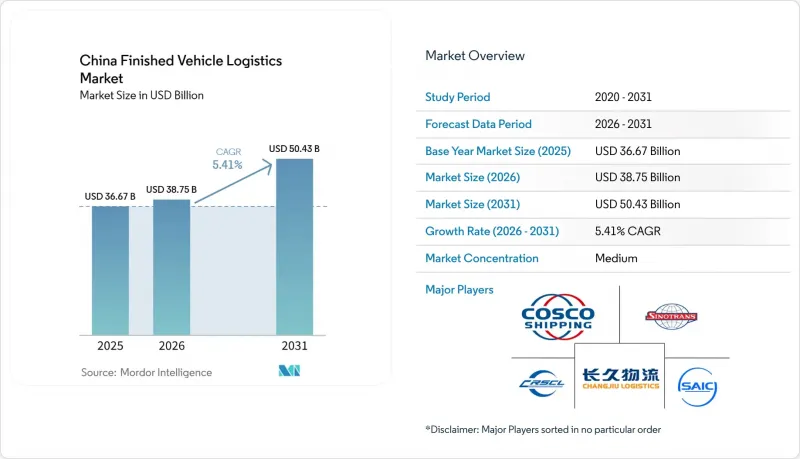
中國成品車物流市場的發展主要受出口目的地不斷擴大、新能源汽車裝卸要求日益嚴格以及單次運輸附加價值服務不斷成長的推動。本報告按物流功能(運輸、倉儲配送、附加價值服務)、目的地(國內、國際)、車輛類型(乘用車、商用車、非公路用車)、終端用戶產業(整車廠、經銷商、其他)及地區(北方、東北、中部等)進行細分。市場預測以美元計價。
中國成品車物流市場趨勢及洞察
擴大新能源汽車出口,並在各省之間重新分配車輛
中國整車物流市場正日益受到新能源汽車出口擴張以及內陸生產基地與國內外目的地之間整車運輸需求的影響。這正促使物流網路從以配送主導的系統轉型為必須管理工廠叢集、堆場、港口和經銷商之間更頻繁、更均衡的長途運輸的系統。由於生產集中在少數幾個關鍵製造區域,而需求卻分散在內陸省份和海外市場,營運挑戰進一步加劇。這一趨勢增加了車輛處理、規劃要求以及跨多條運輸路線對專用資產的需求。因此,即使運輸效率提高,中國整車物流市場的單位運輸價值仍在增加。
沿海出口走廊中港口、鐵路和滾裝船運輸的整合
中國成品車物流市場最重要的基礎設施變革是鐵路、港口和滾裝船運輸能力在整個出口走廊的深度整合。 2025年4月,中國開通了首條從北部灣港到傑貝阿里港的滾裝船航線。與傳統路線相比,該航線將運輸時間縮短了4至10天,並將「新國際陸海貿易走廊」的物流效率提高了10%至15%。 2026年1月,一列載有重慶製造新能源車的海鐵聯運列車從南沙港出發,隨後與一艘開往中東的船舶對接。這表明,內陸工廠也可以融入正常的出口供應鏈,減少中轉環節。 2025年6月,新華社報告稱,中歐之間的貨運列車運輸成品車僅需約12天,每輛車的物流成本約為2000美元,而陸路運輸則需要25至30天,每輛車的成本約為2500美元。這凸顯了內陸地區高優先級出口批次的重要性。隨著這些多式聯運路線從試驗走廊發展成為覆蓋更廣泛內陸和沿海樞紐的可複製營運模式,中國的整車物流市場將從中受益。
出口高峰期專用汽車裝運船隻的運輸能力出現瓶頸。
即使在2025年和2026年船舶運力有所提升之後,中國整車物流市場在出口高峰期仍將面臨運輸能力緊張的問題。問題不僅在於船隊規模;泊位的可用性、船期的可靠性以及碼頭的準備情況也會影響車輛的準時運輸量。換言之,二線出口港口並非總能吸收來自最擁擠沿海港口的剩餘運力,尤其是在大型船舶需要特定泊位深度或貨物裝卸輔助的情況下。實際上,這種情況導致不同業者的出口運輸能力存在差異,使得規模較小或一體化程度較低的托運人更容易受到季度末壓力的影響。因此,一旦出口成長超過港口和航運基礎設施的發展速度,中國整車物流市場容易受到實際瓶頸的影響。
細分市場分析
到2025年,運輸環節將佔中國成品車物流市場64.87%的市場佔有率,成為最大的功能性細分市場。同時,附加價值服務及其他細分市場預計到2031年將以7.16%的複合年成長率成長。這一構成比表明,即使利潤來源開始轉向以運輸流程為中心的服務,實體運輸仍然是市場的基礎。道路運輸仍然是向國內經銷商補貨以及短途城際和省內運輸的核心方式。海運和內河航運在運輸大量出口貨物以及連接沿河製造地與遠洋碼頭方面繼續發揮至關重要的作用。
在中國的整車物流市場,能夠將檢驗、損傷評估、電池處理、預計到達時間可視化以及報關協調整合到單一服務包中的供應商正逐漸獲得認可。鐵路運輸雖然目前市佔率仍較小,但在成本和時間限制遠比單純的柔軟性更為重要的長途內陸運輸路線上,其重要性日益凸顯。倉儲和配送的角色也在發生變化,因為整車製造商不再滿足於被動的車輛存儲,而是要求更快的處理速度和更有效率的車輛調度。這種轉變使得複雜的設施、交付前檢驗、港口調度和數位化堆場流程等功能性差異化因素,而不僅僅是規模,變得更加重要。
截至2025年,國內物流在中國成品車物流市場佔73.10%,而國際物流預計到2031年將以6.76%的複合年成長率成長。這表明,儘管國內物流仍將是市場的基礎,但出口導向物流的重要性正以更快的速度日益凸顯。由於中國擁有覆蓋沿海和內陸零售市場的龐大國內分銷網路,國內物流市場仍保持龐大的規模。然而,國際物流市場正從一種利基出口功能發展成為能夠駕馭複雜出口業務的企業的核心成長引擎。
出口物流受益於運輸走廊的建設、港口間協調的加強以及內陸生產群集對鐵路和海運一體化模式的廣泛接受。進口和入境物流流量仍然很重要,因為它們支撐著綜合利用率,並有助於緩解部分沿海碼頭的運力方向失衡。一個不太明顯的影響是,出口體系的強化可能會降低國內產能利用率,因為專用車輛和運輸能力將轉移到高價值的海外路線。能夠更有效管理進出口物流的營運商,將更有利於在中國整體整車物流市場中維持資產利用率和價格紀律。
其他好處:
- Excel格式的市場預測(ME)表
- 3個月的分析師支持
目錄
第1章:引言
- 研究假設和市場定義
- 調查範圍
第2章:調查方法
第3章執行摘要
第4章 市場狀況
- 市場概況及物流在成品車中的作用
- 汽車相關支出趨勢
- 市場促進因素
- 新能源汽車出口增加與省際車輛調配
- 沿海出口走廊中港口、鐵路和滾裝船運輸的整合
- 原始設備製造商對損傷緩解和即時車輛可視性的需求
- 整合經銷商網路並最佳化直接向經銷商的交付
- 數位化場地管理、大門自動化和ETA控制塔擴建。
- 為發展多模態和物流網路提供政策支援。
- 市場限制因素
- 出口旺季期間專用汽車裝運船隻的運輸能力出現瓶頸。
- 短程及場內運輸中車輛損壞風險較高
- 國內道路運輸面臨來自通行費、燃油成本和空駛返程成本的壓力。
- 區域間營運標準有差異,裝卸基礎設施也不盡相同。
- 法律規範
- 價值鍊和分銷管道的結構分析
- 技術創新的前景
- 波特五力分析
- 成品車物流要求的變化
- 地緣政治事件對供應鏈變化的影響
第5章 市場規模與成長預測
- 透過物流功能
- 運輸
- 路
- 航空
- 海路和內河航道
- 鐵路
- 倉儲/物流
- 附加價值服務及其他
- 運輸
- 目的地
- 國內的
- 國際的
- 進口/入境
- 出口/海外
- 車輛類型
- 乘用車(包括二輪車和三輪車)
- 商用車輛
- 非公路用車輛
- 按最終用戶行業分類
- OEMs
- 經銷商
- 其他(租車公司、車隊租賃公司、政府及國防機構車輛等)
- 按地區
- 北
- 東北
- 東方
- 中心
- 南
- 西南
- 西北
第6章 競爭情勢
- 市場集中度
- 關鍵策略趨勢
- 市佔率分析
- 公司簡介
- SAIC Motor Transportation and Logistics Co., Ltd.
- Changjiu Logistics Co., Ltd.
- China Railway Special Cargo Logistics Co., Ltd.
- Sinotrans Limited
- COSCO Shipping Logistics Co., Ltd.
- China Merchants Logistics Group Co., Ltd.
- FAW Logistics Co., Ltd.
- Dongfeng Logistics Group Co., Ltd.
- GAC Logistics Co., Ltd.
- Changan Minsheng APLL Logistics Co., Ltd.
- BAIC Logistics Co., Ltd.
- Geely Logistics Co., Ltd.
- BYD Logistics Co., Ltd.
- NYK Line(Including Yusen Logistics)
- Kuehne+Nagel
- DHL Group
- CMA CGM Group(Including CEVA Logistics)
- DSV A/S(Including DB Schenker)
- Nippon Express Holdings
- Wallenius Wilhelmsen
- Hoegh Autoliners
第7章 市場機會與未來展望
According to Mordor Intelligence, the China finished vehicle logistics market size is projected to expand from USD 36.67 billion in 2025 to USD 38.75 billion in 2026, and reach USD 50.43 billion by 2031, growing at a CAGR of 5.41% from 2026 to 2031.
The China finished vehicle logistics market is being lifted by a wider export footprint, more demanding handling requirements for new energy vehicles, and a steady rise in value-added service content per shipment. This report is Segmented by Logistics Function (Transportation, Warehousing & Distribution, Value-Added Services), by Destination (Domestic, International), by Type of Vehicles (Passenger Vehicles, Commercial Vehicles, Off-Highway Vehicles), by End-User Industry (OEMs, Dealers, Others), and by Region (North, Northeast, Central, and More). The Market Forecasts are Provided in Terms of Value (USD).
China Finished Vehicle Logistics Market Trends and Insights
Rising NEV Exports and Inter-Provincial Vehicle Repositioning
The China finished vehicle logistics market is increasingly shaped by rising NEV export activity and by the need to reposition finished vehicles between inland production bases and both domestic and export destinations. This is changing the network from a mainly distribution-led system into one that must manage more frequent long-distance balancing moves between factory clusters, staging yards, ports, and dealer points. The operating challenge is stronger because production remains concentrated in a limited number of major manufacturing zones, while demand is spreading across interior provinces and overseas markets. That pattern lifts vehicle handling complexity, planning requirements, and the need for specialized asset deployment across multiple corridors. As a result, the China finished vehicle logistics market is seeing higher logistics value per unit moved, even when transport productivity improves.
Port-Rail-RoRo Integration Across Coastal Export Corridors
The most important infrastructure shift in the China finished vehicle logistics market is the deeper integration of rail, port, and RoRo capacity across export corridors. In April 2025, China opened its first RoRo route from Beibu Gulf Port to Jebel Ali, cutting transit time by 4 to 10 days against conventional routing and improving logistics efficiency by 10% to 15% within the New International Land-Sea Trade Corridor. In January 2026, a rail-sea intermodal freight train loaded with Chongqing-made NEVs departed for Nansha Port and then connected to a vessel bound for the Middle East, showing that inland factories can now plug into regular export chains with fewer breakpoints. Xinhua also reported in June 2025 that China-Europe freight trains were carrying finished vehicles in around 12 days at a logistics cost of around USD 2,000 per vehicle, against 25 to 30 days and around USD 2,500 per vehicle by road, which strengthens the case for high-priority and inland export batches. The China finished vehicle logistics market will benefit as these intermodal links move from pilot corridors into repeatable operating models across a wider set of inland and coastal nodes.
Specialized Car-Carrier Capacity Bottlenecks in Peak Export Seasons
The China finished vehicle logistics market still faces capacity pressure in peak export periods, even after a wave of vessel additions in 2025 and 2026. The problem is not only fleet size, because berth access, scheduling reliability, and terminal readiness also determine how much vehicle volume can move on time. That means secondary export ports cannot always absorb overflow from the busiest coastal gateways, especially when larger vessels need specific berth depth and handling support. In practice, this keeps export capacity uneven across operators and leaves smaller or less integrated shippers more exposed to quarter-end pressure. The China finished vehicle logistics market, therefore, remains vulnerable to execution bottlenecks whenever export growth outpaces the readiness of port and shipping infrastructure.
Other drivers and restraints analyzed in the detailed report include:
- OEM Demand for Damage-Reduction and Real-Time Vehicle Visibility
- Policy Support for Multimodal Freight and Logistics Network Upgrades
- High Vehicle Damage Exposure in Short-Haul and Yard-to-Yard Movements
For complete list of drivers and restraints, kindly check the Table Of Contents.
Segment Analysis
Transportation accounted for 64.87% of the China finished vehicle logistics market share in 2025, which made it the largest functional segment, while value-added services and others are projected to grow at a 7.16% CAGR through 2031. That mix shows that physical movement still anchors the market, even as profit pools start to shift toward services built around the transport leg. Road transport remains the core mode for domestic dealer replenishment and for shorter inter-city and intra-provincial moves. Sea and inland waterways continue to matter for bulk export batches and for linking inland river manufacturing zones with deep-sea terminals.
The China finished vehicle logistics market is gradually rewarding providers that can bundle inspection, damage certification, battery handling, ETA visibility, and customs coordination into a single service offer. Rail still represents a smaller share, but it is becoming more relevant on longer inland routes where cost and time discipline matter more than pure flexibility. Warehousing and distribution are also changing in role, because OEMs now want faster processing and better staging rather than passive vehicle storage. That shift means compounds, pre-delivery inspection, port-side sequencing, and digital yard flow are becoming more central to functional differentiation than simple transport volume alone.
Domestic logistics held 73.10% of the China finished vehicle logistics market size in 2025, while international logistics is forecast to grow at a 6.76% CAGR through 2031. This keeps domestic activity as the base of the market, but it also shows that export-oriented logistics is gaining weight at a faster pace. The domestic segment remained larger because China still supports a vast internal distribution network across coastal and inland retail markets. The international segment, however, is moving beyond a niche export function and into a core growth engine for operators that can manage outbound complexity.
Export logistics is benefiting from corridor upgrades, growing port integration, and wider acceptance of rail-sea handoffs for inland production clusters. Import and inbound flows still matter because they support compound utilization and help reduce directional imbalance at some coastal terminals. A less visible effect is that stronger export deployment can tighten domestic equipment availability when specialized rolling stock or carrier capacity gets pulled toward higher-value overseas routes. Providers that manage outbound and return flow more efficiently will be better placed to protect asset utilization and pricing discipline across the China finished vehicle logistics market.
Complete Report Scope:
- By Logistics Function
- Transportation
- Road
- Air
- Sea and Inland Waterways
- Rail
- Warehousing and Distribution
- Value-added Services and Others
- Transportation
- By Destination
- Domestic
- International
- Import/Inbound
- Export/Outbound
- By Type of Vehicles
- Passenger Vehicles (Including Two and Three-Wheelers)
- Commercial Vehicles
- Off-Highway Vehicles
- By End-user Industry
- OEMs
- Dealers
- Others (Rental Companies, Fleet leasing companies, Government and Defense Fleets, etc.)
- By Region
- North
- Northeast
- East
- Central
- South
- Southwest
- Northwest
List of Companies Covered in this Report:
- SAIC Motor Transportation and Logistics Co., Ltd.
- Changjiu Logistics Co., Ltd.
- China Railway Special Cargo Logistics Co., Ltd.
- Sinotrans Limited
- COSCO Shipping Logistics Co., Ltd.
- China Merchants Logistics Group Co., Ltd.
- FAW Logistics Co., Ltd.
- Dongfeng Logistics Group Co., Ltd.
- GAC Logistics Co., Ltd.
- Changan Minsheng APLL Logistics Co., Ltd.
- BAIC Logistics Co., Ltd.
- Geely Logistics Co., Ltd.
- BYD Logistics Co., Ltd.
- NYK Line (Including Yusen Logistics)
- Kuehne+Nagel
- DHL Group
- CMA CGM Group (Including CEVA Logistics)
- DSV A/S (Including DB Schenker)
- Nippon Express Holdings
- Wallenius Wilhelmsen
- Hoegh Autoliners
Additional Benefits:
- The market estimate (ME) sheet in Excel format
- 3 months of analyst support
TABLE OF CONTENTS
1 Introduction
- 1.1 Study Assumptions and Market Definition
- 1.2 Scope of the Study
2 Research Methodology
3 Executive Summary
4 Market Landscape
- 4.1 Market Overview and Role of Logistics in Finished Vehicle
- 4.2 Automotive Spending Trends
- 4.3 Market Drivers
- 4.3.1 Rising NEV Exports and Inter-Provincial Vehicle Repositioning
- 4.3.2 Port-Rail-RoRo Integration Across Coastal Export Corridors
- 4.3.3 OEM Demand for Damage-Reduction and Real-Time Vehicle Visibility
- 4.3.4 Dealer Network Consolidation and Direct-To-Dealer Delivery Optimization
- 4.3.5 Expansion of Digital Yard Management, Gate Automation, and ETA Control Towers
- 4.3.6 Policy Support for Multimodal Freight and Logistics Network Upgrades
- 4.4 Market Restraints
- 4.4.1 Specialized Car-Carrier Capacity Bottlenecks in Peak Export Seasons
- 4.4.2 High Vehicle Damage Exposure in Short-Haul and Yard-to-Yard Movements
- 4.4.3 Toll, Fuel, and Empty-Return Cost Pressure on Domestic Road Transport
- 4.4.4 Fragmented Regional Operating Standards and Loading Infrastructure Gaps
- 4.5 Regulatory Framework
- 4.6 Value Chain and Distribution Channel Architecture Analysis
- 4.7 Technology Innovations Outlook
- 4.8 Porter's Five Forces Analysis
- 4.8.1 Threat of New Entrants
- 4.8.2 Bargaining Power of Suppliers
- 4.8.3 Bargaining Power of Buyers
- 4.8.4 Threat of Substitutes
- 4.8.5 Rivalry Among Competitors
- 4.9 Evolution of Finished Vehicle Logistics Requirements
- 4.10 Impact of Geo-Political Events on Supply Chain Shifts
5 Market Size and Growth Forecasts
- 5.1 By Logistics Function
- 5.1.1 Transportation
- 5.1.1.1 Road
- 5.1.1.2 Air
- 5.1.1.3 Sea and Inland Waterways
- 5.1.1.4 Rail
- 5.1.2 Warehousing and Distribution
- 5.1.3 Value-added Services and Others
- 5.1.1 Transportation
- 5.2 By Destination
- 5.2.1 Domestic
- 5.2.2 International
- 5.2.2.1 Import/Inbound
- 5.2.2.2 Export/Outbound
- 5.3 By Type of Vehicles
- 5.3.1 Passenger Vehicles (Including Two and Three-Wheelers)
- 5.3.2 Commercial Vehicles
- 5.3.3 Off-Highway Vehicles
- 5.4 By End-user Industry
- 5.4.1 OEMs
- 5.4.2 Dealers
- 5.4.3 Others (Rental Companies, Fleet leasing companies, Government and Defense Fleets, etc.)
- 5.5 By Region
- 5.5.1 North
- 5.5.2 Northeast
- 5.5.3 East
- 5.5.4 Central
- 5.5.5 South
- 5.5.6 Southwest
- 5.5.7 Northwest
6 Competitive Landscape
- 6.1 Market Concentration
- 6.2 Key Strategic Moves
- 6.3 Market Share Analysis
- 6.4 Company Profiles (Includes Global Level Overview, Market Level Overview, Core Segments, Financials as Available, Strategic Information, Market Rank/Share for Key Companies, Products and Services, and Recent Developments)
- 6.4.1 SAIC Motor Transportation and Logistics Co., Ltd.
- 6.4.2 Changjiu Logistics Co., Ltd.
- 6.4.3 China Railway Special Cargo Logistics Co., Ltd.
- 6.4.4 Sinotrans Limited
- 6.4.5 COSCO Shipping Logistics Co., Ltd.
- 6.4.6 China Merchants Logistics Group Co., Ltd.
- 6.4.7 FAW Logistics Co., Ltd.
- 6.4.8 Dongfeng Logistics Group Co., Ltd.
- 6.4.9 GAC Logistics Co., Ltd.
- 6.4.10 Changan Minsheng APLL Logistics Co., Ltd.
- 6.4.11 BAIC Logistics Co., Ltd.
- 6.4.12 Geely Logistics Co., Ltd.
- 6.4.13 BYD Logistics Co., Ltd.
- 6.4.14 NYK Line (Including Yusen Logistics)
- 6.4.15 Kuehne+Nagel
- 6.4.16 DHL Group
- 6.4.17 CMA CGM Group (Including CEVA Logistics)
- 6.4.18 DSV A/S (Including DB Schenker)
- 6.4.19 Nippon Express Holdings
- 6.4.20 Wallenius Wilhelmsen
- 6.4.21 Hoegh Autoliners
7 Market Opportunities and Future Outlook
- 7.1 White-space and Unmet-Need Assessment

 美國汽車塗料物流:市場佔有率分析、產業趨勢與統計、成長預測(2026-2031)
 汽車物流市場:依運輸方式、服務類型、車輛類型和最終用戶分類-2026-2032年全球市場預測
 汽車物流市場分析及預測(至2035年):依類型、產品類型、服務、技術、零件、應用、流程、運輸方式及階段分類德國車輛物流:市場佔有率分析、產業趨勢與統計及成長預測(2026-2031)輪胎物流市場分析及預測(至2035年):類型、產品類型、服務、技術、組件、應用、流程、部署狀態、最終用戶
 汽車物流市場規模、佔有率和趨勢分析報告:按活動、類型、分銷、物流解決方案、地區和細分市場分類(2026-2033 年)
 2026年全球汽車物流市場報告汽車物流:市場佔有率分析、產業趨勢與統計、成長預測(2026-2031)成品車物流市場:依運輸方式、服務類型、所有權類型、設備類型及最終用戶分類-2026-2032年全球市場預測
 汽車物流市場規模、佔有率、成長及全球產業分析:按類型、應用和地區分類的洞察,2026-2034 年預測