


 |
市場調查報告書
商品編碼
2073209
德國車輛物流:市場佔有率分析、產業趨勢與統計及成長預測(2026-2031)Germany Finished Vehicle Logistics - Market Share Analysis, Industry Trends & Statistics, Growth Forecasts (2026 - 2031) |
||||||

※ 本網頁內容可能與最新版本有所差異。詳細情況請與我們聯繫。
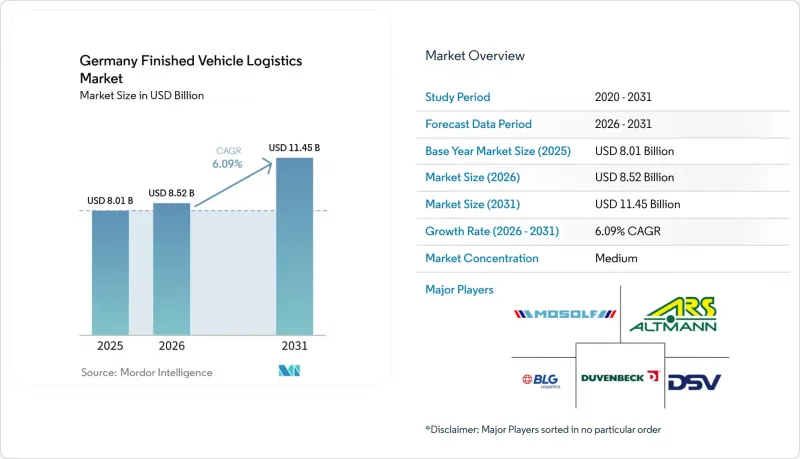
據 Mordor Intelligence 稱,2025 年德國成品車物流市場價值為 80.1 億美元,預計 2026 年將達到 85.2 億美元,到 2031 年將達到 114.5 億美元,2026 年至 2031 年的複合年成長率為 6.09%。
德國成品車物流市場目前正經歷結構性轉型,以適應傳統車輛出貨量下降和向電動車快速轉型的趨勢。本報告按物流功能(運輸、倉儲配送、附加價值服務)、目的地(國內、國際)、車輛類型(乘用車、商用車、非公路用車)、終端用戶產業(整車製造商、經銷商、其他)及地區(北萊茵-威斯特法倫州、巴伐利亞州、巴登-騰堡州等)進行細分。市場預測以美元計價。
德國整車物流市場的趨勢與洞察
原始設備製造商對依序交付(JIS)車輛的需求
由於德國汽車製造商仍然採用不容忍任何順序錯誤的訂單模式,因此,在德國成品車物流市場中,準時交貨仍然是物流合約和服務設計的核心要素。 BMW正在對其慕尼黑工廠進行大規模維修,並計劃於2026年8月開始生產「新級」車型。這項變更與新的運輸流程計劃直接相關,因為電動車和內燃機汽車的生產項目將共用同一生產空間。奧迪也正在加強生產與物流的整合,例如英戈爾施塔特和傑爾工廠在Q3車型生產方面的合作,以及在英戈爾施塔特工廠籌備一款新的電動車車型,目前鐵路運輸已融入到兩地之間的車輛運輸中。在供應商層面,倉庫內的順序管理、自動化運輸和即時狀態共用不再是可選的附加功能,而是整車製造商越來越期望的標準作業。這使得運輸商的技術專長在選擇時顯得格外重要。這是因為承運商現在必須展現出在整個車輛運輸過程中既具備實物搬運能力,又能持續提供事件級報告。因此,當主要整車製造商重新競標時,無法滿足同步交付期限和透明里程碑追蹤要求的承運商很可能會在德國整車物流市場失去市場佔有率。
擴大港口和內陸碼頭的吞吐能力,並配合鐵路運輸。
在德國成品車物流市場,鐵路一體化基礎設施正成為最顯著的競爭優勢之一,它不僅減少了對卡車的依賴,支持了低排放氣體合約的簽訂,也提升了港口與內陸綜合設施之間長途運輸的品質。杜伊斯堡港務局(Duisport)在北萊茵-威斯特法倫州擁有極其強大的市場地位,其21個港池、10個貨櫃碼頭以及約200公里的自有鐵路網路,每年處理超過1億噸貨物。 ARS Altmann AG公司擁有超過4000輛專用鐵路貨車(歐洲最大的私營鐵路貨車車隊),透過在工廠到港口的運輸規劃方面提供顯著優勢,為這一多式聯運轉型提供了有力支持。奧地利聯邦鐵路貨運集團(ÖBB Rail Cargo Group)計劃在2026年將其維羅納-杜伊斯堡線路的往返班次增加到每週10班,從而提升西德的多式聯運連通性,並增強跨境汽車物流的韌性。隨著越來越多的物流流程圍繞多式聯運進行重新設計,擁有鐵路運輸通道、碼頭管理能力和強大的多模態調度能力的運營商在獲取不斷成長的合約方面更具優勢。這提升了德國整車物流市場中固定基礎設施所有權的價值,因為接入鐵路樞紐如今對服務可靠性和排放氣體都產生了影響。
道路運輸司機短缺和薪資壓力
德國持續面臨專業駕駛短缺的問題,而整車物流業受到的壓力尤其顯著。這是因為汽車運輸需要專業的裝載、固定和狀態管理技能。這個問題不僅在於訂單困難;即使訂單旺盛,車輛也可能閒置,導致資產運轉率降低,並在需求高峰期延誤服務恢復。對於那些嚴重依賴國內卡車運輸、面臨嚴格的運費管制且路線柔軟性有限的業者而言,這種壓力最為嚴峻。不斷上漲的工資和合規成本也小規模的本地運輸商造成了更大的衝擊,因為他們難以透過更廣泛的服務組合來分攤增加的成本。因此,僅從事陸路運輸的業者更難應對運輸量的波動,也難以承擔與向經銷商和車隊交付相關的更多技術性任務。因此,儘管駕駛員短缺不會改變透過多模態和混合服務創造價值的長期趨勢,但它無疑是德國整車物流市場短期內面臨的一大阻礙因素。
細分市場分析
2025年,運輸業佔德國成品車物流市場的64.86%。道路運輸仍然是向經銷商、租賃公司和車隊交付車輛的主要方式,因為最後一公里車輛配送仍然依賴國內路線上靈活的卡車運輸。鐵路服務於從工廠到港口的主要中長途走廊,提高了能夠直接管理運輸能力而非僅依賴第三方的營運商的資產價值。在該領域,擁有4000多節鐵路貨車的ARS Altmann AG公司在歐洲鐵路基礎設施領域佔據了最強大的地位之一。雖然海運和內河航運在德國仍然處於次要地位,但它們繼續為主要門戶走廊相關的出口和剩餘物流提供支援。
預計2026年至2031年間,倉儲及配送業將以7.84%的複合年成長率成長,成為德國成品車物流市場中成長最快的物流職能。這不僅是因為倉儲需求旺盛,還因為電動車交付前流程的延長,包括軟體檢驗、充電準備、宣傳活動活動和裝運前狀態管理等環節,正在推動增值環節的轉變。 BLG物流到2025年將在其整個網路中處理420萬輛汽車,光是布雷默哈芬汽車碼頭就將處理125萬輛,這凸顯了即使在生產疲軟的環境下,整體吞吐量仍然至關重要。
到2025年,德國國內物流將佔德國整車物流市場的62.51%,成為最大的目的地類別。這一成長主要由經銷商補貨、租賃車輛交付以及在人口密集的都市區和工業走廊地帶的車隊交付所驅動,在這些區域,服務頻率和交付質量與基本路線網路的覆蓋範圍同等重要。國內需求相對穩定,這與德國龐大的新車市場以及即使出口環境疲軟也持續存在的車輛更換週期密切相關。另一方面,由於最後一公里配送時間、駕駛者可用性和配送過程中的車輛狀況管理都會影響服務成本,國內運輸在道路運輸執行上面臨越來越大的壓力。因此,服務於此領域的純道路運輸者的利潤率低於主要專注於多模態或聯運的營運商。
國際物流預計到2031年將以7.44%的複合年成長率成長,成為德國整車物流市場中成長最快的細分領域。出口仍然至關重要,因為德國的組裝生產仍然需要供應給遍布歐洲內外的龐大經銷商和經銷商網路,而港口和鐵路連接在確保競爭優勢方面仍然發揮著核心作用。隨著越來越多的車輛從德國以外的生產基地運抵德國,並在進入本地分銷管道之前需要進行國內加工,進口業務在該領域的成長速度更快。
其他好處:
- Excel格式的市場預測(ME)表
- 3個月的分析師支持
目錄
第1章:引言
- 研究假設和市場定義
- 調查範圍
第2章:調查方法
第3章執行摘要
第4章 市場狀況
- 市場概況及物流在成品車中的作用
- 汽車相關支出趨勢
- 市場促進因素
- 原始設備製造商對依序交付車輛的需求
- 擴大港口和內陸碼頭與鐵路的加工能力。
- 電動車特有的車輛處理和交付前處理要求
- 數位化可視性、損害緩解和異常管理
- 德國原始設備製造商的低排放物流採購
- 工廠和港口網路重組以實現多式聯運物流
- 市場限制因素
- 鐵路運輸能力不足和較長的規劃前置作業時間限制
- 道路運輸業駕駛人和薪資上漲壓力
- 德國交通走廊和港口的基礎設施瓶頸
- 有貨物損壞風險、空車返程運輸風險、資產運轉率降低風險。
- 法律規範
- 價值鍊與通路結構分析
- 技術創新的前景
- 波特五力模型
- 成品車物流要求的變化
- 地緣政治事件對供應鏈轉型的影響
第5章 市場規模與成長預測
- 按職能分類的物流
- 運輸
- 道路運輸
- 航空
- 海路和內河航道
- 鐵路
- 倉儲/物流
- 附加價值服務及其他
- 運輸
- 目的地
- 國內的
- 國際的
- 進口/入境
- 出口/出境
- 按車輛類型
- 乘用車(包括二輪車和三輪車)
- 商用車輛
- 非公路用車輛
- 按最終用戶行業分類
- OEMs
- 經銷商
- 其他(租賃公司、貨運租賃公司、政府及國防車輛等)
- 按地區
- 北萊茵-威斯特法倫州
- 巴伐利亞(拜仁)
- 巴登-符騰堡州
- 其他州
第6章 競爭情勢
- 市場集中度
- 關鍵策略趨勢
- 市佔率分析
- 公司簡介
- MOSOLF Group
- ARS Altmann AG
- BLG Logistics Group
- DSV A/S(including DB Schenker)
- Duvenbeck Group
- Hodlmayr International AG
- CAT Automobillogistik GmbH & Co. KG
- Kuehne+Nagel
- DHL Group
- Rhenus Automotive
- Schnellecke Logistics
- CEVA Logistics(CMA CGM)
- Galliker Transport AG
- Koopman Logistics Group
- Grupo CAT
- Anji Logistics Europe
- Wallenius Wilhelmsen
- United European Car Carriers(UECC)
- Hyundai GLOVIS Europe
- Autokontor Bayern GmbH
- Lagermax Autotransport GmbH
- Hellmann Worldwide Logistics
第7章 市場機會與未來展望
According to Mordor Intelligence, the germany finished vehicle logistics were valued at USD 8.01 billion in 2025 and are expected to reach USD 8.52 billion in 2026 and USD 11.45 billion by 2031, growing at a CAGR of 6.09% over 2026-2031. The Germany finished vehicle logistics market is currently undergoing structural transformation as it adapts to declining conventional vehicle volumes and a rapid shift toward electric mobility. This report is Segmented by Logistics Function (Transportation, Warehousing & Distribution, Value-Added Services), by Destination (Domestic, International), by Type of Vehicles (Passenger, Commercial, Off-Highway), by End-User Industry (OEMs, Dealers, Others), and by Region (North Rhine-Westphalia, Bavaria, Baden-Wurttemberg, and More). The Market Forecasts are Provided in Terms of Value (USD).
Germany Finished Vehicle Logistics Market Trends and Insights
OEM Demand for Just-in-Sequence Vehicle Deliveries
German automakers continue to run build-to-order production systems that leave little room for sequencing mistakes, so just-in-sequence delivery remains central to finished vehicle logistics contracts and to service design in the Germany finished vehicle logistics market. BMW is preparing its Munich plant for Neue Klasse production from August 2026, following a major plant overhaul. That change is directly tied to new outbound flow planning as electric and combustion programs share the same manufacturing footprint. Audi is also tightening production and logistics integration through joint Ingolstadt and Gyor activity for the Q3 and through preparations for a new electric model in Ingolstadt, with rail already embedded in body transport between sites. At the provider level, warehouse sequencing, automated movements, and real-time status sharing are no longer optional add-ons; OEMs increasingly expect them as part of standard execution. This makes technology depth more important in carrier selection because a provider now has to prove both physical handling capability and consistent event-level reporting across the vehicle journey. Operators that cannot support synchronized delivery windows and transparent milestone tracking are therefore more likely to lose share in the Germany finished vehicle logistics market when large OEM tenders are reissued.
Rail-Linked Port and Inland Terminal Capacity Expansion
Rail-linked infrastructure is becoming one of the clearest competitive advantages in the Germany finished vehicle logistics market because it reduces truck dependence, supports lower-emission contracts, and improves the quality of long-distance connections between ports and inland compounds. Duisport gives North Rhine-Westphalia an unusually strong position because it handles more than 100 million tons a year across 21 port basins, 10 container terminals, and around 200 kilometers of its own rail network. ARS Altmann AG supports this intermodal shift with more than 4,000 dedicated rail wagons, the largest privately owned vehicle rail fleet in Europe, and a major advantage in plant-to-port transport planning. OBB Rail Cargo Group expanded its Verona-Duisburg service to 10 weekly round trips in 2026, improving west German intermodal connectivity and adding resilience to cross-border automotive flows. As more flows are redesigned around intermodal execution, providers with rail access, terminal control, and strong multimodal scheduling are better positioned to capture contract growth. This is raising the value of fixed infrastructure ownership inside the Germany finished vehicle logistics market because access to rail-linked nodes now affects both service reliability and emissions performance.
Driver Shortages and Wage Pressure in Road Carrying
Germany continues to face a shortage of professional drivers, and finished vehicle logistics feels that pressure more sharply because car carrying requires specialized loading, securing, and condition-control skills. This problem affects more than just recruitment because equipment can sit idle even when order books are healthy, lowering asset utilization and slowing service recovery during demand spikes. The pressure is strongest for operators that depend heavily on domestic truck movements, where rate discipline is tight, and route flexibility is limited. Wage inflation and compliance costs also hit smaller regional carriers harder because they have less room to spread cost increases across a broader service mix. These conditions reduce the ability of road-only providers to absorb volume swings or take on more technical work around dealer and fleet deliveries. The driver gap, therefore, acts as a clear near-term restraint on the Germany finished vehicle logistics market, even though it does not alter the longer-term shift toward multimodal, compound-led value creation.
Other drivers and restraints analyzed in the detailed report include:
- EV-Specific Vehicle Handling and Pre-Delivery Processing Needs
- Digital Visibility, Damage Reduction, and Exception Management
- Infrastructure Bottlenecks Across German Corridors and Ports
For complete list of drivers and restraints, kindly check the Table Of Contents.
Segment Analysis
Transportation held 64.86% of the Germany finished vehicle logistics market share in 2025. Road transport remained the main delivery mode for dealer, leasing, and fleet handovers because last-mile vehicle distribution still depends on flexible truck access across domestic routes. Rail handled the main medium- and long-distance plant-to-port corridors, making asset ownership more valuable for operators who could control capacity directly rather than rely solely on third parties. ARS Altmann AG stood out in this layer with more than 4,000 rail wagons, giving it one of the strongest positions in rail infrastructure across Europe. Sea transport and inland waterways remained secondary within Germany itself, but they still supported export and overflow flows tied to major gateway corridors.
Warehousing and distribution is projected to grow at a 7.84% CAGR from 2026 to 2031, making it the fastest-growing logistics function in the Germany finished vehicle logistics market. The reason is not simple storage demand alone because the value shift comes from longer EV pre-delivery routines, software validation, charging readiness, campaign work, and condition-control processes before release. BLG Logistics handled 4.2 million vehicles across its network in 2025, while AutoTerminal Bremerhaven alone processed 1.25 million, underscoring how much compound throughput still matters even in softer production conditions.
Domestic flows held 62.51% of the Germany finished vehicle logistics market share in 2025, making them the largest destination category. This volume rested on dealer replenishment, leasing handovers, and fleet deliveries across the country's dense urban and industrial corridors, where service frequency and handover quality matter as much as basic route coverage. Domestic demand is relatively stable because it is tied to Germany's large new-vehicle market and to replacement cycles that continue even when export conditions weaken. At the same time, domestic work places more pressure on road-based execution because last-mile delivery windows, driver availability, and condition-sensitive handovers all affect service cost. That is why pure road-haul operators serving this layer are facing tighter margin conditions than multimodal or compound-led providers.
International logistics is forecast to expand at a 7.44% CAGR through 2031, making it the faster-moving destination layer in the Germany finished vehicle logistics market. Export flows remain important because German assembly output still serves wide dealer and distributor networks across Europe and outside Europe, which keeps port access and rail connectivity central to competitive positioning. Import flows are rising faster in this category because more vehicles are arriving from non-German production bases and require inland processing before release into local channels.
Complete Report Scope:
- By Logistics Function
- Transportation
- Road
- Air
- Sea and Inland Waterways
- Rail
- Warehousing & Distribution
- Value-added Services and Others
- Transportation
- By Destination
- Domestic
- International
- Import/Inbound
- Export/Outbound
- By Type of Vehicles
- Passenger Vehicles (Including Two and Three-Wheelers)
- Commercial Vehicles
- Off-Highway Vehicles
- By End-user Industry
- OEMs
- Dealers
- Others (Rental Companies, Fleet leasing companies, Government & Defense Fleets, etc.)
- By Region
- North Rhine-Westphalia
- Bavaria (Bayern)
- Baden-Wurttemberg
- Rest of States
List of Companies Covered in this Report:
- MOSOLF Group
- ARS Altmann AG
- BLG Logistics Group
- DSV A/S (including DB Schenker)
- Duvenbeck Group
- Hodlmayr International AG
- CAT Automobillogistik GmbH & Co. KG
- Kuehne + Nagel
- DHL Group
- Rhenus Automotive
- Schnellecke Logistics
- CEVA Logistics (CMA CGM)
- Galliker Transport AG
- Koopman Logistics Group
- Grupo CAT
- Anji Logistics Europe
- Wallenius Wilhelmsen
- United European Car Carriers (UECC)
- Hyundai GLOVIS Europe
- Autokontor Bayern GmbH
- Lagermax Autotransport GmbH
- Hellmann Worldwide Logistics
Additional Benefits:
- The market estimate (ME) sheet in Excel format
- 3 months of analyst support
TABLE OF CONTENTS
1 Introduction
- 1.1 Study Assumptions & Market Definition
- 1.2 Scope of the Study
2 Research Methodology
3 Executive Summary
4 Market Landscape
- 4.1 Market Overview and Role of Logistics in Finished Vehicle
- 4.2 Automotive Spending Trends
- 4.3 Market Drivers
- 4.3.1 OEM Demand for Just-in-Sequence Vehicle Deliveries
- 4.3.2 Rail-Linked Port and Inland Terminal Capacity Expansion
- 4.3.3 EV-Specific Vehicle Handling and Pre-Delivery Processing Needs
- 4.3.4 Digital Visibility, Damage Reduction, and Exception Management
- 4.3.5 Low-Emission Logistics Procurement by German OEMs
- 4.3.6 Plant and Port Network Reconfiguration Toward Intermodal Flows
- 4.4 Market Restraints
- 4.4.1 Rail Slot Scarcity and Long Lead-Time Planning Constraints
- 4.4.2 Driver Shortages and Wage Pressure in Road Car Carrying
- 4.4.3 Infrastructure Bottlenecks Across German Corridors and Ports
- 4.4.4 Damage Risk, Empty Backhauls, and Asset Underutilization
- 4.5 Regulatory Framework
- 4.6 Value Chain and Distribution Channel Architecture Analysis
- 4.7 Technology Innovations Outlook
- 4.8 Porter's Five Forces
- 4.8.1 Threat of New Entrants
- 4.8.2 Bargaining Power of Suppliers
- 4.8.3 Bargaining Power of Buyers
- 4.8.4 Threat of Substitutes
- 4.8.5 Rivalry Among Competitors
- 4.9 Evolution of Finished Vehicle Logistics Requirements
- 4.10 Impact of Geo-Political Events on Supply Chain Shifts
5 Market Size & Growth Forecasts (Value)
- 5.1 By Logistics Function
- 5.1.1 Transportation
- 5.1.1.1 Road
- 5.1.1.2 Air
- 5.1.1.3 Sea and Inland Waterways
- 5.1.1.4 Rail
- 5.1.2 Warehousing & Distribution
- 5.1.3 Value-added Services and Others
- 5.1.1 Transportation
- 5.2 By Destination
- 5.2.1 Domestic
- 5.2.2 International
- 5.2.2.1 Import/Inbound
- 5.2.2.2 Export/Outbound
- 5.3 By Type of Vehicles
- 5.3.1 Passenger Vehicles (Including Two and Three-Wheelers)
- 5.3.2 Commercial Vehicles
- 5.3.3 Off-Highway Vehicles
- 5.4 By End-user Industry
- 5.4.1 OEMs
- 5.4.2 Dealers
- 5.4.3 Others (Rental Companies, Fleet leasing companies, Government & Defense Fleets, etc.)
- 5.5 By Region
- 5.5.1 North Rhine-Westphalia
- 5.5.2 Bavaria (Bayern)
- 5.5.3 Baden-Wurttemberg
- 5.5.4 Rest of States
6 Competitive Landscape
- 6.1 Market Concentration
- 6.2 Key Strategic Moves
- 6.3 Market Share Analysis
- 6.4 Company Profiles (includes Global level Overview, Market level overview, Core Segments, Financials as available, Strategic Information, Market Rank/Share for key companies, Products & Services, and Recent Developments)
- 6.4.1 MOSOLF Group
- 6.4.2 ARS Altmann AG
- 6.4.3 BLG Logistics Group
- 6.4.4 DSV A/S (including DB Schenker)
- 6.4.5 Duvenbeck Group
- 6.4.6 Hodlmayr International AG
- 6.4.7 CAT Automobillogistik GmbH & Co. KG
- 6.4.8 Kuehne + Nagel
- 6.4.9 DHL Group
- 6.4.10 Rhenus Automotive
- 6.4.11 Schnellecke Logistics
- 6.4.12 CEVA Logistics (CMA CGM)
- 6.4.13 Galliker Transport AG
- 6.4.14 Koopman Logistics Group
- 6.4.15 Grupo CAT
- 6.4.16 Anji Logistics Europe
- 6.4.17 Wallenius Wilhelmsen
- 6.4.18 United European Car Carriers (UECC)
- 6.4.19 Hyundai GLOVIS Europe
- 6.4.20 Autokontor Bayern GmbH
- 6.4.21 Lagermax Autotransport GmbH
- 6.4.22 Hellmann Worldwide Logistics
7 Market Opportunities & Future Outlook
- 7.1 White-space & Unmet-Need Assessment

 中國成品車物流:市場佔有率分析、產業趨勢與統計及成長預測(2026-2031年)美國汽車塗料物流:市場佔有率分析、產業趨勢與統計、成長預測(2026-2031)
 汽車物流市場:依運輸方式、服務類型、車輛類型和最終用戶分類-2026-2032年全球市場預測
 汽車物流市場分析及預測(至2035年):依類型、產品類型、服務、技術、零件、應用、流程、運輸方式及階段分類輪胎物流市場分析及預測(至2035年):類型、產品類型、服務、技術、組件、應用、流程、部署狀態、最終用戶
 汽車物流市場規模、佔有率和趨勢分析報告:按活動、類型、分銷、物流解決方案、地區和細分市場分類(2026-2033 年)
 2026年全球汽車物流市場報告汽車物流:市場佔有率分析、產業趨勢與統計、成長預測(2026-2031)成品車物流市場:依運輸方式、服務類型、所有權類型、設備類型及最終用戶分類-2026-2032年全球市場預測
 汽車物流市場規模、佔有率、成長及全球產業分析:按類型、應用和地區分類的洞察,2026-2034 年預測