


 |
市場調查報告書
商品編碼
2124158
嵌入式安全:市場佔有率分析、行業趨勢和統計數據、成長預測(2026-2031 年)Embedded Security - Market Share Analysis, Industry Trends & Statistics, Growth Forecasts (2026 - 2031) |
||||||

※ 本網頁內容可能與最新版本有所差異。詳細情況請與我們聯繫。
根據 Mordor Intelligence 預測,嵌入式安全市場規模將從 2025 年的 92.3 億美元和 2026 年的 101.1 億美元成長到 2031 年的 159.5 億美元,2026 年至 2031 年的年複合成長率(CAGR)為 9.54%。
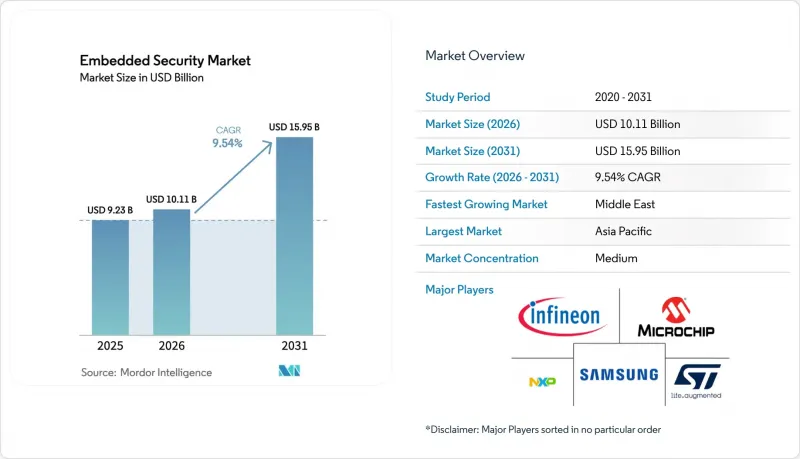
本報告按組件類型(硬體、軟體、服務)、應用(支付、身份驗證、內容保護等)、終端用戶產業(汽車、醫療、家用電子電器、電信、航太與國防等)、部署模式(本地部署、雲端部署)和地區(北美、歐洲等)進行細分。市場預測以美元計價。
全球嵌入式安全市場趨勢與洞察
汽車電子控制單元(ECU)的快速電氣化和高級駕駛輔助系統(ADAS)的普及
電池式電動車平台整合多達 100 個電控系統(ECU),每個 ECU 都必須支援安全啟動、加密韌體更新和經認證的空中下載 (OTA) 修補程式。隨著一級供應商將 AURIX TC4x 裝置整合到電池管理和分區架構中,英飛凌的汽車安全控制器年銷售額成長了 18%。諸如特斯拉的「硬體 4」之類的集中式運算設計聚合了加密處理工作負載,提高了每輛車半導體的附加價值。高級駕駛輔助 (ADAS) 感測器透過乙太網路骨幹網路交換安全關鍵數據,促使原始設備製造商 (OEM) 部署帶有入侵偵測韌體的安全閘道。 Stellantis 和義法半導體 (STMicroelectronics) 正在共同開發整合專用安全元件的 V2G(車網互動)模組,展示了雙向充電如何將安全性擴展到車輛之外。
EMVCo對非接觸式支付系統(包括銀行卡和POS終端)的要求
EMVCo 的非接觸式核心 3.0 要求自 2025 年 1 月起出貨的新支付終端必須實施中繼繼電器緩解和生物識別,這就要求採用具有 NFC 控制器的雙介面安全元件。據萬事達卡稱,非接觸式支付在歐洲的普及率為 78%,在亞太地區為 65%,但在北美仍僅為 42%,因此需要進行硬體升級。 PCI PTS 7.0 也加強了對實體篡改的監管,迫使終端供應商從通用處理器遷移到經過認證的安全晶片。受印度 RuPay 卡的推出和 Pix 在巴西的擴張推動,恩智浦 (NXP) 的安全支付 IC 銷售額環比成長 12%。嵌入式安全元件也是支援 eSIM 的智慧型手機中令牌化錢包的基礎,預計到 2024 年,該領域的出貨量將達到 12 億顆。
在對成本高度敏感的物聯網領域,與通用微控制器相比,平均售價 (ASP) 存在較大差距。
安全型微控制器 (MCU) 的價格在 1.50 美元至 3 美元之間,而通用型微控制器的價格僅為 0.30 美元至 0.50 美元,這種價格差距正在擠壓消費物聯網的毛利率。儘管整合了 Arm TrustZone 的 STM32L5 和 STM32U5 裝置已經上市,但搭載率仍然低於 25%。此外,它們的高靜態電流會使電池壽命縮短高達 30%。 Microchip 的 PIC32CM LS00(售價 0.85 美元)縮小了這一差距,但仍需要產品重新認證。
細分市場分析
到2025年,硬體領域的嵌入式安全市場將佔總收入的近一半,但隨著企業面臨長達12-18個月的通用準則評估,服務領域的成長速度更快。儘管在成熟的支付和SIM卡領域,硬體利潤率受到壓縮,但後量子時代的安全元件和TPM仍然保持著強勁的絕對收入。靜態分析工具和金鑰管理中介軟體等軟體工具正在填補過去承包韌體所佔據的空白,使OEM廠商能夠保留其智慧財產權。
服務的成長反映了側通道專家和認證評估人員的短缺,導致諮詢費用超過每天 2000 美元。泰雷茲、蘭布斯和新思科技等公司目前正將生命週期管理、認證文件和安全審計整合到常規軟體包中,模糊了晶片銷售和訂閱之間的界限。隨著平台即服務 (PaaS) 產品的成熟,將晶片、韌體和雲端儀表板捆綁到單一合約中的混合收入模式在嵌入式安全市場中日益普遍。
支付產業將持續引領嵌入式安全市場,預計到2025年將佔銷售額的36.64%。同時,由於強制採用密碼金鑰作為防範網路釣魚的措施,身分驗證產業正保持兩位數的成長動能。各國政府和網路保險公司正採取日益嚴格的措施打擊單因素身份驗證登錄,促使企業採用FIDO2硬體符記和設備關聯密鑰。隨著各大工作室轉向可信任執行環境(TEE)中的軟體多DRM技術,內容保護硬體的需求趨於穩定,而傳統機上盒的需求則在下降。
雲端服務提供者要求管理主機使用通行金鑰,以及醫療改革要求對電子健康記錄進行多因素身份驗證訪問,這些因素正在進一步加速身份驗證市場的成長。這種轉變與能夠儲存傳統金鑰和基於網格的金鑰的硬體產生了協同效應,從而提升了面向未來的投資價值。因此,預計到本十年末,與身分驗證相關的嵌入式安全市場規模將縮小與支付市場的差距,尤其是在非接觸式支付普及率較低的地區。
區域分析
預計到2025年,亞太地區將佔嵌入式安全市場收入的40.42%。台灣和韓國為安全元件提供尖端晶圓,而中國的多層保護方案(MLPS)強制使用國產加密智慧財產權,從而提振了本地需求。儘管市場規模龐大,但隨著智慧型手機和支付卡的普及日趨成熟,亞太地區的成長速度正在放緩,導致新增銷售量下降。
中東地區是成長最快的地區,複合年成長率高達11.52%,這主要得益於沙烏地阿拉伯價值超過5億美元的NEOM智慧城市專案合約以及阿拉伯聯合大公國強制要求關鍵基礎設施硬體加密的網路安全法規。相關項目涵蓋智慧電網、自動駕駛交通和國家識別系統等領域,從而催生了對工業、消費和公共設備安全元件的需求。
北美和歐洲合計約佔總銷售額的45%。儘管由於汽車和支付生態系統的成熟,這兩個地區的成長速度有所放緩,但它們在後量子技術先導計畫和工業IoT維修發揮著主導作用。歐洲的《網路彈性法案》強制要求整合安全元件,但其對亞洲晶圓廠的依賴使其面臨地緣政治風險。在美國,國防法規限制採購範圍,只能從國防部授權的晶圓代工廠採購,導致供應緊張,但來源透明度得到了保證。南美洲和非洲市場仍處於起步階段。巴西的Pix支付和奈及利亞的央行數位貨幣eNaira提供了局部機遇,但它們的規模尚不足以改變全球排名。
其他好處:
- Excel格式的市場預測(ME)表
- 3個月的分析師支持
目錄
第1章:引言
- 研究假設和市場定義
- 調查範圍
第2章:調查方法
第3章執行摘要
第4章 市場狀況
- 市場概覽
- 市場促進因素
- 汽車電子控制單元(ECU)的快速電氣化和高級駕駛輔助系統(ADAS)的普及
- EMVCo 強制要求銀行卡和 POS 終端使用非接觸式支付。
- 物聯網邊緣節點在智慧家庭和工業領域的擴展
- 後量子密碼技術過渡藍圖:面向長壽命控制器
- 歐盟網路彈性法案強制要求建立基於硬體的信任基礎
- 數位電池護照催生了對安全元件的需求。
- 市場限制因素
- 通用微控制器與對成本敏感的物聯網設備之間的平均售價 (ASP) 有顯著差異。
- 行業特定標準差異(GlobalPlatform 與 TCG)
- 供應鏈中的「幽靈晶圓代工廠」風險限制了合格的供應來源。
- 缺乏安全元件韌體檢驗所需的技能
- 產業價值鏈分析
- 監理情勢
- 技術展望
- 波特五力分析
- 宏觀經濟因素對市場的影響
- 關鍵績效指標
第5章 市場規模與成長預測
- 依組件類型
- 硬體
- 軟體
- 服務
- 透過使用
- 沉澱
- 認證
- 內容保護
- 其他用途
- 按最終用戶行業分類
- 車
- 衛生保健
- 家用電子產品
- 電訊
- 航太/國防
- 其他終端用戶產業
- 不同的發展
- 現場
- 雲
- 按地區
- 北美洲
- 美國
- 加拿大
- 墨西哥
- 南美洲
- 巴西
- 阿根廷
- 其他南美國家
- 歐洲
- 德國
- 英國
- 法國
- 義大利
- 西班牙
- 俄羅斯
- 其他歐洲國家
- 亞太地區
- 中國
- 日本
- 印度
- 韓國
- 澳洲
- 其他亞太國家
- 中東
- 沙烏地阿拉伯
- 阿拉伯聯合大公國
- 土耳其
- 其他中東國家
- 非洲
- 奈及利亞
- 埃及
- 其他非洲國家
- 北美洲
第6章 競爭情勢
- 市場集中度
- 策略趨勢
- 市佔率分析
- 公司簡介
- Infineon Technologies AG
- NXP Semiconductors NV
- STMicroelectronics NV
- Microchip Technology Inc.
- Samsung Electronics Co.
- Texas Instruments Inc.
- Renesas Electronics Corp.
- Qualcomm Inc.
- Broadcom Inc.
- Lattice Semiconductor Corp.
- Synopsys Inc.
- Arm Ltd.
- Rambus Inc.
- Verimatrix SA
- Thales Group
- G+D Mobile Security GmbH
- Idemia Group
- Karamba Security Ltd.
- Trillium Secure Inc.
- ESCRYPT GmbH
- Sectigo Ltd.
- Mocana Corp.
- Intellias Ltd.
- Winbond Electronics Corp.
- Nuvoton Technology Corp.
- IAR Systems AB
- Secure-IC SA
- PQShield Ltd.
第7章 市場機會與未來展望
According to Mordor Intelligence, the embedded security market size is projected to expand from USD 9.23 billion in 2025 and USD 10.11 billion in 2026 to USD 15.95 billion by 2031, registering a CAGR of 9.54% between 2026 to 2031.
This report is Segmented by Component Type (Hardware, Software, and Services), Application (Payment, Authentication, Content Protection, and More), End-User Industry (Automotive, Healthcare, Consumer Electronics, Telecommunications, Aerospace and Defense, and More), Deployment (On-Premises, and Cloud), and Geography (North America, Europe, and More). The Market Forecasts are Provided in Terms of Value (USD).
Global Embedded Security Market Trends and Insights
Rapid Electrification And ADAS Adoption In Automotive ECUs
Battery-electric platforms integrate up to 100 electronic control units, each obligated to support secure boot, encrypted firmware updates, and authenticated over-the-air patches. Infineon confirmed 18% annual growth in automotive security-controller revenue as Tier-1 suppliers embed AURIX TC4x devices in battery-management and zonal architectures. Centralized compute designs such as Tesla's Hardware 4 concentrate cryptographic workloads, lifting per-vehicle silicon value. Advanced driver-assistance sensors exchange safety-critical data over Ethernet backbones, so OEMs insert secure gateways with intrusion-detection firmware. Stellantis and STMicroelectronics are co-developing vehicle-to-grid modules that embed dedicated secure elements, signaling how bidirectional charging extends security beyond the cabin.
EMVCo Contactless Payment Mandates For Cards And POS Terminals
EMVCo's Contactless Kernel 3.0 forces new payment terminals shipped after January 2025 to implement relay-attack mitigation and biometric verification, compelling dual-interface secure elements with NFC controllers. Mastercard reported 78% contactless penetration in Europe and 65% in Asia Pacific, leaving North America at 42% and primed for hardware refresh. PCI PTS 7.0 simultaneously tightens physical-tamper rules, pushing terminal vendors from generic processors toward certified secure chips. NXP saw a 12% sequential lift in secure-payment IC revenue on India's RuPay card roll-out and Brazil's Pix expansion. Embedded secure elements also power tokenized wallets in eSIM-enabled smartphones, a segment that shipped 1.2 billion units in 2024.
High ASP Gap Versus Commodity Microcontrollers In Cost-Sensitive IoT
Secure MCUs cost USD 1.50-3.00 compared with USD 0.30-0.50 generic parts, a premium that squeezes consumer-IoT gross margins. Attach rates stay below 25% in smart-home accessories despite available STM32L5 and STM32U5 devices that integrate Arm TrustZone. Higher quiescent current also shortens battery life by up to 30%. Microchip's PIC32CM LS00, priced at USD 0.85, narrows the gap but still forces product re-certification.
Other drivers and restraints analyzed in the detailed report include:
- Expanding IoT Edge Nodes In Smart-Home And Industrial Settings
- Post-Quantum-Crypto Migration Roadmaps For Long-Life Controllers
- Fragmented Standards Across Verticals
For complete list of drivers and restraints, kindly check the Table Of Contents.
Segment Analysis
The embedded security market size for hardware reached nearly half of total revenue in 2025, yet services are rising faster as organizations confront 12- to 18-month Common Criteria evaluations. Hardware margins compress in mature payment and SIM segments, while post-quantum-ready secure elements and TPMs keep absolute revenue solid. Software tools, such as static analyzers and key-management middleware, close gaps that once favored turnkey firmware and empower OEMs to retain intellectual property.
Services growth reflects a scarcity of side-channel experts and certified evaluators, driving consulting day rates above USD 2,000. Thales, Rambus, and Synopsys now wrap lifecycle management, certification artifacts, and security audits into recurring packages, blurring the line between silicon sale and subscription. As platform-as-a-service offerings mature, the embedded security market welcomes more hybrid revenue models that bundle chips, firmware, and cloud dashboards in a single contract.
Payment still leads the embedded security market with a 36.64% slice of revenue in 2025, but authentication posts a double-digit growth trajectory supported by phishing-resistant passkey mandates. Governments and cyber-insurers increasingly penalize single-factor logins, prompting enterprises to adopt FIDO2 hardware tokens and device-bound keys. Content-protection hardware stabilizes as studios pivot to software-based multi-DRM inside trusted execution environments, trimming demand for legacy set-top boxes.
Authentication's ascent is amplified by cloud providers that require passkeys for administrative consoles and by healthcare reforms that call for multi-factor access to electronic health records. The shift aligns with hardware that can store both classical and lattice-based keys, future-proofing investment. As a result, the embedded security market size tied to authentication is set to narrow the gap with payment by the end of the decade, particularly in regions that lag in contactless penetration.
Complete Report Scope:
- By Component Type
- Hardware
- Software
- Services
- By Application
- Payment
- Authentication
- Content Protection
- Other Applications
- By End-User Industry
- Automotive
- Healthcare
- Consumer Electronics
- Telecommunications
- Aerospace and Defense
- Other End-User Industries
- By Deployment
- On-Premise
- Cloud
- By Geography
- North America
- United States
- Canada
- Mexico
- South America
- Brazil
- Argentina
- Rest of South America
- Europe
- Germany
- United Kingdom
- France
- Italy
- Spain
- Russia
- Rest of Europe
- Asia Pacific
- China
- Japan
- India
- South Korea
- Australia
- Rest of Asia Pacific
- Middle East
- Saudi Arabia
- United Arab Emirates
- Turkey
- Rest of Middle East
- Africa
- Nigeria
- Egypt
- Rest of Africa
- North America
Geography Analysis
Asia Pacific controlled 40.42% of embedded security market revenue in 2025. Taiwan and South Korea supply leading-edge secure-element wafers, while China's Multi-Level Protection Scheme forces domestic cryptographic IP, lifting local demand. Despite its size, the region's growth moderates as mature smartphone and payment-card penetration reduces incremental volume.
The Middle East is the fastest-growing geography at 11.52% CAGR, fueled by Saudi Arabia's NEOM smart-city contracts exceeding USD 500 million and the UAE Cybersecurity Decree that mandates hardware encryption for critical infrastructure. Projects span smart grids, autonomous transit, and national identity layers, creating a pipeline for secure elements across industrial, consumer, and civic devices.
North America and Europe jointly contribute roughly 45% of revenue. Both regions face slower growth due to mature automotive and payment ecosystems, but they lead post-quantum pilots and industrial-IoT retrofits. Europe's Cyber Resilience Act forces secure-element integration yet depends on Asian fabs for supply, exposing geopolitical risk. In the United States, defense restrictions confine sourcing to DMEA-trusted foundries, tightening supply but ensuring provenance. South America and Africa remain early-stage markets; Brazil's Pix payment and Nigeria's eNaira CBDC offer pockets of opportunity yet lack scale to shift global rankings.
- Infineon Technologies AG
- NXP Semiconductors NV
- STMicroelectronics NV
- Microchip Technology Inc.
- Samsung Electronics Co.
- Texas Instruments Inc.
- Renesas Electronics Corp.
- Qualcomm Inc.
- Broadcom Inc.
- Lattice Semiconductor Corp.
- Synopsys Inc.
- Arm Ltd.
- Rambus Inc.
- Verimatrix SA
- Thales Group
- G+D Mobile Security GmbH
- Idemia Group
- Karamba Security Ltd.
- Trillium Secure Inc.
- ESCRYPT GmbH
- Sectigo Ltd.
- Mocana Corp.
- Intellias Ltd.
- Winbond Electronics Corp.
- Nuvoton Technology Corp.
- IAR Systems AB
- Secure-IC SA
- PQShield Ltd.
Additional Benefits:
- The market estimate (ME) sheet in Excel format
- 3 months of analyst support
TABLE OF CONTENTS
1 INTRODUCTION
- 1.1 Study Assumptions and Market Definition
- 1.2 Scope of the Study
2 RESEARCH METHODOLOGY
3 EXECUTIVE SUMMARY
4 MARKET LANDSCAPE
- 4.1 Market Overview
- 4.2 Market Drivers
- 4.2.1 Rapid Electrification and ADAS Adoption in Automotive ECUs
- 4.2.2 EMVCo Contactless Payment Mandates for Cards and POS Terminals
- 4.2.3 Expanding IoT Edge Nodes in Smart-Home and Industrial Settings
- 4.2.4 Post-Quantum-Crypto Migration Roadmaps for Long-Life Controllers
- 4.2.5 EU Cyber-Resilience Act Requiring Hardware Roots of Trust
- 4.2.6 Digital Battery Passports Creating Secure-Element Demand
- 4.3 Market Restraints
- 4.3.1 High ASP Gap Versus Commodity Microcontrollers in Cost-Sensitive IoT
- 4.3.2 Fragmented Standards Across Verticals (GlobalPlatform vs. TCG)
- 4.3.3 Supply-Chain "Ghost-Foundry" Risk Limiting Qualified Sources
- 4.3.4 Shortage of Secure-Element Firmware Verification Skill Sets
- 4.4 Industry Value Chain Analysis
- 4.5 Regulatory Landscape
- 4.6 Technological Outlook
- 4.7 Porter's Five Forces Analysis
- 4.7.1 Threat of New Entrants
- 4.7.2 Bargaining Power of Buyers
- 4.7.3 Bargaining Power of Suppliers
- 4.7.4 Threat of Substitutes
- 4.7.5 Intensity of Competitive Rivalry
- 4.8 Impact of Macroeconomic Factors on the Market
- 4.9 Key Performance Indicators
5 MARKET SIZE AND GROWTH FORECASTS (VALUE)
- 5.1 By Component Type
- 5.1.1 Hardware
- 5.1.2 Software
- 5.1.3 Services
- 5.2 By Application
- 5.2.1 Payment
- 5.2.2 Authentication
- 5.2.3 Content Protection
- 5.2.4 Other Applications
- 5.3 By End-User Industry
- 5.3.1 Automotive
- 5.3.2 Healthcare
- 5.3.3 Consumer Electronics
- 5.3.4 Telecommunications
- 5.3.5 Aerospace and Defense
- 5.3.6 Other End-User Industries
- 5.4 By Deployment
- 5.4.1 On-Premise
- 5.4.2 Cloud
- 5.5 By Geography
- 5.5.1 North America
- 5.5.1.1 United States
- 5.5.1.2 Canada
- 5.5.1.3 Mexico
- 5.5.2 South America
- 5.5.2.1 Brazil
- 5.5.2.2 Argentina
- 5.5.2.3 Rest of South America
- 5.5.3 Europe
- 5.5.3.1 Germany
- 5.5.3.2 United Kingdom
- 5.5.3.3 France
- 5.5.3.4 Italy
- 5.5.3.5 Spain
- 5.5.3.6 Russia
- 5.5.3.7 Rest of Europe
- 5.5.4 Asia Pacific
- 5.5.4.1 China
- 5.5.4.2 Japan
- 5.5.4.3 India
- 5.5.4.4 South Korea
- 5.5.4.5 Australia
- 5.5.4.6 Rest of Asia Pacific
- 5.5.5 Middle East
- 5.5.5.1 Saudi Arabia
- 5.5.5.2 United Arab Emirates
- 5.5.5.3 Turkey
- 5.5.5.4 Rest of Middle East
- 5.5.6 Africa
- 5.5.6.1 Nigeria
- 5.5.6.2 Egypt
- 5.5.6.3 Rest of Africa
- 5.5.1 North America
6 COMPETITIVE LANDSCAPE
- 6.1 Market Concentration
- 6.2 Strategic Moves
- 6.3 Market Share Analysis
- 6.4 Company Profiles (includes Global Level Overview, Market Level Overview, Core Segments, Financials as Available, Strategic Information, Market Rank/Share for Key Companies, Products and Services, and Recent Developments)
- 6.4.1 Infineon Technologies AG
- 6.4.2 NXP Semiconductors NV
- 6.4.3 STMicroelectronics NV
- 6.4.4 Microchip Technology Inc.
- 6.4.5 Samsung Electronics Co.
- 6.4.6 Texas Instruments Inc.
- 6.4.7 Renesas Electronics Corp.
- 6.4.8 Qualcomm Inc.
- 6.4.9 Broadcom Inc.
- 6.4.10 Lattice Semiconductor Corp.
- 6.4.11 Synopsys Inc.
- 6.4.12 Arm Ltd.
- 6.4.13 Rambus Inc.
- 6.4.14 Verimatrix SA
- 6.4.15 Thales Group
- 6.4.16 G+D Mobile Security GmbH
- 6.4.17 Idemia Group
- 6.4.18 Karamba Security Ltd.
- 6.4.19 Trillium Secure Inc.
- 6.4.20 ESCRYPT GmbH
- 6.4.21 Sectigo Ltd.
- 6.4.22 Mocana Corp.
- 6.4.23 Intellias Ltd.
- 6.4.24 Winbond Electronics Corp.
- 6.4.25 Nuvoton Technology Corp.
- 6.4.26 IAR Systems AB
- 6.4.27 Secure-IC SA
- 6.4.28 PQShield Ltd.
7 MARKET OPPORTUNITIES AND FUTURE OUTLOOK
- 7.1 White-Space and Unmet-Need Assessment

 嵌入式安全市場-策略分析與預測(2026-2031年)
 OTT串流內容保護:市場佔有率分析、產業趨勢與統計、成長預測(2026-2031年)可信任執行環境 (TEE) 管理:市場佔有率分析、產業趨勢與統計資料、成長預測 (2026-2031)
 數位認證和嵌入式安全數位認證和嵌入式安全市場數據概覽:2026年第三季度
 嵌入式安全市場:依安全類型、設備類型、連接技術、管理架構和應用分類-2026-2032年全球市場預測TPM(可信任平台模組):市場佔有率分析、行業趨勢和統計數據、成長預測(2026-2031 年)
 物聯網嵌入式安全市場:按組件、應用、最終用戶和地區分類
 2026年全球人工智慧可信任執行市場報告
 物聯網嵌入式安全市場規模、佔有率和成長分析:按組件、部署模式、組織規模、應用、產業和地區分類-2026-2033年產業預測