


 |
市場調查報告書
商品編碼
2062031
TPM(可信任平台模組):市場佔有率分析、行業趨勢和統計數據、成長預測(2026-2031 年)Trusted Platform Module (TPM) - Market Share Analysis, Industry Trends & Statistics, Growth Forecasts (2026 - 2031) |
||||||

※ 本網頁內容可能與最新版本有所差異。詳細情況請與我們聯繫。
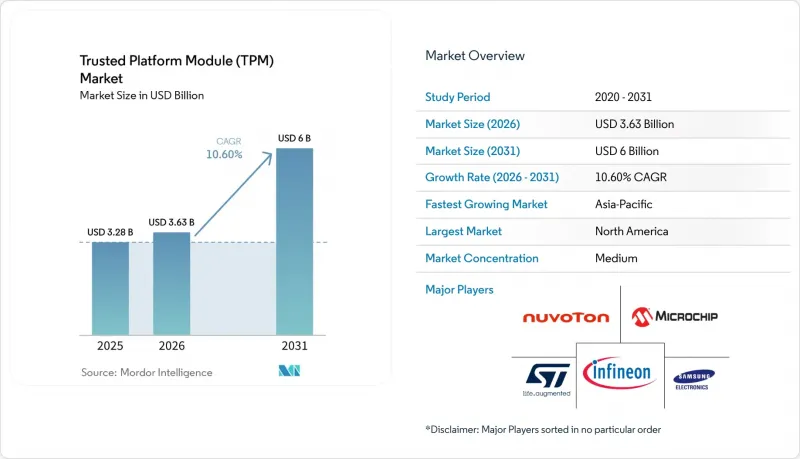
據 Mordor Intelligence 稱,2025 年可信任平台模組 (TPM) 市值為 32.8 億美元,預計到 2031 年將達到 60 億美元,而 2026 年市場價值為 36.3 億美元,預測期(2026-2031 年)的複合年成長率為 10.60%。
本報告按TPM類型(例如離散TPM (dTPM))、主機介面(SPI/ESPI、I2C/I3C、LPC等)、終端設備(桌上型電腦和筆記型電腦、伺服器和資料中心平台、物聯網和嵌入式系統、汽車電子等)、產業(IT和電信、銀行、金融服務和保險、醫療和生命科學等)以及醫療和生命科學等)以及地區進行細分。市場預測以美元為單位。
全球可信任平台模組 (TPM) 市場趨勢與洞察
桌面伺服器中基於硬體的「信任根」的普及應用日益廣泛
隨著基於硬體的信任基礎從可選升級轉變為強制性安全層,對可信任平台模組 (TPM) 的需求日益成長。微軟將 TPM 2.0 定位為 Windows 11 安全防護的核心,包括 BitLocker、Windows Hello 企業版和基於虛擬化的安全功能。如今,這種信任基礎正擴展到整合 Microsoft Pluton 到最新處理器系列的新型客戶端平台,將硬體支援的身份更深地嵌入到標準設備架構中。網路基礎設施領域也出現了類似的趨勢,IETF RFC 9683 正式定義了配備 TPM 的路由器、交換器和防火牆的遠端完整性檢驗工作流程。這使得市場服務範圍從傳統 PC 擴展到伺服器、網路設備和雲端基礎設施。
Windows 11 升級週期中的 TPM 2.0 需求
Windows 10 停止支援直接推動了 TPM 市場從作業系統遷移中獲益。微軟繼續將 TPM 2.0 定位為 Windows 11 的強制安全要求。這項標準迫使企業提前評估已部署的設備,因為不符合此要求的設備在長期服務週期內將難以保持正常運作。該要求強化了更廣泛的終端安全架構,將 TPM 2.0 與安全啟動、UEFI、設備 ID 和度量啟動過程連結起來。因此,整個市場的軟體遷移已呈現硬體採購的趨勢。
45nm及更早可信代晶圓代工廠節點的供應鏈不穩定。
成熟製程節點的供應緊張仍然是TPM市場面臨的直接瓶頸。分立式TPM設計依賴40-90nm工藝,在這些工藝中,防篡改、屏蔽和側通道保護比密度提升更為重要。由於此類產品系列通常設計用於長壽命和嚴苛的工作環境,因此供應商在不影響認證和生命週期承諾的情況下,向新製造流程過渡的速度受到限制。安全認證和平台級檢驗也會延緩供應商的變更,使擁有豐富製造和合規經驗的現有供應商更具優勢。因此,即使需求強勁,認證節點的供應中斷也可能限制短期市場擴張。
細分市場分析
到2025年,獨立式TPM將佔據可信任平台模組(TPM)市場48.8%的佔有率,這表明企業和政府買家仍然優先考慮密鑰儲存中的實體隔離和可靠性檢驗。在防篡改封裝、獨立電源域和認證深度直接影響採購決策的系統中,獨立式TPM的地位仍然穩固。整合式TPM和韌體TPM解決方案在PC和行動平台中日益普及,因為它們無需額外組件即可增加安全功能。這迫使獨立式TPM供應商不僅要在基本供給能力上競爭,還要在認證記錄、供應鏈可追溯性和長期生命週期支援方面展開競爭。
虛擬TPM (vTPM) 預計將在2026年至2031年間以12.8%的複合年成長率成長,成為TPM市場中成長最快的格式。隨著軟體信任管理在這些環境中的擴展速度遠超新型獨立硬體,vTPM和fTPM在雲端環境和邊緣AI系統的應用也日益廣泛。基於ARM的嵌入式架構研究表明,韌體主導的信任模型中已存在後量子認證路徑。 wolfSSL於2026年5月發布的韌體TPM支援ML-DSA和ML-KEM,展示了在原生PQC晶片廣泛應用之前,供應商如何滿足這些需求。
預計到2025年,SPI/eSPI將維持46.7%的市場佔有率,這反映了其在商用PC和工業嵌入式系統中的廣泛應用。這種廣泛的採用確保了此介面的重要性,即使新的平台設計傾向於更高吞吐量的連接。 LPC也持續支援重要的傳統基礎設施,但隨著伺服器和資料中心架構逐漸拋棄舊式匯流排設計,其角色正在減弱。在可信任平台模組(TPM)市場,主機介面的選擇以及純粹的安全功能正日益影響供應商的選擇、認證流程和續約時間。
預計從2026年到2031年,PCIe/USB的複合年成長率將達到13.7%,這表明現代伺服器基礎設施設計中將出現廣泛的平台遷移。這項變更意義重大,因為介面遷移通常需要系統級的重新認證,這為供應商提供了適應新架構的採購機會。 I2C和I3C在汽車和物聯網應用領域也正在獲得市場佔有率,在這些領域,減少引腳數量至關重要,而I3C則為下一代控制和認證工作負載提供了高吞吐量。意法半導體(STMicroelectronics)透過其ST33KTPM系列產品滿足了這些需求,該系列產品提供SPI或I2C選項,並通過了FIPS 140-3和通用準則EAL4+認證,並擁有工業級版本,動作溫度範圍為-40 度C至105 度C ,產品壽命長達20年。
區域分析
預計到2025年,北美將佔據可信任平台模組(TPM)市場38.2%的佔有率,成為最大的區域貢獻者。美國仍然是核心市場參與者,由於聯邦採購要求、雲端保障需求和企業安全標準,對認證晶片的需求保持穩定。超大規模資料中心的密集分佈也推動了TPM市場伺服器端部署的擴張。加拿大雖然規模較小,但透過數位政府專案和金融業的安全要求,也扮演著重要的角色。北美對可信任供應商的偏好有助於維持認證獨立TPM供應商的定價權。
預計亞太地區在2026年至2031年間將以12.4%的複合年成長率成長,成為可信任平台模組(TPM)市場成長最快的區域市場。日本、韓國、中國和印度都在積極發展汽車、半導體和連網型設備領域,為此加速成長做出了貢獻。中國對GB 44495標準的採用,正在擴大全部區域對安全汽車電子產品的合規性需求。在韓國,這一趨勢正在蔓延,BOS Semiconductors公司將Rambus安全IP整合到其採用三星5nm製程製造的Eagle-N汽車AI加速器中,該IP支援認證啟動和受保護的空中下載(OTA)更新。此外,可信任運算組織(TCG)日本區域論壇也表明,亞太地區的標準化工作正在日趨成熟,足以支援在整個生態系統中更廣泛地部署。
歐洲是第二大區域市場,其中德國、英國和法國是主要需求中心。 Windows 11 的遷移要求和歐盟《網路彈性法案》進一步推動了企業和產品安全用例中認證硬體信任根的普及。南美、中東和非洲仍處於早期應用階段,部署主要集中在政府、國防和通訊項目,而非大規模企業更新周期。儘管這些地區目前的規模較小,但由於基礎設施數位化和國家層級網路安全投資的增加,可信任平台模組 (TPM) 市場的角色預計將在未來擴大。
其他好處:
- Excel格式的市場預測(ME)表
- 3個月的分析師支持
目錄
第1章:引言
- 市場分析與定義的前提條件
- 分析範圍
第2章 分析方法
第3章執行摘要
第4章 市場狀況
- 市場概覽
- 市場促進因素
- 桌面伺服器中基於硬體的信任根的普及應用
- Windows 11 升級週期中的 TPM 2.0 需求
- 網路保險保費的上漲正在推動對經過認證的安全元件的需求。
- 符合 UNECE R155/R156 標準可加速汽車應用領域安全 ECU 的普及。
- 邊緣人工智慧推理平台需要硬體安全來保護模型智慧財產權
- 開發量子容錯韌體的努力正在推動下一代 TPM 的更新。
- 市場限制因素
- 45奈米及更早製程節點可靠晶圓代工廠環節的供應鏈波動
- 在注重成本的物聯網節點中採用輕量級加密替代方案
- 雲端運算、邊緣運算和汽車行業的認證標準分散。
- 一種新的零信任架構,減少了對本地TPM的依賴。
- 產業價值鏈分析
- 監理情勢
- 技術展望
- 宏觀經濟因素對市場的影響
- 波特五力分析
第5章:預測市場規模與成長率
- 按類型分類的TPM
- 離散式TPM(dTPM)
- 整合式TPM(iTPM/平台信任技術)
- 韌體TPM(fTPM)
- 虛擬TPM(vTPM/軟體)
- 透過主機介面
- SPI/eSPI
- I2C/I3C
- LPC
- PCIe/USB
- 按最終用途設備
- 桌上型電腦和筆記型電腦
- 伺服器資料中心平台
- 物聯網與嵌入式系統
- 汽車電子
- 工業控制與自動化
- 行動和消費設備
- 其他終端設備類別
- 按行業
- 資訊科技/通訊
- 銀行、金融服務和保險業 (BFSI)
- 醫學與生命科學
- 政府/國防
- 零售和商業
- 其他工業部門
- 按地區
- 北美洲
- 美國
- 加拿大
- 其他北美國家
- 南美洲
- 巴西
- 阿根廷
- 其他南美國家
- 歐洲
- 德國
- 英國
- 法國
- 義大利
- 其他歐洲國家
- 亞太地區
- 中國
- 日本
- 韓國
- 印度
- 其他亞太國家
- 中東
- 沙烏地阿拉伯
- 阿拉伯聯合大公國
- 其他中東國家
- 非洲
- 南非
- 奈及利亞
- 其他非洲國家
- 北美洲
第6章 競爭情勢
- 市場集中度
- 策略趨勢
- 市佔率分析
- 公司簡介
- Infineon Technologies AG
- Nuvoton Technology Corp.
- STMicroelectronics NV
- Microchip Technology Inc.
- Samsung Electronics Co. Ltd.
- Renesas Electronics Corp.
- Texas Instruments Inc.
- Intel Corp.
- Advanced Micro Devices Inc.
- Marvell Technology Inc.
- Broadcom Inc.
- Winbond Electronics Corp.
- IBM Corp.
- Cisco Systems Inc.
- Dell Technologies Inc.
- Hewlett Packard Enterprise Co.
- Lenovo Group Ltd.
- Google LLC
- Microsoft Corp.
- Huawei Technologies Co. Ltd.
第7章 市場機會與未來展望
According to Mordor Intelligence, the trusted platform module (TPM) market size was valued at USD 3.28 billion in 2025 and estimated to grow from USD 3.63 billion in 2026 to reach USD 6.00 billion by 2031, at a CAGR of 10.60% during the forecast period (2026-2031).
This report is Segmented by TPM Type (Discrete TPM (dTPM), and More), Host-Interface (SPI/ESPI, I2C/I3C, LPC, and More), End-Use Device (PCs and Laptops, Servers and Data-Center Platforms, Iot and Embedded Systems, Automotive Electronics, and More), Industry Vertical (IT and Telecom, BFSI, Healthcare and Life Sciences, and More), and Geography. The Market Forecasts are Provided in Terms of Value (USD).
Global Trusted Platform Module (TPM) Market Trends and Insights
Growing Adoption of Hardware-Based Root of Trust in PCs and Servers
Demand in the Trusted Platform Module (TPM) market has strengthened as the hardware root of trust has shifted from an optional upgrade to a required security layer. Microsoft places TPM 2.0 at the center of Windows 11's protections, including BitLocker, Windows Hello for Business, and virtualization-based security.That same trust anchor now extends to newer client platforms that integrate Microsoft Pluton into modern processor families, moving hardware-backed identity deeper into standard device architecture. Network infrastructure is also adopting this pattern, as IETF RFC 9683 formalized remote integrity verification workflows for routers, switches, and firewalls that contain TPMs.This expands the market's serviceable base beyond traditional PCs into servers, networking equipment, and cloud infrastructure.
Mandatory TPM 2.0 Requirement for Windows 11 Upgrade Cycle
The Windows 10 support deadline turned the TPM market into a direct beneficiary of operating system migration. Microsoft continues to treat TPM 2.0 as a non-negotiable security requirement in Windows 11. That baseline forces enterprises to assess their installed fleets earlier than planned, because devices that cannot meet the requirement become harder to keep in place over long service cycles. The same expectation reinforces a broader endpoint security stack that links TPM 2.0 with secure boot, UEFI, device identity, and measured startup processes. The result is that a software transition now behaves like a hardware procurement event across the market.
Supply Chain Volatility for 45 Nm and Older Trusted Foundry Nodes
Supply tightness at mature nodes remains a direct brake on the TPM market. Discrete TPM designs depend on 40-90nm processes where tamper resistance, shielding, and side-channel protection matter more than density gains. Product families in this category are often designed for long life and harsh operating conditions, which limits how quickly vendors can move to new manufacturing paths without affecting qualification and lifecycle commitments. Security certification and platform-level validation also slow down sourcing changes, which favors incumbents with deep manufacturing and compliance experience. As a result, supply disruptions at qualified nodes can limit near-term market expansion even when demand remains firm.
Other drivers and restraints analyzed in the detailed report include:
- Rising Cyber-Insurance Premiums Driving Demand for Certified Secure Elements
- Automotive UNECE R155/R156 Compliance Accelerating Secure ECU Rollouts
- Cost-Sensitive IoT Nodes Opting for Lightweight Crypto Alternatives
For complete list of drivers and restraints, kindly check the Table Of Contents.
Segment Analysis
Discrete TPM held 48.8% of the trusted platform module (TPM) market share in 2025, which shows that enterprise and government buyers still place a premium on physical separation for key storage and trust validation. Its position remains strongest in systems where tamper-resistant packaging, independent power domains, and certification depth directly shape procurement decisions. Integrated TPM and firmware TPM solutions continue to gain presence in PCs and mobile platforms because they add security functions without requiring a separate component. This is pushing discrete suppliers to compete less on basic availability and more on certification history, supply-chain provenance, and long-term lifecycle support.
Virtual TPM is projected to grow at a 12.8% CAGR from 2026 to 2031, making it the fastest-growing format in the TPM market. The industry is also seeing vTPM and fTPM gain traction in cloud environments and edge AI systems, where software-managed trust can scale faster than new discrete hardware. Research on ARM-based embedded architectures already points to post-quantum attestation paths that can be implemented within firmware-led trust models. wolfSSL's May 2026 firmware TPM release with ML-DSA and ML-KEM support shows how vendors are responding to that need before native PQC silicon becomes widely available.
SPI/eSPI retained 46.7% of the market in 2025, reflecting its broad installed base across commercial PCs and embedded industrial systems. That footprint keeps the interface relevant even as newer platform designs favor higher-throughput connections. LPC still supports a meaningful legacy base, but its role is narrowing as server and data-center architectures move away from older bus designs. In the Trusted Platform Module (TPM) market, host-interface selection now affects supplier choice, qualification work, and upgrade timing as much as raw security capability.
PCIe/USB is forecast to grow at a 13.7% CAGR from 2026 to 2031, indicating a broader platform shift in modern server and infrastructure designs. This change matters because interface migration often requires system-level requalification and opens procurement windows for vendors aligned with the new architecture. I2C and I3C are also gaining share in automotive and IoT use cases where lower pin counts matter, and I3C offers higher throughput for next-generation control and attestation workloads. STMicroelectronics addresses these needs through its ST33KTPM family with SPI or I2C options, FIPS 140-3 and Common Criteria EAL4+ certification, and industrial variants rated from -40°C to 105°C with a 20-year product lifetime.
Geography Analysis
North America held 38.2% of the trusted platform module (TPM) market share in 2025, which made it the largest regional contributor. The United States remains the anchor because federal procurement expectations, cloud assurance needs, and enterprise security baselines keep certified silicon in steady demand. A dense concentration of hyperscale data centers also supports stronger server-side deployment across the Trusted Platform Module (TPM) market. Canada adds a smaller but meaningful layer through digital government programs and financial-sector security requirements. North America's preference for trusted sourcing helps preserve pricing power for qualified discrete TPM suppliers.
Asia-Pacific is projected to grow at a 12.4% CAGR from 2026 to 2031, making it the fastest-growing regional segment of the trusted platform module (TPM) market. Japan, South Korea, China, and India are all contributing to this acceleration through stronger automotive, semiconductor, and connected-device activity. China's GB 44495 rollout is widening the compliance pull for secure vehicle electronics across the region. South Korea shows the depth of this movement, with Rambus security IP integrated into BOS Semiconductors' Eagle-N automotive AI accelerator on Samsung's 5nm process for authenticated startup and protected over-the-air updates. The Trusted Computing Group's Japan Regional Forum also shows that standards engagement in Asia-Pacific is mature enough to support broader deployment across the ecosystem.
Europe is the second-largest regional market, with Germany, the United Kingdom, and France as principal demand centers. Windows 11 migration requirements and the EU Cyber Resilience Act are reinforcing the case for certified hardware roots of trust across enterprise and product-security use cases. South America, the Middle East, and Africa remain earlier-stage regions where adoption is concentrated in government, defense, and telecom projects rather than mass enterprise refresh cycles. These regions are still smaller today, but infrastructure digitization and sovereign cybersecurity investment should support a broader role for the Trusted Platform Module (TPM) market over time.
- Infineon Technologies AG
- Nuvoton Technology Corp.
- STMicroelectronics N.V.
- Microchip Technology Inc.
- Samsung Electronics Co. Ltd.
- Renesas Electronics Corp.
- Texas Instruments Inc.
- Intel Corp.
- Advanced Micro Devices Inc.
- Marvell Technology Inc.
- Broadcom Inc.
- Winbond Electronics Corp.
- IBM Corp.
- Cisco Systems Inc.
- Dell Technologies Inc.
- Hewlett Packard Enterprise Co.
- Lenovo Group Ltd.
- Google LLC
- Microsoft Corp.
- Huawei Technologies Co. Ltd.
Additional Benefits:
- The market estimate (ME) sheet in Excel format
- 3 months of analyst support
TABLE OF CONTENTS
1 INTRODUCTION
- 1.1 Study Assumptions and Market Definition
- 1.2 Scope of the Study
2 RESEARCH METHODOLOGY
3 EXECUTIVE SUMMARY
4 MARKET LANDSCAPE
- 4.1 Market Overview
- 4.2 Market Drivers
- 4.2.1 Growing Adoption of Hardware-Based Root of Trust in PCs and Servers
- 4.2.2 Mandatory TPM 2.0 Requirement for Windows 11 Upgrade Cycle
- 4.2.3 Rising Cyber-Insurance Premiums Driving Demand for Certified Secure Elements
- 4.2.4 Automotive UNECE R155/R156 Compliance Accelerating Secure ECU Rollouts
- 4.2.5 Edge AI Inference Platforms Requiring Hardware Security for Model IP Protection
- 4.2.6 Quantum-Resistant Firmware Initiatives Boosting Next-Gen TPM Refresh
- 4.3 Market Restraints
- 4.3.1 Supply Chain Volatility for 45 nm and Older Trusted Foundry Nodes
- 4.3.2 Cost-Sensitive IoT Nodes Opting for Lightweight Crypto Alternatives
- 4.3.3 Fragmented Attestation Standards Across Cloud, Edge, and Automotive Domains
- 4.3.4 Emerging Zero-Trust Architectures Reducing Reliance on Local TPMs
- 4.4 Industry Value Chain Analysis
- 4.5 Regulatory Landscape
- 4.6 Technological Outlook
- 4.7 Impact of Macroeconomic Factors on the Market
- 4.8 Porter's Five Forces Analysis
- 4.8.1 Threat of New Entrants
- 4.8.2 Bargaining Power of Suppliers
- 4.8.3 Bargaining Power of Buyers
- 4.8.4 Threat of Substitutes
- 4.8.5 Degree of Competitive Rivalry
5 MARKET SIZE AND GROWTH FORECASTS
- 5.1 By TPM Type
- 5.1.1 Discrete TPM (dTPM)
- 5.1.2 Integrated TPM (iTPM/Platform Trust Tech)
- 5.1.3 Firmware TPM (fTPM)
- 5.1.4 Virtual TPM (vTPM/Software)
- 5.2 By Host-Interface
- 5.2.1 SPI/eSPI
- 5.2.2 I2C/I3C
- 5.2.3 LPC
- 5.2.4 PCIe/USB
- 5.3 By End-Use Device Category
- 5.3.1 PCs and Laptops
- 5.3.2 Servers and Data-Center Platforms
- 5.3.3 IoT and Embedded Systems
- 5.3.4 Automotive Electronics
- 5.3.5 Industrial Control and Automation
- 5.3.6 Mobile and Consumer Devices
- 5.3.7 Other End-Use Device Categories
- 5.4 By Industry Vertical
- 5.4.1 IT and Telecom
- 5.4.2 BFSI
- 5.4.3 Healthcare and Life Sciences
- 5.4.4 Government and Defense
- 5.4.5 Retail and Commerce
- 5.4.6 Other Industry Verticals
- 5.5 By Geography
- 5.5.1 North America
- 5.5.1.1 United States
- 5.5.1.2 Canada
- 5.5.1.3 Rest of North America
- 5.5.2 South America
- 5.5.2.1 Brazil
- 5.5.2.2 Argentina
- 5.5.2.3 Rest of South America
- 5.5.3 Europe
- 5.5.3.1 Germany
- 5.5.3.2 United Kingdom
- 5.5.3.3 France
- 5.5.3.4 Italy
- 5.5.3.5 Rest of Europe
- 5.5.4 Asia-Pacific
- 5.5.4.1 China
- 5.5.4.2 Japan
- 5.5.4.3 South Korea
- 5.5.4.4 India
- 5.5.4.5 Rest of Asia-Pacific
- 5.5.5 Middle East
- 5.5.5.1 Saudi Arabia
- 5.5.5.2 United Arab Emirates
- 5.5.5.3 Rest of Middle East
- 5.5.6 Africa
- 5.5.6.1 South Africa
- 5.5.6.2 Nigeria
- 5.5.6.3 Rest of Africa
- 5.5.1 North America
6 COMPETITIVE LANDSCAPE
- 6.1 Market Concentration
- 6.2 Strategic Moves
- 6.3 Market Share Analysis
- 6.4 Company Profiles (includes Global Level Overview, Market Level Overview, Core Segments, Financials as available, Strategic Information, Market Rank/Share, Products and Services, Recent Developments)
- 6.4.1 Infineon Technologies AG
- 6.4.2 Nuvoton Technology Corp.
- 6.4.3 STMicroelectronics N.V.
- 6.4.4 Microchip Technology Inc.
- 6.4.5 Samsung Electronics Co. Ltd.
- 6.4.6 Renesas Electronics Corp.
- 6.4.7 Texas Instruments Inc.
- 6.4.8 Intel Corp.
- 6.4.9 Advanced Micro Devices Inc.
- 6.4.10 Marvell Technology Inc.
- 6.4.11 Broadcom Inc.
- 6.4.12 Winbond Electronics Corp.
- 6.4.13 IBM Corp.
- 6.4.14 Cisco Systems Inc.
- 6.4.15 Dell Technologies Inc.
- 6.4.16 Hewlett Packard Enterprise Co.
- 6.4.17 Lenovo Group Ltd.
- 6.4.18 Google LLC
- 6.4.19 Microsoft Corp.
- 6.4.20 Huawei Technologies Co. Ltd.
7 MARKET OPPORTUNITIES and FUTURE OUTLOOK
- 7.1 White-Space and Unmet-Need Assessment

 安全認證晶片市場:全球市場預測,2026-2032年
 嵌入式安全市場-策略分析與預測(2026-2031年)
 嵌入式安全:市場佔有率分析、行業趨勢和統計數據、成長預測(2026-2031 年)OTT串流內容保護:市場佔有率分析、產業趨勢與統計、成長預測(2026-2031年)可信任執行環境 (TEE) 管理:市場佔有率分析、產業趨勢與統計資料、成長預測 (2026-2031)
 數位認證和嵌入式安全數位認證和嵌入式安全市場數據概覽:2026年第三季度嵌入式安全市場:依安全類型、設備類型、連接技術、管理架構和應用分類-2026-2032年全球市場預測
 物聯網嵌入式安全市場:按組件、應用、最終用戶和地區分類
 2026年全球人工智慧可信任執行市場報告