


 |
市場調查報告書
商品編碼
2118188
OTT串流內容保護:市場佔有率分析、產業趨勢與統計、成長預測(2026-2031年)OTT Streaming Content Protection - Market Share Analysis, Industry Trends & Statistics, Growth Forecasts (2026 - 2031) |
||||||

※ 本網頁內容可能與最新版本有所差異。詳細情況請與我們聯繫。
根據 Mordor Intelligence 預測,OTT 串流內容保護市場規模將從 2025 年的 11.3 億美元和 2026 年的 13.3 億美元成長到 2031 年的 27.1 億美元,2026 年至 2031 年的複合年成長率為 15.30%。
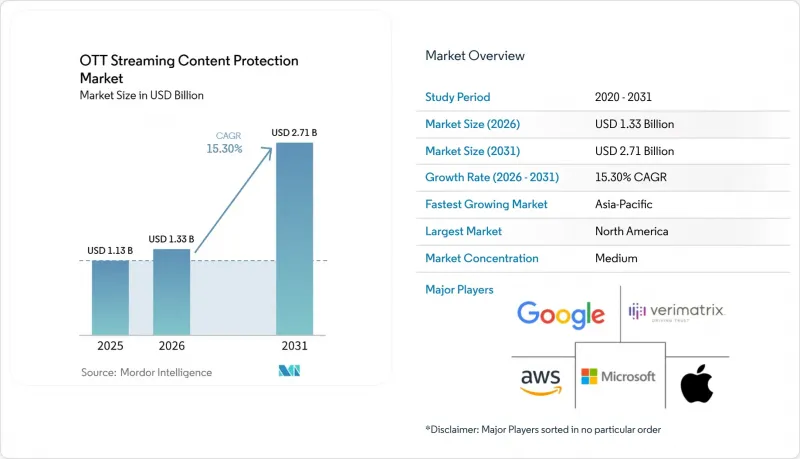
本報告按串流服務模式(定期訂閱收費(SVOD)、按次收費(TVOD/PPV)、混合收費)、應用程式(內容加密和授權、反盜版監控和清除等)、最終用戶(媒體和娛樂公司等)以及地區進行細分。市場預測以美元計價。
全球OTT串流內容保護市場趨勢與洞察
由於盜版和濫用身分驗證憑證的行為日益猖獗,造成了損失。
由於盜版和未經授權的帳戶訪問,內容保護在OTT串流媒體市場正從一項技術功能轉變為商業性優先事項。 Netflix在推出付費帳戶共用功能後,付費用戶數量顯著成長,這表明按家庭設定規則不僅可以限制訪問,還可以促進付費用戶轉換。其他平台可能會將類似的管理功能視為控制存取、保護套餐條款以及獲取新付費用戶的手段。這給中型服務提供者帶來了壓力,他們需要在不引發不必要的客戶申訴的情況下,實施同時播放限制、設備控制、位置驗證和帳戶認證等措施。營運要求不僅限於初始策略設置,平台還需要系統來識別異常使用情況、一致地做出判斷,並且不干擾合法觀看。因此,能夠將權限管理與使用者友善工作流程結合的安全供應商,更有能力滿足訂閱服務使用者整體廣泛的需求。
擴大優質體育賽事直播與活動串流服務
體育賽事直播對OTT串流內容保護市場而言是一個極具挑戰性的應用場景,因為一旦直播結束,賽事的價值就會迅速下降。版權所有擁有者需要相應的控制機制,以便在賽事進行期間識別洩漏、追蹤洩漏來源、評估外洩傳播範圍並進行干預。 BuyDRM報告稱,其KeyOS平台結合了MultiKey DRM和MultiMark浮水印,用於2026年FIFA世界盃的官方直播。這種部署方式表明,加密和浮水印必須協同工作,才能在不干擾合法觀眾的情況下,為龐大的使用者群體提供安全保障。分發協議越來越要求潛在服務提供者在最終確定版權協議之前,證明其保護能力。因此,擁有實況活動經驗的供應商或許能夠更早進入採購流程,並擁有更短、更有針對性的引進週期。
設備和平台之間互通性的複雜性
由於單一的DRM系統無法覆蓋所有主流終端,設備互通性仍然是OTT串流內容保護市場面臨的一項實際挑戰。 Widevine支援Android、Chrome和許多智慧電視系統,而Apple裝置需要FairPlay,PlayReady則支援Windows Edge和Xbox環境。運營商必須為每個支援的設備組維護單獨的軟體更新、安全性修補程式、設備認證、許可伺服器配置和測試流程。採用CBCS模式加密的CMAF打包可以減少新設備群組的冗餘編碼工作,並簡化一些打包任務。然而,這並不能消除維護單獨的DRM策略或在各個平台上強制執行高清和4K輸出要求的必要性。由此產生的工作量對於將傳統服務擴展到OTT分發的廣播公司和本地服務提供者而言,可能是一個特別嚴峻的挑戰。
細分市場分析
預計到2025年,定期訂閱收費(SVOD)將佔總收入的55.63%。訂閱服務通常擁有高價值的內容庫,並需遵守來自製片公司的嚴格要求,包括基於硬體的解密、會話級浮水印、對同時播放串流數量的控制,以及在支援的設備上提供強大的版權保護。這些要求使得訂閱服務成為OTT串流內容保護市場中,貫穿整個交付生命週期的保護服務的重要且穩定的買家。 Netflix在付費共用方面的經驗表明,當應用程式存取控制並輔以清晰的客戶政策時,可以有效促進用戶轉化為訂閱用戶。對於必須在眾多設備、地點和觀看會話中保護家庭套餐規則的服務而言,類似的控制措施也至關重要。
廣告支援收費(AVOD/FAST)預計到2031年將以16.05%的複合年成長率成長。該模式為觀眾提供免費觀看服務,同時依靠廣告收入維持運營,並依賴可靠的內容分發。未經授權的CDN重新分發可能會將廣告展示洩漏到服務控制範圍之外,從而降低宣傳活動投放和報告的可靠性。交易型收費(TVOD/PPV)需要對早期發佈內容進行用戶級可追溯性,而混合模式則需要在免費和付費層級之間管理不同的保護策略。為了滿足這些需求,市場編配,該方案能夠在單一的OTT串流內容保護市場服務中容納多種規則,而不是為每種經營模式建立單獨的系統。
區域分析
2025年,北美地區佔了37.86%的收入佔有率。該地區匯集了優質版權資源、製片廠的嚴格要求、廣泛的家庭存取控制以及成熟的串流媒體基礎設施。該地區的服務嚴重依賴訂閱和廣告支援的分發模式,這使得它們更容易受到未經授權的再分發和憑證濫用的影響。在加拿大和墨西哥,隨著娛樂和運動內容庫跨國分發到不同平台,對區域版權管理的需求日益成長。此外,北美製片廠的交易也對整個OTT串流內容保護市場產生了影響,因為其他地區的平台會為本地觀眾購買好萊塢內容的授權。
歐洲是全球第二大區域市場,合規環境複雜。在英國、德國和法國,訂閱影片服務在北美以外地區廣泛使用,並擁有龐大的加值內容庫。歐洲的區域版權要求促使人們對優質電影庫的存取控制、區域限制和基於會話的保護機制提出需求。南美洲是OTT串流內容保護市場的新興地區,其中巴西是推動OTT普及、廣告支援型串流媒體成長和投資的主要力量,因為平台正在擴展服務,而本地體育賽事轉播權的價值也在不斷提升。
預計到2031年,亞太地區的複合年成長率將達到15.98%。在印度,聯網電視使用者群體正在不斷擴大,這得益於基於硬體的數位版權管理(DRM)技術,該技術能夠實現優質的大螢幕觀看體驗和廣泛的線上節目存取。韓國K內容的出口以及日本優質本地內容和體育內容的供應也推動了版權所有者在安全相關方面的支出。根據DoveRunner統計,非法平台上未經授權傳播K內容的案例累計已達4.94億起。中東和非洲的OTT串流內容保護市場仍處於早期發展階段,其中沙烏地阿拉伯和阿拉伯聯合大公國在中東地區扮演主導角色,而南非和奈及利亞則在非洲地區發揮重要作用。
其他好處:
- Excel格式的市場預測(ME)表
- 3個月的分析師支持
目錄
第1章:引言
- 研究假設和市場定義
- 調查範圍
第2章:調查方法
第3章執行摘要
第4章 市場狀況
- 市場概覽
- 市場促進因素
- 擴大優質體育賽事直播和活動串流播放範圍
- OTT服務在多個裝置上的使用範圍不斷擴大
- 盜版和濫用認證資訊造成的損失增加
- 加強對加值內容的工作室合規要求
- 「預防優先」安全措施,防範CDN入侵與直播轉播
- 在 4K、8K 和 HDR 串流中引入基於硬體的 DRM。
- 市場限制因素
- 設備和平台之間互通性的複雜性。
- 安全投資和營運成本的負擔
- 觀看便利性和播放品質之間的權衡
- 針對直播內容採取反盜版措施的時間框架已經縮短。
- 產業價值鏈分析
- 監理情勢
- 技術展望
- 波特五力分析
- 宏觀經濟因素對市場的影響
第5章 市場規模與成長預測
- 透過串流媒體服務模式
- 訂閱式收費(SVOD)
- 交易收費(TVOD/PPV)
- 廣告支援收費(AVOD/FAST)
- 混合型貨幣化和收費模式
- 透過使用
- 存取控制和權限管理
- 共用認證資訊和同步流控制
- 領土限制和權利適用
- 內容加密和許可
- 取證浮水印和資料外洩識別
- 版權侵權監控和內容刪除
- 存取控制和權限管理
- 最終用戶
- OTT串流平台
- 廣播員
- 電信業者和付費電視業者
- 媒體和娛樂公司
- 其他最終用戶
- 按地區
- 北美洲
- 美國
- 加拿大
- 墨西哥
- 南美洲
- 巴西
- 阿根廷
- 智利
- 其他南美國家
- 歐洲
- 德國
- 英國
- 法國
- 義大利
- 西班牙
- 其他歐洲國家
- 亞太地區
- 中國
- 日本
- 印度
- 韓國
- 澳洲
- 其他亞太國家
- 中東
- 沙烏地阿拉伯
- 阿拉伯聯合大公國
- 卡達
- 其他中東國家
- 非洲
- 南非
- 埃及
- 奈及利亞
- 其他非洲國家
- 北美洲
第6章 競爭情勢
- 市場集中度
- 策略趨勢
- Vendor Positioning Analysis
- 公司簡介
- Google LLC
- Microsoft Corporation
- Apple Inc.
- Amazon Web Services, Inc.
- Verimatrix, Inc.
- Irdeto BV
- NAGRAVISION Sa rl
- Synamedia Limited
- Castlabs GmbH
- NFA Group Inc. dba BuyDRM
- EZDRM, Inc.
- Bitmovin Inc.
- Axinom GmbH
- Brightcove Inc.
- Akamai Technologies, Inc.
- Edgio, Inc.
- Mux, Inc.
- Kaltura, Inc.
第7章 市場機會與未來展望
According to Mordor Intelligence, the OTT streaming content protection market size is projected to expand from USD 1.13 billion in 2025 and USD 1.33 billion in 2026 to USD 2.71 billion by 2031, registering a CAGR of 15.30% between 2026 to 2031.
This report is Segmented by Streaming Service Model (Recurring Subscription Billing (SVOD), Transactional Billing (TVOD/PPV), and Hybrid Monetization Billing), Application (Content Encryption and License Management, Anti-Piracy Monitoring and Takedown, and More), End User (Media and Entertainment Companies, and More), and Geography. The Market Forecasts are Provided in Terms of Value (USD).
Global OTT Streaming Content Protection Market Trends and Insights
Rising Piracy and Credential-Abuse Losses
Piracy and unauthorized account access are shifting content protection from a technical function to a commercial priority in the OTT streaming market. Netflix reported strong paid membership growth after introducing paid sharing, showing that household rules can support subscription conversion rather than just restrict access. Other platforms are likely to view similar controls as a way to manage access, protect plan terms, and develop new paid-user paths. This creates pressure on mid-sized services to introduce concurrent-stream limits, device controls, location checks, and account verification without creating unnecessary customer complaints. The operational requirement extends beyond the initial policy because platforms need systems that identify unusual use, apply decisions consistently, and avoid interrupting legitimate viewing. Security providers that can combine entitlement management with customer-friendly workflows are therefore positioned to address a broader buyer need across subscription services.
Expansion of Premium Live Sports and Event Streaming
Live sports create a demanding use case for the OTT streaming content protection market because the value of an event declines once the live window has ended. Rights holders need controls that can identify a leak, trace its source, assess its spread, and support an intervention while the event is still in progress. BuyDRM reported that its KeyOS platform combined MultiKey DRM and MultiMark forensic watermarking for official FIFA World Cup 2026 streams. This type of deployment shows why encryption and watermarking must operate together at high audience volumes without disrupting authorized viewers. Distribution agreements increasingly require a prospective service to demonstrate its protection capabilities before a rights deal is completed. Vendors with live-event experience can consequently enter the buying process earlier and may face shorter, more focused implementation cycles.
Device and Platform Interoperability Complexity
Device interoperability remains a practical restraint for the OTT streaming content protection market because no single DRM system covers every major endpoint. Widevine supports Android, Chrome, and many smart-TV systems, while FairPlay is required for Apple devices, and PlayReady supports Windows Edge and Xbox environments. Operators must maintain separate software updates, security patches, device certifications, license-server configurations, and testing routines for their supported device groups. CMAF packaging with CBCS-mode encryption can reduce duplicate encoding work for newer device fleets and can simplify some packaging operations. It does not remove the need to maintain separate DRM policies or enforce HD and 4K output requirements across platforms. The resulting workload can be especially difficult for broadcasters and regional services that are extending their traditional offerings to OTT distribution.
Other drivers and restraints analyzed in the detailed report include:
- Proliferation of Multi-Device OTT Consumption
- Increasing Studio Compliance Requirements for Premium Content
- Security Investment and Operating-Cost Burden
For complete list of drivers and restraints, kindly check the Table Of Contents.
Segment Analysis
Recurring Subscription Billing (SVOD) captured 55.63% of revenue in 2025. Subscription services typically host high-value libraries and operate under strict studio requirements for hardware-backed decryption, session-level watermarking, concurrent-stream control, and reliable rights enforcement across supported devices. Those requirements make the segment a large and durable buyer of protection services throughout the delivery lifecycle within the OTT streaming content protection market. Netflix's experience with paid sharing showed that access controls can support subscription conversion when applied with a clear customer policy. Similar controls are relevant for services that must protect household plan rules across many devices, locations, and viewing sessions.
Advertising-Supported Billing (AVOD/FAST) is projected to grow at a CAGR of 16.05% through 2031. This model extends free viewing to audiences but is funded by advertising revenue and depends on reliable delivery. Unlicensed CDN redistribution can move advertising impressions outside the service's controlled inventory and reduce confidence in campaign delivery and reporting. Transactional Billing (TVOD/PPV) requires user-level traceability for early-window releases, while hybrid models must manage different protection policies across free and paid tiers. These needs support unified multi-DRM orchestration for several rules within one OTT streaming content protection market service, rather than separate systems for each business model.
Complete Report Scope:
- By Streaming Service Model
- Recurring Subscription Billing (SVOD)
- Transactional Billing (TVOD/PPV)
- Advertising-Supported Billing (AVOD/FAST)
- Hybrid Monetization Billing
- By Application
- Access Control and Entitlement Management
- Credential-Sharing and Concurrent-Stream Control
- Geo-Restriction and Rights Enforcement
- Content Encryption and License Management
- Forensic Watermarking and Leak Attribution
- Anti-Piracy Monitoring and Takedown
- Access Control and Entitlement Management
- By End User
- OTT Streaming Platforms
- Broadcasters
- Telecom and Pay-TV Operators
- Media and Entertainment Companies
- Other End Users
- By Geography
- North America
- United States
- Canada
- Mexico
- South America
- Brazil
- Argentina
- Chile
- Rest of South America
- Europe
- Germany
- United Kingdom
- France
- Italy
- Spain
- Rest of Europe
- Asia-Pacific
- China
- Japan
- India
- South Korea
- Australia
- Rest of Asia-Pacific
- Middle East
- Saudi Arabia
- United Arab Emirates
- Qatar
- Rest of Middle East
- Africa
- South Africa
- Egypt
- Nigeria
- Rest of Africa
- North America
Geography Analysis
North America held 37.86% of revenue in 2025. The region combines a large concentration of premium rights, active studio requirements, widespread household access controls, and established streaming infrastructure. Its services have substantial exposure to subscription and advertising-supported distribution, which increases the consequences of unauthorized redistribution and credential abuse. Canada and Mexico add demand for territorial rights management as entertainment and sports libraries are distributed across borders and services. North American studio contracts also influence the broader OTT streaming content protection market, as platforms in other regions license Hollywood content for local audiences.
Europe is the second-largest regional market and has a complex compliance environment. The United Kingdom, Germany, and France support dense subscription-video use outside North America and have important premium-content libraries. European territorial rights requirements support demand for access controls, geo-restriction functions, and session-based protection for premium film libraries. South America is an emerging region for the OTT streaming content protection market, with Brazil leading OTT adoption, advertising-supported streaming growth, and investment as platforms expand their services and local sports rights become more valuable.
Asia Pacific is projected to grow at a CAGR of 15.98% through 2031. India's expanding connected-TV audience supports hardware-backed DRM for premium large-screen viewing and wider access to online programming. South Korea's K-content exports and Japan's premium local content and sports offerings also support security spending by rights holders. DoveRunner reported 494 million cumulative instances of unauthorized K-content distribution across illegal platforms. The Middle East and Africa remain earlier-stage opportunities for the OTT streaming content protection market, led by Saudi Arabia and the UAE in the Middle East and South Africa and Nigeria in Africa.
- Google LLC
- Microsoft Corporation
- Apple Inc.
- Amazon Web Services, Inc.
- Verimatrix, Inc.
- Irdeto B.V.
- NAGRAVISION S.a r.l.
- Synamedia Limited
- Castlabs GmbH
- NFA Group Inc. dba BuyDRM
- EZDRM, Inc.
- Bitmovin Inc.
- Axinom GmbH
- Brightcove Inc.
- Akamai Technologies, Inc.
- Edgio, Inc.
- Mux, Inc.
- Kaltura, Inc.
Additional Benefits:
- The market estimate (ME) sheet in Excel format
- 3 months of analyst support
TABLE OF CONTENTS
1 INTRODUCTION
- 1.1 Study Assumptions and Market Definition
- 1.2 Scope of The Study
2 RESEARCH METHODOLOGY
3 EXECUTIVE SUMMARY
4 MARKET LANDSCAPE
- 4.1 Market Overview
- 4.2 Market Drivers
- 4.2.1 Expansion of Premium Live Sports and Event Streaming
- 4.2.2 Proliferation of Multi-Device OTT Consumption
- 4.2.3 Rising Piracy and Credential-Abuse Losses
- 4.2.4 Increasing Studio Compliance Requirements for Premium Content
- 4.2.5 Prevention-First Security for CDN Leeching and Live Restreaming
- 4.2.6 Hardware-Backed DRM Adoption for 4K, 8K, and HDR Streaming
- 4.3 Market Restraints
- 4.3.1 Device and Platform Interoperability Complexity
- 4.3.2 Security Investment and Operating-Cost Burden
- 4.3.3 Viewer-Friction and Playback-Quality Tradeoffs
- 4.3.4 Shortened Piracy Response Windows for Live Content
- 4.4 Industry Value Chain Analysis
- 4.5 Regulatory Landscape
- 4.6 Technological Outlook
- 4.7 Porter's Five Forces Analysis
- 4.7.1 Bargaining Power of Buyers
- 4.7.2 Bargaining Power of Suppliers
- 4.7.3 Threat of New Entrants
- 4.7.4 Threat of Substitutes
- 4.7.5 Intensity of Competitive Rivalry
- 4.8 Impact of Macroeconomic Factors on the Market
5 MARKET SIZE AND GROWTH FORECASTS (VALUE)
- 5.1 By Streaming Service Model
- 5.1.1 Recurring Subscription Billing (SVOD)
- 5.1.2 Transactional Billing (TVOD/PPV)
- 5.1.3 Advertising-Supported Billing (AVOD/FAST)
- 5.1.4 Hybrid Monetization Billing
- 5.2 By Application
- 5.2.1 Access Control and Entitlement Management
- 5.2.1.1 Credential-Sharing and Concurrent-Stream Control
- 5.2.1.2 Geo-Restriction and Rights Enforcement
- 5.2.2 Content Encryption and License Management
- 5.2.3 Forensic Watermarking and Leak Attribution
- 5.2.4 Anti-Piracy Monitoring and Takedown
- 5.2.1 Access Control and Entitlement Management
- 5.3 By End User
- 5.3.1 OTT Streaming Platforms
- 5.3.2 Broadcasters
- 5.3.3 Telecom and Pay-TV Operators
- 5.3.4 Media and Entertainment Companies
- 5.3.5 Other End Users
- 5.4 By Geography
- 5.4.1 North America
- 5.4.1.1 United States
- 5.4.1.2 Canada
- 5.4.1.3 Mexico
- 5.4.2 South America
- 5.4.2.1 Brazil
- 5.4.2.2 Argentina
- 5.4.2.3 Chile
- 5.4.2.4 Rest of South America
- 5.4.3 Europe
- 5.4.3.1 Germany
- 5.4.3.2 United Kingdom
- 5.4.3.3 France
- 5.4.3.4 Italy
- 5.4.3.5 Spain
- 5.4.3.6 Rest of Europe
- 5.4.4 Asia-Pacific
- 5.4.4.1 China
- 5.4.4.2 Japan
- 5.4.4.3 India
- 5.4.4.4 South Korea
- 5.4.4.5 Australia
- 5.4.4.6 Rest of Asia-Pacific
- 5.4.5 Middle East
- 5.4.5.1 Saudi Arabia
- 5.4.5.2 United Arab Emirates
- 5.4.5.3 Qatar
- 5.4.5.4 Rest of Middle East
- 5.4.6 Africa
- 5.4.6.1 South Africa
- 5.4.6.2 Egypt
- 5.4.6.3 Nigeria
- 5.4.6.4 Rest of Africa
- 5.4.1 North America
6 COMPETITIVE LANDSCAPE
- 6.1 Market Concentration
- 6.2 Strategic Moves
- 6.3 Vendor Positioning Analysis
- 6.4 Company Profiles (includes Global Level Overview, Market Level Overview, Core Segments, Financials as available, Strategic Information, Market Rank/Share, Products and Services, Recent Developments)
- 6.4.1 Google LLC
- 6.4.2 Microsoft Corporation
- 6.4.3 Apple Inc.
- 6.4.4 Amazon Web Services, Inc.
- 6.4.5 Verimatrix, Inc.
- 6.4.6 Irdeto B.V.
- 6.4.7 NAGRAVISION S.a r.l.
- 6.4.8 Synamedia Limited
- 6.4.9 Castlabs GmbH
- 6.4.10 NFA Group Inc. dba BuyDRM
- 6.4.11 EZDRM, Inc.
- 6.4.12 Bitmovin Inc.
- 6.4.13 Axinom GmbH
- 6.4.14 Brightcove Inc.
- 6.4.15 Akamai Technologies, Inc.
- 6.4.16 Edgio, Inc.
- 6.4.17 Mux, Inc.
- 6.4.18 Kaltura, Inc.
7 MARKET OPPORTUNITIES AND FUTURE OUTLOOK
- 7.1 White-Space and Unmet-Need Assessment

 嵌入式安全市場-策略分析與預測(2026-2031年)
 嵌入式安全:市場佔有率分析、行業趨勢和統計數據、成長預測(2026-2031 年)可信任執行環境 (TEE) 管理:市場佔有率分析、產業趨勢與統計資料、成長預測 (2026-2031)
 數位認證和嵌入式安全數位認證和嵌入式安全市場數據概覽:2026年第三季度
 嵌入式安全市場:依安全類型、設備類型、連接技術、管理架構和應用分類-2026-2032年全球市場預測TPM(可信任平台模組):市場佔有率分析、行業趨勢和統計數據、成長預測(2026-2031 年)
 物聯網嵌入式安全市場:按組件、應用、最終用戶和地區分類
 2026年全球人工智慧可信任執行市場報告
 物聯網嵌入式安全市場規模、佔有率和成長分析:按組件、部署模式、組織規模、應用、產業和地區分類-2026-2033年產業預測