


 |
市場調查報告書
商品編碼
2118239
可信任執行環境 (TEE) 管理:市場佔有率分析、產業趨勢與統計資料、成長預測 (2026-2031)Trusted Execution Environment Management - Market Share Analysis, Industry Trends & Statistics, Growth Forecasts (2026 - 2031) |
||||||

※ 本網頁內容可能與最新版本有所差異。詳細情況請與我們聯繫。
據 Mordor Intelligence 稱,2025 年可信任執行環境 (TEE) 管理市場價值為 16.7 億美元,預計到 2031 年將達到 55.7 億美元,而 2026 年為 20.1 億美元,2026 年至 2031 年預測成長率內的複合成長率為 22.61%。
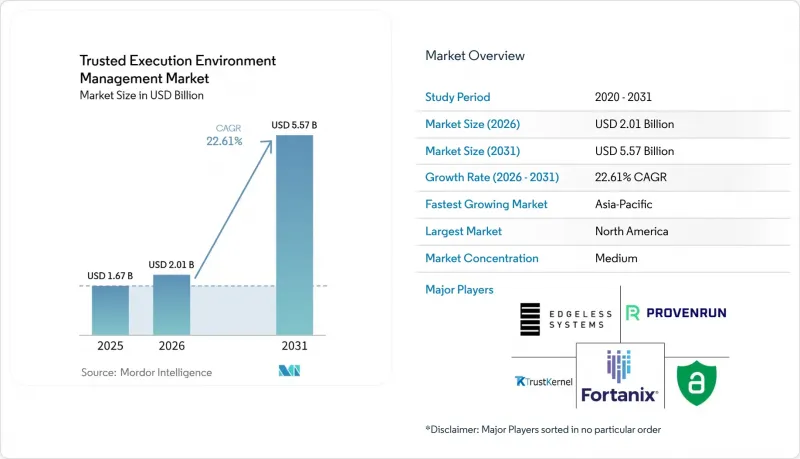
本報告按組件(硬體、軟體、服務)、部署模式(雲端、混合、本地部署)、應用(行動安全、數位支付等)、企業規模(大型企業、中小企業)、最終用戶(IT與電信、銀行、金融服務和保險等)以及地區進行細分。市場預測以美元計價。
全球可信任執行環境 (TEE) 管理市場趨勢與洞察
日益嚴峻的網路安全威脅以及資料外洩帶來的高昂成本
安全事件的經濟影響正在推動可信任執行環境 (TEE) 管理市場的成長。 IBM 的一份報告預測,到 2025 年,全球資料外洩的平均成本將達到 444 萬美元,而美國則高達 1,022 萬美元。 Verizon 的 2025 年報告記錄了 12195 起已確認的資料外洩事件,其中 44% 的事件涉及勒索軟體。該報告還發現,30% 的資料外洩事件涉及第三方,凸顯了供應商和基礎設施整個信任鏈中存在的漏洞。此外,IBM 的研究表明,97% 經歷過人工智慧相關安全事件的組織缺乏足夠的人工智慧存取控制。 TEE 管理平台可以隔離模型權重和推理工作負載,同時將金鑰存取與憑證證據關聯。
資料保護和數位韌性規則
隨著網路安全要求從政策聲明轉向產品和營運控制,可信任執行環境 (TEE) 管理市場正從中受益。歐盟第 2024/2847 號法規,即“網路彈性法案”,已於 2024 年 12 月 10 日生效。自 2026 年 9 月 11 日起,已實際被利用的漏洞的報告義務將生效;自 2027 年 12 月 11 日起,涵蓋整個產品生命週期的要求將生效。 2026 年 5 月,瑞典資料保護機構發布了關於 TEE 實施的 GDPR 指南,將正確實施的 TEE 視為第 32 條規定的技術保障措施。該指南明確了管理身份驗證和加密金鑰的各方的課責。這些要求使得硬體支援的證據對醫療保健、金融服務、汽車和其他受監管用戶而言變得日益重要。
整合的複雜性和技能的缺乏
儘管可信任執行環境 (TEE) 具有強大的安全價值,但由於部署難題尚未解決,其管理市場面臨短期限制。 Intel TDX、AMD SEV-SNP、ARM TrustZone 和 RISC-V 安全區各自採用不同的 API、認證流程和威脅模型。安全團隊通常需要同時支援多個此類環境。 ESET 的研究顯示,到 2026 年,雲端安全將成為中小企業計畫投資的第二大領域。然而,實施 TEE 需要高階技能,而這些技能無法透過一般的雲端安全培訓來獲得。雖然託管測試服務和敏感容器可以減輕這種負擔,但對於沒有專職安全工程師的組織而言,TEE 的普及速度仍然會比較緩慢。
細分市場分析
到 2025 年,軟體將佔據可信任執行環境 (TEE) 管理市場 64.82% 的佔有率。雖然基於矽晶片的可靠性仍然至關重要,因為虛擬機器管理程式的漏洞可能會破壞純軟體認證,但安全晶片、嵌入式硬體安全模組和系統晶片(SoC)安全功能功能主要構成底層投資。先進的硬體仍然很普遍,例如 Rambus CryptoManager RT-648,這是一款符合 ISO 26262 和 ISO/SAE 21434 標準的汽車嵌入式硬體安全模組,以及符合 FIPS 203、204 和 2020 標準的後量子演算法。然而,軟體仍然佔據市場主導地位,它提供必要的策略管理、金鑰編配和機密容器工具,使這些多樣化的 TEE 硬體能夠大規模運作。
預計2026年至2031年,服務市場將以24.73%的複合年成長率成長。託管測試和專業整合正在推動可信任執行環境 (TEE) 管理市場的成長,因為許多用戶需要協助協調硬體、工作負載和安全策略。硬體領域可信任執行環境 (TEE) 管理市場的規模也將受到後量子密碼技術普及程度的影響。美國國家標準與技術研究院 (NIST) 於2024年最終確定了前三個後量子密碼標準,這將為缺乏加密柔軟性的設備帶來更新換代週期。提供更新路徑和抗量子攻擊支援的供應商將受益,而缺乏模組化升級能力的系統可能會被迫提前更換。
到 2025 年,雲端部署將佔總收入的 68.41%。採用 Intel TDX 和 AMD SEV-SNP 的安全虛擬機器降低了以往硬體隔離計算所需的資本投入。在需要直接控制基礎設施的政府和國防等空氣間隙環境中,本地部署模式仍然至關重要。對於那些需要可信任執行環境 (TEE) 層級隔離但又不想建構伺服器叢集的組織而言,雲端平台也提供了一條通往 TEE 管理市場的切實可行的途徑。
混合部署預計將在 2026 年至 2031 年間以 23.84% 的複合年成長率成長。各組織正透過身分驗證管道和加密控制,將敏感的本地資料與雲端規模的 AI 推理整合。英特爾的 TD 保留架構支援在毫秒級內更新 TDX 模組,無需幾分鐘的重新啟動時間。此功能滿足生產 AI 環境中 99.999% 可用性的合約要求。 Edgeless Systems 在可信任執行環境 (TEE) 管理市場提供高度機密的容器編排管理,即使是客戶方的 Kubernetes 管理員也無法存取應用程式資料。
區域分析
到2025年,北美將佔據可信賴執行環境(TEE)管理市場34.62%的佔有率。美國聯邦政府的採購正在支援國防和情報相關工作負載的基於硬體的安全認證。企業雲端採用率的集中化使得敏感虛擬機器在商業性可行。根據IBM的報告,到2025年,美國安全漏洞的平均成本將達到1,022萬美元,是全球平均的2.3倍。這種差距促使企業越來越關注董事會層級的檢驗計算隔離。
歐洲是可信任執行環境 (TEE) 管理市場第二大區域,而《網路彈性法案》下的報告義務將於 2026 年 9 月到期。瑞典隱私監管局於 2026 年 5 月發布了關於 TEE 實施的 GDPR 指南,其他歐盟監管機構也正在考慮制定相關指南。 Edgeless Systems 公司報告稱,其 Privatemode AI 系統已在德國 ePA 系統中運作,保護 5,000 萬名患者的資料。法國 ProvenRun 公司圍繞著 ProvenCore 和 ProvenHSM 建構了高水準的保障認證體系。
預計亞太地區在2026年至2031年間將以23.68%的複合年成長率成長。日本產業技術綜合研究所(AIST)支持了IETF TEEP計劃,該計劃旨在實現汽車和工業IoT的生命週期管理。韓國正在支持聯網汽車的研究,而印度的資料保護法規正在推動主權人工智慧的普及。在中國,國內生態系統正透過基於RISC-V的敏感部署方案不斷擴展。南美洲、中東和非洲地區正處於人工智慧應用的早期階段,這些地區在銀行、金融和保險(BFSI)產業的合規性、數位身分計畫、資料居住法、巴西的《通用資料保護法》(LGPD)以及對主權雲端的投資等方面的舉措,都可能促進人工智慧的普及。
其他好處:
- Excel格式的市場預測(ME)表
- 3個月的分析師支持
目錄
第1章:引言
- 研究假設和市場定義
- 調查範圍
第2章:調查方法
第3章執行摘要
第4章 市場狀況
- 市場概覽
- 市場促進因素
- 日益嚴重的網路安全威脅和資料外洩造成的成本不斷上升
- 關於資料保護和數位韌性的監管義務
- 雲端、邊緣和連網型設備的擴展
- 行動支付和數位身分的成長
- 實施高度機密的AI和隱私保護分析
- 異質運算環境中對可攜式身份驗證的需求
- 市場限制因素
- 高度一體化的複雜性和熟練工人短缺
- 效能開銷和處理負載相容性的限制
- 跨廠商認證和互通性差距
- 關於長壽命元件和向後量子系統過渡的不確定性
- 宏觀經濟因素對市場的影響
- 產業價值鏈分析
- 科技趨勢
- 監理情勢
- 波特五力分析
第5章 市場規模與成長預測
- 按組件
- 硬體
- 軟體
- 服務
- 按部署模式
- 雲
- 混合
- 現場
- 透過使用
- 行動安全和數位支付
- 物聯網和邊緣安全
- 汽車安全
- 工業和操作技術(物聯網)安全
- 機密計算和資料隱私
- 政府/國防
- 其他用途
- 按公司規模
- 大公司
- 小型企業
- 最終用戶
- 資訊科技/通訊
- BFSI
- 汽車和運輸業
- 醫療保健和生命科學
- 零售與電子商務
- 工業製造
- 其他最終用戶
- 按地區
- 北美洲
- 美國
- 加拿大
- 墨西哥
- 南美洲
- 巴西
- 阿根廷
- 其他南美國家
- 歐洲
- 德國
- 英國
- 法國
- 俄羅斯
- 西班牙
- 其他歐洲國家
- 亞太地區
- 中國
- 日本
- 印度
- 韓國
- 東南亞
- 其他亞太國家
- 中東和非洲
- 中東
- 沙烏地阿拉伯
- 阿拉伯聯合大公國
- 其他中東國家
- 非洲
- 南非
- 奈及利亞
- 其他非洲國家
- 中東
- 北美洲
第6章 競爭情勢
- 市場集中度
- 策略趨勢
- 市佔率分析
- 公司簡介
- Fortanix, Inc.
- ProvenRun SAS
- TrustKernel Technology Co., Ltd.
- Trustonic Limited
- Anjuna Security, Inc.
- Edgeless Systems GmbH
- Scontain GmbH
- Secretarium Limited
- Decentriq AG
- Secure-IC SAS
- Rambus Inc.
- Intrinsic ID BV
- Licel Corporation
- Safeheron Pte. Ltd.
- Oasis Labs, Inc.
- CryptoNext Security SAS
- Confidential AI, Inc.
- XaiTEE, Inc.
- QLAD, Inc.
- Automata Network Pte. Ltd.
第7章 市場機會與未來展望
According to Mordor Intelligence, the trusted execution environment management market size was valued at USD 1.67 billion in 2025 and estimated to grow from USD 2.01 billion in 2026 to reach USD 5.57 billion by 2031, at a CAGR of 22.61% during the forecast period 2026-2031.
This report is Segmented by Component (Hardware, Software, and Services), Deployment Model (Cloud, Hybrid, and On-Premises), Application (Mobile Security and Digital Payments, and More), Enterprise Size (Large Enterprises, and Small and Mid-Sized Enterprises), End Users (IT and Telecommunication, BFSI, and More), and Geography. The Market Forecasts are Provided in Terms of Value (USD).
Global Trusted Execution Environment Management Market Trends and Insights
Rising Cybersecurity Threats and Data-Breach Costs
The financial impact of security incidents supports the Trusted Execution Environment Management Market. IBM reported a global average breach cost of USD 4.44 million in 2025, while the U.S. average reached USD 10.22 million. Verizon documented 12,195 confirmed breaches in its 2025 report and found ransomware in 44% of incidents. The same report found third-party involvement in 30% of breaches, which highlights weaknesses across supplier and infrastructure trust chains. IBM also found that 97% of organizations that experienced an AI-related security incident lacked proper AI access controls. TEE management platforms can isolate model weights and inference workloads, while linking key access to attestation evidence.
Data Protection and Digital Resilience Rules
The Trusted Execution Environment Management Market benefits as cybersecurity requirements move from policy statements into product and operational controls. Regulation EU 2024/2847, known as the Cyber Resilience Act, entered into force on December 10, 2024. Reporting obligations for actively exploited vulnerabilities apply from September 11, 2026, and full product lifecycle requirements will apply from December 11, 2027. Sweden's privacy authority published GDPR guidance on TEE deployments in May 2026 and treated properly implemented TEEs as a technical safeguard under Article 32. The guidance places accountability with the party that controls attestation and encryption keys. These requirements make hardware-backed evidence more relevant to healthcare, financial services, automotive, and other regulated users.
Integration Complexity and Skills Scarcity
The Trusted Execution Environment Management Market faces a near-term constraint because strong security value does not remove implementation difficulty. Intel TDX, AMD SEV-SNP, ARM TrustZone, and RISC-V enclaves use different APIs, attestation processes, and threat models. Security teams must often support multiple of these environments simultaneously. ESET found cloud security was the second-highest planned investment area for small and mid-sized businesses in 2026. However, implementing TEE requires skills beyond typical cloud security training. Managed attestation services and confidential containers can reduce this burden, but adoption will remain slower where organizations lack dedicated security engineers.
Other drivers and restraints analyzed in the detailed report include:
- Cloud, Edge, and Connected Device Expansion
- Mobile Payments and Digital Identity Growth
- Performance Overhead and Limited Workload Fit
For complete list of drivers and restraints, kindly check the Table Of Contents.
Segment Analysis
Software held 64.82% of the Trusted Execution Environment Management Market share in 2025. Although silicon-based trust remains critical because a compromised hypervisor may undermine software-only attestations, secure chips, embedded hardware security modules, and system-on-chip security functions act primarily as the foundational investment layer. Advanced hardware, such as the Rambus CryptoManager RT-648, an automotive embedded hardware security module with ISO 26262 and ISO/SAE 21434 support, as well as post-quantum algorithms aligned with FIPS 203, 204, and 20, continues to proliferate. It is, however, software that commands the majority of the market by providing essential policy management, key orchestration, and confidential container tools that enable this diverse TEE hardware to actually operate at scale.
Services are projected to grow at a 24.73% CAGR from 2026 to 2031. Managed attestation and professional integration are driving growth in the Trusted Execution Environment Management Market because many users need help connecting hardware, workloads, and security policies. The Trusted Execution Environment Management Market size for hardware will also be affected by post-quantum readiness. NIST finalized its first 3 post-quantum cryptography standards in 2024, creating a replacement cycle for devices that lack cryptographic agility. Vendors that embed update paths and quantum-resistant support can benefit, while systems without modular upgrades may face earlier replacement.
Cloud deployment held 68.41% of revenue in 2025. Confidential virtual machines using Intel TDX and AMD SEV-SNP have reduced the capital investment previously needed for hardware-isolated computing. The on-premises model remains important for air-gapped government and defense settings that require direct infrastructure control. Cloud platforms also offer a practical route into the Trusted Execution Environment Management Market for organizations that need TEE-grade isolation without building server fleets.
Hybrid deployment is projected to grow at a 23.84% CAGR from 2026 to 2031. Organizations are connecting sensitive on-premises data with cloud-scale AI inference through attestation pipelines and cryptographic controls. Intel's TD Preserving Architecture supports runtime TDX Module updates in milliseconds rather than reboot windows that can last minutes. This capability supports production AI environments where 99.999% availability is a contractual requirement. Edgeless Systems offers confidential container orchestration that keeps application data inaccessible even to customer-side Kubernetes administrators in the Trusted Execution Environment Management Market.
Complete Report Scope:
- By Component
- Hardware
- Software
- Services
- By Deployment Model
- Cloud
- Hybrid
- On-Premises
- By Application
- Mobile Security and Digital Payments
- IoT and Edge Security
- Automotive Security
- Industrial and Operational Technology Security
- Confidential Computing and Data Privacy
- Government and Defense
- Other Applications
- By Enterprise Size
- Large Enterprises
- Small and Mid-sized Enterprises
- By End Users
- IT and Telecommunication
- BFSI
- Automotive and Transportation
- Healthcare and Life Sciences
- Retail and E-Commerce
- Industrial Manufacturing
- Other End Users
- By Geography
- North America
- United States
- Canada
- Mexico
- South America
- Brazil
- Argentina
- Rest of South America
- Europe
- Germany
- United Kingdom
- France
- Russia
- Spain
- Rest of Europe
- Asia-Pacific
- China
- Japan
- India
- South Korea
- Southeast Asia
- Rest of Asia-Pacific
- Middle East and Africa
- Middle East
- Saudi Arabia
- United Arab Emirates
- Rest of Middle East
- Africa
- South Africa
- Nigeria
- Rest of Africa
- Middle East
- North America
Geography Analysis
North America held 34.62% of the Trusted Execution Environment Management Market share in 2025. U.S. federal procurement supports hardware-attested security for defense and intelligence workloads. The concentration of enterprise cloud deployments makes confidential virtual machine adoption commercially practical. IBM reported an average breach cost of USD 10.22 million in the United States in 2025, 2.3 times the global average. This gap is increasing board-level interest in verifiable compute isolation.
Europe is the second-largest region in the Trusted Execution Environment Management Market, and Cyber Resilience Act reporting obligations are due in September 2026. Sweden's privacy authority issued GDPR guidance on TEE deployments in May 2026, which other European Union regulators are studying. Edgeless Systems reported that its Privatemode AI operates within Germany's ePA system and protects the data of 50 million patients. France's ProvenRun has built high-assurance credentials around ProvenCore and ProvenHSM.
Asia-Pacific is projected to grow at a 23.68% CAGR from 2026 to 2031. Japan's AIST has supported IETF TEEP work for automotive and industrial IoT lifecycle management. South Korea has supported connected-vehicle research, while India's data protection rules are encouraging sovereign AI deployments. China's domestic ecosystem is expanding through RISC-V-based approaches for sensitive deployments. South America, the Middle East, and Africa are early-stage regions where BFSI compliance, digital identity programs, data-residency laws, Brazil's LGPD, and sovereign cloud investments can support adoption.
- Fortanix, Inc.
- ProvenRun S.A.S.
- TrustKernel Technology Co., Ltd.
- Trustonic Limited
- Anjuna Security, Inc.
- Edgeless Systems GmbH
- Scontain GmbH
- Secretarium Limited
- Decentriq AG
- Secure-IC S.A.S.
- Rambus Inc.
- Intrinsic ID B.V.
- Licel Corporation
- Safeheron Pte. Ltd.
- Oasis Labs, Inc.
- CryptoNext Security SAS
- Confidential AI, Inc.
- XaiTEE, Inc.
- QLAD, Inc.
- Automata Network Pte. Ltd.
Additional Benefits:
- The market estimate (ME) sheet in Excel format
- 3 months of analyst support
TABLE OF CONTENTS
1 INTRODUCTION
- 1.1 Study Assumptions and Market Definition
- 1.2 Scope of the Study
2 RESEARCH METHODOLOGY
3 EXECUTIVE SUMMARY
4 MARKET LANDSCAPE
- 4.1 Market Overview
- 4.2 Market Drivers
- 4.2.1 Rising Cybersecurity Threats and Data-Breach Costs
- 4.2.2 Regulatory Mandates for Data Protection and Digital Resilience
- 4.2.3 Expansion of Cloud, Edge, and Connected Devices
- 4.2.4 Growth of Mobile Payments and Digital Identity
- 4.2.5 Confidential AI and Privacy-Preserving Analytics Adoption
- 4.2.6 Demand for Portable Attestation Across Heterogeneous Compute
- 4.3 Market Restraints
- 4.3.1 High Integration Complexity and Skills Scarcity
- 4.3.2 Performance Overhead and Limited Workload Fit
- 4.3.3 Cross-Vendor Attestation and Interoperability Gaps
- 4.3.4 Long-Lived Device Fleets and Post-Quantum Migration Uncertainty
- 4.4 Impact of Macroeconomic Factors on the Market
- 4.5 Industry Value-Chain Analysis
- 4.6 Technology Outlook
- 4.7 Regulatory Landscape
- 4.8 Porter's Five Forces Analysis
- 4.8.1 Threat of New Entrants
- 4.8.2 Bargaining Power of Suppliers
- 4.8.3 Bargaining Power of Buyers
- 4.8.4 Threat of Substitutes
- 4.8.5 Intensity of Competitive Rivalry
5 MARKET SIZE AND GROWTH FORECASTS (VALUE)
- 5.1 By Component
- 5.1.1 Hardware
- 5.1.2 Software
- 5.1.3 Services
- 5.2 By Deployment Model
- 5.2.1 Cloud
- 5.2.2 Hybrid
- 5.2.3 On-Premises
- 5.3 By Application
- 5.3.1 Mobile Security and Digital Payments
- 5.3.2 IoT and Edge Security
- 5.3.3 Automotive Security
- 5.3.4 Industrial and Operational Technology Security
- 5.3.5 Confidential Computing and Data Privacy
- 5.3.6 Government and Defense
- 5.3.7 Other Applications
- 5.4 By Enterprise Size
- 5.4.1 Large Enterprises
- 5.4.2 Small and Mid-sized Enterprises
- 5.5 By End Users
- 5.5.1 IT and Telecommunication
- 5.5.2 BFSI
- 5.5.3 Automotive and Transportation
- 5.5.4 Healthcare and Life Sciences
- 5.5.5 Retail and E-Commerce
- 5.5.6 Industrial Manufacturing
- 5.5.7 Other End Users
- 5.6 By Geography
- 5.6.1 North America
- 5.6.1.1 United States
- 5.6.1.2 Canada
- 5.6.1.3 Mexico
- 5.6.2 South America
- 5.6.2.1 Brazil
- 5.6.2.2 Argentina
- 5.6.2.3 Rest of South America
- 5.6.3 Europe
- 5.6.3.1 Germany
- 5.6.3.2 United Kingdom
- 5.6.3.3 France
- 5.6.3.4 Russia
- 5.6.3.5 Spain
- 5.6.3.6 Rest of Europe
- 5.6.4 Asia-Pacific
- 5.6.4.1 China
- 5.6.4.2 Japan
- 5.6.4.3 India
- 5.6.4.4 South Korea
- 5.6.4.5 Southeast Asia
- 5.6.4.6 Rest of Asia-Pacific
- 5.6.5 Middle East and Africa
- 5.6.5.1 Middle East
- 5.6.5.1.1 Saudi Arabia
- 5.6.5.1.2 United Arab Emirates
- 5.6.5.1.3 Rest of Middle East
- 5.6.5.2 Africa
- 5.6.5.2.1 South Africa
- 5.6.5.2.2 Nigeria
- 5.6.5.2.3 Rest of Africa
- 5.6.5.1 Middle East
- 5.6.1 North America
6 COMPETITIVE LANDSCAPE
- 6.1 Market Concentration
- 6.2 Strategic Moves
- 6.3 Market Share Analysis
- 6.4 Company Profiles (includes Global Level Overview, Market Level Overview, Core Segments, Financials as available, Strategic Information, Market Rank/Share, Products and Services, Recent Developments)
- 6.4.1 Fortanix, Inc.
- 6.4.2 ProvenRun S.A.S.
- 6.4.3 TrustKernel Technology Co., Ltd.
- 6.4.4 Trustonic Limited
- 6.4.5 Anjuna Security, Inc.
- 6.4.6 Edgeless Systems GmbH
- 6.4.7 Scontain GmbH
- 6.4.8 Secretarium Limited
- 6.4.9 Decentriq AG
- 6.4.10 Secure-IC S.A.S.
- 6.4.11 Rambus Inc.
- 6.4.12 Intrinsic ID B.V.
- 6.4.13 Licel Corporation
- 6.4.14 Safeheron Pte. Ltd.
- 6.4.15 Oasis Labs, Inc.
- 6.4.16 CryptoNext Security SAS
- 6.4.17 Confidential AI, Inc.
- 6.4.18 XaiTEE, Inc.
- 6.4.19 QLAD, Inc.
- 6.4.20 Automata Network Pte. Ltd.
7 MARKET OPPORTUNITIES AND FUTURE OUTLOOK
- 7.1 White-Space and Unmet-Need Assessment

 嵌入式安全市場-策略分析與預測(2026-2031年)
 嵌入式安全:市場佔有率分析、行業趨勢和統計數據、成長預測(2026-2031 年)OTT串流內容保護:市場佔有率分析、產業趨勢與統計、成長預測(2026-2031年)
 數位認證和嵌入式安全數位認證和嵌入式安全市場數據概覽:2026年第三季度
 嵌入式安全市場:依安全類型、設備類型、連接技術、管理架構和應用分類-2026-2032年全球市場預測TPM(可信任平台模組):市場佔有率分析、行業趨勢和統計數據、成長預測(2026-2031 年)
 物聯網嵌入式安全市場:按組件、應用、最終用戶和地區分類
 2026年全球人工智慧可信任執行市場報告
 物聯網嵌入式安全市場規模、佔有率和成長分析:按組件、部署模式、組織規模、應用、產業和地區分類-2026-2033年產業預測