


 |
市場調查報告書
商品編碼
2124147
人力資源分析:市場佔有率分析、產業趨勢與統計、成長預測(2026-2031)HR Analytics - Market Share Analysis, Industry Trends & Statistics, Growth Forecasts (2026 - 2031) |
||||||

※ 本網頁內容可能與最新版本有所差異。詳細情況請與我們聯繫。
根據 Mordor Intelligence 預測,人力資源分析市場規模預計將在 2025 年達到 48.9 億美元,2026 年達到 57.1 億美元,到 2031 年達到 108.2 億美元,2026 年至 2031 年的複合年成長率為 13.64%。
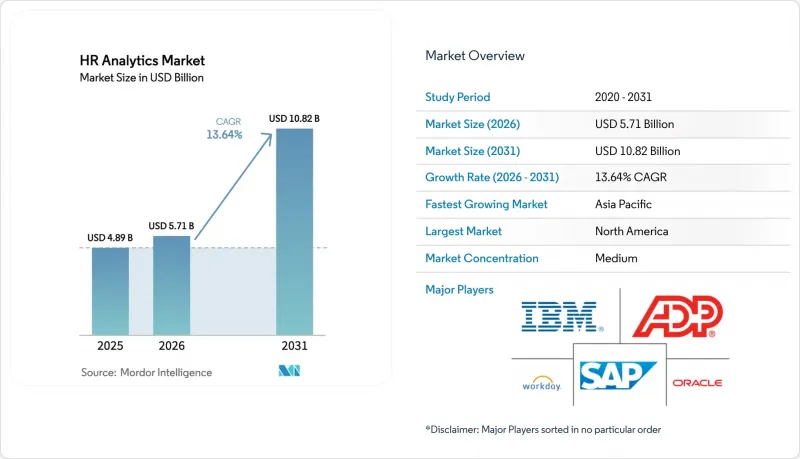
本報告按組件(解決方案和服務)、部署模式(本地部署和雲端部署)、組織規模(大型企業和中小企業)、應用程式(人才招聘和入職、勞動力規劃和最佳化等)、最終用戶產業(IT和電信、零售和消費品、製造業等)以及地區進行細分。市場預測以美元計價。
全球人力資源分析市場趨勢與洞察
基於雲端的人力資源分析技術正迅速普及。
將人力資源分析遷移到雲端,消除了以往只有大型企業才需要承擔的初始硬體和授權成本。 ISG 對 1200 家機構的調查顯示,到 2025 年底,69% 的機構將至少運行一個軟體即服務 (SaaS) 形式的人力資源模組,較 2023 年的 52% 顯著成長。 Oracle在 2025 財政年度新增了 1400 家 Fusion Cloud HCM 客戶,因為預算敏感型買家青睞其模組化、按員工收費的模式。 Workday 在 2025 年發布了三個主要版本,這與傳統本地部署通常的年度更新形成鮮明對比,凸顯了多租戶設計帶來的快速功能交付優勢。然而,這種資料流經超大規模資料中心的架構,可能會與歐盟的跨境法規產生衝突。亞馬遜因違反 GDPR 處理員工資料而被罰款 7.46 億歐元(8.43 億美元),這案例凸顯了這種矛盾。
降低離職率和最佳化人事費用是必要的。
預計2025年,美國雇主將因員工自願離職而損失1兆美元,促使企業依賴預測模型,以便在員工離職前數月發出離職風險預警。 IBM的華生分析(Watson Analytics)結合員工的服務年資、晉升歷史以及外部勞動市場訊號,成功預測了哪些員工將在一年內離職,準確率高達95%。基於這些分析,實施有針對性的留任獎金和輪班模式調整的醫院,將註冊護理師的離職率降低了22%,平均每位留住的員工可節省52,100美元。薪資削減情況分析也揭示了一些案例,即新員工的收入高於其資深同事。這引發了“隱性離職”,促使企業透過中期薪資審查來解決這個問題。隨著人力資源長(CHRO)量化這些成本節約效果,財務部門開始將人才分析視為一種成本控制手段,而非可有可無的工具。
人力資源資料科學人才短缺
人力分析師需要掌握 SQL、Python、統計學和人力資源政策的知識,而具備這些技能的人才在全球就業市場仍然十分稀缺。 LinkedIn 發布的《2025 年新興職業報告》將人力分析專家的成長率排在第七位,但這些職位的平均空缺時間超過 90 天,薪資比一般人力資源分析師高出 25% 至 35%。德勤的研究表明,許多中型企業由於缺乏建立預測模型的人才,仍然停留在說明儀錶板階段。雖然像 Visier 這樣的供應商提供的拖放式工具降低了入門門檻,但仍需要經驗豐富的分析師來解讀模型輸出並實施相應的干預措施。除非大學和企業內部培訓機構能夠擴大人才庫,否則人才短缺將繼續限制中小企業在數據分析方面的投資報酬率 (ROI)。
細分市場分析
預計到2025年,解決方案業務將佔總營收的69.73%,凸顯了企業對預置式儀錶板、預先建置連接器和內建預測機型的偏好,這些產品只需極少的配置運作。實施諮詢、客製化模型開發和託管分析等服務正以13.89%的複合年成長率快速成長。這是因為企業缺乏內部資料人才,因此依賴合作夥伴進行資料遷移、變更管理和偏差檢查。有關可解釋性和隱私的監管要求正在推動對專業諮詢專案的需求,預計這將削弱軟體供應商在人力資源分析市場中的市場佔有率優勢。
訂閱式定價模式允許買家隨著時間的推移添加模組,從而將引進週期從數月縮短至數週。 Oracle Oracle會計年度的雲端服務費用成長了 23%,這主要得益於客戶需要將複雜的組織結構對應到標準化的指標庫中。Accenture和 IBM 透過將資料科學家與工業和組織心理學家相結合,將原始洞察轉化為人才保留和技能提升計劃,從而實現了兩位數成長,並拓展了其人才分析業務。諮詢服務的成長表明,儘管軟體仍然是人力資源分析市場的支柱,但服務業仍將繼續發展壯大。
預計到 2025 年,雲端採用將佔總支出的 75.67%,複合年成長率 (CAGR) 為 13.96%,超過所有其他採用方案。多租戶設計有助於加快功能發布速度,Workday 在 2025 年的三次重大更新證明了這一點,而傳統架構每年只能進行修補更新。此外,付費使用制緩解了財務長在招聘凍結期間對「軟體閒置」的擔憂,因為供應商的收入與客戶的員工規模掛鉤。
在政府機構和監管嚴格的銀行業,本地部署平台仍然普遍存在。在這些產業,資料居住要求和對大型主機的複雜依賴性正在減緩轉型步伐。根據 SAP 的報告,到 2025 年,SuccessFactors 將新增 2100 家雲端客戶,而本地部署的 ECC 授權數量將下降 9%。混合架構——即雲端分析層與用於儲存敏感記錄的國內鏡像相結合——在俄羅斯、印尼和越南是一種臨時解決方案,但不斷上漲的營運成本最終可能會迫使這些企業全面遷移到 SaaS 平台。
區域分析
預計到2025年,北美將佔全球銷售額的39.48%。這項預測得到了美國證券交易委員會(SEC)相關規定的支持,該規定要求上市公司披露人力資本信息,同時,風險投資也大力扶持人力資源科技新創公司。 2025年,美國公司平均每家將在人工智慧驅動的人力資源工具上投入160萬美元。加拿大《同工同酬法》進一步推動了對薪資分析的需求,而墨西哥製造業近岸外包的蓬勃發展也增加了對能夠跟上工廠擴張步伐的勞動力規劃儀錶板的需求。
亞太地區是成長最快的地區,複合年成長率達14.69%。隨著人工智慧自動化技術重塑服務交付模式,印度領先的IT公司已實施技能圖譜以進行員工重新部署。中國國營企業正響應政府的現代化政策,推動人力資源流程數位化;在日本,勞動人口減少迫使製造業企業最大限度地提高每位員工的生產力。澳洲2024年《公平工作法》修正案將休假權利擴展至零工經濟從業者,為分析技術在管理非正式勞動力方面創造了新的應用情境。
歐洲的《企業永續性報告指令》正在將多元化和培訓指標納入經審計的財務報表,從而將人力資源分析納入財務長的職責範圍。德國的《勞動委員會共同決策規則》強制要求對員工監控進行同意程序,這將影響產品藍圖。在中東,沙烏地阿拉伯的「沙烏地化」配額制度催生了追蹤本地和外籍勞工比例的儀錶板的合主導需求。儘管南美洲的投資仍落後,但巴西的勞動法改革正推動雇主採用雲端分析技術,以確保混合辦公模式的合規性。
其他好處:
- Excel格式的市場預測(ME)表
- 3個月的分析師支持
目錄
第1章:引言
- 研究假設和市場定義
- 調查範圍
第2章:調查方法
第3章執行摘要
第4章 市場狀況
- 市場概覽
- 市場促進因素
- 基於雲端的人力資源分析技術正迅速普及。
- 降低離職率和最佳化人事費用是必要的。
- 混合辦公和遠距辦公正在加速數據驅動的人力資源(HR)發展。
- 生成式人工智慧副駕駛已整合到人力資源套件中
- 強制揭露與ESG相關的人力資本
- 用於健康分析的穿戴式設備數據和生物識別數據
- 市場限制因素
- 資料科學領域人才短缺
- 資料隱私和合規性的複雜性
- 與演算法偏見相關的訴訟風險
- 傳統的孤立的人力資源資料架構
- 產業價值鏈分析
- 監理情勢
- 技術展望
- 波特五力分析
- 宏觀經濟因素對市場的影響
第5章 市場規模與成長預測
- 按組件
- 解決方案
- 服務
- 部署模式
- 現場
- 雲
- 按組織規模
- 大公司
- 小型企業
- 透過使用
- 人才招聘和入職流程
- 勞動力規劃與最佳化
- 薪酬分析
- 學習與發展分析
- 員工敬業度與幸福感分析
- 多元化、股權和包容性 (DEI) 分析
- 按最終用戶行業分類
- IT/通訊
- 銀行、金融服務和保險(BFSI)
- 零售和消費品
- 醫療保健和生命科學
- 製造業
- 政府/公共部門
- 其他終端用戶產業
- 按地區
- 北美洲
- 美國
- 加拿大
- 墨西哥
- 歐洲
- 德國
- 英國
- 法國
- 俄羅斯
- 其他歐洲國家
- 亞太地區
- 中國
- 日本
- 印度
- 韓國
- 澳洲
- 其他亞太國家
- 中東和非洲
- 中東
- 沙烏地阿拉伯
- 阿拉伯聯合大公國
- 其他中東國家
- 非洲
- 南非
- 埃及
- 其他非洲國家
- 中東
- 南美洲
- 巴西
- 阿根廷
- 其他南美國家
- 北美洲
第6章 競爭情勢
- 市場集中度
- 策略趨勢
- 市佔率分析
- 公司簡介
- SAP SE
- Oracle Corporation
- Workday Inc.
- IBM Corporation
- ADP Inc.
- UKG Inc.
- Tableau Software, LLC
- Visier Inc.
- Crunchr BV
- Culture Amp Pty Ltd
- ChartHop Inc.
- PeopleInsight Analytics Corp.
- Lattice HQ Inc.
- Gloat Ltd.
- Eightfold AI Inc.
- HiBob Ltd.
- Syndio Solutions Inc.
- Nakisa Inc.
- Zoho Corporation Pvt Ltd.
- GainInsights Solutions Pvt Ltd.
- Cornerstone OnDemand Inc.
- Ceridian HCM Holding Inc.
- BambooHR LLC
- Paycor Inc.
- Personio GmbH
第7章 市場機會與未來展望
According to Mordor Intelligence, the HR analytics market size is projected to be USD 4.89 billion in 2025, USD 5.71 billion in 2026, and reach USD 10.82 billion by 2031, growing at a CAGR of 13.64% from 2026 to 2031.
This report is Segmented by Component (Solutions, and Services), Deployment Mode (On-Premise, and Cloud), Organization Size (Large Enterprises, and Small and Medium Enterprises), Application (Talent Acquisition and Onboarding, Workforce Planning and Optimization, and More), End-User Industry (IT and Telecom, Retail and Consumer Goods, Manufacturing, and More), and Geography. Market Forecasts are in Value (USD).
Global HR Analytics Market Trends and Insights
Cloud-Based HR Analytics Adoption Surge
Moving HR analytics to the cloud has eliminated the upfront hardware and licensing costs that once limited adoption to very large companies. An ISG poll of 1,200 organizations showed that 69% were already running at least one HR module in software-as-a-service form by the close of 2025, a steep jump from 52% in 2023. Oracle added 1,400 Fusion Cloud HCM clients during fiscal 2025 as modular, per-employee pricing appealed to budget-sensitive buyers. Workday shipped three major releases in 2025, versus the single annual update common in legacy on-premises deployments, underscoring the feature-velocity advantage of a multi-tenant design. The same architecture, however, channels data through hyperscale centers that can clash with EU cross-border rules, a tension highlighted by Amazon's EUR 746 million (USD 843 million) GDPR fine for employee data processing.
Need to Cut Attrition and Optimize Workforce Cost
Voluntary turnover costs U.S. employers USD 1 trillion in 2025, prompting firms to lean on predictive models that flag flight risk months before a resignation. IBM's Watson Analytics reached 95% accuracy in predicting which workers would exit within a year by blending tenure, promotion history, and external labor-market signals. Hospitals that paired these insights with targeted retention bonuses and shift-pattern tweaks trimmed registered-nurse attrition by 22%, saving an average of USD 52,100 per avoided departure. Pay-compression dashboards also reveal cases where new hires out-earn long-serving colleagues, a trigger for "quiet quitting" that companies address through mid-cycle salary corrections. As CHROs quantify such savings, finance teams increasingly treat people analytics as a cost-containment lever rather than a discretionary tool.
Shortage of HR Data-Science Talent
People analytics roles blend SQL, Python, statistics, and HR policy knowledge, a skill cocktail still rare in labor markets worldwide. LinkedIn's 2025 Emerging Jobs Report ranked people analytics specialist seventh by growth rate, yet the median position sat unfilled for more than 90 days and carried salary premiums of 25-35% over standard HR analyst positions. Deloitte observes that many mid-market firms stall at descriptive dashboards because they lack the staff to build predictive models. Drag-and-drop tools from vendors such as Visier reduce entry barriers, but interpreting model output and steering interventions still call for seasoned analysts. Until universities and in-house academies expand pipelines, talent scarcity will cap analytics ROI for small to midsize employers.
Other drivers and restraints analyzed in the detailed report include:
- Hybrid and Remote Work Accelerating Data-Driven HR
- Generative-AI Copilots Embedded in HR Suites
- Data-Privacy and Compliance Complexity
For complete list of drivers and restraints, kindly check the Table Of Contents.
Segment Analysis
Solutions captured 69.73% of 2025 revenue, underscoring enterprises' preference for packaged dashboards, prebuilt connectors, and embedded predictive models that can be activated with minimal configuration. Services such as implementation consulting, custom model development, and managed analytics are advancing at a 13.89% CAGR, as firms without in-house data talent rely on partners for data migration, change management, and bias-testing. The HR analytics market share advantage enjoyed by software vendors is likely to narrow as regulatory requirements for explainability and privacy drive demand for specialized advisory projects.
Subscription pricing lets buyers add modules over time, compressing deployment cycles from months to weeks. Oracle recorded a 23% jump in cloud-services fees in fiscal-2025 because clients needed mapping of complex org structures to standardized metric libraries. Accenture and IBM both expanded workforce analytics practices by double digits, pairing data scientists with industrial-organizational psychologists to turn raw insights into retention or reskilling programs. This advisory uptick signals that services will continue to gain ground, even though software remains the spine of the HR analytics market.
Cloud installations accounted for 75.67% of 2025 spending and are growing at a 13.96% CAGR, outpacing all other deployment options. Multi-tenant design accelerates feature releases, evidenced by Workday's three major updates in 2025 versus annual patches on legacy stacks. Consumption-based pricing also aligns vendor revenue with customer headcount, easing CFO concerns about shelf-ware during hiring freezes.
On-premises platforms persist in government and highly regulated banking, where data residency or mainframe entanglements slow migration. SAP reported that SuccessFactors added 2,100 cloud customers in 2025, while on-premises ECC licenses fell 9%. Hybrid architectures, a cloud analytics layer combined with in-country mirrors for sensitive records, are an interim fix in Russia, Indonesia, and Vietnam, but overhead costs may eventually push holdouts toward full SaaS adoption.
Complete Report Scope:
- By Component
- Solutions
- Services
- By Deployment Mode
- On-Premise
- Cloud
- By Organization Size
- Large Enterprises
- Small and Medium Enterprises
- By Application
- Talent Acquisition and Onboarding
- Workforce Planning and Optimization
- Compensation and Payroll Analytics
- Learning and Development Analytics
- Employee Engagement and Wellbeing Analytics
- Diversity, Equity and Inclusion Analytics
- By End-User Industry
- IT and Telecom
- Banking, financial services and insurance (BFSI)
- Retail and Consumer Goods
- Healthcare and Life Sciences
- Manufacturing
- Government and Public Sector
- Other End-User Industries
- By Geography
- North America
- United States
- Canada
- Mexico
- Europe
- Germany
- United Kingdom
- France
- Russia
- Rest of Europe
- Asia-Pacific
- China
- Japan
- India
- South Korea
- Australia
- Rest of Asia-Pacific
- Middle East and Africa
- Middle East
- Saudi Arabia
- United Arab Emirates
- Rest of Middle East
- Africa
- South Africa
- Egypt
- Rest of Africa
- Middle East
- South America
- Brazil
- Argentina
- Rest of South America
- North America
Geography Analysis
North America accounted for 39.48% of 2025 revenue, supported by SEC rules mandating human-capital disclosures for listed companies and robust venture investment in HR tech startups. U.S. enterprises spent an average of USD 1.6 million each on AI-powered HR tooling during 2025. Canada's Pay Equity Act further boosts demand for compensation analytics, while Mexico's manufacturing nearshoring boom drives the need for headcount-planning dashboards that keep pace with plant expansions.
Asia-Pacific is the fastest-growing region, with a 14.69% CAGR. India's IT majors adopted skills graphs to redeploy staff as generative-AI automation reshapes delivery models. China's state-owned enterprises digitize HR processes under government modernization mandates, and Japan's shrinking labor pool forces manufacturers to maximize productivity per worker. Australia's 2024 Fair Work amendments extend leave entitlements to gig-economy workers, opening new analytics use cases in contingent labor management.
Europe's Corporate Sustainability Reporting Directive embeds diversity and training metrics into audited statements, pushing HR analytics into CFO territory. Germany's works council co-determination rules require consent layers for employee monitoring, thereby influencing product roadmaps. In the Middle East, Saudi Arabia's Saudization quotas create a compliance-driven need for dashboards that track citizen-to-expat ratios. South America lags in spending, yet Brazil's labor-law modernization is nudging employers toward cloud analytics for hybrid scheduling compliance.
- SAP SE
- Oracle Corporation
- Workday Inc.
- IBM Corporation
- ADP Inc.
- UKG Inc.
- Tableau Software, LLC
- Visier Inc.
- Crunchr BV
- Culture Amp Pty Ltd
- ChartHop Inc.
- PeopleInsight Analytics Corp.
- Lattice HQ Inc.
- Gloat Ltd.
- Eightfold AI Inc.
- HiBob Ltd.
- Syndio Solutions Inc.
- Nakisa Inc.
- Zoho Corporation Pvt Ltd.
- GainInsights Solutions Pvt Ltd.
- Cornerstone OnDemand Inc.
- Ceridian HCM Holding Inc.
- BambooHR LLC
- Paycor Inc.
- Personio GmbH
Additional Benefits:
- The market estimate (ME) sheet in Excel format
- 3 months of analyst support
TABLE OF CONTENTS
1 INTRODUCTION
- 1.1 Study Assumptions and Market Definition
- 1.2 Scope of the Study
2 RESEARCH METHODOLOGY
3 EXECUTIVE SUMMARY
4 MARKET LANDSCAPE
- 4.1 Market Overview
- 4.2 Market Drivers
- 4.2.1 Cloud-Based HR Analytics Adoption Surge
- 4.2.2 Need to Cut Attrition and Optimise Workforce Cost
- 4.2.3 Hybrid and Remote Work Accelerating Data-Driven HR
- 4.2.4 Generative-AI Copilots Embedded in HR Suites
- 4.2.5 ESG-Linked Human-Capital Disclosure Mandates
- 4.2.6 Wearable and Biometric Data for Wellbeing Analytics
- 4.3 Market Restraints
- 4.3.1 Shortage of HR Data-Science Talent
- 4.3.2 Data-Privacy and Compliance Complexity
- 4.3.3 Algorithmic-Bias Litigation Risk
- 4.3.4 Legacy Siloed HR Data Architectures
- 4.4 Industry Value Chain Analysis
- 4.5 Regulatory Landscape
- 4.6 Technological Outlook
- 4.7 Porter's Five Forces Analysis
- 4.7.1 Bargaining Power of Suppliers
- 4.7.2 Bargaining Power of Buyers
- 4.7.3 Threat of New Entrants
- 4.7.4 Threat of Substitutes
- 4.7.5 Intensity of Competitive Rivalry
- 4.8 Impact of Macroeconomic Factors on the Market
5 MARKET SIZE AND GROWTH FORECASTS (VALUE)
- 5.1 By Component
- 5.1.1 Solutions
- 5.1.2 Services
- 5.2 By Deployment Mode
- 5.2.1 On-Premise
- 5.2.2 Cloud
- 5.3 By Organization Size
- 5.3.1 Large Enterprises
- 5.3.2 Small and Medium Enterprises
- 5.4 By Application
- 5.4.1 Talent Acquisition and Onboarding
- 5.4.2 Workforce Planning and Optimization
- 5.4.3 Compensation and Payroll Analytics
- 5.4.4 Learning and Development Analytics
- 5.4.5 Employee Engagement and Wellbeing Analytics
- 5.4.6 Diversity, Equity and Inclusion Analytics
- 5.5 By End-User Industry
- 5.5.1 IT and Telecom
- 5.5.2 Banking, financial services and insurance (BFSI)
- 5.5.3 Retail and Consumer Goods
- 5.5.4 Healthcare and Life Sciences
- 5.5.5 Manufacturing
- 5.5.6 Government and Public Sector
- 5.5.7 Other End-User Industries
- 5.6 By Geography
- 5.6.1 North America
- 5.6.1.1 United States
- 5.6.1.2 Canada
- 5.6.1.3 Mexico
- 5.6.2 Europe
- 5.6.2.1 Germany
- 5.6.2.2 United Kingdom
- 5.6.2.3 France
- 5.6.2.4 Russia
- 5.6.2.5 Rest of Europe
- 5.6.3 Asia-Pacific
- 5.6.3.1 China
- 5.6.3.2 Japan
- 5.6.3.3 India
- 5.6.3.4 South Korea
- 5.6.3.5 Australia
- 5.6.3.6 Rest of Asia-Pacific
- 5.6.4 Middle East and Africa
- 5.6.4.1 Middle East
- 5.6.4.1.1 Saudi Arabia
- 5.6.4.1.2 United Arab Emirates
- 5.6.4.1.3 Rest of Middle East
- 5.6.4.2 Africa
- 5.6.4.2.1 South Africa
- 5.6.4.2.2 Egypt
- 5.6.4.2.3 Rest of Africa
- 5.6.4.1 Middle East
- 5.6.5 South America
- 5.6.5.1 Brazil
- 5.6.5.2 Argentina
- 5.6.5.3 Rest of South America
- 5.6.1 North America
6 COMPETITIVE LANDSCAPE
- 6.1 Market Concentration
- 6.2 Strategic Moves
- 6.3 Market Share Analysis
- 6.4 Company Profiles (includes Global Level Overview, Market Level Overview, Core Segments, Financials as Available, Strategic Information, Market Rank/Share for Key Companies, Products and Services, and Recent Developments)
- 6.4.1 SAP SE
- 6.4.2 Oracle Corporation
- 6.4.3 Workday Inc.
- 6.4.4 IBM Corporation
- 6.4.5 ADP Inc.
- 6.4.6 UKG Inc.
- 6.4.7 Tableau Software, LLC
- 6.4.8 Visier Inc.
- 6.4.9 Crunchr BV
- 6.4.10 Culture Amp Pty Ltd
- 6.4.11 ChartHop Inc.
- 6.4.12 PeopleInsight Analytics Corp.
- 6.4.13 Lattice HQ Inc.
- 6.4.14 Gloat Ltd.
- 6.4.15 Eightfold AI Inc.
- 6.4.16 HiBob Ltd.
- 6.4.17 Syndio Solutions Inc.
- 6.4.18 Nakisa Inc.
- 6.4.19 Zoho Corporation Pvt Ltd.
- 6.4.20 GainInsights Solutions Pvt Ltd.
- 6.4.21 Cornerstone OnDemand Inc.
- 6.4.22 Ceridian HCM Holding Inc.
- 6.4.23 BambooHR LLC
- 6.4.24 Paycor Inc.
- 6.4.25 Personio GmbH
7 MARKET OPPORTUNITIES AND FUTURE OUTLOOK
- 7.1 White-Space and Unmet-Need Assessment

 人力資源分析市場-2026-2032年全球市場預測
 神經多樣性人力資源技術市場預測至2034年:按部署類型、解決方案、技術、組織規模、最終用戶和地區分類的全球分析神經多樣性分析與洞察市場預測(2034 年)—按解決方案類型、神經多樣性概況、部署模式、應用、最終用戶和地區分類的全球分析2034 年神經多樣性人力資源和人才分析平台市場預測——全球平台類型、分析重點領域、部署方法、經營模式、產業、最終用戶和地區分析——產業特定分析
 歐洲人力資源分析:市場佔有率分析、產業趨勢與統計、成長預測(2026-2031)銀行、金融服務和保險 (BFSI) 行業的人力分析:市場佔有率分析、行業趨勢與統計數據、成長預測(2026-2031 年)
 人力資源分析市場規模、佔有率和趨勢分析報告:按解決方案、服務、部署類型、企業規模、最終用途、地區和細分市場預測(2026-2033 年)
 人力資源分析市場-全球產業規模、佔有率、趨勢、機會和預測,按解決方案、部署方式、企業規模、最終用途、服務、地區和競爭格局分類,2021-2031年預測
 人力資源分析市場規模、佔有率和成長分析(按解決方案、服務、部署類型、公司規模、最終用途和地區分類)-2026-2033年產業預測
 人力資源與人事分析軟體市場(按解決方案、服務、類型和地區):未來預測(2026-2032 年)