


 |
市場調查報告書
商品編碼
2064521
銀行、金融服務和保險 (BFSI) 行業的人力分析:市場佔有率分析、行業趨勢與統計數據、成長預測(2026-2031 年)People Analytics In BFSI - Market Share Analysis, Industry Trends & Statistics, Growth Forecasts (2026 - 2031) |
||||||

※ 本網頁內容可能與最新版本有所差異。詳細情況請與我們聯繫。
根據 Mordor Intelligence 預測,BFSI(銀行、金融服務和保險)行業的人力分析市場規模預計將從 2025 年的 30.2 億美元和 2026 年的 34.9 億美元成長到 2031 年的 76.2 億美元,2026 年至 2031 年的年複合成長率(CAGR)。
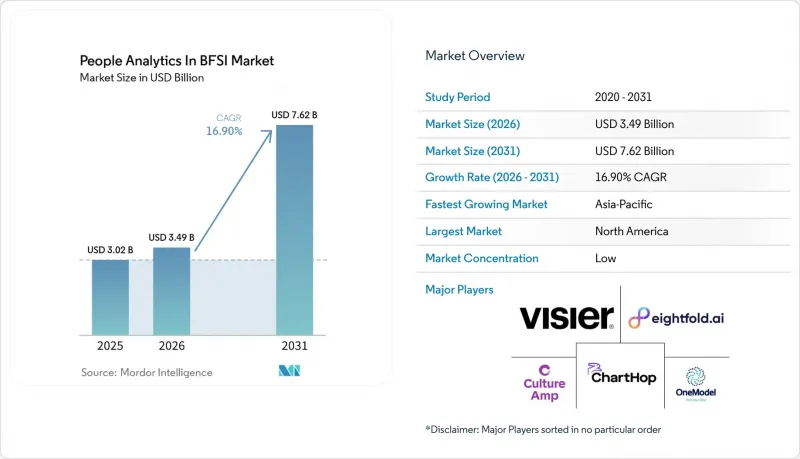
本報告按元件(軟體、服務)、部署類型(雲端、本地部署、混合部署)、企業規模(大型企業、中小企業)、應用領域(員工差旅規劃、人才招聘與培訓等)、最終用戶(銀行、保險、金融服務等)以及地區進行細分。市場預測以美元計價。
全球銀行、金融服務和保險(BFSI)人員分析市場的趨勢和見解。
人工智慧驅動的人才智慧和員工離職預測模型
金融服務業的人力分析發展源自於其人才職能從回顧性報告到即時決策支援的顯著轉變。儘管金融服務業人力資源團隊的採用率仍落後於其他部門,但這並不意味著市場已飽和,而是顯示未來仍有龐大的發展空間。一項實際的變革是,人工智慧模型現在可以在員工流動週期的早期階段檢測到員工異常情況和潛在的離職風險叢集,從而無需人力資源團隊在問題出現後才創建儀表板。這對大規模金融機構意義重大,因為隨著內部生產力和內部招募率的提高,人才分析對於營運效率和人才保留都至關重要。使用金融業資料集的同行評審研究表明,基於生成對抗網路(GAN)-Transformer 的離職預測模型準確率已達到 92% 至 96.95%,隨著預測性留任分析走出實驗階段,其在金融服務業的商業意義也日益凸顯。
勞動力數據和可審計性的監管複雜性
隨著員工資料管治融入更廣泛的營運彈性及人工智慧合規框架,面向業務安全(BFSI)產業的人力分析正日益受到重視。資料營運風險評估(DORA)的實施,使得記錄對第三方服務的依賴性變得尤為重要,進而推動了對能夠維護持久日誌並實現人力資源工作流程可追溯管理的平台的需求。歐盟人工智慧法規將員工績效評估、離職預測和任務分配系統視為高風險人工智慧應用,因此在選擇供應商時,對員工的管治監督和透明度至關重要。儘管歐盟於2026年5月簽署的《數位綜合協議》將就業領域人工智慧合規的全面實施期限延長至2027年12月,但這一寬限期有利於那些提前建立合規營運模式的組織。在BFSI人力分析市場,隨著實施日期的臨近,這種情況很可能導致分階段的採用浪潮,而非平穩的漸進式發展。
跨境員工資料的資料隱私、資料駐留與摩擦
資料主權仍然是銀行、金融服務和保險(BFSI)產業人力分析面臨的最突出限制之一。這是因為員工記錄通常包含敏感的本地勞動、隱私和薪資訊息,這些資訊難以跨境標準化。在中國和俄羅斯,員工資料本地儲存是強制性的,這迫使跨國公司建立平行的人力資源環境,削弱了高階分析所需的統一勞動力模型。在印度,2025年底新增了與《資料保護和隱私法》(DPDP)相關的跨境合規義務,這使得隱私管理更需要與勞動和稅務框架相協調,而不是將其視為一項獨立工作。根據2026年5月的報告,一些公司正在將人力資本人工智慧相關的營運遷移回企業內部或嚴格控制的內部網路,以維持對薪酬、繼任計畫和紀律數據的直接控制。這一趨勢正在減緩BFSI產業人力分析平台的部署速度,尤其是在缺乏跨多個司法管轄區在本地部署技術能力的小規模區域性金融機構。
細分市場分析
預計到2025年,軟體將佔據銀行、金融服務和保險(BFSI)行業人力分析市場佔有率的64.37%,這證實了平台而非服務仍然是該領域的主要支出項目。軟體佔最大佔有率的原因在於,BFSI機構更重視可預測的授權結構和產品本身的功能,而非具有固定期限和高度服務依賴性的合約。隨著供應商開始將諸如離職風險評分、薪酬差距檢驗、技能推斷和人才規劃等功能整合到標準產品版本中,而不是將其作為客製化項目打包,這一趨勢進一步加強。在BFSI人力分析領域,這一趨勢有利於能夠將分析功能直接整合到管理人員和人力資源工作流程中的SaaS原生供應商,而不是將洞察分析視為單獨的報告層。
預計到2031年,服務業將以16.93%的複合年成長率成長,顯示隨著平台日趨複雜,實施難度也隨之增加。由於人才資料通常分散在分散的人力資源資訊系統(HRIS)環境和傳統銀行系統中,金融機構仍需要諮詢、整合、配置和託管支援。截至2025年初,僅有18%的金融服務公司高階主管在其人才職能部門實施了生成式人工智慧,顯示平台潛力與企業準備程度之間存在差距。預計2026年人力資源人工智慧預算將大幅成長,這也是服務需求與軟體同步成長而非取代軟體的原因之一。因此,在銀行、金融服務和保險(BFSI)行業的人力分析領域,儘管軟體仍保持主導地位,但服務作為必要的執行層正在不斷發展,以確保平台能夠在實際營運約束下正常運作。
預計到2025年,雲端將佔據銀行、金融服務和保險(BFSI)產業人力分析市場規模的69.41%。這反映了大規模人力資本管理(HCM)生態系統的強大地位,該生態系統已開始將分析功能打包到更廣泛的套件部署中。這種主導地位源自於雲端交付所帶來的規模經濟效益,尤其是在金融機構尋求更快的更新速度、更便利的人力資源和財務工作流程整合以及更低的基礎設施開銷時,這一點更為明顯。 Workday、SAP SuccessFactors和Oracle HCM Cloud推動了嵌入式分析的普及。因此,許多BFSI行業的買家正在從獨立工具轉向套件主導的部署模式。因此,儘管資料敏感度使得BFSI人力分析的部署討論比許多其他軟體類別更為複雜,但雲端仍然被視為預設的營運模式。
隨著機構對分析柔軟性的需求日益成長,同時又不願犧牲對高度敏感的員工記錄的本地控制權,混合部署預計到2031年將以17.63%的複合年成長率成長,成為所有部署模式中成長最快的。這並非回歸傳統思維,而是一種經過深思熟慮的架構選擇,其依據是資料儲存位置、隱私和監管要求。 2026年5月的一份報告指出,一些公司正在根據需要將人力資本人工智慧工作負載遷移回託管網路,這與該領域混合模式的興起不謀而合。對主權雲端的投資也在拓展合規選項,AWS和Google雲端承諾在印尼進行大規模資料中心投資,以回應2026年4月的在地化法規。在銀行、金融服務和保險(BFSI)產業的人力分析市場,混合模式正逐漸成為一種以合規為導向的架構,而不僅僅是權宜之計。
區域分析
到2025年,北美將成為最大的區域市場,佔銀行、金融服務和保險(BFSI)人力分析市場38.43%的佔有率。這一地位反映了雲端人力資源管理的成熟應用、更大的軟體預算以及服務金融機構的專業供應商的豐富人才儲備。美國證券交易委員會(SEC)基於SK條例的人力資本揭露框架提高了董事會和投資者層面人才保留、發展和薪酬的透明度,從而支撐了對可審計的勞動力數據系統的穩定需求。維吉尼亞和緬因州於2026年推出的州級工資透明度措施,以及同年稍後康乃狄克州推出的類似措施,進一步增加了區域性銀行和保險公司的資訊揭露壓力。因此,北美BFSI人力分析受益於成熟技術的應用以及將勞動力數據與公司管治重點緊密聯繫起來的資訊揭露環境。
預計到2031年,亞太地區將以17.89%的複合年成長率成長,成為BFSI(銀行、金融服務和保險)人力分析市場成長最快的地區。該地區之所以脫穎而出,是因為印度、中國、韓國、澳洲和新加坡等BFSI產業的龐大勞動力正在快速實現數位轉型。在印度,印度儲備銀行於2025年11月發布的外包指南提高了加強合規性和員工監控的需求。這導致人們對關鍵員工追蹤、背景調查和事件報告系統的期望值不斷提高。在中國,一項針對2026年主要上市銀行的分析顯示,金融機構正在根據人工智慧替代性對職位進行分類,為重新部署規劃和內部人才細分奠定更正式的基礎。在新加坡,透過產業主導的技能發展計劃,正在建立一種區域模式,這推動了BFSI人力分析整體技能分析和人才規劃工具的普及應用。
歐洲正遵循監管主導的路徑推進人力分析技術的應用,而南美、中東和非洲則蘊藏著巨大的發展機遇,儘管這些地區在銀行業、金融服務業和保險業(BFSI)的人力分析領域仍處於起步階段。隨著歐盟工資透明指令(EU Wage Transparency Directive)於2026年6月在各國實施的最後期限臨近,一些歐洲國家的銀行已著手改善職位結構、薪資等級和薪資分析能力。法國尤其積極,法國公共銀行協會(BPCE)已簽署一項關於生成式人工智慧的就業協議,該協議將於2025年生效;法國銀行家協會也正在研究生成式人工智慧對九個銀行職位類別的影響。在南美,數位銀行的擴張和人力資源部門的現代化正為雲端主導的採用鋪平道路;而沙烏地阿拉伯、阿拉伯聯合大公國和南非則對人才規劃、在地化專案和數位化人才保留的需求日益成長。
其他好處:
- Excel格式的市場預測(ME)表
- 3個月的分析師支持
目錄
第1章:引言
- 市場分析與定義的前提條件
- 分析範圍
第2章 分析方法
第3章執行摘要
第4章 市場狀況
- 市場概覽
- 市場促進因素
- 勞動力數據和可審計性的監管複雜性
- 人工智慧驅動的人才分析與員工離職預測模型
- 銀行和保險公司雲端人力資源現代化
- 以數位和人工智慧相關職位的技能型人才規劃
- 與現場行動和合規性相關的行為風險監測
- 強制性工資透明度和人力資本揭露
- 市場限制因素
- 員工資料的資料隱私、資料駐留和跨境摩擦
- 將傳統人力資源系統與核心系統整合的複雜性。
- 招聘決策中的演算法偏見和可解釋性風險
- 受監管的銀行、金融服務和保險 (BFSI) 行業在人工智慧應用準備方面存在差異
- 宏觀經濟因素對市場的影響
- 產業價值鏈分析
- 監理情勢
- 技術展望
- 波特五力分析
第5章:預測市場規模與成長率
- 按組件
- 軟體
- 服務
- 透過部署方法
- 雲
- 現場
- 混合
- 公司規模
- 大公司
- 小型企業
- 透過使用
- 勞動力計劃
- 人才招聘和培訓
- 員工敬業度與發展
- 員工留任與流失分析
- 薪酬分析
- 合規性、風險和勞動力分析
- 最終用戶
- 銀行
- 保險
- 金融服務
- 金融科技
- 資本市場和投資公司
- 按地區
- 北美洲
- 美國
- 加拿大
- 墨西哥
- 南美洲
- 巴西
- 阿根廷
- 其他南美國家
- 歐洲
- 德國
- 英國
- 法國
- 義大利
- 西班牙
- 俄羅斯
- 荷蘭
- 其他歐洲國家
- 亞太地區
- 中國
- 日本
- 印度
- 韓國
- 澳洲和紐西蘭
- 其他亞太國家
- 中東
- 沙烏地阿拉伯
- 阿拉伯聯合大公國
- 其他中東國家
- 非洲
- 南非
- 奈及利亞
- 其他非洲國家
- 北美洲
第6章 競爭情勢
- 市場集中度
- 策略趨勢
- 市佔率分析
- 公司簡介。
- Visier, Inc.
- Eightfold AI Inc.
- One Model Inc.
- ChartHop, Inc.
- Culture Amp Pty Ltd
- Orgvue Limited
- Panalyt Inc.
- TalentNeuron, LLC
- Syndio Solutions, Inc.
- Praisidio, Inc.
- Worklytics Co.
- Aura Intelligence, Inc.
- Sapience Analytics Corporation
- Prohance Inc.
- Gloat Ltd.
- Perceptyx, Inc.
- Betterworks System Inc.
- Leapsome GmbH
- Hi Bob, Inc.
- Knoetic, Inc.
第7章 市場機會與未來展望
According to Mordor Intelligence, the people analytics in BFSI market size is projected to expand from USD 3.02 billion in 2025 and USD 3.49 billion in 2026 to USD 7.62 billion by 2031, registering a CAGR of 16.90% between 2026 to 2031.
This report is Segmented by Component (Software, and Services), Deployment Mode (Cloud, On-Premises, and Hybrid), Enterprise Size (Large Enterprises, and Small and Medium Enterprises), Application (Workforce Planning, Talent Acquisition and Onboarding, and More), End-User (Banking, Insurance, Financial Services, and More), and Geography. The Market Forecasts are Provided in Terms of Value (USD).
Global People Analytics In BFSI Market Trends and Insights
AI-Powered Talent Intelligence And Predictive Attrition Modeling
The people analytics in BFSI market is being driven by a clear shift from backward-looking reporting to real-time decision support within talent functions. Adoption in financial services talent teams still trails other business functions, which leaves a meaningful runway for further deployment rather than signaling saturation. The practical change is that HR teams are no longer expected to pull dashboards after a problem appears, because AI models can now flag workforce anomalies and potential flight-risk clusters earlier in the cycle. In large institutions, this matters because internal productivity gains and higher internal fill rates make workforce analytics relevant to both operating efficiency and retention. The commercial case is stronger now because peer-reviewed research on financial-sector datasets showed that GAN-Transformer attrition models achieved 92% to 96.95% accuracy, moving predictive retention analytics out of the experimental stage for people analytics in the BFSI market.
Rising Regulatory Complexity In Workforce Data And Auditability
The people analytics in BFSI market is also gaining support as workforce data governance is folded into broader operational resilience and AI compliance frameworks. DORA has raised the need to document third-party service dependencies, which increases demand for platforms that can maintain durable logs and traceable controls across HR workflows. The EU AI Act has treated employee performance evaluation, attrition prediction, and task allocation systems as high-risk AI uses, making governance oversight and worker transparency more central in vendor selection. A May 2026 EU Digital Omnibus agreement delayed the full employment AI compliance deadline to December 2027, but that extra time favors institutions that start building compliant operating models early. In the people analytics market in the BFSI, this setup is likely to produce stepwise adoption waves as firms move closer to enforcement rather than a smooth, gradual uptake path.
Data Privacy, Data Residency, And Cross-Border Employee Data Friction
Data sovereignty remains one of the clearest constraints on people analytics in the BFSI market because employee records often carry local labor, privacy, and compensation sensitivities that are harder to standardize across borders. China and Russia require local storage of employee data, which pushes multinational firms toward parallel HR environments and weakens the unified workforce models that advanced analytics needs. India added another layer in late 2025 through DPDP-related cross-border compliance obligations, which increased the need to align privacy management with labor and tax structures rather than treating it as a stand-alone exercise. Some firms were reported in May 2026 to be moving human capital AI activity back on-premises or into tightly controlled internal networks to retain direct control over compensation, succession, and disciplinary data. That pattern slows platform rollouts in the people analytics market in BFSI sector, especially for smaller regional institutions that lack the technical capacity to operate local deployments across multiple jurisdictions.
Other drivers and restraints analyzed in the detailed report include:
- Cloud HR Modernization Across Banks And Insurers
- Skills-Based Workforce Planning For Digital And AI Roles
- Algorithmic Bias And Explainability Risk In Employment Decisions
For complete list of drivers and restraints, kindly check the Table Of Contents.
Segment Analysis
Software accounted for 64.37% of the people analytics in BFSI market share in 2025, confirming that platforms, not services, remain the core spending line in this category. The largest share lies with software, as BFSI institutions prefer predictable licensing structures and direct product capabilities over open-ended, services-heavy engagements. That preference has strengthened as vendors embed attrition scoring, pay equity review, skills inference, and workforce planning features into standard product releases rather than packaging them as custom projects. In people analytics in the BFSI industry, this pattern favors SaaS-native vendors that can embed analytics directly into managers' and HR workflows, rather than treating insights as a separate reporting layer.
Services are projected to grow at a 16.93% CAGR through 2031, indicating that implementation complexity is rising as platforms become more sophisticated. Institutions still need advisory, integration, configuration, and managed support because workforce data often sits across fragmented HRIS environments and legacy banking systems. Only 18% of financial services executives were implementing generative AI in their talent functions in early 2025, suggesting a gap between the potential of the platform and enterprise readiness. HR-AI budgets rose sharply for 2026, which helps explain why services demand is growing alongside software rather than being displaced by it. The people analytics in the BFSI market, therefore, keeps software in the lead, while services expand as the execution layer required to make those platforms work under real operating constraints.
Cloud accounted for 69.41% of the people analytics in BFSI market size in 2025, reflecting the strong position of large HCM ecosystems that now package analytics as part of broader suite adoption. This lead is grounded in the scale advantages of cloud delivery, especially where institutions want faster updates, easier integration across HR and finance workflows, and lower infrastructure overhead. Workday, SAP SuccessFactors, and Oracle HCM Cloud have helped normalize embedded analytics, which has pulled many BFSI buyers toward suite-led deployment models rather than stand-alone tools. People analytics in the BFSI market has therefore treated cloud as the default operating model, even though data sensitivity makes the deployment discussion more complex than in many other software categories.
Hybrid deployment is projected to grow at a 17.63% CAGR through 2031, the fastest among deployment models, as institutions increasingly seek analytics flexibility without sacrificing local control over sensitive employee records. This is not a return to legacy thinking, but a deliberate architecture choice shaped by data residency, privacy, and regulated oversight. Some firms were reported in May 2026 to be moving human capital AI workloads back into controlled networks where necessary, which aligns with the rise of hybrid models in the sector. Sovereign cloud investments are also expanding compliant options, with AWS and Google Cloud committing to major in-country data center investments in Indonesia after the April 2026 localization rules. In the people analytics market in the BFSI, hybrid is becoming a compliance architecture rather than a temporary bridge.
Geography Analysis
North America accounted for 38.43% of the people analytics market in the BFSI market in 2025, making it the largest regional market. This position reflects mature cloud HR adoption, larger software budgets, and a deep pool of specialized vendors serving financial institutions. The SEC human capital disclosure framework under Regulation S-K has made retention, talent development, and compensation more visible at the board and investor level, which supports steady demand for auditable workforce data systems. State-level pay transparency measures in Virginia and Maine in 2026, followed by Connecticut later in the year, added another layer of reporting pressure for regional banks and insurers. The people analytics in the BFSI market in North America, therefore, benefits from a mix of mature technology adoption and a disclosure environment that keeps workforce data close to enterprise governance priorities.
Asia-Pacific is projected to grow at a 17.89% CAGR through 2031, making it the fastest-growing region in the people analytics market in BFSI. The region stands out because large BFSI workforces are being digitized quickly across India, China, South Korea, Australia, and Singapore. India is seeing stronger compliance and greater workforce monitoring needs following the Reserve Bank of India's outsourcing directions issued in November 2025, which raised expectations for essential personnel tracking, background verification, and incident reporting discipline. In China, an analysis of major listed banks in 2026 showed that institutions were categorizing roles by AI substitutability, creating a more formal basis for redeployment planning and internal workforce segmentation. Singapore also adds a regional template through industry-led skilling programs, which supports broader adoption of skills analytics and workforce planning tools across the people analytics in BFSI market.
Europe follows a regulatory-first adoption path, while South America, the Middle East, and Africa represent earlier-stage but meaningful expansion opportunities for people analytics in the BFSI market. The June 2026 transposition deadline for the EU Pay Transparency Directive prompted banks in several European countries to improve their job architecture, pay grading, and compensation analytics capabilities. France showed particularly visible activity, with BPCE signing an employment accord around generative AI in 2025 and the French Banking Federation studying the impact of GenAI across nine banking professions. In South America, digital banking expansion and HR modernization are opening the door to cloud-led adoption, while Saudi Arabia, the UAE, and South Africa are driving demand for workforce planning, localization programs, and digital talent retention.
- Visier, Inc.
- Eightfold AI Inc.
- One Model Inc.
- ChartHop, Inc.
- Culture Amp Pty Ltd
- Orgvue Limited
- Panalyt Inc.
- TalentNeuron, LLC
- Syndio Solutions, Inc.
- Praisidio, Inc.
- Worklytics Co.
- Aura Intelligence, Inc.
- Sapience Analytics Corporation
- Prohance Inc.
- Gloat Ltd.
- Perceptyx, Inc.
- Betterworks System Inc.
- Leapsome GmbH
- Hi Bob, Inc.
- Knoetic, Inc.
Additional Benefits:
- The market estimate (ME) sheet in Excel format
- 3 months of analyst support
TABLE OF CONTENTS
1 INTRODUCTION
- 1.1 Study Assumptions and Market Definition
- 1.2 Scope of the Study
2 RESEARCH METHODOLOGY
3 EXECUTIVE SUMMARY
4 MARKET LANDSCAPE
- 4.1 Market Overview
- 4.2 Market Drivers
- 4.2.1 Rising Regulatory Complexity in Workforce Data and Auditability
- 4.2.2 AI-Powered Talent Intelligence and Predictive Attrition Modeling
- 4.2.3 Cloud HR Modernization Across Banks and Insurers
- 4.2.4 Skills-Based Workforce Planning for Digital and AI Roles
- 4.2.5 Behavioral-Risk Monitoring for Front-Line Conduct and Compliance
- 4.2.6 Pay Transparency and Human Capital Disclosure Mandates
- 4.3 Market Restraints
- 4.3.1 Data Privacy, Data Residency, and Cross-Border Employee Data Friction
- 4.3.2 Legacy HR and Core System Integration Complexity
- 4.3.3 Algorithmic Bias and Explainability Risk in Employment Decisions
- 4.3.4 AI Readiness Gaps Across Regulated BFSI Workforces
- 4.4 Impact of Macroeconomic Factors on the Market
- 4.5 Industry Value Chain Analysis
- 4.6 Regulatory Landscape
- 4.7 Technological Outlook
- 4.8 Porter's Five Forces Analysis
- 4.8.1 Threat of New Entrants
- 4.8.2 Bargaining Power of Buyers
- 4.8.3 Bargaining Power of Suppliers
- 4.8.4 Threat of Substitutes
- 4.8.5 Intensity of Competitive Rivalry
5 MARKET SIZE AND GROWTH FORECASTS (VALUE)
- 5.1 By Component
- 5.1.1 Software
- 5.1.2 Services
- 5.2 By Deployment Mode
- 5.2.1 Cloud
- 5.2.2 On-premises
- 5.2.3 Hybrid
- 5.3 Enterprise Size
- 5.3.1 Large Enterprises
- 5.3.2 Small and Medium Enterprises
- 5.4 By Application
- 5.4.1 Workforce Planning
- 5.4.2 Talent Acquisition and Onboarding
- 5.4.3 Employee Engagement and Development
- 5.4.4 Retention and Attrition Analytics
- 5.4.5 Payroll and Compensation Analytics
- 5.4.6 Compliance and Risk Workforce Analytics
- 5.5 By End-user
- 5.5.1 Banking
- 5.5.2 Insurance
- 5.5.3 Financial Services
- 5.5.4 FinTech
- 5.5.5 Capital Markets and Investment Firms
- 5.6 By Geography
- 5.6.1 North America
- 5.6.1.1 United States
- 5.6.1.2 Canada
- 5.6.1.3 Mexico
- 5.6.2 South America
- 5.6.2.1 Brazil
- 5.6.2.2 Argentina
- 5.6.2.3 Rest of South America
- 5.6.3 Europe
- 5.6.3.1 Germany
- 5.6.3.2 United Kingdom
- 5.6.3.3 France
- 5.6.3.4 Italy
- 5.6.3.5 Spain
- 5.6.3.6 Russia
- 5.6.3.7 Netherlands
- 5.6.3.8 Rest of Europe
- 5.6.4 Asia-Pacific
- 5.6.4.1 China
- 5.6.4.2 Japan
- 5.6.4.3 India
- 5.6.4.4 South Korea
- 5.6.4.5 Australia and New Zealand
- 5.6.4.6 Rest of Asia-Pacific
- 5.6.5 Middle East
- 5.6.5.1 Saudi Arabia
- 5.6.5.2 United Arab Emirates
- 5.6.5.3 Rest of Middle East
- 5.6.6 Africa
- 5.6.6.1 South Africa
- 5.6.6.2 Nigeria
- 5.6.6.3 Rest of Africa
- 5.6.1 North America
6 COMPETITIVE LANDSCAPE
- 6.1 Market Concentration
- 6.2 Strategic Moves
- 6.3 Market Share Analysis
- 6.4 Company Profiles (includes Global Level Overview, Market Level Overview, Core Segments, Financials as available, Strategic Information, Market Rank/Share, Products and Services, Recent Developments).
- 6.4.1 Visier, Inc.
- 6.4.2 Eightfold AI Inc.
- 6.4.3 One Model Inc.
- 6.4.4 ChartHop, Inc.
- 6.4.5 Culture Amp Pty Ltd
- 6.4.6 Orgvue Limited
- 6.4.7 Panalyt Inc.
- 6.4.8 TalentNeuron, LLC
- 6.4.9 Syndio Solutions, Inc.
- 6.4.10 Praisidio, Inc.
- 6.4.11 Worklytics Co.
- 6.4.12 Aura Intelligence, Inc.
- 6.4.13 Sapience Analytics Corporation
- 6.4.14 Prohance Inc.
- 6.4.15 Gloat Ltd.
- 6.4.16 Perceptyx, Inc.
- 6.4.17 Betterworks System Inc.
- 6.4.18 Leapsome GmbH
- 6.4.19 Hi Bob, Inc.
- 6.4.20 Knoetic, Inc.
7 MARKET OPPORTUNITIES AND FUTURE OUTLOOK
- 7.1 White-Space and Unmet-Need Assessment

 人力資源分析:市場佔有率分析、產業趨勢與統計、成長預測(2026-2031)
 人力資源分析市場-2026-2032年全球市場預測
 神經多樣性人力資源技術市場預測至2034年:按部署類型、解決方案、技術、組織規模、最終用戶和地區分類的全球分析神經多樣性分析與洞察市場預測(2034 年)—按解決方案類型、神經多樣性概況、部署模式、應用、最終用戶和地區分類的全球分析2034 年神經多樣性人力資源和人才分析平台市場預測——全球平台類型、分析重點領域、部署方法、經營模式、產業、最終用戶和地區分析——產業特定分析歐洲人力資源分析:市場佔有率分析、產業趨勢與統計、成長預測(2026-2031)
 人力資源分析市場規模、佔有率和趨勢分析報告:按解決方案、服務、部署類型、企業規模、最終用途、地區和細分市場預測(2026-2033 年)
 人力資源分析市場-全球產業規模、佔有率、趨勢、機會和預測,按解決方案、部署方式、企業規模、最終用途、服務、地區和競爭格局分類,2021-2031年預測
 人力資源分析市場規模、佔有率和成長分析(按解決方案、服務、部署類型、公司規模、最終用途和地區分類)-2026-2033年產業預測