


 |
市場調查報告書
商品編碼
2122945
北美暖通空調設備:市佔率分析、產業趨勢與統計及成長預測(2026-2031 年)North America HVAC Equipment - Market Share Analysis, Industry Trends & Statistics, Growth Forecasts (2026 - 2031) |
||||||

※ 本網頁內容可能與最新版本有所差異。詳細情況請與我們聯繫。
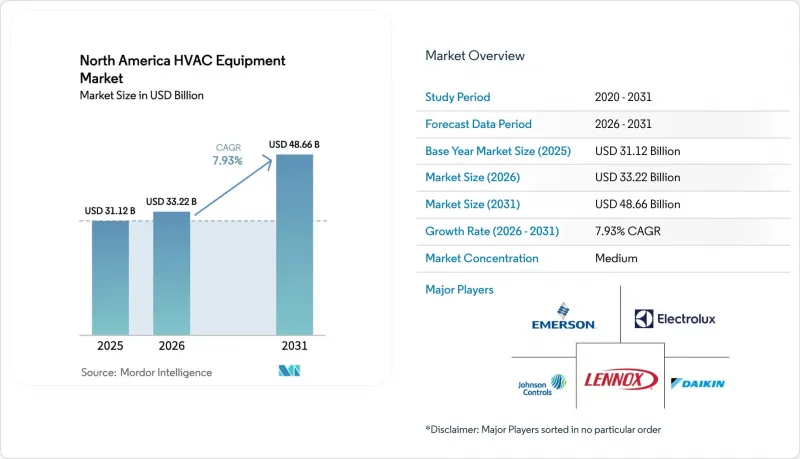
根據 Mordor Intelligence 預測,北美 HVAC 設備市場規模將從 2025 年的 311.2 億美元成長到 2026 年的 332.2 億美元,然後在 2031 年達到 486.6 億美元,2026 年至 2031 年的複合年成長率為 7.93%。
本報告按設備類型(暖氣設備、通風設備、空調設備)、安裝類型(新建、維修、更換)、最終用戶(住宅、商業、工業)、商業建築類型(辦公大樓、醫療設施等)和國家/地區進行細分。市場預測以美元計價。
北美暖通空調設備市場趨勢與洞察
熱泵的迅速普及和暖氣電氣化
聯邦政府對每台設備最高可達 2000 美元的稅額扣抵,加上各州禁止新建天然氣管道,使得美國熱泵的出貨量首次超過了燃氣爐。在加拿大,即使在華氏零下 15 度(約攝氏 46 度)的低溫環境下也能滿載運轉的寒冷氣候型熱泵正日益受到歡迎,這得益於公共產業提供的 5,000 加幣(約 3,950 美元)的補貼。變速壓縮機的季節性能係數 (SOP) 目前通常可達 3.5,這使得東北部許多市場的投資回收期縮短至不到六年。隨著區域燃氣公司轉向電氣化獎勵,將熱泵與備用電阻加熱器結合的雙燃料系統在維修專案中越來越受到關注。預計這種結構性轉變將在整個預測期內推動北美暖通空調設備市場向電加熱方向發展。
低全球暖化潛勢 A2L 冷媒的加速普及,正引發設備更換熱潮。
美國《創新與製造法案》將在2024年前將氫氟碳化合物(HFC)配額減少40%,這將導致R-410A價格上漲60%,並迫使原始設備製造商(OEM)轉向R-454B和R-32配方。修訂後的ASHRAE 15和NFPA 1標準強制要求整合洩漏檢測和提高通風性能,從而促進採用工廠預充冷媒的設備,以最大限度地減少現場冷媒處理。由於預計配額將進一步減少,建築物業主正在積極淘汰使用10-12年的系統,這加速了設備更換浪潮,有利於擁有廣泛分銷網路的品牌。更短的產品生命週期增加了售後市場零件的收入,並使能夠快速切換設計平台的製造商受益。
改用A2L冷媒將增加責任責任險費用。
到2025年,隨著保險承銷商將洩漏相關的火災風險納入保費,承包商的保險費上漲了15%至25%,更嚴格的合規措施導致每個機房額外增加500至1500美元的成本。無法獲得培訓和檢測設備資金的小規模安裝商正在退出市場,導致通路整合和人事費用上升。多戶住宅的物業經理正面臨保險公司的嚴格審查,導致熱泵維修傳統暖氣爐的批准延遲。短期內,飆升的責任成本預計將抑制價格敏感型住宅對A2L系統的接受度。
細分市場分析
到2025年,空調設備將佔北美暖通空調設備市場總額的46.43%,複合年成長率達8.64%,主要受製冷度日數增加和R-410A系統逐步淘汰的推動。該細分市場在北美暖通空調設備市場的銷售反映了其在住宅和小規模商業場所的強勁需求。無管道迷你分離式空調系統因其滿足了不適合安裝管道場所的維修需求而脫穎而出,而變冷劑流量(VRF)平台則可實現大型商業空間的同步供暖和製冷。
熱泵作為暖氣設備,正迅速縮小與燃氣暖氣設備之間的差距。強制電氣化和各種補貼計畫正在縮小熱泵與燃氣暖氣設備的安裝成本差異,而電動解決方案正在改變其在北美暖通空調設備市場的佔有率。通風設備,例如能源回收通風機和加濕器,正受益於室內空氣品質 (IAQ) 法規的合規性,而由於計費簡便且節省空間,一體式末端設備再次被多用戶住宅設計規範所採用。
到2025年,維修和更換安裝將佔北美暖通空調設備市場佔有率的60.84%,隨著屋主在更嚴格的冷媒法規訂定前加快系統升級,短期銷售將持續成長。融資優惠和季節性更換宣傳活動鼓勵住宅在盛夏發生代價高昂的故障之前及早解決問題。同時,受墨西哥工業廠房和美國陽光地帶多用戶住宅項目的影響,北美新建築的暖通空調設備市場正以8.29%的複合年成長率成長。
建築公司擴大採用預製機房,這些機房在交付已完成佈線和冷藏,從而減少了高達 50% 的現場人工。電氣化簡化了平面佈局,無需鋪設燃氣管道,但需要升級配電盤,每個單元將增加 2,000 至 4,000 美元的成本。到 2031 年,維修和新建項目之間的差距只會略微縮小,設備更換支出仍將是整體成長的主要驅動力之一。
其他好處:
- Excel格式的市場預測(ME)表
- 3個月的分析師支持
目錄
第1章:引言
- 研究假設和市場定義
- 調查範圍
第2章:調查方法
第3章執行摘要
第4章 市場狀況
- 市場概覽
- 市場促進因素
- 住宅和非住宅建設活動活動活性化
- 嚴格的能源效率法規和獎勵
- 熱泵的迅速普及和暖氣電氣化
- 對智慧互聯暖通空調系統的需求日益成長
- 低全球暖化潛值 A2L 冷媒的採用正在加速,從而掀起了一股替代浪潮。
- 預製模組化暖通空調設備的出現,使得快速維修成為可能。
- 市場限制因素
- 高效率系統的初始設備成本較高
- 安裝和維護工作中技術純熟勞工短缺
- 由於關鍵電子元件和感測器短缺,供應鏈脆弱性增加。
- 向 A2L 冷媒的過渡增加了責任險的成本。
- 產業價值鏈分析
- 宏觀經濟因素對市場的影響
- 監理情勢
- 技術展望
- 波特五力分析
- 關鍵績效指標
第5章 市場規模與成長預測
- 依設備類型
- 加熱設備
- 鍋爐和熔爐
- 熱泵
- 整合式加熱器
- 通風設備
- 空調機組(AHU)
- 空氣過濾器
- 風機盤管機組
- 加濕器和除濕器
- 空調設備
- 單元空調
- 管道式分離式空調
- 無管道迷你分離式空調
- 整體式屋頂空調
- 可變冷媒流量(VRF)系統
- 室內空調
- 包裝式終端空調
- 冷卻器
- 單元空調
- 加熱設備
- 按安裝類型
- 新建工程
- 改裝/更換
- 最終用戶
- 住宅
- 商業的
- 產業
- 按建築類型(商業)
- 辦公大樓
- 醫療機構
- 飯店及休閒
- 零售商店和購物中心
- 教育機構
- 資料中心
- 國家
- 美國
- 加拿大
- 墨西哥
第6章 競爭情勢
- 市場集中度
- 策略趨勢
- 市佔率分析
- 公司簡介
- Carrier Global Corporation
- Daikin Industries Ltd.
- Johnson Controls International PLC
- Trane Technologies PLC
- Lennox International Inc.
- Rheem Manufacturing Company, Inc.
- Goodman Manufacturing Company, LP
- Nortek Global HVAC LLC
- Emerson Electric Co.
- Honeywell International Inc.
- LG Electronics Inc.
- Mitsubishi Electric Corporation
- Panasonic Corporation
- Bosch Thermotechnology Corp.
- Danfoss A/S
- Electrolux AB
- Uponor Corporation
- Gree Electric Appliances Inc.
- AAON Inc.
- Fujitsu General Ltd.
第7章 市場機會與未來展望
According to Mordor Intelligence, the North America HVAC equipment market size is expected to grow from USD 31.12 billion in 2025 to USD 33.22 billion in 2026 and is forecast to reach USD 48.66 billion by 2031 at 7.93% CAGR over 2026-2031.
This report is Segmented by Equipment Type (Heating Equipment, Ventilation Equipment, and Air-Conditioning Equipment), Installation Type (New Construction, Retrofit, and Replacement), End User (Residential, Commercial, and Industrial), Building Type for Commercial (Office Buildings, Healthcare Facilities, and More), and Country. The Market Forecasts are Provided in Terms of Value (USD).
North America HVAC Equipment Market Trends and Insights
Rapid Adoption of Heat Pumps and Electrification of Heating
Federal tax credits of up to USD 2,000 per unit, combined with state bans on new natural-gas hookups, have propelled heat-pump shipments beyond gas furnaces for the first time in U.S. history. Cold-climate units capable of delivering full capacity at -15 °F, backed by CAD 5,000 (USD 3,950) in utility rebates, are taking hold in Canada. Variable-speed compressors now routinely achieve seasonal COPs of 3.5, reducing payback periods to fewer than 6 years in many Northeast markets. As regional gas utilities pivot toward electrification incentives, dual-fuel systems pairing heat pumps with backup resistance heaters are gaining traction in retrofit projects. This structural shift is expected to re-weight the North America HVAC equipment market toward electrically driven heating across the forecast horizon.
Accelerating Adoption of Low-GWP A2L Refrigerants Creating Replacement Wave
The American Innovation and Manufacturing Act triggered a 40% cut in hydrofluorocarbon quotas by 2024, lifting R-410A prices 60% and pushing OEMs to R-454B and R-32 formulations. Revised ASHRAE 15 and NFPA 1 codes now require integrated leak detection and enhanced ventilation, encouraging factory-charged equipment that minimizes field refrigerant handling. Building owners are pre-emptively retiring 10- to 12-year-old systems ahead of further quota cuts, accelerating a replacement wave that benefits brands with deep distributor networks. Shorter product life cycles increase aftermarket parts revenue and favor manufacturers able to quickly pivot design platforms.
Transition to A2L Refrigerants Increasing Liability Insurance Costs
Contractor insurance premiums rose 15-25% in 2025 as underwriters priced in leak-related fire risk, with compliance upgrades adding USD 500-1,500 per mechanical room. Smaller installers unable to fund training and detection equipment are exiting, consolidating channels, and raising labor costs. Multifamily property managers face insurer scrutiny, slowing approvals for heat-pump retrofits that would displace legacy furnaces. In the near term, elevated liability costs suppress penetration of A2L systems among price-sensitive residential buyers.
Other drivers and restraints analyzed in the detailed report include:
- Growing Demand for Smart and Connected HVAC Systems
- Stringent Energy-Efficiency Regulations and Incentives
- Supply-Chain Vulnerability Due to Critical Electronics and Sensor Shortages
For complete list of drivers and restraints, kindly check the Table Of Contents.
Segment Analysis
Air-conditioning equipment represented 46.43% of the overall North America HVAC equipment market share in 2025 and is scaling at an 8.64% CAGR, supported by rising cooling-degree days and the retirement of R-410A systems. The subsegment's revenue of the North America HVAC equipment market reflects its entrenched role in both residential and light-commercial buildings. Ductless mini-splits stand out by capturing retrofit demand where duct installation is impractical, while variable refrigerant flow platforms enable simultaneous heating and cooling across large commercial footprints.
Heat pumps, classified within heating equipment, are closing the gap fast. Electrification mandates and rebate stacks narrow the installed-cost delta versus gas furnaces, redirecting share within the North America HVAC equipment market toward electrically driven solutions. Ventilation gear such as energy-recovery ventilators and humidifiers rides the wave of IAQ compliance, while packaged terminal units return to multifamily design specs due to simplified billing and space savings.
Retrofit and replacement installations accounted for 60.84% of the North America HVAC equipment market share in 2025 and continue to drive near-term sales as owners accelerate system retirements ahead of tighter refrigerant caps. Financing promotions and seasonal replacement campaigns encourage homeowners to act before costly midsummer failures. Meanwhile, the North America HVAC equipment market size attached to new construction grows at an 8.29% CAGR, propelled by industrial plants in Mexico and multifamily projects across the U.S. Sunbelt.
Builders increasingly specify pre-packaged mechanical rooms that arrive fully wired and charged, trimming onsite labor by up to 50%. Electrification simplifies floor plans by eliminating gas piping but pushes panel upgrades that add USD 2,000-4,000 per dwelling. The balance between retrofit and new construction will narrow only modestly through 2031, keeping replacement spend a dominant thread in the overall growth story.
Complete Report Scope:
- By Equipment Type
- Heating Equipment
- Boilers and Furnaces
- Heat Pumps
- Unitary Heaters
- Ventilation Equipment
- Air Handling Units (AHUs)
- Air Filters
- Fan Coil Units
- Humidifiers and Dehumidifiers
- Air-Conditioning Equipment
- Unitary Air Conditioners
- Ducted Splits
- Ductless Mini-Splits
- Packaged Rooftops
- Variable Refrigerant Flow (VRF) Systems
- Room Air Conditioners
- Packaged Terminal Air Conditioners
- Chillers
- Unitary Air Conditioners
- Heating Equipment
- By Installation Type
- New Construction
- Retrofit / Replacement
- By End User
- Residential
- Commercial
- Industrial
- By Building Type (Commercial)
- Office Buildings
- Healthcare Facilities
- Hospitality and Leisure
- Retail Stores and Malls
- Educational Institutions
- Data Centers
- By Country
- United States
- Canada
- Mexico
List of Companies Covered in this Report:
- Carrier Global Corporation
- Daikin Industries Ltd.
- Johnson Controls International PLC
- Trane Technologies PLC
- Lennox International Inc.
- Rheem Manufacturing Company, Inc.
- Goodman Manufacturing Company, L.P.
- Nortek Global HVAC LLC
- Emerson Electric Co.
- Honeywell International Inc.
- LG Electronics Inc.
- Mitsubishi Electric Corporation
- Panasonic Corporation
- Bosch Thermotechnology Corp.
- Danfoss A/S
- Electrolux AB
- Uponor Corporation
- Gree Electric Appliances Inc.
- AAON Inc.
- Fujitsu General Ltd.
Additional Benefits:
- The market estimate (ME) sheet in Excel format
- 3 months of analyst support
TABLE OF CONTENTS
1 INTRODUCTION
- 1.1 Study Assumptions and Market Definition
- 1.2 Scope of the Study
2 RESEARCH METHODOLOGY
3 EXECUTIVE SUMMARY
4 MARKET LANDSCAPE
- 4.1 Market Overview
- 4.2 Market Drivers
- 4.2.1 Rising Residential and Non-residential Construction Activity
- 4.2.2 Stringent Energy-Efficiency Regulations and Incentives
- 4.2.3 Rapid Adoption of Heat Pumps and Electrification of Heating
- 4.2.4 Growing Demand for Smart and Connected HVAC Systems
- 4.2.5 Accelerating Adoption of Low-GWP A2L Refrigerants Creating Replacement Wave
- 4.2.6 Emergence of Prefabricated Modular HVAC Units for Quick Retrofits
- 4.3 Market Restraints
- 4.3.1 High Initial Capital Cost of High-Efficiency Systems
- 4.3.2 Skilled Labor Shortage for Installation and Maintenance
- 4.3.3 Supply-Chain Vulnerability Due to Critical Electronics and Sensor Shortages
- 4.3.4 Transition to A2L Refrigerants Increasing Liability Insurance Costs
- 4.4 Industry Value Chain Analysis
- 4.5 Impact of Macroeconomic Factors on the Market
- 4.6 Regulatory Landscape
- 4.7 Technological Outlook
- 4.8 Porter's Five Forces Analysis
- 4.8.1 Bargaining Power of Suppliers
- 4.8.2 Bargaining Power of Buyers
- 4.8.3 Threat of New Entrants
- 4.8.4 Threat of Substitutes
- 4.8.5 Intensity of Competitive Rivalry
- 4.9 Key Performance Indicators
5 MARKET SIZE AND GROWTH FORECASTS (VALUE)
- 5.1 By Equipment Type
- 5.1.1 Heating Equipment
- 5.1.1.1 Boilers and Furnaces
- 5.1.1.2 Heat Pumps
- 5.1.1.3 Unitary Heaters
- 5.1.2 Ventilation Equipment
- 5.1.2.1 Air Handling Units (AHUs)
- 5.1.2.2 Air Filters
- 5.1.2.3 Fan Coil Units
- 5.1.2.4 Humidifiers and Dehumidifiers
- 5.1.3 Air-Conditioning Equipment
- 5.1.3.1 Unitary Air Conditioners
- 5.1.3.1.1 Ducted Splits
- 5.1.3.1.2 Ductless Mini-Splits
- 5.1.3.1.3 Packaged Rooftops
- 5.1.3.1.4 Variable Refrigerant Flow (VRF) Systems
- 5.1.3.2 Room Air Conditioners
- 5.1.3.3 Packaged Terminal Air Conditioners
- 5.1.3.4 Chillers
- 5.1.3.1 Unitary Air Conditioners
- 5.1.1 Heating Equipment
- 5.2 By Installation Type
- 5.2.1 New Construction
- 5.2.2 Retrofit / Replacement
- 5.3 By End User
- 5.3.1 Residential
- 5.3.2 Commercial
- 5.3.3 Industrial
- 5.4 By Building Type (Commercial)
- 5.4.1 Office Buildings
- 5.4.2 Healthcare Facilities
- 5.4.3 Hospitality and Leisure
- 5.4.4 Retail Stores and Malls
- 5.4.5 Educational Institutions
- 5.4.6 Data Centers
- 5.5 By Country
- 5.5.1 United States
- 5.5.2 Canada
- 5.5.3 Mexico
6 COMPETITIVE LANDSCAPE
- 6.1 Market Concentration
- 6.2 Strategic Moves
- 6.3 Market Share Analysis
- 6.4 Company Profiles (Includes Global Level Overview, Market Level Overview, Core Segments, Financials as Available, Strategic Information, Market Rank/Share, Products and Services, and Recent Developments)
- 6.4.1 Carrier Global Corporation
- 6.4.2 Daikin Industries Ltd.
- 6.4.3 Johnson Controls International PLC
- 6.4.4 Trane Technologies PLC
- 6.4.5 Lennox International Inc.
- 6.4.6 Rheem Manufacturing Company, Inc.
- 6.4.7 Goodman Manufacturing Company, L.P.
- 6.4.8 Nortek Global HVAC LLC
- 6.4.9 Emerson Electric Co.
- 6.4.10 Honeywell International Inc.
- 6.4.11 LG Electronics Inc.
- 6.4.12 Mitsubishi Electric Corporation
- 6.4.13 Panasonic Corporation
- 6.4.14 Bosch Thermotechnology Corp.
- 6.4.15 Danfoss A/S
- 6.4.16 Electrolux AB
- 6.4.17 Uponor Corporation
- 6.4.18 Gree Electric Appliances Inc.
- 6.4.19 AAON Inc.
- 6.4.20 Fujitsu General Ltd.
7 MARKET OPPORTUNITIES AND FUTURE OUTLOOK
- 7.1 White-Space and Unmet-Need Assessment

 美國暖通空調設備:市場佔有率分析、產業趨勢與統計及成長預測(2026-2031)歐洲暖通空調設備:市場佔有率分析、產業趨勢與統計及成長預測(2026-2031)
 暖通空調設備市場報告:趨勢、預測與競爭分析(至2035年)暖通空調設備:市場佔有率分析、產業趨勢與統計、成長預測(2026-2031)
 北美暖通空調設備,2023-2031年Frost Radar(TM):暖通空調設備,2026 年暖通空調馬達市場:全球產業分析、市場規模及佔有率和預測(2026-2033 年)-按馬達類型、額定功率、暖通空調設備類型、最終用途、國家和地區分類
 暖通空調設備市場:2026-2032年全球市場預測(按組件、技術、燃料類型、容量、最終用途、安裝類型和分銷管道分類)全球暖通空調設備市場(2026-2031年)暖通空調馬達:市場佔有率分析、產業趨勢與統計、成長預測(2026-2031)