


 |
市場調查報告書
商品編碼
2072580
暖通空調馬達:市場佔有率分析、產業趨勢與統計、成長預測(2026-2031)HVAC Motor - Market Share Analysis, Industry Trends & Statistics, Growth Forecasts (2026 - 2031) |
||||||

※ 本網頁內容可能與最新版本有所差異。詳細情況請與我們聯繫。
根據 Mordor Intelligence 預測,HVAC 馬達市場規模預計將從 2025 年的 204.1 億美元成長到 2026 年的 213.5 億美元,然後從 2026 年到 2031 年以 4.74% 的複合年成長率成長,到 2031 年達到 269.1 億美元。
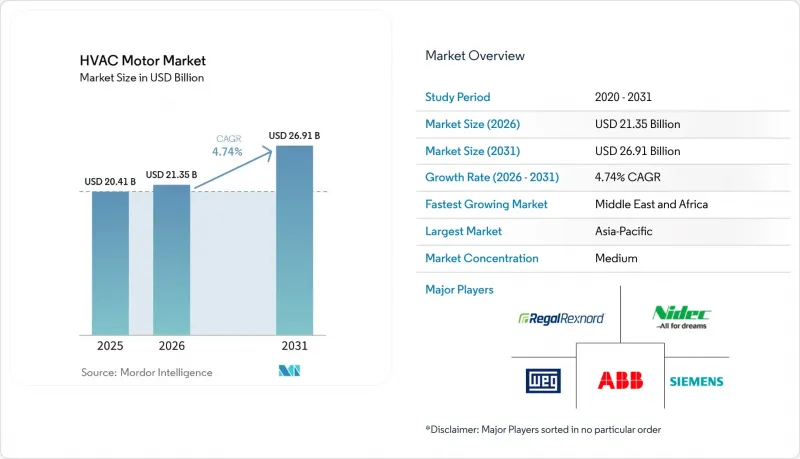
本報告按馬達類型(交流感應馬達、電子整流馬達、無刷直流馬達等)、額定功率(小於1馬力、1至5馬力等)、暖通空調設備類型(空調和熱泵、通風扇和鼓風機等)、最終用戶領域(住宅、商業等)以及地區進行細分。市場預測以美元計價。
全球暖通空調馬達市場趨勢與洞察
提高馬達和風扇的能源效率標準將有助於實現合規性升級。
美國能源局(DOE) 於 2025 年發布的一項最終規則擴大了功率範圍在 0.25 至 3 馬力之間的電動馬達的最低能效標準範圍。這直接影響到廣泛用於暖通空調 (HVAC) 電機市場的住宅和小規模商用電機,並將於 2029 年 1 月 1 日起強制執行。據能源部稱,到 2058 年,該規則將使整個燃料循環的能源消耗量減少 8.8 千兆焦耳,並為消費者帶來 211 億美元至 475 億美元的淨現值收益,而製造商的總轉換成本估計為 3.6 億美元。另一項直接針對功率範圍在 1 至 200 馬力之間的通用電動機的最終規則已設定了 2027 年 6 月 1 日的合規截止日期,從而堵住了此前允許許多大型商用 HVAC 電機在較低標準下運行的重大漏洞。 HVAC 馬達市場涵蓋了從小型住宅風扇系統到大型商用通風裝置的各種應用,因此這些截止日期有顯著的重疊。因此,合規的負擔將同時落在非常廣泛的安裝基礎之上。實際上,即使在買家歷來優先考慮低初始成本而非更高效率的應用領域,定速馬達(PSC)和簾子極馬達也正在提前淘汰。此次監管重組為暖通空調馬達市場向感應電動機(EC)、永磁同步馬達(PMSM)和其他已滿足更嚴格能源效率要求的變速平台過渡提供了更清晰的路徑。
熱泵和變頻式空調系統的廣泛應用,導致每個系統中變速馬達的採用率不斷提高。
儘管全球熱泵銷量在2024年和2025年有所放緩,但美國在2024年仍保持成長,熱泵銷量持續優於天然氣加熱器。這表明,在主要經濟體中,電加熱仍然是暖通空調馬達市場強勁的需求驅動力。此外,根據國際能源總署(IEA)的報告,2024年全球熱泵銷量較2020年成長27%,顯示變頻驅動設備的市場規模較幾年前大幅擴大。預測顯示,到2035年,熱泵將滿足日本和美國40%的空間加熱需求,顯示儘管短期內可能出現波動,但中期發展方向依然穩固。現代變頻驅動熱泵除了配備變速壓縮機馬達外,還採用多個無刷馬達或永磁馬達用於空氣循環、閥門控制和輔助泵,與傳統的單速機組相比,每個系統的馬達相關附加價值更高。美國環保署 (EPA) 的技術轉型計畫將於 2025 年 1 月 1 日起對住宅空調和熱泵實施全球暖化潛值 (GWP) 限制,迫使原始設備製造商 (OEM) 重新設計其產品,以適應 R-32 和 R-454B 等 A2L 冷媒。這項重新設計工作正在擴大變速和扭力匹配馬達平台在暖通空調 (HVAC) 馬達市場的應用範圍,即使在短期設備出貨量波動較大的地區也是如此。
高效率馬達的高昂初始成本阻礙了其廣泛應用。
在暖通空調馬達市場,高昂的初始成本仍是一大障礙。這是因為EC馬達、永磁同步馬達(PMSM)和開關式磁阻電動機的價格仍然遠高於功率相近的標準交流感應馬達。這個問題在住宅和其他對價格敏感的銷售管道中尤為突出,開發商和原始設備製造商(OEM)選擇電機,但電力成本最終由業主或居住者承擔。這種成本分攤機制削弱了降低生命週期成本優勢的論證力度,尤其是在新興市場,因為這些市場尚未普及補貼計畫和能源績效合約。這項限制尤其重要,因為成長最快的細分市場集中在銷售量龐大的領域,而這些領域仍然最容易受到高初始成本的影響。隨著美國能源局(DOE)擴大馬達標準,要求目標產品在2029年後達到更嚴格的能源效率標準,解決這個問題的關鍵將更在於監管而非經濟層面。在規模擴大、監管完善和採購經驗累積導致價格差異縮小之前,高階設計在暖通空調馬達市場對成本敏感的應用領域的滲透速度可能會仍然緩慢。
細分市場分析
至2025年,交流感應馬達空調馬達市場銷售額的63.55%,繼續維持其最大佔有率。這主要歸功於原始設備製造商(OEM)的採購模式、與現有設備的兼容性以及極低的單位製造成本,這些因素持續推動此類馬達的發展。這一規模主要得益於現有設備基礎,而非其強大的未來市場定位,因為許多買家仍然優先考慮接線相容性和便利的現場更換。 EC馬達是成長最快的馬達類型,預計到2031年將以5.54%的複合年成長率成長。這是因為在大樓自動化系統中,馬達電子元件越來越被視為運作資料點,而非被動元件。在暖通空調馬達產業,這種轉變正在改變遙測、調製精度和整合控制的價值,而不僅僅是單純的效率。
永磁同步馬達(PMSM)和無刷直流馬達在VRF壓縮機驅動和精密空調應用中仍然保持領先的性能地位。在這些領域,其高昂的價格與其優異的性能相符。 2026年5月,ABB推出了全球首款獲得ATEX和IECEx認證的無磁IE6電機,適用於危險區域。這表明,供應商正致力於透過利用不使用稀土元素的高效平台來搶佔高階細分市場。儘管開關式磁阻電動機)一直在不斷發展,但其在部分負載下的雜訊問題仍阻礙了其廣泛應用。
預計到2025年,功率低於1馬力的馬達將佔暖通空調馬達市場規模的58.89%,複合年成長率(CAGR)預計為5.26%。這反映了小型馬達在風機盤管、能源回收通風機、小型分離式室內機和靜壓箱風扇的廣泛應用。在多區域VRF系統和無管道系統中,對這類電機的需求也在成長,這些系統中每個空調區域都使用專用電機,而不是使用單一大型中央風機。這種配置使每個安裝項目的馬達數量加倍,而最小功率頻寬的馬達在替換和新安裝項目中仍然佔據核心地位。暖通空調馬達產業一個更顯著的變化是,該功率頻寬內的產品組成正從PSC產品轉向EC和PMSM設計,這推高了平均售價,即使銷量成長放緩。
1-5馬力功率範圍的馬達適用於小規模商用空氣處理機組和資料中心龍頭冷卻裝置。這些系統採用風扇陣列,以多個小型電機取代一個大型電機,以實現冗餘和部分負載控制。 5-20馬力頻寬的馬達在屋頂機組、冷卻塔和大規模空氣處理系統中仍然非常重要,這些設備運作長,因此更容易證明提高效率的投資是合理的。 ABB報告稱,其運動控制業務在2026年第一季的訂單年增了9%。這反映了暖通空調和建築終端市場的持續需求,包括20馬力以上的大型馬達應用。因此,從額定功率配置來看,暖通空調馬達市場的成長不僅源自於設備銷售的成長,也源自於對系統內氣流和冷卻負載分配方式的重新思考。
區域分析
到2025年,亞太地區將佔據全球暖通空調馬達市場45.54%的佔有率,成為該地區最大的生產和需求中心。中國繼續發揮核心作用。其暖通空調供應鏈大規模整合了馬達、壓縮機、電子元件和最終設備組裝,使該地區能夠保持成本競爭力並快速回應市場需求。此外,隨著高效變頻系統在大型現有裝置中取代老舊的單速設備,該地區的發展趨勢正從單純的規模擴張轉向更最佳化的產品組合。印度住宅空調普及率的提高和本地產能的進一步擴張,進一步推動了這一發展勢頭。 ABB表示,印度目前是其第四大市場,並計劃在2026年在所有業務部門的製造領域投資7,500萬美元。這凸顯了南亞地區需求和生產的戰略重要性。
在北美,一場由法規主導的更新周期正在進行中。美國能源局(DOE) 設定的合規期限分別為 2027 年和 2029 年,這些期限已影響到商用和住宅設備的規格選擇。根據國際能源總署 (IEA) 的報告,2024 年美國熱泵銷量成長了 15%。儘管由於冷媒轉型導致總銷量下降,但熱泵銷量在 2025 年仍繼續優於燃氣加熱器。歐洲的發展路徑與之類似,更嚴格的生態設計要求和建築性能目標促使買家轉向高效率馬達和整合式驅動器。 2025 年 10 月,WEG 推出了 W80 AXgen 軸流電機,該電機具有 IE5+ 能效等級和緊湊的外形規格。這表明該供應商正在將其先進平台定位為適用於空氣處理機和鼓風機等對能源效率要求極高的應用。
中東和非洲是成長最快的區域市場,預計到2031年將以4.96%的複合年成長率成長,這主要得益於海灣合作理事會(GCC)的大型企劃、高冷凍需求以及對商用級系統日益成長的需求。海灣市場極端的環境溫度、快速的城市發展以及更嚴格的建築法規,都維持了對能夠承受長時間運作和高冷卻負荷的馬達的需求。南美洲市場成長相對緩慢,但巴西仍然是一個重要的市場,其強大的國內製造業基礎為商業和工業設施的供應穩定和設備更換需求提供了支撐。總體而言,從區域趨勢來看,已開發市場監管驅動的設備更換以及快速成長地區結構性冷卻需求的雙重因素共同支撐著暖通空調馬達市場的發展。
其他好處:
- Excel格式的市場預測(ME)表
- 3個月的分析師支持
目錄
第1章:引言
- 研究假設和市場定義
- 調查範圍
第2章:調查方法
第3章執行摘要
第4章 市場狀況
- 市場概覽
- 市場促進因素
- 對馬達和風扇的能效標準更加嚴格
- 縮短商業設施維修投資回收期
- 熱泵和變頻式空調系統的普及
- 室內空氣品質與通風系統維修
- 資料中心精密冷卻和風扇壁維修
- 為過渡到低全球暖化潛值冷媒而進行的重新設計
- 市場限制因素
- 高效率馬達的初始成本高
- 控制電子和半導體領域的瓶頸
- 高級維修專案中承包商和試運行面臨的挑戰
- 冷媒過渡的時間和實施方式存在不確定性。
- 產業價值鏈分析
- 監理情勢
- 技術展望
- 波特五力分析
- 市場宏觀經濟趨勢的評估
第5章 市場規模與成長預測
- 依馬達類型
- 感應電動機
- 電子整流(EC)電機
- 無刷直流馬達
- 永磁同步馬達
- 開關式磁阻電動機
- 額定功率
- 小於1馬力
- 1 HP~5 HP
- 5 HP~20 HP
- 20馬力或以上
- 按暖通空調設備類型
- 空調和熱泵
- 通風扇和鼓風機
- 暖氣爐和鍋爐
- 冷卻器和冷卻塔
- 按最終用途類別
- 住宅
- 商業
- 工業和公共機構
- 按地區
- 北美洲
- 美國
- 加拿大
- 墨西哥
- 南美洲
- 巴西
- 阿根廷
- 其他南美國家
- 歐洲
- 德國
- 英國
- 法國
- 義大利
- 西班牙
- 其他歐洲國家
- 亞太地區
- 中國
- 日本
- 印度
- 韓國
- ASEAN
- 其他亞太國家
- 中東和非洲
- 中東
- 沙烏地阿拉伯
- 阿拉伯聯合大公國
- 土耳其
- 其他中東國家
- 非洲
- 南非
- 奈及利亞
- 其他非洲國家
- 中東
- 北美洲
第6章 競爭情勢
- 市場集中度
- 策略趨勢
- 市佔率分析
- 公司簡介
- Regal Rexnord Corporation
- Nidec Corporation
- WEG SA
- ABB Ltd.
- Siemens AG
- Johnson Electric Holdings Ltd.
- AMETEK, Inc.
- Toshiba International Corp.
- TECO-Westinghouse Motor Co.
- Mitsubishi Electric Corp.
- Emerson Electric Co.(Copeland)
- Danfoss A/S
- Hitachi, Ltd.
- Brook Crompton UK Ltd.
- Genteq
- Grundfos
- Infinitum
- Wolong Electric Group Co. Ltd.
- Yaskawa Electric Corp.
- Schneider Electric SE
第7章 市場機會與未來展望
According to Mordor Intelligence, the HVAC motor market size is expected to grow from USD 20.41 billion in 2025 to USD 21.35 billion in 2026 and is forecast to reach USD 26.91 billion by 2031 at 4.74% CAGR over 2026-2031.
This report is Segmented by Motor Type (AC Induction Motors, Electronically Commutated (EC) Motors, Brushless DC Motors, and More), Power Rating (Less Than 1 HP, 1 HP To 5 HP, and More), HVAC Equipment Type (Air Conditioner and Heat Pumps, Ventilation Fans and Blowers, and More), End-Use Sector (Residential, Commercial, and More), and Geography. The Market Forecasts are Provided in Terms of Value (USD).
Global HVAC Motor Market Trends and Insights
Tightening Motor and Fan Efficiency Standards Drive Compliance-Mandated Upgrades
The US DOE final rule issued in 2025 expanded minimum efficiency standards to expanded scope electric motors in the 0.25-3 HP range, which directly affects the residential and light commercial motor categories widely used across the HVAC motor market, with compliance required from January 1, 2029. DOE said the rule will deliver 8.8 quads of full-fuel-cycle energy savings and USD 21.1-47.5 billion in consumer net present value benefits through 2058, while total manufacturer conversion costs are estimated at USD 360 million. A separate direct final rule already set a June 1, 2027, compliance date for general electric motors in the 1-200 HP range, which closes a major gap that had allowed many larger commercial HVAC motors to remain under weaker standards. These overlapping deadlines matter because the HVAC motor market serves both small residential fan systems and large commercial air-moving equipment, so the compliance burden is reaching a very broad installed base at once. The practical effect is faster retirement of PSC and shaded-pole designs, even in applications where buyers had historically favored low first cost over efficiency improvement. This rule-led reset is giving the HVAC motor market a clearer path toward EC, PMSM, and other variable-speed platforms that already align better with tighter efficiency expectations.
Heat Pump and Inverter HVAC Adoption Expand Variable-Speed Motor Content Per System
Global heat pump sales weakened in 2024 and 2025, but the United States still recorded growth in 2024, and heat pumps continued to outsell natural gas furnaces, which shows that electrified heating remains a durable demand driver for the HVAC motor market in major economies. The IEA also reported that global heat pump sales in 2024 were 27% above 2020 levels, which points to a much larger installed base of inverter-led equipment than the market had just a few years ago. The same outlook indicates that heat pumps will meet 40% of space heating demand in Japan and the United States by 2035, which keeps the medium-term direction intact even after short-term volatility. Each modern inverter-driven heat pump uses a variable-speed compressor motor and several additional brushless or permanent magnet motors for air movement, valve control, and auxiliary pumping, which raises motor content value per system versus older single-speed units. The US EPA Technology Transitions program applied GWP limits to residential air conditioners and heat pumps from January 1, 2025, forcing OEMs to redesign products around A2L refrigerants such as R-32 and R-454B. That redesign work is expanding the role of variable-speed and torque-matched motor platforms across the HVAC motor market, even where near-term equipment shipments have been uneven.
High Upfront Cost of Premium-Efficiency Motors Limits Adoption
High first cost remains a real barrier in the HVAC motor market because EC, PMSM, and switched reluctance units still carry a clear premium over standard AC induction motors at similar power ratings. This issue is most visible in new residential construction and other price-sensitive channels where the developer or OEM selects the motor, but the building owner or occupant pays the power bill later. That split weakens the case for lifecycle savings, especially in emerging markets where rebate programs and energy performance contracts are less common. The restraint is especially important because the fastest unit growth is still concentrated in the same high-volume segments that are most exposed to upfront cost pressure. The correction path is more regulatory than economic, since the US DOE expanded-scope motor standards will require covered products to meet tighter efficiency levels from 2029. Until scale, regulation, and procurement learning lower the premium, the HVAC motor market will continue to see slower penetration of top-end designs in cost-led applications.
Other drivers and restraints analyzed in the detailed report include:
- Commercial Retrofit Payback Compression Speeds Forced Upgrade Cycles
- Data Center Precision Cooling Creates Specification-Led Demand
- Control Electronics and Semiconductor Bottlenecks Slow Premium Motor Shipments
For complete list of drivers and restraints, kindly check the Table Of Contents.
Segment Analysis
AC induction motors held 63.55% of the HVAC motor market revenue in 2025, keeping the largest position in the HVAC motor market because OEM sourcing habits, installed-base compatibility, and very low unit manufacturing costs still favor them. This scale came more from the legacy installed base than from stronger future positioning, since many buyers still prioritize wiring compatibility and simple field replacement. EC motors are the fastest-growing motor type at a 5.54% CAGR through 2031, as building automation systems increasingly treat motor electronics as operating data points rather than passive components. In the HVAC motor industry, that shift is changing the value of telemetry, modulation accuracy, and integrated controls alongside pure efficiency.
PMSM and brushless DC motors continue to hold the highest-performance positions in VRF compressor drives and precision air handling, where torque density, acoustics, and part-load control support higher prices. ABB launched the world's first magnet-free IE6 motor certified to ATEX and IECEx for hazardous areas in May 2026, which showed how suppliers are using rare-earth-free high-efficiency platforms to defend premium niches. Switched reluctance motors still face acoustic concerns at partial load, which is limiting broader use even as development work continues.
Less than 1 HP motors accounted for 58.89% of the HVAC motor market size in 2025 and are anticipated to expand at 5.26% CAGR, reflecting the heavy use of small motors in fan coils, energy recovery ventilators, mini-split indoor units, and plenum fans. Demand in this class is also rising because multi-zone VRF and ductless systems use dedicated motors in each conditioned zone rather than a single large central blower. That architecture multiplies motor count per installed project and keeps the smallest power band central to both replacement and new installations. Within the HVAC motor industry, the more important change is the mix shift inside this band from PSC products toward EC and PMSM designs, which lifts average selling prices even when unit growth is moderate.
The 1-5 HP range is gaining from light commercial air handlers and data center in-row cooling units, where fan arrays replace one larger motor with several smaller ones for redundancy and part-load control. The 5-20 HP band remains important in rooftop units, cooling towers, and larger air handling systems, where efficiency-upgrade payback is easier to justify under long operating hours. ABB reported 9% comparable order growth in its Motion business in Q1 2026, reflecting continued demand from HVAC and buildings end markets, including large-motor applications above 20 HP. The power-rating mix, therefore, shows that the HVAC motor market is growing not only through more equipment sales but also through a redesign of how airflow and cooling loads are distributed across systems.
Complete Report Scope:
- By Motor Type
- AC Induction Motors
- Electronically Commutated (EC) Motors
- Brushless DC Motors
- Permanent Magnet Synchronous Motors
- Switched Reluctance Motors
- By Power Rating
- Less than 1 HP
- 1 HP to 5 HP
- 5 HP to 20 HP
- Above 20 HP
- By HVAC Equipment Type
- Air Conditioners and Heat Pumps
- Ventilation Fans and Blowers
- Furnaces and Boilers
- Chillers and Cooling Towers
- By End-Use Sector
- Residential
- Commercial
- Industrial and Institutional
- By Geography
- North America
- United States
- Canada
- Mexico
- South America
- Brazil
- Argentina
- Rest of South America
- Europe
- Germany
- United Kingdom
- France
- Italy
- Spain
- Rest of Europe
- Asia-Pacific
- China
- Japan
- India
- South Korea
- ASEAN
- Rest of Asia-Pacific
- Middle East and Africa
- Middle East
- Saudi Arabia
- United Arab Emirates
- Turkey
- Rest of the Middle East
- Africa
- South Africa
- Nigeria
- Rest of Africa
- Middle East
- North America
Geography Analysis
Asia-Pacific held 45.54% of the HVAC motor market share in 2025, making it the largest regional base for both production and demand. China remains central because its HVAC supply chains connect motors, compressors, electronics, and final equipment assembly at scale, which keeps the region cost-competitive and highly responsive. The regional story is also moving from pure volume toward better product mix, as higher-efficiency inverter systems replace older single-speed equipment across a large installed base. India is adding to this momentum through rising residential air conditioning penetration and a broader expansion of local manufacturing capacity. ABB said India is now tied as its fourth-largest market and outlined planned 2026 manufacturing investment of USD 75 million across its businesses, which underscores the strategic weight of South Asian demand and production.
North America is moving through a rule-led upgrade cycle, with DOE compliance dates in 2027 and 2029 already shaping specification decisions in commercial and residential equipment. The IEA reported that US heat pump sales rose 15% in 2024 and that heat pumps continued to outsell gas furnaces in 2025, even though overall sales volumes weakened during the refrigerant transition. Europe is following a parallel path, where tighter ecodesign expectations and building performance targets are pushing buyers toward premium-efficiency motors and integrated drives. WEG launched its W80 AXgen axial flux motor in October 2025 with IE5+ efficiency and a smaller form factor, showing how suppliers are positioning advanced platforms for efficiency-led applications such as air handlers and blowers.
The Middle East and Africa are the fastest-growing regional segments at a 4.96% CAGR through 2031, supported by GCC megaprojects, high cooling intensity, and rising demand for commercial-grade systems. Extreme ambient temperatures, rapid urban development, and tighter building rules in Gulf markets are sustaining demand for motors built for long operating hours and heavy cooling loads. South America remains a more measured growth market, but Brazil still matters because domestic manufacturing depth supports supply availability and replacement demand across commercial and industrial installations. Overall, the regional mix shows that the HVAC motor market is being supported by a combination of rule-driven upgrades in developed markets and structural cooling demand in faster-growing climates.
- Regal Rexnord Corporation
- Nidec Corporation
- WEG S.A.
- ABB Ltd.
- Siemens AG
- Johnson Electric Holdings Ltd.
- AMETEK, Inc.
- Toshiba International Corp.
- TECO-Westinghouse Motor Co.
- Mitsubishi Electric Corp.
- Emerson Electric Co. (Copeland)
- Danfoss A/S
- Hitachi, Ltd.
- Brook Crompton UK Ltd.
- Genteq
- Grundfos
- Infinitum
- Wolong Electric Group Co. Ltd.
- Yaskawa Electric Corp.
- Schneider Electric SE
Additional Benefits:
- The market estimate (ME) sheet in Excel format
- 3 months of analyst support
TABLE OF CONTENTS
1 INTRODUCTION
- 1.1 Study Assumptions and Market Definition
- 1.2 Scope of the Study
2 RESEARCH METHODOLOGY
3 EXECUTIVE SUMMARY
4 MARKET LANDSCAPE
- 4.1 Market Overview
- 4.2 Market Drivers
- 4.2.1 Tightening Motor and Fan Efficiency Standards
- 4.2.2 Commercial Retrofit Payback Compression
- 4.2.3 Heat Pump and Inverter HVAC Adoption
- 4.2.4 Indoor Air Quality and Ventilation Upgrades
- 4.2.5 Data Center Precision Cooling and Fan-Wall Retrofits
- 4.2.6 Low-GWP Refrigerant Transition Re-Engineering
- 4.3 Market Restraints
- 4.3.1 High Upfront Cost of Premium-Efficiency Motors
- 4.3.2 Control Electronics and Semiconductor Bottlenecks
- 4.3.3 Installer and Commissioning Gaps for Advanced Retrofits
- 4.3.4 Refrigerant Transition Timing and Enforcement Uncertainty
- 4.4 Industry Value Chain Analysis
- 4.5 Regulatory Landscape
- 4.6 Technological Outlook
- 4.7 Porter's Five Forces Analysis
- 4.7.1 Bargaining Power of Suppliers
- 4.7.2 Bargaining Power of Buyers
- 4.7.3 Threat of New Entrants
- 4.7.4 Threat of Substitutes
- 4.7.5 Intensity of Competitive Rivalry
- 4.8 Assessment of Macroeconomic Trends on the Market
5 MARKET SIZE AND GROWTH FORECASTS (VALUE)
- 5.1 By Motor Type
- 5.1.1 AC Induction Motors
- 5.1.2 Electronically Commutated (EC) Motors
- 5.1.3 Brushless DC Motors
- 5.1.4 Permanent Magnet Synchronous Motors
- 5.1.5 Switched Reluctance Motors
- 5.2 By Power Rating
- 5.2.1 Less than 1 HP
- 5.2.2 1 HP to 5 HP
- 5.2.3 5 HP to 20 HP
- 5.2.4 Above 20 HP
- 5.3 By HVAC Equipment Type
- 5.3.1 Air Conditioners and Heat Pumps
- 5.3.2 Ventilation Fans and Blowers
- 5.3.3 Furnaces and Boilers
- 5.3.4 Chillers and Cooling Towers
- 5.4 By End-Use Sector
- 5.4.1 Residential
- 5.4.2 Commercial
- 5.4.3 Industrial and Institutional
- 5.5 By Geography
- 5.5.1 North America
- 5.5.1.1 United States
- 5.5.1.2 Canada
- 5.5.1.3 Mexico
- 5.5.2 South America
- 5.5.2.1 Brazil
- 5.5.2.2 Argentina
- 5.5.2.3 Rest of South America
- 5.5.3 Europe
- 5.5.3.1 Germany
- 5.5.3.2 United Kingdom
- 5.5.3.3 France
- 5.5.3.4 Italy
- 5.5.3.5 Spain
- 5.5.3.6 Rest of Europe
- 5.5.4 Asia-Pacific
- 5.5.4.1 China
- 5.5.4.2 Japan
- 5.5.4.3 India
- 5.5.4.4 South Korea
- 5.5.4.5 ASEAN
- 5.5.4.6 Rest of Asia-Pacific
- 5.5.5 Middle East and Africa
- 5.5.5.1 Middle East
- 5.5.5.1.1 Saudi Arabia
- 5.5.5.1.2 United Arab Emirates
- 5.5.5.1.3 Turkey
- 5.5.5.1.4 Rest of the Middle East
- 5.5.5.2 Africa
- 5.5.5.2.1 South Africa
- 5.5.5.2.2 Nigeria
- 5.5.5.2.3 Rest of Africa
- 5.5.5.1 Middle East
- 5.5.1 North America
6 COMPETITIVE LANDSCAPE
- 6.1 Market Concentration
- 6.2 Strategic Moves
- 6.3 Market Share Analysis
- 6.4 Company Profiles (includes Global level Overview, Market level overview, Core Segments, Financials as available, Strategic Information, Market Rank/Share for key companies, Products and Services, and Recent Developments)
- 6.4.1 Regal Rexnord Corporation
- 6.4.2 Nidec Corporation
- 6.4.3 WEG S.A.
- 6.4.4 ABB Ltd.
- 6.4.5 Siemens AG
- 6.4.6 Johnson Electric Holdings Ltd.
- 6.4.7 AMETEK, Inc.
- 6.4.8 Toshiba International Corp.
- 6.4.9 TECO-Westinghouse Motor Co.
- 6.4.10 Mitsubishi Electric Corp.
- 6.4.11 Emerson Electric Co. (Copeland)
- 6.4.12 Danfoss A/S
- 6.4.13 Hitachi, Ltd.
- 6.4.14 Brook Crompton UK Ltd.
- 6.4.15 Genteq
- 6.4.16 Grundfos
- 6.4.17 Infinitum
- 6.4.18 Wolong Electric Group Co. Ltd.
- 6.4.19 Yaskawa Electric Corp.
- 6.4.20 Schneider Electric SE
7 MARKET OPPORTUNITIES AND FUTURE OUTLOOK
- 7.1 White-space and Unmet-Need Assessment

 暖通空調設備市場報告:趨勢、預測與競爭分析(至2035年)
 北美暖通空調設備,2023-2031年Frost Radar(TM):暖通空調設備,2026 年暖通空調馬達市場:全球產業分析、市場規模及佔有率和預測(2026-2033 年)-按馬達類型、額定功率、暖通空調設備類型、最終用途、國家和地區分類
 暖通空調設備市場:2026-2032年全球市場預測(按組件、技術、燃料類型、容量、最終用途、安裝類型和分銷管道分類)全球暖通空調設備市場(2026-2031年)
 暖通空調設備市場:按應用、產品類型和地區分類
 暖通空調設備市場規模、佔有率、趨勢和預測:按類型、系統類型、最終用戶和地區分類,2026-2034年全球暖通空調設備市場規模、佔有率、趨勢和成長分析報告(2026-2034年)印度暖通空調市場(2025-2030 年)