


 |
市場調查報告書
商品編碼
2122859
汽車電動驅動橋:市場佔有率分析、產業趨勢與統計、成長預測(2026-2031)Automotive Electric Drive Axle - Market Share Analysis, Industry Trends & Statistics, Growth Forecasts (2026 - 2031) |
||||||

※ 本網頁內容可能與最新版本有所差異。詳細情況請與我們聯繫。
據 Mordor Intelligence 稱,汽車電動驅動橋市場預計到 2026 年價值 143.7 億美元,高於 2025 年的 130.5 億美元,預計到 2031 年將達到 232.6 億美元。
預計 2026 年至 2031 年的複合年成長率為 10.12%。
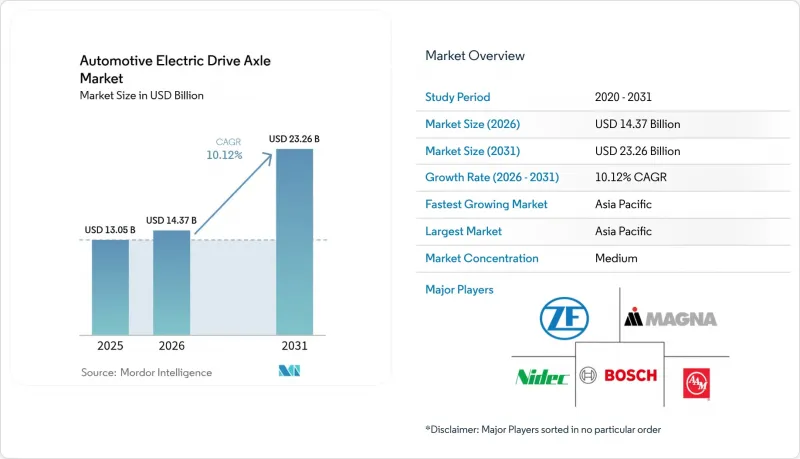
本報告按驅動系統類型(電池驅動電驅動橋、混合動力驅動橋等)、整合度(二合一(馬達和齒輪)、三合一(馬達、齒輪、逆變器等))、車輛類型(乘用車、輕型商用車等)、銷售管道(原廠配件和售後改裝套件)以及地區進行細分。市場預測以美元計價。
全球汽車電動驅動橋市場趨勢及洞察
OEM廠商的電氣化藍圖正在加速電動橋的需求。
由於全球汽車製造商制定了穩健的多年生產目標,一級供應商對訂單量前景異常清晰,從而能夠對專用電力驅動橋生產線和本地零件採購進行大規模資本投資。 BMW「新等級」車型的第六代電驅動系統將動力傳動效率提升了20%,同時支援轎車、SUV和緊湊型跨界車的後輪驅動和四輪驅動佈局。採埃孚已獲得價值310億歐元的與高壓電動出行相關的訂單,這表明清晰的藍圖能夠直接轉化為對供應商具有約束力且資金籌措可觀的合約。
政府零排放法規和購車獎勵
強制性的銷售配額和對違規行為的嚴厲處罰,正將電動軸的採用從自願選擇轉變為監管要求。英國的零排放車輛(ZEV)法規旨在2024年使電動車銷量佔總銷量的22%,到2035年達到100%,並對每輛不合規車輛處以15,000英鎊的罰款。這項罰款遠高於動力系統的成本溢價。加州的「先進清潔車II」(Advanced Clean Cars II)法規要求到2035年實現輕型車輛100%零排放銷售,到2036年實現中型和重型車輛車隊的全面轉型,從而鞏固了市場需求,使其不受短期燃油價格波動的影響。
稀土元素磁鐵價格波動
釹和鏑價格的劇烈波動正在削弱利潤率的可預測性,並迫使製造商轉向其他磁鐵化學成分和勵磁技術。日產汽車計畫透過改用釤鐵磁體來降低30%的馬達成本,並減少對集中於特定地區的供應鏈的依賴。通用電氣航空航太公司(GE Aerospace)的23千瓦兩相磁電機在不使用鏑的情況下提高了功率密度,這表明,在擺脫稀土元素材料時,性能方面的妥協不再不可避免。
細分市場分析
預計2025年,電池驅動的電動橋將佔汽車電動驅動橋市場73.45%的銷售量,凸顯其在汽車電動驅動橋市場的核心地位。這一主導地位得益於大規模生產的擴大、快速充電樁的普及以及旨在實現零廢氣排放的政策。混合動力電動橋正在適應過渡期的運作週期,而燃料電池電動橋雖然仍在研發中,但其複合年成長率(CAGR)高達11.08%,這主要得益於重型卡車試點計畫和公車示範測試的推動。隨著氫能基礎設施的發展,燃料電池平台汽車電動驅動橋的市場規模預計將進一步擴大,例如Symbio公司針對8級卡車推出的400千瓦「StackPack」計畫。加州對公車部署的支持也凸顯了其在長途運輸領域的巨大潛力。
原始設備製造商 (OEM) 對燃料電池增程器的興趣日益濃厚,以及各國氫能策略的增程器,預示著動力傳動系統多樣性將逐步擴展。能夠客製化模組化外殼以相容於電池或燃料電池堆的供應商,將能夠有效規避生產規模風險,因為車隊營運商正在積極試用這兩種技術。
整合了馬達、齒輪和逆變器的「三合一」單元仍佔據42.45%的市場佔有率,在現有冷卻限制下提供了經濟高效的封裝方案。然而,客戶的詢價請求(RFQ)越來越傾向於「四合一」佈局,該佈局還整合了熱迴路,而這一細分市場正以11.21%的複合年成長率成長。隨著寬能隙半導體降低散熱並實現更小的冷卻迴路,與「四合一」設計相關的汽車電動驅動橋市場規模預計將會成長。舍弗勒的解決方案將所有元件整合到一個70公斤的模組中,使其適用於緊湊型C級車。
在高性能電動車領域,熱設計的複雜性仍然是其廣泛應用的一大障礙,因為持續的功率負載需要獨立的冷卻器。供應商正在投資相變材料和分迴路結構,以在不增加品質的情況下提高峰值功率耐受能力。
區域分析
亞太地區是汽車電動驅動橋市場的核心,預計到2025年將佔全球銷售量的44.70%,並以11.94%的複合年成長率持續成長。 2024年,中國電動車產量佔全球總產量的70%以上,為本土電動驅動橋製造商帶來了無可比擬的規模優勢。政府補貼、國內電池材料開採以及積極的配額目標,使得工廠使用率維持在高位。匯豐銀行預測,到2030年,該地區的新電動車銷量預計將佔全球總銷量的60%以上。日本一級供應商正在快速轉型。 NIDEK正在開發針對低成本微型電動車最佳化的小型電機,而中型供應商則在研發方面開展合作,以彌合技術差距。
在北美,電動皮卡和政策主導的在地採購規則正蓬勃發展。 《通膨降低法案》將消費者補貼與本地生產的動力總成採購掛鉤,這推動了對車橋組裝的新投資。博格華納報告稱,2025年第一季其電動產品銷量較去年同期成長47%,反映出美國OEM工廠的強勁產能擴張。美國車橋公司(American Axle)的e-Beam電動輔助器,憑藉其150千瓦的輸出功率,專為非承載式車身平台設計,正瞄準這波卡車熱潮。
在嚴格的汽車二氧化碳排放法規的支持下,歐洲繼續保持其在高階電動車工程領域的領先地位。儘管宏觀經濟環境疲軟,但強制電動車市場確保了對車橋的穩定需求,預計到2024年,電動車市場佔有率將達到22%,到2035年將達到100%。採埃孚(ZF)正與依維柯客車(IVECO BUS)合作,提供整合式動力總成解決方案,並正在探索與富士康在數位底盤系統領域的合作。隨著各品牌致力於擴大其在德國高速公路上的續航里程,溫度控管技術的創新以及800V電壓的應用正在影響競標結果。同時,在新興的東協市場,預計2035年電動車的複合年成長率將達到16%至39%,車橋總成的大規模南向擴張需要成熟的資金籌措和充電基礎設施。
其他好處:
- Excel格式的市場預測(ME)表
- 3個月的分析師支持
目錄
第1章:引言
- 研究假設和市場定義
- 調查範圍
第2章:調查方法
第3章執行摘要
第4章 市場狀況
- 市場概覽
- 市場促進因素
- 各汽車製造商的電氣化藍圖正在加速推動電動橋的需求。
- 政府強制推行零排放車輛購買政策和獎勵措施。
- 隨著電池組成本降至每千瓦時 80 美元以下,電動軸的價格競爭力變得更加突出。
- 近年來,新型純電動SUV和皮卡車的推出量激增。
- 向 800V 架構的過渡需要下一代車軸設計。
- 透過電力驅動橋資訊服務實現軟體定義扭力向量控制的商業化
- 市場限制因素
- 稀土元素磁鐵價格波動
- 與傳統動力傳動系統相比,初始成本差異
- OEM內部資源正在縮小一級供應商的目標市場。
- 四合一整合層級的溫度控管限制
- 價值供應鏈分析
- 監理情勢
- 技術展望
- 波特五力模型
第5章 市場規模與成長預測
- 依推進類型
- 電池驅動電動軸
- 混合軸
- 燃料電池電動軸
- 依整合程度
- 二合一(馬達和齒輪)
- 三合一(馬達、齒輪、變頻器)
- 四合一(馬達、齒輪、變頻器、溫度控管)
- 車輛類型
- 搭乘用車
- 輕型商用車
- 中型和重型商用車輛
- 非公路車輛和特殊車輛(工程車輛和農業車輛)
- 按銷售管道
- 原廠正品零件
- 售後改裝套件
- 按地區
- 北美洲
- 美國
- 加拿大
- 其他北美國家
- 南美洲
- 巴西
- 阿根廷
- 其他南美國家
- 歐洲
- 德國
- 英國
- 法國
- 西班牙
- 義大利
- 其他歐洲國家
- 亞太地區
- 中國
- 日本
- 印度
- 韓國
- 其他亞太國家
- 中東和非洲
- 阿拉伯聯合大公國
- 沙烏地阿拉伯
- 南非
- 其他中東和非洲國家
- 北美洲
第6章 競爭情勢
- 市場集中度
- 策略趨勢
- 市佔率分析
- 公司簡介
- ZF Friedrichshafen AG
- Robert Bosch GmbH
- Magna International Inc.
- Nidec Corporation
- American Axle & Manufacturing
- Dana Inc.
- GKN Automotive
- Schaeffler AG
- BorgWarner Inc.
- Aisin Corporation
- Cummins Inc.
- Valeo SA
- Hitachi Astemo
- BYD Co. Ltd.
- Hyundai Mobis
第7章 市場機會與未來展望
According to Mordor Intelligence, the automotive electric drive axle market size in 2026 is estimated at USD 14.37 billion, growing from 2025 value of USD 13.05 billion with 2031 projections showing USD 23.26 billion, growing at 10.12% CAGR over 2026-2031.
This report is Segmented by Propulsion Type (Battery-Electric Axle, Hybrid Axle, and More), Integration Level (2-In-1 (Motor, and Gear), 3-In-1 (Motor, Gear, and Inverter), and More), Vehicle Type (Passenger Cars, Light Commercial Vehicles, and More), Sales Channel (OEM-Fitted and Aftermarket Retrofit Kits), and Geography. The Market Forecasts are Provided in Terms of Value (USD).
Global Automotive Electric Drive Axle Market Trends and Insights
OEM Electrification Road-maps Accelerate E-axle Demand
Firm multi-year production targets from global automakers are giving Tier-1 suppliers unusually clear visibility into order volumes, encouraging larger capital outlays for dedicated e-axle lines and localized component sourcing. BMW's sixth-generation eDrive for the Neue Klasse raises drivetrain efficiency by 20% while supporting both rear- and all-wheel layouts across sedans, SUVs, and compact crossovers. ZF has already booked EUR 31 billion in high-voltage e-mobility orders, demonstrating how locked-in road maps convert directly into binding, bankable contracts for suppliers.
Government Zero-emission Mandates and Purchase Incentives
Binding sales quotas and steep non-compliance penalties are turning e-axle adoption from a discretionary choice into a regulatory requirement. The UK ZEV mandate starts with 22% electric sales in 2024 and climbs to 100% by 2035, backed by GBP 15,000 fines per non-compliant vehicle that materially exceed drivetrain cost premiums. California's Advanced Clean Cars II rule compels 100% zero-emission light-duty sales by 2035 and full medium- and heavy-duty fleet conversion by 2036, cementing demand irrespective of short-term fuel-price swings .
Rare-earth Magnet Price Volatility
Sharp swings in neodymium and dysprosium pricing are eroding margin predictability and pushing manufacturers toward alternative magnet chemistries or excitation technologies. Nissan targets a 30% motor-cost cut by substituting samarium-iron magnets, reducing exposure to supply chains concentrated in one geography. GE Aerospace's 23 kW dual-phase magnetic motor eliminates dysprosium yet improves power density, proving that performance compromises are no longer inevitable when moving away from rare-earth materials .
Other drivers and restraints analyzed in the detailed report include:
- Battery-pack Cost Falls Below USD 80/kWh, Widening E-axle Affordability
- Surge in Battery-electric SUV and Pickup Launches
- Up-front Cost Gap vs. Conventional Drivelines
For complete list of drivers and restraints, kindly check the Table Of Contents.
Segment Analysis
Battery-electric axles delivered 73.45% of 2025 volumes, underscoring their centrality in the automotive electric drive axle market. Mass-production scale, rapid charger rollouts, and policy preference for zero-tailpipe emissions anchor this lead. Hybrid e-axles address transitional duty cycles, while fuel-cell axles, though nascent, are pacing at an 11.08% CAGR on the back of heavy-duty truck pilots and bus trials. The automotive electric drive axle market size for fuel-cell platforms is projected to rise alongside hydrogen infrastructure, aided by projects such as Symbio's 400 kW StackPack for Class 8 trucks. California's support for bus deployments validates long-haul promise.
Growing OEM interest in fuel-cell range extenders and national hydrogen strategies suggests a gradual broadening of powertrain diversity. Suppliers that can tailor modular housings to either battery-electric or fuel-cell stacks will hedge volume risk as fleet operators experiment with both technologies.
A 42.45% share still resides with 3-in-1 units that merge motor, gear, and inverter, offering cost-effective packaging within current cooling envelopes. Yet customer RFQs now favor 4-in-1 layouts that also integrate thermal loops, lifting that segment at an 11.21% CAGR. The automotive electric drive axle market size attached to 4-in-1 designs is forecast to compound as wide-bandgap semiconductors reduce heat rejection and enable smaller cooling circuits. Schaeffler's solution combines all elements into a 70 kg module that fits compact C-segment vehicles.
Thermal complexity still caps adoption in high-performance EVs where sustained power loads demand separate chillers. Suppliers are investing in phase-change materials and split-loop architectures to extend peak-power windows without raising mass.
Complete Report Scope:
- By Propulsion Type
- Battery-Electric Axle
- Hybrid Axle
- Fuel-Cell Electric Axle
- By Integration Level
- 2-in-1 (Motor, and Gear)
- 3-in-1 (Motor, Gear, and Inverter)
- 4-in-1 (Motor, Gear, Inverter, and Thermal)
- By Vehicle Type
- Passenger Cars
- Light Commercial Vehicles
- Medium and Heavy Commercial Vehicles
- Off-Highway and Specialty (Construction and Agriculture)
- By Sales Channel
- OEM-Fitted
- Aftermarket Retrofit Kits
- By Geography
- North America
- United States
- Canada
- Rest of North America
- South America
- Brazil
- Argentina
- Rest of South America
- Europe
- Germany
- United Kingdom
- France
- Spain
- Italy
- Rest of Europe
- Asia-Pacific
- China
- Japan
- India
- South Korea
- Rest of Asia-Pacific
- Middle East and Africa
- United Arab Emirates
- Saudi Arabia
- South Africa
- Rest of Middle East and Africa
- North America
Geography Analysis
Asia-Pacific captured 44.70% of 2025 revenue and is expanding at a 11.94% CAGR, making it the gravitational center of the automotive electric drive axle market. China produced more than 70% of global EVs in 2024, giving local e-axle makers unmatched scale advantages. State subsidies, domestic mining of battery materials, and aggressive quota targets sustain high plant-utilization rates. HSBC forecasts the region will represent over 60% of new EV sales by 2030. Japanese Tier-1s are pivoting quickly: Nidec is optimizing smaller e-motors tailored to low-cost micro EVs, while midsize suppliers are pooling R&D to close technology gaps.
North America is building momentum around electric pickups and policy-driven local content rules. The Inflation Reduction Act ties consumer rebates to regionally sourced drivetrains, steering fresh investment into axle assembly lines. BorgWarner reported a 47% year-on-year rise in e-product sales for Q1 2025, reflecting strong ramp-ups at US OEM plants. American Axle's e-Beam targets this truck wave with 150 kW output for body-on-frame platforms.
Europe maintains a lead in premium EV engineering underpinned by stringent fleet CO2 rules. The 22% electric sales mandate in 2024, moving to 100% by 2035, ensures steady axle demand despite a softer macro backdrop. ZF is partnering with IVECO BUS for integrated driveline solutions while courting Foxconn for digital chassis systems. Thermal-management innovation and 800 V adoption shape tenders as brands strive for extended range on high-speed German motorways. Meanwhile, emerging ASEAN markets eye a 16-39% EV CAGR through 2035, though financing and charging infrastructure must mature before large-scale axle assembly shifts south.
- ZF Friedrichshafen AG
- Robert Bosch GmbH
- Magna International Inc.
- Nidec Corporation
- American Axle & Manufacturing
- Dana Inc.
- GKN Automotive
- Schaeffler AG
- BorgWarner Inc.
- Aisin Corporation
- Cummins Inc.
- Valeo SA
- Hitachi Astemo
- BYD Co. Ltd.
- Hyundai Mobis
Additional Benefits:
- The market estimate (ME) sheet in Excel format
- 3 months of analyst support
TABLE OF CONTENTS
1 Introduction
- 1.1 Study Assumptions & Market Definition
- 1.2 Scope of the Study
2 Research Methodology
3 Executive Summary
4 Market Landscape
- 4.1 Market Overview
- 4.2 Market Drivers
- 4.2.1 OEM electrification road-maps accelerate e-axle demand
- 4.2.2 Government zero-emission mandates and purchase incentives
- 4.2.3 Battery-pack cost falls below USD 80/kWh, widening e-axle affordability
- 4.2.4 Surge in battery-electric SUV and pickup launches
- 4.2.5 Shift to 800 V architectures requiring next-gen axle designs
- 4.2.6 Monetization of software-defined torque-vectoring via e-axle data services
- 4.3 Market Restraints
- 4.3.1 Rare-earth magnet price volatility
- 4.3.2 Up-front cost gap vs. conventional drivelines
- 4.3.3 OEM insourcing squeezing Tier-1 addressable market
- 4.3.4 Thermal-management limits at 4-in-1 integration level
- 4.4 Value/Supply-Chain Analysis
- 4.5 Regulatory Landscape
- 4.6 Technological Outlook
- 4.7 Porter's Five Forces
- 4.7.1 Threat of New Entrants
- 4.7.2 Bargaining Power of Buyers/Consumers
- 4.7.3 Bargaining Power of Suppliers
- 4.7.4 Threat of Substitutes
- 4.7.5 Intensity of Competitive Rivalry
5 Market Size & Growth Forecasts (Value (USD))
- 5.1 By Propulsion Type
- 5.1.1 Battery-Electric Axle
- 5.1.2 Hybrid Axle
- 5.1.3 Fuel-Cell Electric Axle
- 5.2 By Integration Level
- 5.2.1 2-in-1 (Motor, and Gear)
- 5.2.2 3-in-1 (Motor, Gear, and Inverter)
- 5.2.3 4-in-1 (Motor, Gear, Inverter, and Thermal)
- 5.3 By Vehicle Type
- 5.3.1 Passenger Cars
- 5.3.2 Light Commercial Vehicles
- 5.3.3 Medium and Heavy Commercial Vehicles
- 5.3.4 Off-Highway and Specialty (Construction and Agriculture)
- 5.4 By Sales Channel
- 5.4.1 OEM-Fitted
- 5.4.2 Aftermarket Retrofit Kits
- 5.5 By Geography
- 5.5.1 North America
- 5.5.1.1 United States
- 5.5.1.2 Canada
- 5.5.1.3 Rest of North America
- 5.5.2 South America
- 5.5.2.1 Brazil
- 5.5.2.2 Argentina
- 5.5.2.3 Rest of South America
- 5.5.3 Europe
- 5.5.3.1 Germany
- 5.5.3.2 United Kingdom
- 5.5.3.3 France
- 5.5.3.4 Spain
- 5.5.3.5 Italy
- 5.5.3.6 Rest of Europe
- 5.5.4 Asia-Pacific
- 5.5.4.1 China
- 5.5.4.2 Japan
- 5.5.4.3 India
- 5.5.4.4 South Korea
- 5.5.4.5 Rest of Asia-Pacific
- 5.5.5 Middle East and Africa
- 5.5.5.1 United Arab Emirates
- 5.5.5.2 Saudi Arabia
- 5.5.5.3 South Africa
- 5.5.5.4 Rest of Middle East and Africa
- 5.5.1 North America
6 Competitive Landscape
- 6.1 Market Concentration
- 6.2 Strategic Moves
- 6.3 Market Share Analysis
- 6.4 Company Profiles (Includes Global Level Overview, Market Level Overview, Core Segments, Financials, Strategic Information, Market Rank/Share, Products & Services, Recent Developments)
- 6.4.1 ZF Friedrichshafen AG
- 6.4.2 Robert Bosch GmbH
- 6.4.3 Magna International Inc.
- 6.4.4 Nidec Corporation
- 6.4.5 American Axle & Manufacturing
- 6.4.6 Dana Inc.
- 6.4.7 GKN Automotive
- 6.4.8 Schaeffler AG
- 6.4.9 BorgWarner Inc.
- 6.4.10 Aisin Corporation
- 6.4.11 Cummins Inc.
- 6.4.12 Valeo SA
- 6.4.13 Hitachi Astemo
- 6.4.14 BYD Co. Ltd.
- 6.4.15 Hyundai Mobis
7 Market Opportunities & Future Outlook
- 7.1 White-Space & Unmet-Need Assessment

 中國無磁電橋系統:市佔率分析、產業趨勢與統計及成長預測(2026-2031年)無磁電橋系統:市場佔有率分析、行業趨勢和統計數據、成長預測(2026-2031 年)美國無磁電橋系統:市場佔有率分析、產業趨勢與統計、成長預測(2026-2031)歐洲無磁電橋系統:市場佔有率分析、產業趨勢與統計及成長預測(2026-2031 年)
 汽車電動驅動橋市場:依驅動橋位置、驅動系統、馬達技術、車輛類型和最終用戶分類-2026-2032年全球市場預測
 電動車改裝電驅動橋市場預測(至 2034 年)—按車輛類型、功率輸出、傳動系統、組件、改裝類型、最終用戶、銷售管道和地區進行全球分析。
 電動橋驅動系統市場-全球產業規模、佔有率、趨勢、機會及預測(依系統類型、車輛類型、需求類別、地區及競爭格局分類,2021-2031年)電動驅動橋行星齒輪市場按階段、車輛類型、扭力容量、材料、製造流程和應用分類-全球預測,2026-2032年