


 |
市場調查報告書
商品編碼
2117411
歐洲無磁電橋系統:市場佔有率分析、產業趨勢與統計及成長預測(2026-2031 年)Europe Magnet Free Electric Axle System - Market Share Analysis, Industry Trends & Statistics, Growth Forecasts (2026 - 2031) |
||||||

※ 本網頁內容可能與最新版本有所差異。詳細情況請與我們聯繫。
據 Mordor Intelligence 稱,2025 年歐洲無磁電橋系統市值為 16.8 億美元,預計到 2031 年將從 2026 年的 19.1 億美元成長至 36.4 億美元,預測期(2026-2031 年)的複合年成長率為 13.76%。
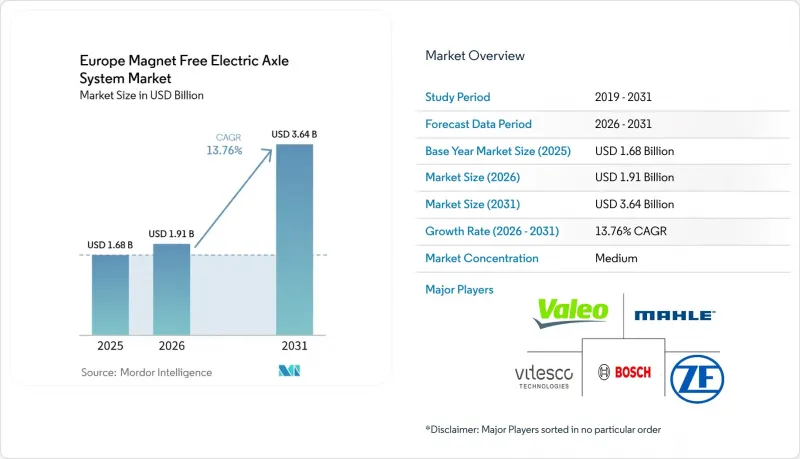
本報告按馬達類型(例如,外部勵同步馬達)、驅動系統(例如,純電動)、電橋配置(例如,單橋)、車輛類型(乘用車、商用車)和地區(德國、英國、西班牙、義大利、法國、荷蘭和其他歐洲國家)進行細分。市場預測以美元計價。
歐洲無磁電橋系統市場趨勢與洞察。
從 2025 年起,歐盟 27 國將加強與電動車主導的二氧化碳減排法規。
乘用車二氧化碳排放量超過93.6克/公里限值將面臨每克95歐元的罰款,迫使汽車製造商承擔高昂的合規成本,這推動了電池式電動車的普及,並刺激了對無磁電橋系統的需求。隨著引擎的逐步淘汰,轉向混合動力汽車的替代方案已不再可行。這項變化加速了無磁電橋的投資回報週期,避免了對稀土元素的依賴。雖然車隊平均法提供了暫時的緩解,但製造商正在快速部署相關平台。 Stellantis已對其義大利工廠進行了大量投資,以滿足這些新目標。隨著WLTP測試和未來法規要求在實際駕駛條件下進行評估,無磁電機將展現其優勢。這些馬達即使在高速公路上也能保持輸出功率,而不會出現因過熱而導致的功率損失。
為了降低中國供應鏈的風險,汽車製造商正在轉向使用稀土元素的馬達。
隨著中國收緊稀土元素加工出口限制,電力驅動橋系統市場迅速轉向繞線式和磁阻式馬達。 BMW第六代電力驅動橋不再使用釹磁體,與上一代相比,損耗顯著降低,重量更輕。法雷奧和馬勒聯合推出的EESM平台,與傳統的永磁系統相比,顯著降低了碳排放。儘管歐洲的「ResourceEU」舉措旨在擴大國內回收利用,但目前的處理能力仍然有限,因此無磁鐵架構成為一個切實可行的選擇。
定子銅價波動推高了物料清單成本。
倫敦金屬交易所(LME)期貨市場價格出現顯著波動,推高了無磁電機物料清單(BOM)成本。這是因為無磁電機設計比有磁電機設計需要更多的銅。由於缺乏有效的避險市場,一級供應商的利潤率面臨壓力,被迫重新談判長期合約或改用再生材料。儘管歐盟舉措提高再生銅的使用率,但電機用銅的回收率仍然很低。
細分市場分析
預計到2025年,外勵同步馬達將佔總銷售量的46.56%。這反映了無磁電橋系統市場在效率和地緣政治穩定性之間的平衡。一旦波形整形逆變器被證實能夠滿足母線運轉週期內的ISO標準雜訊水平,開關式磁阻電動機預計將以15.42%的複合年成長率成長,成為所有馬達類型中成長最快的。感應電動機雖然在雙馬達配置中輔助前橋,但由於其高速運轉時的效率較低,市場佔有率有限。同時,永磁馬達僅在注重成本的緊湊型轎車項目中佔據一定的市場佔有率。
通用平台計畫投入量產,旨在大幅降低碳排放。靈活的解決方案使原始設備製造商 (OEM) 能夠在稀土元素和磁性設計之間進行選擇。即將推出的高階客戶的客製化感應模組,凸顯了跨大西洋的技術交流。最後,針對噪音、振動和聲振粗糙度 (NVH) 挑戰的專利凸顯了 SRM 大規模應用的最後一個障礙,因此市場預測高度依賴實施時間。
預計2025年,純電動動力系統將佔汽車總保有量的63.28%,年複合成長率達18.28%,在無磁電橋系統市場中顯著超越插電式混合動力和輕度混合動力車型。隨著電池價格大幅下降,雙動力傳動系統車型的整體擁有成本(TCO)優勢正在減弱。同時,相關法規預計最終將停止內燃機汽車的銷售。
儘管插電式混合動力汽車預計仍將佔據相當大的市場佔有率,但隨著合規補貼的減少,它們的自主選擇空間正在縮小。雖然混合動力汽車即使沒有公共充電設施也能繼續運作,但數據顯示,通行費獎勵措施正在迅速彌補這一差距。一個明顯的轉變是,一家大型汽車製造商推出了一款全新的平台,專門用於純電動車車型,凸顯了汽車產業正在逐步放棄插電式混合動力架構。
其他好處:
- Excel格式的市場預測(ME)表
- 3個月的分析師支持
目錄
第1章:引言
- 市場分析與定義的前提條件
- 分析範圍
第2章 分析方法
第3章執行摘要
第4章 市場狀況
- 市場概覽
- 市場促進因素
- 從 2025 年起,歐盟 27 個國家在電動車主導減少二氧化碳排放的義務將更加嚴格。
- 為了降低在中國供應鏈中的風險,汽車製造商正在轉向使用稀土元素的馬達。
- 電池成本趨於一致,正在加速推動對全電動電橋的需求。
- 車隊營運商的總體擁有成本模型往往傾向於整合式電力驅動橋。
- 高壓碳化矽逆變器可提高不使用磁鐵的馬達的效率。
- 一級供應商和原始設備製造商之間在繞線轉子冷卻技術方面的共同智慧財產權,使得馬達的功率密度達到 20-30 kW/kg。
- 市場限制因素
- 定子銅價格波動推高了物料清單成本。
- 歐洲在公車上應用SRM聲學NVH測試的實務經驗有限。
- 關於EESM轉子絕緣材料使用壽命的標準存在差異
- 歐盟範圍內層壓和沖壓生產能力短缺
- 價值鍊和供應鏈分析
- 監理情勢
- 技術展望
- 波特五力分析
第5章:預測市場規模與成長率
- 依馬達類型
- 外勵同步馬達(EESM)
- 感應馬達
- 開關式磁阻電動機
- 永磁電機
- 透過驅動系統
- 全電動
- 油電混合驅動
- 插電式混合動力驅動
- 電驅動橋配置
- 單軸電驅動
- 雙電軸
- 整合式電力驅動橋
- 按車輛類型
- 搭乘用車
- 掀背車
- 轎車
- SUV/MUV
- 商用車輛
- 輕型商用車
- 中型和大型商用車輛
- 巴士和長途汽車
- 搭乘用車
- 國家
- 德國
- 英國
- 西班牙
- 義大利
- 法國
- 荷蘭
- 其他歐洲國家
第6章 競爭情勢
- 市場集中度
- 策略趨勢
- 市佔率分析
- 公司簡介
- ZF Friedrichshafen AG
- Robert Bosch GmbH
- Vitesco Technologies Group AG
- GKN Automotive Ltd
- Valeo SA
- MAHLE GmbH
- Dana Incorporated
- BorgWarner Inc.
- Schaeffler AG
- AVL List GmbH
- Siemens AG
- Magna International Inc.
- Punch Powertrain NV
- Nidec Corporation
- Continental AG
- Allison Transmission Holdings Inc.
- American Axle and Manufacturing Holdings Inc.
- Hitachi Astemo Ltd
- Infinitum Electric Inc.
- Parker Hannifin Corp.
第7章 市場機會與未來展望
According to Mordor Intelligence, the Europe magnet free electric axle system market size was valued at USD 1.68 billion in 2025 and is estimated to grow from USD 1.91 billion in 2026 to reach USD 3.64 billion by 2031, at a CAGR of 13.76% during the forecast period (2026-2031).
This report is Segmented by Motor Type (Externally Excited Synchronous Motors and More), Drive Type (Fully Electric and More), E-Axle Configuration (Single and More), Vehicle Type (Passenger Cars and Commercial Vehicles), and Geography (Germany, United Kingdom, Spain, Italy, France, Netherlands, and Rest of Europe). The Market Forecasts are Provided in Terms of Value (USD).
Europe Magnet Free Electric Axle System Market Trends and Insights
EV-led CO2-cut Mandates Across EU-27 Tighten Post-2025
Penalties of EUR 95 per gram over the 93.6 g CO2/km passenger-car limit expose OEMs to significant compliance costs, driving battery-electric adoption and boosting demand for magnet free electric axle systems. With the engine phase-out, hybrid fallback strategies are no longer available. This shift accelerates ROI cycles for magnet free e-axles, which avoid the pitfalls of rare-earth dependencies. While fleet averaging provides a brief respite, manufacturers are hastening their platform rollouts. Stellantis allocated significant investments to several of its Italian plants to align with these new targets. As WLTP and the forthcoming regulations impose real-world evaluations, magnet free motors gain an advantage. These motors maintain their output on highways without facing thermal derating.
OEM Shift to Rare-Earth-Free Motors to De-Risk China Supply Chain
China's tighter export rules on rare-earth processing triggered a swift shift towards wound-field and reluctance machines in the electric axle system market. BMW's Gen6 e-axle, now free of neodymium, boasts significantly lower losses and reduced weight compared to its predecessor. Valeo and MAHLE introduced an EESM platform with a substantially smaller carbon footprint than traditional permanent-magnet systems. While Europe's ResourceEU initiative aims to increase domestic recycling, current capacities remain limited, making magnet free architectures a pragmatic choice.
Stator Copper Price Volatility Inflates BOM Cost
LME futures experienced significant volatility, leading to higher bill-of-materials costs for magnet free motors, which require more copper than magnet-based designs. Without robust hedging markets, tier-1 suppliers faced margin pressures, necessitating renegotiation of long-term contracts or a shift towards recycled feedstock. Although the EU's initiative aims to increase the use of recycled copper, the recovery rate for motor-grade copper remains low.
Other drivers and restraints analyzed in the detailed report include:
- Battery Cost Parity Accelerates Demand for Fully Electric E-Axles
- Fleet-Operator TCO Models Favor Integrated E-Axles
- Limited Field Experience with SRM Acoustic NVH in Europe Buses
For complete list of drivers and restraints, kindly check the Table Of Contents.
Segment Analysis
Externally excited synchronous motors held 46.56% revenue in 2025, reflecting their balance of efficiency and geopolitical resilience within the magnet free electric axle system market. Switched reluctance motors are forecast to expand at 15.42% CAGR, the highest among motor types, once waveform-shaping inverters verify ISO-compatible noise levels for bus duty cycles. Induction machines, while aiding front axles in dual-motor setups, compromise efficiency at highway speeds, resulting in a modest market share. Meanwhile, permanent-magnet units find their niche solely in budget-conscious compact car programs.
A joint platform is set to enter series production, aiming to achieve a significant reduction in carbon footprint. A flexible solution allows OEMs to choose between a rare-earth-free or magnet-based design. An upcoming induction module, tailored for a premium client, highlights the transatlantic exchange of technology. Lastly, patents addressing NVH challenges underscore the final hurdle for the mass adoption of SRM, leaving its market forecast vulnerable to the timing of execution.
Fully electric drivetrains captured 63.28% of installations in 2025 and are growing at an 18.28% CAGR, vastly outpacing plug-in and mild hybrids in the magnet free electric axle system market. As battery prices drop significantly, the total cost of ownership (TCO) advantages of dual-powertrain models diminish. Meanwhile, regulations are set to halt the sale of combustion engines in the future.
While plug-in hybrids are projected to account for a notable share of the market volume, their margin for maneuvering shrinks as compliance credits become scarcer. Although hybrids continue to operate in duty cycles where public chargers are absent, data indicate that toll incentives are rapidly bridging this gap. In a clear shift, a major automaker is launching its new platform exclusively as a pure electric model, underscoring the industry's move away from plug-in architecture.
Complete Report Scope:
- By Motor Type
- Externally Excited Synchronous Motors (EESM)
- Induction Motors
- Switched Reluctance Motors
- Permanent Magnet Motors
- By Drive Type
- Fully Electric Drive
- Hybrid Drive
- Plug-in Hybrid Drive
- By E-Axle Configuration
- Single E-Axle
- Dual E-Axle
- Integrated E-Axle
- By Vehicle Type
- Passenger Cars
- Hatchbacks
- Sedans
- SUV and MUVs
- Commercial Vehicles
- Light Commercial Vehicles
- Medium and Heavy Commercial Vehicles
- Buses and Coaches
- Passenger Cars
- By Country
- Germany
- United Kingdom
- Spain
- Italy
- France
- Netherlands
- Rest of Europe
List of Companies Covered in this Report:
- ZF Friedrichshafen AG
- Robert Bosch GmbH
- Vitesco Technologies Group AG
- GKN Automotive Ltd
- Valeo SA
- MAHLE GmbH
- Dana Incorporated
- BorgWarner Inc.
- Schaeffler AG
- AVL List GmbH
- Siemens AG
- Magna International Inc.
- Punch Powertrain NV
- Nidec Corporation
- Continental AG
- Allison Transmission Holdings Inc.
- American Axle and Manufacturing Holdings Inc.
- Hitachi Astemo Ltd
- Infinitum Electric Inc.
- Parker Hannifin Corp.
Additional Benefits:
- The market estimate (ME) sheet in Excel format
- 3 months of analyst support
TABLE OF CONTENTS
1 Introduction
- 1.1 Study Assumptions and Market Definition
- 1.2 Scope of the Study
2 Research Methodology
3 Executive Summary
4 Market Landscape
- 4.1 Market Overview
- 4.2 Market Drivers
- 4.2.1 EV-Led CO2-cut Mandates Across EU-27 Tighten Post-2025
- 4.2.2 OEM Shift to Rare-earth-free motors to De-risk China Supply Chain
- 4.2.3 Battery Cost Parity Accelerates Demand for Fully Electric E-axles
- 4.2.4 Fleet-operator TCO Models Favor Integrated E-axles
- 4.2.5 High-voltage SiC Inverters Boost Magnet-free Motor Efficiency
- 4.2.6 Tier-1/OEM joint IP on Wound-rotor Cooling Unlocks 20-30 kW/kg Motors
- 4.3 Market Restraints
- 4.3.1 Stator Copper Price Volatility Inflates BOM Cost
- 4.3.2 Limited Field Experience with SRM Acoustic NVH in Europe Buses
- 4.3.3 Standards Gap for EESM Rotor Insulation Longevity
- 4.3.4 Scarcity of EU-scale Laminations Stamping Capacity
- 4.4 Value/Supply-Chain Analysis
- 4.5 Regulatory Landscape
- 4.6 Technological Outlook
- 4.7 Porter's Five Forces
- 4.7.1 Threat of New Entrants
- 4.7.2 Bargaining Power of Suppliers
- 4.7.3 Bargaining Power of Buyers
- 4.7.4 Threat of Substitutes
- 4.7.5 Competitive Rivalry
5 Market Size and Growth Forecasts (Value (USD))
- 5.1 By Motor Type
- 5.1.1 Externally Excited Synchronous Motors (EESM)
- 5.1.2 Induction Motors
- 5.1.3 Switched Reluctance Motors
- 5.1.4 Permanent Magnet Motors
- 5.2 By Drive Type
- 5.2.1 Fully Electric Drive
- 5.2.2 Hybrid Drive
- 5.2.3 Plug-in Hybrid Drive
- 5.3 By E-Axle Configuration
- 5.3.1 Single E-Axle
- 5.3.2 Dual E-Axle
- 5.3.3 Integrated E-Axle
- 5.4 By Vehicle Type
- 5.4.1 Passenger Cars
- 5.4.1.1 Hatchbacks
- 5.4.1.2 Sedans
- 5.4.1.3 SUV and MUVs
- 5.4.2 Commercial Vehicles
- 5.4.2.1 Light Commercial Vehicles
- 5.4.2.2 Medium and Heavy Commercial Vehicles
- 5.4.2.3 Buses and Coaches
- 5.4.1 Passenger Cars
- 5.5 By Country
- 5.5.1 Germany
- 5.5.2 United Kingdom
- 5.5.3 Spain
- 5.5.4 Italy
- 5.5.5 France
- 5.5.6 Netherlands
- 5.5.7 Rest of Europe
6 Competitive Landscape
- 6.1 Market Concentration
- 6.2 Strategic Moves
- 6.3 Market Share Analysis
- 6.4 Company Profiles (Includes Global level Overview, Market level overview, Core Segments, Financials as available, Strategic Information, Market Rank/Share for key companies, Products and Services, and Recent Developments)
- 6.4.1 ZF Friedrichshafen AG
- 6.4.2 Robert Bosch GmbH
- 6.4.3 Vitesco Technologies Group AG
- 6.4.4 GKN Automotive Ltd
- 6.4.5 Valeo SA
- 6.4.6 MAHLE GmbH
- 6.4.7 Dana Incorporated
- 6.4.8 BorgWarner Inc.
- 6.4.9 Schaeffler AG
- 6.4.10 AVL List GmbH
- 6.4.11 Siemens AG
- 6.4.12 Magna International Inc.
- 6.4.13 Punch Powertrain NV
- 6.4.14 Nidec Corporation
- 6.4.15 Continental AG
- 6.4.16 Allison Transmission Holdings Inc.
- 6.4.17 American Axle and Manufacturing Holdings Inc.
- 6.4.18 Hitachi Astemo Ltd
- 6.4.19 Infinitum Electric Inc.
- 6.4.20 Parker Hannifin Corp.
7 Market Opportunities and Future Outlook
- 7.1 White-space and Unmet-Need Assessment

 中國無磁電橋系統:市佔率分析、產業趨勢與統計及成長預測(2026-2031年)無磁電橋系統:市場佔有率分析、行業趨勢和統計數據、成長預測(2026-2031 年)美國無磁電橋系統:市場佔有率分析、產業趨勢與統計、成長預測(2026-2031)汽車電動驅動橋:市場佔有率分析、產業趨勢與統計、成長預測(2026-2031)
 汽車電動驅動橋市場:依驅動橋位置、驅動系統、馬達技術、車輛類型和最終用戶分類-2026-2032年全球市場預測
 電動車改裝電驅動橋市場預測(至 2034 年)—按車輛類型、功率輸出、傳動系統、組件、改裝類型、最終用戶、銷售管道和地區進行全球分析。
 電動橋驅動系統市場-全球產業規模、佔有率、趨勢、機會及預測(依系統類型、車輛類型、需求類別、地區及競爭格局分類,2021-2031年)電動驅動橋行星齒輪市場按階段、車輛類型、扭力容量、材料、製造流程和應用分類-全球預測,2026-2032年