


 |
市場調查報告書
商品編碼
2117405
無磁電橋系統:市場佔有率分析、行業趨勢和統計數據、成長預測(2026-2031 年)Magnet Free Electric Axle System - Market Share Analysis, Industry Trends & Statistics, Growth Forecasts (2026 - 2031) |
||||||

※ 本網頁內容可能與最新版本有所差異。詳細情況請與我們聯繫。
根據 Mordor Intelligence 估計,2025 年無磁電橋系統的市場規模為 32.6 億美元,2026 年為 36.6 億美元,預計到 2031 年將達到 64.8 億美元。
預計 2026 年至 2031 年的年複合成長率(CAGR)為 12.14%。
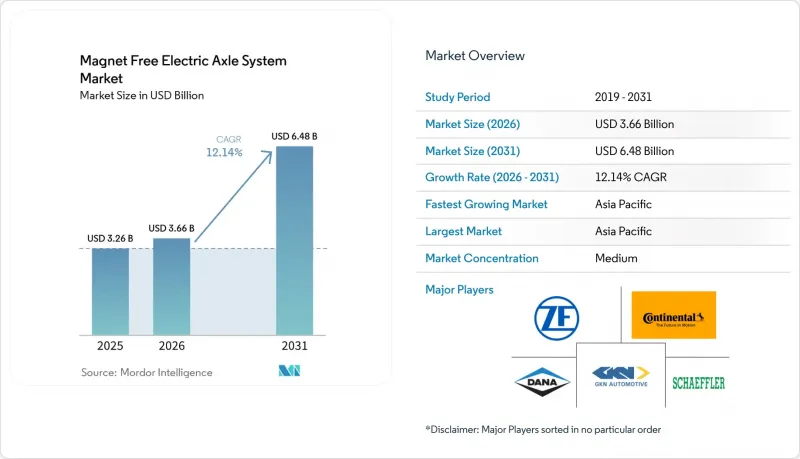
本報告按馬達類型(外部勵同步馬達、感應馬達等)、驅動系統(純電動、混合動力等)、電橋配置(單電橋、雙電橋等)、車輛類型(乘用車、商用車)和地區(北美、南美等)細分。市場預測以美元計價。
無磁電橋系統的全球市場趨勢與洞察。
透過減少對稀土元素的依賴來穩定供應鏈
中國鏑和鋱的許可核准延遲導致歐洲現貨價格飆升,促使整車製造商(OEM)調整其電驅動橋藍圖,轉向無磁電機。中國仍然主導全球重稀土元素分離產能,造成了西方煉廠短期內無法解決的瓶頸。博格華納與美國卡車製造商簽訂的感應馬達契約,是緩解磁鐵供不應求的戰略舉措。即使新煉廠的產量預計會增加,西方的產量也只能滿足部分需求,這進一步凸顯了無磁設計在可擴展性和自給自足方面的重要性。歐盟的《關鍵原料法案》規定,到2030年,單一國家的供應量不得超過65%,這將進一步鞏固無磁性技術的應用。
與PM型電驅動橋相比,生命週期成本更低
研究表明,在商業週期中長期使用後,感應電動機電橋的成本可與永磁馬達電橋相媲美。這是因為感應馬達避免了昂貴的釹材料成本,也消除了與去磁相關的維護難題。對於外勵磁設計,當釹價格大幅上漲時,用於勵磁繞組的銅和疊片鋼的成本遠低於稀土元素的採購成本。 Dana 的 TM4 SUMO MD感應電動機專為持續高功率而設計,無需使用任何稀土元素。這項創新技術使車隊能夠長期避免更換磁鐵。此外,歐盟電池護照法規也鼓勵採用無磁電機。這是因為稀土元素的回收效率低於銅和鋼,導致永磁驅動裝置的處置成本更高。
與永磁馬達相比,功率輸出和扭力密度較低。
與感應馬達和外勵馬達相比,永磁馬達具有更高的升功率密度。這種差異迫使原始設備製造商 (OEM) 要么增大外殼尺寸,要么在緊湊型電動車的封裝方面做出妥協。例如,在高性能領域,人們依靠磁鐵在更小的體積內實現更高的功率。對於相同的轉子直徑,開關磁阻馬達 (SRM) 的扭矩密度不如永磁同步馬達 (PMSM),這會影響大型卡車的有效載荷能力。研究表明,銅引起的磁場損耗會降低高溫的連續額定功率,這給在嚴苛工況下運作的外勵馬達設計帶來了挑戰。此外,採用扭矩矢量控制的電動車需要快速響應時間,而感應馬達在不依賴大型且昂貴的逆變器的情況下難以滿足這一要求。
細分市場分析
到2025年,外勵同步馬達的銷售佔比將達到48.13%。這反映了汽車製造商致力於實現消費者認為「平順」的正弦扭矩特性,同時減少對稀土元素的依賴。同時,開關式磁阻電動機預計到2031年將以14.17%的複合年成長率成長。雖然在那些優先考慮可靠性而非峰值效率的車輛中,感應馬達仍然佔據主導地位,但隨著碳化矽(SiC)逆變器降低傳統紋波,以及無磁電橋系統市場走向更廣泛的應用,開關式磁阻電動機馬達正日益普及。 BMW第六代eDrive系統將外勵同步馬達與800V碳化矽逆變器結合,在不使用釹的情況下提供400kW的功率,鞏固了其高階市場地位。這種配置既滿足了環境、社會和治理(ESG)指標,也滿足了駕駛者的期望。
根據2025年發表的研究,EESM內部的勵磁電流調變技術能夠實現即時磁通弱化,克服了永磁同步馬達(PMSM)高速運轉時的退磁瓶頸。法雷奧和馬爾勒的「iBEE」將48V EESM技術引入輕混動力系統,並針對價格敏感的細分市場採用了稀土元素設計。同時,在雙馬達全輪驅動佈局中,感應馬達正擴大被用作前輪軸的動力選擇。這是一種過渡策略,直到開關磁阻馬達(SRM)技術成熟為止,因為感應馬達具有齒槽轉矩低、驅動脫離時電阻小的優勢。
由於汽車製造商在插電式混合動力和輕度混合模式中採用了無磁電機,電池成本降低,混合動力系統在2025年佔總銷量的57.22%。預計到2031年,純電動車架構將以17.64%的複合年成長率成長。這主要得益於都市區零排放區的擴大和電池價格的下降,使得稀土元素的電力驅動橋在經濟上更具吸引力,尤其是在最後一公里物流領域。插電式混合動力汽車扮演著過渡角色,它們採用無磁電機來滿足《通膨控制法案》的礦物標準,同時保留內燃機以進行長途運輸。
戴姆勒卡車公司於2026年向西蒙·魯斯公司交付75輛eActros 600卡車,顯示在都市區道路上,純電動無磁卡車的成本與柴油卡車相當。在中國,針對純電續航里程超過50公里的車輛的補貼政策抵消了高矽電工鋼的成本,進一步促進了無磁性混合動力汽車的普及。在歐洲,隨著內燃機(ICE)禁令的臨近,插電式混合動力汽車的市佔率正在萎縮,研發支出預計將重新分配到純電動電橋上。無磁電橋系統的市場成長主要集中在這一領域。
區域分析
預計到2025年,亞太地區將佔據無磁電橋系統市場44.61%的佔有率,並在2031年之前以15.71%的複合年成長率成長。這主要得益於中國旨在加強國內電工鋼板生產的「雙循環」策略,以及印度的PLI(生產關聯激勵)計劃,該計劃為本地電橋設備投資提供補貼。大陸集團已對其位於天津的電力驅動工廠進行了大規模投資,利用寶鋼的超薄鋼板生產EESM單元。此舉有助於中國OEM製造商應對歐盟的出口限制,這些限制限制了他們對單一國家原料的依賴。此外,日本電產公司大幅擴大了其電橋產能,並將製造地多元化至塞爾維亞和墨西哥,在維持亞太地區強勁需求的同時,增強了抵禦地緣政治風險的能力。
在歐洲,由於稀土元素能源分配法規嚴格,寶馬、梅賽德斯-奔馳和大眾等主要汽車製造商正優先發展無磁電機並加強區域供應鏈。舍弗勒為其混合動力汽車計畫生產無磁電橋,正是這項轉變的象徵。此外,阿姆斯特丹和巴塞隆納等城市正在引進達夫和沃爾沃的雙電橋卡車用於物流,進一步推進電氣化進程。
在北美,各國正積極採取措施限制使用中國製造的磁鐵,汽車製造商也正在推廣符合消費者稅額扣抵的感應式和EESM解決方案。博格華納公司為重型卡車平台提供的無磁驅動模組契約,凸顯了該地區對在地採購策略的重視。加拿大和美國正優先推進中型貨車的電氣化,而拉丁美洲也正在崛起成為關鍵參與者。巴西正積極吸引投資以減少對亞洲的依賴,阿根廷則利用其鋰基產業生態系統來滿足日益成長的無磁動力傳動系統需求。
其他好處:
- Excel格式的市場預測(ME)表
- 3個月的分析師支持
目錄
第1章:引言
- 市場分析與定義的前提條件
- 分析範圍
第2章 分析方法
第3章執行摘要
第4章 市場狀況
- 市場概覽
- 市場促進因素
- 透過減少對稀土元素的依賴來保障供應鏈安全
- 與PM型電驅動橋相比,生命週期成本更低
- 原始設備製造商的碳中和目標和ESG要求
- 支持非稀土元素引擎的監管獎勵
- 高矽電工鋼片的技術進步
- 循環經濟中對完全可回收動力傳動系統的需求
- 市場限制因素
- 與永磁馬達相比,功率輸出和扭力密度較低。
- 與噪音和扭矩波動增加相關的問題
- 高頻率範圍內逆變器的開關損耗增加。
- IP濃度圍繞SRM控制軟體
- 價值鍊和供應鏈分析
- 監理情勢
- 技術展望
- 波特五力分析
第5章:預測市場規模與成長率
- 依馬達類型
- 外勵同步馬達(EESM)
- 感應馬達
- 開關式磁阻電動機
- 透過驅動系統
- 全電動
- 油電混合驅動
- 插電式混合動力驅動
- 電驅動橋配置
- 單軸電驅動
- 雙電軸
- 整合式電力驅動橋
- 按車輛類型
- 搭乘用車
- 掀背車
- 轎車
- SUV/MUV
- 商用車輛
- 輕型商用車
- 中型和大型商用車輛
- 巴士和長途汽車
- 搭乘用車
- 按地區
- 北美洲
- 美國
- 加拿大
- 其他北美國家
- 南美洲
- 巴西
- 阿根廷
- 其他南美國家
- 歐洲
- 德國
- 英國
- 西班牙
- 義大利
- 法國
- 荷蘭
- 其他歐洲國家
- 亞太地區
- 印度
- 中國
- 日本
- 韓國
- 印尼
- 其他亞太國家
- 中東和非洲
- 阿拉伯聯合大公國
- 沙烏地阿拉伯
- 土耳其
- 埃及
- 南非
- 其他中東和非洲國家
- 北美洲
第6章 競爭情勢
- 市場集中度
- 策略趨勢
- 市佔率分析
- 公司簡介
- Continental AG
- ZF Friedrichshafen AG
- Schaeffler AG
- GKN Automotive
- Dana Incorporated
- Magna International
- BorgWarner Inc.
- Nidec Corporation
- American Axle & Manufacturing
- Valeo SA
- Mahle GmbH
- Vitesco Technologies
- Punch Powertrain
第7章 市場機會與未來展望
According to Mordor Intelligence, the magnet free electric axle system market size was valued at USD 3.26 billion in 2025, is estimated at USD 3.66 billion in 2026, and is projected to reach USD 6.48 billion by 2031, registering a 12.14% CAGR between 2026 and 2031.
This report is Segmented by Motor Type (Externally Excited Synchronous Motors, Induction Motors, and More), Drive Type (Fully Electric Drive, Hybrid Drive, and More), E-Axle Configuration (Single E-Axle, Dual E-Axle, and More), Vehicle Type (Passenger Cars, Commercial Vehicles), and Geography (North America, South America, and More). The Market Forecasts are Provided in Terms of Value (USD).
Global Magnet Free Electric Axle System Market Trends and Insights
Supply-Chain Security from Rare-Earth Independence
China's export-licensing delays for dysprosium and terbium caused European spot prices to surge significantly, prompting OEMs to shift their e-axle roadmaps toward magnet-free motors. The country continues to dominate global heavy-rare-earth separation capacity, creating a bottleneck that Western refineries cannot resolve in the near term. A contract for induction motors by BorgWarner with a U.S. truck manufacturer demonstrates a strategic move to mitigate magnet shortages. Even with new refineries expected to increase production, Western output will meet only a small fraction of the demand, reinforcing the importance of magnet-free designs for achieving scalability and sovereignty. The EU's Critical Raw Materials Act caps any single-country supply at 65% by 2030, cementing the adoption of magnet-free technologies.
Lower Lifetime Cost Versus PM E-Axles
Studies suggest that induction-motor e-axles achieve cost parity with permanent-magnet units after extended use in commercial duty cycles. This is attributed to their ability to avoid high neodymium costs and eliminate maintenance challenges associated with demagnetization. In externally excited designs, field-winding copper and lamination expenses are significantly lower than rare-earth procurement costs when neodymium prices increase substantially. Dana's TM4 SUMO MD induction motor, designed to deliver continuous high power, operates entirely without rare-earth content. This innovation helps fleets avoid the need for magnet replacements over the long term. Additionally, EU battery passport regulations support the adoption of magnet-free motors, as rare-earth recycling is less efficient than the recovery rates of copper and steel, leading to higher end-of-life costs for permanent-magnet drives.
Lower Power/Torque Density Versus PM Motors
Permanent-magnet units achieve higher power density per liter compared to induction and externally excited motors. This difference forces OEMs to either enlarge housings or compromise on packaging in compact EVs. For instance, high-performance segments rely on magnets to deliver significant power output in a smaller volume. SRMs lag behind PMSMs in torque density at the same rotor diameters, which impacts payload capacity in heavy trucks. Research highlights that copper field losses can reduce continuous ratings under high temperatures, posing challenges for externally excited designs during demanding duty cycles. Additionally, torque-vectoring EVs require rapid response times, a benchmark that induction motors struggle to meet without relying on oversized and more expensive inverters.
Other drivers and restraints analyzed in the detailed report include:
- OEM Carbon-Neutral Targets and ESG Mandates
- Regulatory Incentives Favoring Non-Rare-Earth Motors
- Higher Acoustic and Torque Ripple Issues
For complete list of drivers and restraints, kindly check the Table Of Contents.
Segment Analysis
Externally excited synchronous motors accounted for 48.13% of 2025 revenue, reflecting the automaker's efforts to marry rare-earth independence with sinusoidal torque characteristics that consumers recognize as smooth, while switched reluctance motors are expected to grow at a CAGR of 14.17% through 2031. Induction motors prevail in fleets that value ruggedness over peak efficiency, while switched reluctance is gaining popularity as silicon-carbide inverters damp historic ripple, moving the Magnet Free Electric Axle System market toward broader acceptance. BMW's sixth-generation eDrive confirms premium momentum by pairing an EESM with an 800 V SiC inverter delivering 400 kW without neodymium, a configuration that satisfies both ESG metrics and driver expectations.
Research published in 2025 showed field-current modulation within EESMs unlocks real-time flux weakening, erasing demagnetization limits that hamper PMSMs at highway speeds. Valeo and MAHLE's iBEE brings 48-V EESM technology into mild hybrids, embedding rare-earth-free design in price-sensitive sub-segments. Meanwhile, induction motors are increasingly the front-axle choice in dual-motor AWD layouts, where their lower cogging torque reduces drag when decoupled- a bridge strategy until SRM matures
Hybrid drives accounted for 57.22% of 2025 revenue as OEMs leveraged magnet-free motors across plug-in and mild-hybrid models, which carry lower battery costs. Fully electric architectures are on track for 17.64% CAGR through 2031 because urban zero-emission zones and declining battery prices align to make rare-earth-free e-axles economically compelling, especially in last-mile logistics. Plug-in hybrids serve a transitional role, using magnet-free motors to meet the Inflation Reduction Act's mineral criteria while retaining combustion for long-haul trips.
Daimler Truck's delivery of 75 eActros 600 units to Simon Loos in 2026 illustrates cost parity between full-electric magnet-free trucks and diesel in city routes. China's subsidy structure, rewarding electric-only ranges above 50 km, further boosts magnet-free hybrids by offsetting the cost of high-silicon electrical steel. Plug-in hybrids will shrink in Europe as ICE sales bans approach, reallocating R&D spend toward fully electric e-axles, where magnet free electric axle system market growth concentrates
Complete Report Scope:
- By Motor Type
- Externally Excited Synchronous Motors (EESM)
- Induction Motors
- Switched Reluctance Motors
- By Drive Type
- Fully Electric Drive
- Hybrid Drive
- Plug-in Hybrid Drive
- By E-Axle Configuration
- Single E-Axle
- Dual E-Axle
- Integrated E-Axle
- By Vehicle Type
- Passenger Cars
- Hatchbacks
- Sedans
- SUV and MUVs
- Commercial Vehicles
- Light Commercial Vehicles
- Medium and Heavy Commercial Vehicles
- Buses and Coaches
- Passenger Cars
- By Geography
- North America
- United States
- Canada
- Rest of North America
- South America
- Brazil
- Argentina
- Rest of South America
- Europe
- Germany
- United Kingdom
- Spain
- Italy
- France
- Netherlands
- Rest of Europe
- Asia-Pacific
- India
- China
- Japan
- South Korea
- Indonesia
- Rest of Asia-Pacific
- Middle East and Africa
- United Arab Emirates
- Saudi Arabia
- Turkey
- Egypt
- South Africa
- Rest of Middle East and Africa
- North America
Geography Analysis
Asia-Pacific held 44.61% of the 2025 magnet free electric axle system market share and is poised for a 15.71% CAGR through 2031, driven by China's dual-circulation strategy, which enhances domestic electrical-steel production, and India's PLI scheme, which provides reimbursements for local e-axle capital expenditures. Continental has made a major investment in a Tianjin electric-drive facility to produce EESM units using Baosteel's ultra-thin steel. This initiative supports Chinese OEMs in meeting EU export regulations that limit reliance on single-country raw materials. Additionally, Japan's Nidec has significantly expanded its e-axle production capacity and diversified its manufacturing operations to Serbia and Mexico, ensuring resilience against geopolitical risks while maintaining strong demand in the Asia-Pacific region .
Europe, under strict rare-earth quotas, is seeing a shift as major automakers like BMW, Mercedes-Benz, and Volkswagen prioritize magnet-free motors and strengthen regional supply chains. Schaeffler's production of magnet-free e-axles for hybrid programs exemplifies this transition. Furthermore, logistics fleets in cities such as Amsterdam and Barcelona are adopting dual-e-axle trucks from DAF and Volvo, advancing electrification efforts.
North America is capitalizing on policy measures that discourage the use of Chinese magnet content, prompting automakers to adopt induction and EESM solutions that qualify for consumer tax credits. BorgWarner's contract for a magnet-free drive module in a heavy-truck platform highlights the region's focus on local sourcing strategies. While Canada and the U.S. emphasize electrification of medium-duty delivery vehicles, Latin America is emerging as a key player. Brazil is actively attracting investments to reduce dependence on Asia, and Argentina is leveraging its lithium-centric ecosystems to align with the growing demand for magnet-free powertrains.
- Continental AG
- ZF Friedrichshafen AG
- Schaeffler AG
- GKN Automotive
- Dana Incorporated
- Magna International
- BorgWarner Inc.
- Nidec Corporation
- American Axle & Manufacturing
- Valeo SA
- Mahle GmbH
- Vitesco Technologies
- Punch Powertrain
Additional Benefits:
- The market estimate (ME) sheet in Excel format
- 3 months of analyst support
TABLE OF CONTENTS
1 Introduction
- 1.1 Study Assumptions and Market Definition
- 1.2 Scope of the Study
2 Research Methodology
3 Executive Summary
4 Market Landscape
- 4.1 Market Overview
- 4.2 Market Drivers
- 4.2.1 Supply-Chain Security from Rare-Earth Independence
- 4.2.2 Lower Lifetime Cost Versus PM E-Axles
- 4.2.3 OEM Carbon-Neutral Targets and ESG Mandates
- 4.2.4 Regulatory Incentives Favoring Non-Rare-Earth Motors
- 4.2.5 Breakthroughs in High-Si Electrical Steel
- 4.2.6 Circular-Economy Pull for Fully Recyclable Powertrains
- 4.3 Market Restraints
- 4.3.1 Lower Power/Torque Density Versus PM Motors
- 4.3.2 Higher Acoustic and Torque Ripple Issues
- 4.3.3 Elevated Inverter Switching Losses at High Frequencies
- 4.3.4 IP Concentration Around SRM Control Software
- 4.4 Value / Supply-Chain Analysis
- 4.5 Regulatory Landscape
- 4.6 Technological Outlook
- 4.7 Porter's Five Forces
- 4.7.1 Threat of New Entrants
- 4.7.2 Bargaining Power of Suppliers
- 4.7.3 Bargaining Power of Buyers
- 4.7.4 Threat of Substitutes
- 4.7.5 Competitive Rivalry
5 Market Size and Growth Forecasts (Value in USD)
- 5.1 By Motor Type
- 5.1.1 Externally Excited Synchronous Motors (EESM)
- 5.1.2 Induction Motors
- 5.1.3 Switched Reluctance Motors
- 5.2 By Drive Type
- 5.2.1 Fully Electric Drive
- 5.2.2 Hybrid Drive
- 5.2.3 Plug-in Hybrid Drive
- 5.3 By E-Axle Configuration
- 5.3.1 Single E-Axle
- 5.3.2 Dual E-Axle
- 5.3.3 Integrated E-Axle
- 5.4 By Vehicle Type
- 5.4.1 Passenger Cars
- 5.4.1.1 Hatchbacks
- 5.4.1.2 Sedans
- 5.4.1.3 SUV and MUVs
- 5.4.2 Commercial Vehicles
- 5.4.2.1 Light Commercial Vehicles
- 5.4.2.2 Medium and Heavy Commercial Vehicles
- 5.4.2.3 Buses and Coaches
- 5.4.1 Passenger Cars
- 5.5 By Geography
- 5.5.1 North America
- 5.5.1.1 United States
- 5.5.1.2 Canada
- 5.5.1.3 Rest of North America
- 5.5.2 South America
- 5.5.2.1 Brazil
- 5.5.2.2 Argentina
- 5.5.2.3 Rest of South America
- 5.5.3 Europe
- 5.5.3.1 Germany
- 5.5.3.2 United Kingdom
- 5.5.3.3 Spain
- 5.5.3.4 Italy
- 5.5.3.5 France
- 5.5.3.6 Netherlands
- 5.5.3.7 Rest of Europe
- 5.5.4 Asia-Pacific
- 5.5.4.1 India
- 5.5.4.2 China
- 5.5.4.3 Japan
- 5.5.4.4 South Korea
- 5.5.4.5 Indonesia
- 5.5.4.6 Rest of Asia-Pacific
- 5.5.5 Middle East and Africa
- 5.5.5.1 United Arab Emirates
- 5.5.5.2 Saudi Arabia
- 5.5.5.3 Turkey
- 5.5.5.4 Egypt
- 5.5.5.5 South Africa
- 5.5.5.6 Rest of Middle East and Africa
- 5.5.1 North America
6 Competitive Landscape
- 6.1 Market Concentration
- 6.2 Strategic Moves
- 6.3 Market Share Analysis
- 6.4 Company Profiles (Includes Global Level Overview, Market Level Overview, Core Segments, Financials as Available, Strategic Information, Market Rank/Share for Key Companies, Products and Services, SWOT Analysis, and Recent Developments)
- 6.4.1 Continental AG
- 6.4.2 ZF Friedrichshafen AG
- 6.4.3 Schaeffler AG
- 6.4.4 GKN Automotive
- 6.4.5 Dana Incorporated
- 6.4.6 Magna International
- 6.4.7 BorgWarner Inc.
- 6.4.8 Nidec Corporation
- 6.4.9 American Axle & Manufacturing
- 6.4.10 Valeo SA
- 6.4.11 Mahle GmbH
- 6.4.12 Vitesco Technologies
- 6.4.13 Punch Powertrain
7 Market Opportunities and Future Outlook
- 7.1 White-space and Unmet-need Assessment

 中國無磁電橋系統:市佔率分析、產業趨勢與統計及成長預測(2026-2031年)美國無磁電橋系統:市場佔有率分析、產業趨勢與統計、成長預測(2026-2031)歐洲無磁電橋系統:市場佔有率分析、產業趨勢與統計及成長預測(2026-2031 年)汽車電動驅動橋:市場佔有率分析、產業趨勢與統計、成長預測(2026-2031)
 汽車電動驅動橋市場:依驅動橋位置、驅動系統、馬達技術、車輛類型和最終用戶分類-2026-2032年全球市場預測
 電動車改裝電驅動橋市場預測(至 2034 年)—按車輛類型、功率輸出、傳動系統、組件、改裝類型、最終用戶、銷售管道和地區進行全球分析。
 電動橋驅動系統市場-全球產業規模、佔有率、趨勢、機會及預測(依系統類型、車輛類型、需求類別、地區及競爭格局分類,2021-2031年)電動驅動橋行星齒輪市場按階段、車輛類型、扭力容量、材料、製造流程和應用分類-全球預測,2026-2032年