


 |
市場調查報告書
商品編碼
2117412
美國無磁電橋系統:市場佔有率分析、產業趨勢與統計、成長預測(2026-2031)United States Magnet Free Electric Axle System - Market Share Analysis, Industry Trends & Statistics, Growth Forecasts (2026 - 2031) |
||||||

※ 本網頁內容可能與最新版本有所差異。詳細情況請與我們聯繫。
據 Mordor Intelligence 稱,2025 年美國無磁電橋系統市值為 12.7 億美元,預計到 2031 年將從 2026 年的 14.6 億美元成長至 29 億美元,預測期(2026-2031 年)的複合年預計成長率為 14.76%。
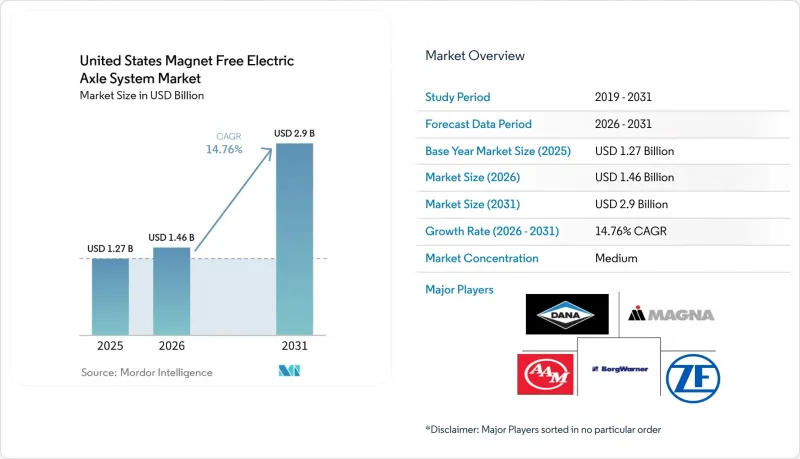
本報告按馬達類型(例如,外部勵同步馬達)、驅動系統(例如,純電動)、電橋配置(例如,單電橋)和車輛類型(乘用車和商用車)進行細分。市場預測以美元計價。
美國無磁電橋系統市場趨勢與洞察。
IRA稅額扣抵加速了國內電動車橋的生產
由於第45X條和第48C條規定的稅額扣抵抵免,採埃孚(ZF)的資本支出減少了30%,該公司承諾投資5億美元,用於擴建其位於南卡羅來納州格雷考特(Graycourt)的工廠。此次擴建將重點建造一條未來無磁電橋的生產線,預計這種電橋將在電動車技術的進步中發揮關鍵作用。同時,通用汽車(GM)正在對其位於奧賴恩(Orion)的工廠進行高達40億美元的巨額投資。這項投資旨在將該工廠改造為電動卡車生產基地,預計於2026年投入生產。
原始設備製造商正在採取措施緩解稀土元素價格波動。
釹和镨氧化物的價格大幅飆升,加倍多,創下歷史新高。此次價格上漲凸顯了各行業(包括電動車產業)在採購這些關鍵稀土元素材料方面所面臨的日益嚴峻的挑戰。成本上漲清晰地顯示了稀土元素市場的波動性,其根源在於供應鏈的限制和不斷成長的需求。為了應對這些挑戰,特斯拉和寶馬已宣布計劃逐步淘汰未來驅動單元中的稀土元素磁鐵。這項策略性舉措旨在減少對這些材料的依賴,降低供應鏈風險,並透過探索電動車零件的替代技術,實現永續性目標。
與最新型IPM馬達相比,效率差異顯著
工程報告指出,在WLTP 3級工況循環中,感應馬達的總損耗高於IPM馬達。這種差異導致續航里程縮短。由於感應馬達損耗較高,能耗增加,降低了車輛的整體效率和性能。此外,續航里程的縮短限制了配備感應馬達的車輛的實用性,降低了其在續航里程至關重要的應用領域的競爭力。
細分市場分析
2025年,感應馬達在美國無磁電橋系統市場佔44.56%的佔有率。這主要得益於特斯拉的前軸戰略以及博格華納計畫於2029年發布的800V整合驅動模組。預計到2031年,外勵同步馬達的複合年成長率將達到17.42%。在法雷奧瑪爾的系統以及寶馬量產的斯太爾計畫的推動下,外勵同步馬達預計將顯著成長。儘管開關式磁阻電動機目前仍屬於小眾產品,但由於其顯著降低了零件成本,因此對於注重成本的車隊而言,它仍然是一個相當吸引力的選擇。
這種感應式設計利用了成熟的鑄造技術,並具有強大的散熱路徑,尤其值得一提的是,它無需使用稀土元素材料。對 Munro Model Y 的拆解顯示,其轉子採用機械加工銅製成。雖然這些轉子具有更高的導熱性,但比鑄鋁轉子成本更高。馬勒的無刷勵磁技術表明,外部勵同步馬達 (EESM) 可以消除滑差損耗,並允許調節勵磁電流,從而在各種轉速下實現最佳效率。同時,美國能源局(DOE) 支持的計劃旨在降低開關磁阻馬達 (SRM) 的轉矩脈動,這有望將其市場應用範圍從堆高機擴展到普通電動車。
到2025年,純電動驅動系統將占美國無磁電橋系統市場的61.28%,預計到2031年將以19.07%的複合年成長率成長,這主要得益於電池成本的下降和充電網路的擴展。福特的路易斯維爾平台、通用汽車的Orion Trucks工廠以及Rivian的R2生產線都在優先生產電池式電動車(BEV)。插電式混合動力汽車仍然佔有一席之地,例如Allison的eGen Flex就被用於長途公車,以實現長續航里程,但這類車輛對新型電橋的需求正在下降。
除了聯邦清潔車輛補貼外,各州的具體獎勵,例如密西根州的工會獎金,也使得純電動車(BEV)的總擁有成本(TCO)朝更有利的方向發展。插電式混合動力汽車的複雜結構不僅增加了車重,也增加了維修需求。同時,並聯式混合動力汽車並未吸引到新的投資。對於車隊營運商而言,與柴油車相比,純電動車顯著更低的維護成本進一步推動了向純電動車的轉型。
其他好處:
- Excel格式的市場預測(ME)表
- 3個月的分析師支持
目錄
第1章:引言
- 市場分析與定義的前提條件
- 分析範圍
第2章 分析方法
第3章執行摘要
第4章 市場狀況
- 市場概覽
- 市場促進因素
- IRA稅額扣抵正在加速國內電動車橋的生產。
- 原始設備製造商正在採取措施緩解稀土元素價格波動。
- EESM 和 SRM 設計中扭力密度的快速提升
- 美國能源局能源部 (DOE) 為使用稀土元素磁鐵以外的磁鐵的馬達 (BREM) 提供研發資金
- 強制要求國防領域非稀土元素動力傳動系統電氣化。
- 美國電線供應過剩導致銅線圈價格下降。
- 市場限制因素
- 最新型IPM馬達的效率差距及比較
- 一級供應商初始模具更換相關的重大資本支出(CAPEX)。
- 高功率開關磁阻馬達轉子散熱極限
- 國內精密層壓材料的供應基礎有限。
- 價值鍊和供應鏈分析
- 監理情勢
- 技術展望
- 波特五力分析
第5章:預測市場規模與成長率
- 依馬達類型
- 外勵同步馬達
- 感應馬達
- 開關式磁阻電動機
- 透過驅動系統
- 全電動
- 油電混合驅動
- 插電式混合動力驅動
- 電驅動橋配置
- 單軸
- 雙電軸
- 整合式電力驅動橋
- 車輛類型
- 搭乘用車
- 掀背車
- 轎車
- SUV 和 MUV
- 商用車輛
- 輕型商用車
- 中型和大型商用車輛
- 巴士和長途汽車
- 搭乘用車
第6章 競爭情勢
- 市場集中度
- 策略趨勢
- 市佔率分析
- 公司簡介
- BorgWarner Inc.
- Dana Incorporated
- American Axle & Manufacturing Holdings, Inc.
- ZF Friedrichshafen AG
- Magna International Inc.
- Vitesco Technologies Group AG
- MAHLE GmbH
- Valeo SA
- Tesla, Inc.
- General Motors Company
- Ford Motor Company
- Rivian Automotive, Inc.
- Meritor, Inc.(Cummins Inc.)
- Allison Transmission Holdings Inc.
- Nidec Motor Corporation(Nidec Corporation)
- Robert Bosch GmbH
- UQM Technologies, Inc.
- Xtrac Limited
- Parker-Hannifin Corporation
第7章 市場機會與未來展望
According to Mordor Intelligence, the United States magnet free electric axle system market size was valued at USD 1.27 billion in 2025 and is estimated to grow from USD 1.46 billion in 2026 to reach USD 2.9 billion by 2031, at a CAGR of 14.76% during the forecast period (2026-2031).
This report is Segmented by Motor Type (Externally Excited Synchronous Motors and More), Drive Type (Fully Electric Drive and More), E-Axle Configuration (Single E-Axle and More), and Vehicle Type (Passenger Cars and Commercial Vehicles). The Market Forecasts are Provided in Terms of Value (USD).
United States Magnet Free Electric Axle System Market Trends and Insights
IRA Tax Credits Accelerating Domestic E-Axle Production
Due to the 30% reduction in capital outlays from Section 45X and Section 48C credits, ZF has pledged a USD 500 million investment to broaden its operations in Gray Court, South Carolina . This expansion will focus on establishing future magnet free e-axle production lines, which are expected to play a significant role in advancing electric vehicle technology. Concurrently, General Motors is channeling a hefty USD 4 billion into its Orion plant . This investment aims to transform the facility into a hub for electric truck production, with operations scheduled to commence in 2026.
OEM Drive to Eliminate Rare-Earth Price Volatility
Prices for neodymium and praseodymium oxides surged significantly, more than doubling to reach a notable high. This price increase highlighted the growing challenges in sourcing rare-earth materials, which are critical for various industries, including electric vehicles. The rising costs underscored the volatility of the rare-earth market, driven by supply chain constraints and increasing demand. In response to these challenges, Tesla and BMW unveiled plans to phase out rare-earth magnets from their upcoming drive units. This strategic move aims to reduce dependency on these materials, mitigate supply chain risks, and align with sustainability goals by exploring alternative technologies for electric vehicle components.
Efficiency Gap vs. Latest IPM Motors
Engineering Reports highlighted that during WLTP class-3 cycles, induction designs faced greater total losses than their IPM motor counterparts. This disparity results in a narrower range, as higher losses in induction designs increase energy consumption, thereby reducing the vehicle's overall efficiency and performance. Additionally, the reduced range limits the practicality of induction-equipped vehicles, making them less competitive in applications where range is a critical factor.
Other drivers and restraints analyzed in the detailed report include:
- Rapid Torque-Density Gains in EESM and SRM Designs
- DOE R&D Funding for Beyond-Rare-Earth-Magnet (BREM) Motors
- High Up-Front Re-Tooling CAPEX for Tier-1 Suppliers
For complete list of drivers and restraints, kindly check the Table Of Contents.
Segment Analysis
Induction motors accounted for 44.56% of the United States magnet free electric axle system market share in 2025, buoyed by Tesla's front-axle strategy and BorgWarner's 800-V integrated drive module slated for 2029 launch. Externally excited synchronous motors will expand at a 17.42% CAGR through 2031. Driven by Valeo-Mahle's systems and BMW's high-volume Steyr program, externally excited synchronous motors are set to grow significantly. While still a niche, switched reluctance motors offer substantial savings in bill-of-materials costs, making them appealing to cost-sensitive fleets.
Induction designs utilize mature casting techniques, boast robust thermal pathways, and notably contain no rare-earth materials. A teardown of Munro's Model Y unveiled machined copper rotors. These rotors enhance thermal conductivity but cost more than cast aluminum. Mahle's brushless excitation demonstrates that EESM can eliminate slip losses and adjust field current for optimal efficiency across varying speeds. Meanwhile, DOE-backed initiatives are targeting a reduction of SRM's torque ripple, a move that could broaden its market appeal from forklifts to mainstream EVs.
Fully electric drive systems held 61.28% of the United States magnet free electric axle system market in 2025 and will grow at a 19.07% CAGR through 2031 as battery costs fall and charging networks densify. Ford's Louisville platform, GM's Orion truck plant, and Rivian's R2 line are all prioritizing battery electric vehicles (BEVs). While plug-in hybrids still play a role, as seen with Allison's eGen Flex used in transit buses for their extended range, their demand for new e-axles is dwindling.
Federal clean-vehicle credits, along with additional state incentives like Michigan's union bonus, are tilting the total cost of ownership (TCO) in favor of BEVs. The added complexity of plug-in hybrids not only increases weight but also maintenance needs. Meanwhile, parallel hybrids aren't attracting new investments. Fleet operators are experiencing significantly lower service costs compared to diesel, further bolstering the shift towards BEVs.
Complete Report Scope:
- By Motor Type
- Externally Excited Synchronous Motors
- Induction Motors
- Switched Reluctance Motors
- By Drive Type
- Fully Electric Drive
- Hybrid Drive
- Plug-in Hybrid Drive
- By E-Axle Configuration
- Single E-Axle
- Dual E-Axle
- Integrated E-Axle
- By Vehicle Type
- Passenger Cars
- Hatchbacks
- Sedans
- SUV and MUVs
- Commercial Vehicles
- Light Commercial Vehicles
- Medium and Heavy Commercial Vehicles
- Buses and Coaches
- Passenger Cars
List of Companies Covered in this Report:
- BorgWarner Inc.
- Dana Incorporated
- American Axle & Manufacturing Holdings, Inc.
- ZF Friedrichshafen AG
- Magna International Inc.
- Vitesco Technologies Group AG
- MAHLE GmbH
- Valeo S.A.
- Tesla, Inc.
- General Motors Company
- Ford Motor Company
- Rivian Automotive, Inc.
- Meritor, Inc. (Cummins Inc.)
- Allison Transmission Holdings Inc.
- Nidec Motor Corporation (Nidec Corporation)
- Robert Bosch GmbH
- UQM Technologies, Inc.
- Xtrac Limited
- Parker-Hannifin Corporation
Additional Benefits:
- The market estimate (ME) sheet in Excel format
- 3 months of analyst support
TABLE OF CONTENTS
1 Introduction
- 1.1 Study Assumptions and Market Definition
- 1.2 Scope of the Study
2 Research Methodology
3 Executive Summary
4 Market Landscape
- 4.1 Market Overview
- 4.2 Market Drivers
- 4.2.1 IRA Tax Credits Accelerating Domestic E-Axle Production
- 4.2.2 OEM Drive to Eliminate Rare-Earth Price Volatility
- 4.2.3 Rapid Torque-Density Gains in EESM and SRM Designs
- 4.2.4 DOE R&D Funding for Beyond-Rare-Earth-Magnet (BREM) Motors
- 4.2.5 Defense Electrification Mandates for Non-Rare-Earth Powertrains
- 4.2.6 Copper-Coil Cost Declines from U.S. Wire-Rod Over-Capacity
- 4.3 Market Restraints
- 4.3.1 Efficiency Gap vs. Latest IPM Motors
- 4.3.2 High Up-Front Re-Tooling CAPEX for Tier-1 Suppliers
- 4.3.3 Rotor Heat-Dissipation Limits in High-Power SRM
- 4.3.4 Limited Domestic Precision-Lamination Supply Base
- 4.4 Value/Supply-Chain Analysis
- 4.5 Regulatory Landscape
- 4.6 Technological Outlook
- 4.7 Porter's Five Forces
- 4.7.1 Threat of New Entrants
- 4.7.2 Bargaining Power of Suppliers
- 4.7.3 Bargaining Power of Buyers
- 4.7.4 Threat of Substitutes
- 4.7.5 Intensity of Competitive Rivalry
5 Market Size and Growth Forecasts (Value (USD))
- 5.1 By Motor Type
- 5.1.1 Externally Excited Synchronous Motors
- 5.1.2 Induction Motors
- 5.1.3 Switched Reluctance Motors
- 5.2 By Drive Type
- 5.2.1 Fully Electric Drive
- 5.2.2 Hybrid Drive
- 5.2.3 Plug-in Hybrid Drive
- 5.3 By E-Axle Configuration
- 5.3.1 Single E-Axle
- 5.3.2 Dual E-Axle
- 5.3.3 Integrated E-Axle
- 5.4 By Vehicle Type
- 5.4.1 Passenger Cars
- 5.4.1.1 Hatchbacks
- 5.4.1.2 Sedans
- 5.4.1.3 SUV and MUVs
- 5.4.2 Commercial Vehicles
- 5.4.2.1 Light Commercial Vehicles
- 5.4.2.2 Medium and Heavy Commercial Vehicles
- 5.4.2.3 Buses and Coaches
- 5.4.1 Passenger Cars
6 Competitive Landscape
- 6.1 Market Concentration
- 6.2 Strategic Moves
- 6.3 Market Share Analysis
- 6.4 Company Profiles (Includes Global level Overview, Market level overview, Core Segments, Financials as available, Strategic Information, Market Rank/Share for key companies, Products and Services, and Recent Developments)
- 6.4.1 BorgWarner Inc.
- 6.4.2 Dana Incorporated
- 6.4.3 American Axle & Manufacturing Holdings, Inc.
- 6.4.4 ZF Friedrichshafen AG
- 6.4.5 Magna International Inc.
- 6.4.6 Vitesco Technologies Group AG
- 6.4.7 MAHLE GmbH
- 6.4.8 Valeo S.A.
- 6.4.9 Tesla, Inc.
- 6.4.10 General Motors Company
- 6.4.11 Ford Motor Company
- 6.4.12 Rivian Automotive, Inc.
- 6.4.13 Meritor, Inc. (Cummins Inc.)
- 6.4.14 Allison Transmission Holdings Inc.
- 6.4.15 Nidec Motor Corporation (Nidec Corporation)
- 6.4.16 Robert Bosch GmbH
- 6.4.17 UQM Technologies, Inc.
- 6.4.18 Xtrac Limited
- 6.4.19 Parker-Hannifin Corporation
7 Market Opportunities and Future Outlook
- 7.1 White-Space and Unmet-Need Assessment

 中國無磁電橋系統:市佔率分析、產業趨勢與統計及成長預測(2026-2031年)無磁電橋系統:市場佔有率分析、行業趨勢和統計數據、成長預測(2026-2031 年)歐洲無磁電橋系統:市場佔有率分析、產業趨勢與統計及成長預測(2026-2031 年)汽車電動驅動橋:市場佔有率分析、產業趨勢與統計、成長預測(2026-2031)
 汽車電動驅動橋市場:依驅動橋位置、驅動系統、馬達技術、車輛類型和最終用戶分類-2026-2032年全球市場預測
 電動車改裝電驅動橋市場預測(至 2034 年)—按車輛類型、功率輸出、傳動系統、組件、改裝類型、最終用戶、銷售管道和地區進行全球分析。
 電動橋驅動系統市場-全球產業規模、佔有率、趨勢、機會及預測(依系統類型、車輛類型、需求類別、地區及競爭格局分類,2021-2031年)電動驅動橋行星齒輪市場按階段、車輛類型、扭力容量、材料、製造流程和應用分類-全球預測,2026-2032年