


 |
市場調查報告書
商品編碼
2117406
中國無磁電橋系統:市佔率分析、產業趨勢與統計及成長預測(2026-2031年)China Magnet Free Electric Axle System - Market Share Analysis, Industry Trends & Statistics, Growth Forecasts (2026 - 2031) |
||||||

※ 本網頁內容可能與最新版本有所差異。詳細情況請與我們聯繫。
根據 Mordor Intelligence 估計,2025 年中國無磁電橋系統的市場規模將達到 11.4 億美元,2026 年將達到 13 億美元。
此外,預計到 2031 年將達到 24.7 億美元,2026 年至 2031 年的複合年成長率為 13.74%。
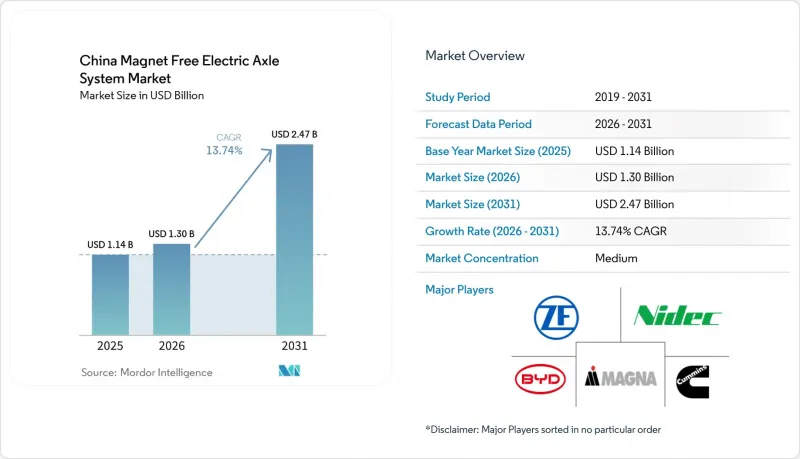
本報告依馬達類型(外部勵同步馬達、感應馬達、開關式磁阻電動機)、驅動系統(純電動、混合動力等)、電橋配置(單電橋、雙電橋、整合電橋)和車輛類型(乘用車、商用車)分類。市場預測以美元計價。
中國無磁電橋系統市場趨勢與洞察。
新能源汽車(NEV)的政府法規和在地採購規則
北京計畫大幅提高插電式混合動力汽車的最低純電續航里程要求。根據修訂後的雙項補助機制,無法追溯國內來源的永磁電機將無法獲得補助。這項調整將引導整車製造商的投資轉向感應馬達和外置同步馬達系統。此外,免徵購置稅的條件也改為提高電池能量密度。而採用更輕、無磁鐵的馬達轉子更容易達到此標準。近期推出的永磁驅動單元出口許可規定,鼓勵外資合資企業轉向在地採購的感應模組。這些規定共同建構了一個保護性政策框架,加速了無磁鐵供應鏈的在地化進程,並鼓勵汽車製造商有效率地重新設計動力傳動系統。
稀土元素價格波動正在加速汽車製造商向不使用磁鐵的馬達轉型。
釹镨氧化物的價格飆升,主要原因是霍爾木茲海峽局勢動盪以及更嚴格的出口配額制度的實施。為此,比亞迪正在調整策略,在提高感應馬達產量的同時,加快研發可變磁通永磁同步馬達。透過從感應系統中去除釹,整車製造商可以確保長期價格穩定。這種做法符合車輛業者優先考慮的保持總擁有成本(TCO)不變的理念。每年投入大量貨車的城市物流公司現在更注重成本穩定,而非僅僅追求微小的效率提升。因此,這些公司正在迅速轉向無磁電橋。不斷成長的需求正在推動規模經濟,降低單位成本,並進一步加速擺脫磁鐵的進程。
高頻逆變器成本不斷上漲
SR馬達正轉向使用SiC MOSFET,這種裝置比傳統的矽IGBT更昂貴。價格上漲正在削弱永磁馬達曾經在低價城市車輛中享有的成本優勢。雖然天成的大尺寸晶圓具有降低成本的潛力,但值得注意的是,其商業性良率仍然很低。即使使用價格低廉的矽元件,感應馬達也能高效運行,儘管效率會略有降低。這為價格競爭創造了暫時的機會。在此期間,豪華汽車製造商可能會繼續使用磁電機,以避免逆變器帶來的額外成本。
細分市場分析
在中國無磁電橋系統市場,感應馬達的採用率已達47.13%。在國家資助的旨在將轉矩脈動減半的研究的支持下,SR Designs公司預計到2031年將以15.17%的複合年成長率持續成長。憑藉成熟的線圈繞製工廠和無縫的軟體移植性,原始設備製造商(OEM)繼續依賴感應馬達。採埃孚(ZF)的電橋系統使汽車製造商無需更換變速箱即可在非同步和同步系統之間切換,從而有效應對稀土元素價格波動的影響。
控制演算法的突破性進展正推動同步磁阻馬達邁向乘用車應用一大步。隨著演算法智慧財產權比轉子硬體成為更重要的差異化因素,供應商現在提供與硬體交付捆綁的韌體授權。外勵式同步馬達正在重型卡車和豪華旅遊巴士領域佔有一席之地。在這些應用中,較長的維護週期使得滑環維護成為切實可行的選擇。隨著同步磁阻馬達和感應馬達技術的不斷發展,採購團隊在最終確定訂單前會考慮釹磁鐵的現貨價格,導致馬達類型配置隨著時間的推移而更加靈活多變。
2025年,純電動驅動系統將佔據中國無磁電橋系統市場64.22%的佔有率。該細分市場正以16.78%的複合年成長率快速成長,主要得益於純電動車與早期插電式混合動力汽車續航里程的趨同以及充電樁的快速普及。中國工業和資訊化部提出的「100公里純電續航里程」要求消除了混合動力汽車傳統的成本優勢。如今,即使混合動力汽車配備了與純電池式電動車類似的電池組,它們仍然需要內燃機。
插電式混合動力汽車正逐漸轉型為主要增程器,用於充電基礎設施稀少的公路上的公車。純電動車(BEV)由於沒有引擎扭力混合功能,因此可以使用更簡單的電橋軟體,並能更最佳化地運作同步共振馬達。比亞迪的銷售數據顯示,從2025年4月起,純電動車的銷售量將超過插電式混合動力車,反映了整體市場趨勢。雖然混合動力汽車對農村用戶仍然有用,但都市區車隊和偏遠地區以外的個人用戶擴大選擇純電動動力傳動系統。
其他好處:
- Excel格式的市場預測(ME)表
- 3個月的分析師支持
目錄
第1章:引言
- 市場分析與定義的前提條件
- 分析範圍
第2章 分析方法
第3章執行摘要
第4章 市場狀況
- 市場概覽
- 市場促進因素
- 政府對新能源汽車(NEV)的強制規定和在地採購規則。
- 稀土元素價格波動加劇,加速了汽車製造商轉型為不使用磁鐵的馬達。
- SR和EESM電機控制演算法的突破性進展
- 與PM E-車橋相比,總擁有成本更低
- 一級供應商必須報告碳足跡
- 國產碳化矽晶片的技術突破,使高壓逆變器成為可能。
- 市場限制因素
- 高頻運轉逆變器高成本
- 永磁馬達NVH與扭力密度之間的差距
- 整合式電力驅動橋系統中溫度控管的複雜性
- 缺乏針對超過 800 伏特馬達絕緣的統一標準
- 價值鍊和供應鏈分析
- 監理情勢
- 技術展望
- 波特五力分析
第5章:預測市場規模與成長率
- 依馬達類型
- 外勵同步馬達(EESM)
- 感應馬達
- 開關式磁阻電動機
- 透過驅動系統
- 全電動
- 油電混合驅動
- 插電式混合動力驅動
- 電驅動橋配置
- 單軸電驅動
- 雙電軸
- 整合式電力驅動橋
- 按車輛類型
- 搭乘用車
- 掀背車
- 轎車
- SUV 和 MUV
- 商用車輛
- 輕型商用車
- 中型和大型商用車輛
- 巴士和長途汽車
- 搭乘用車
第6章 競爭情勢
- 市場集中度
- 策略趨勢
- 市佔率分析
- 公司簡介
- ZF Friedrichshafen AG
- Nidec Corporation
- BYD Co. Ltd.
- Magna International
- Meritor(Cummins)
- Allison Transmission
- Shuanglin Group
- SinoHytec
- Tesla(Gigafactory Shanghai)
- Vitesco Technologies
- Schaeffler AG
- Mahle GmbH
第7章 市場機會與未來展望
According to Mordor Intelligence, the China magnet free electric axle system market size was valued at USD 1.14 billion in 2025 and is estimated at USD 1.30 billion in 2026, and is projected to reach USD 2.47 billion by 2031, growing at a CAGR of 13.74% from 2026 to 2031.
This report is Segmented by Motor Type (Externally Excited Synchronous Motors, Induction Motors, and Switched Reluctance Motors), Drive Type (Fully Electric Drive, Hybrid Drive, and More), E-Axle Configuration (Single E-Axle, Dual E-Axle, and Integrated E-Axle), and Vehicle Type (Passenger Cars and Commercial Vehicles). The Market Forecasts are Provided in Terms of Value (USD).
China Magnet Free Electric Axle System Market Trends and Insights
Government NEV Mandates and Local-Content Rules
Beijing will raise the minimum electric range for plug-in hybrids, significantly increasing the requirement. Under the revised dual-credit framework, permanent-magnet motors without domestic traceability will receive zero credits. This adjustment directs OEM investments towards induction and externally excited synchronous systems. Additionally, purchase-tax exemptions are now contingent on achieving a higher battery energy density. This benchmark becomes more attainable when utilizing a lighter, magnet-free motor rotor. Recent export licensing restrictions on overseas shipments of permanent-magnet drive units are encouraging foreign joint ventures to shift towards locally sourced induction modules. Collectively, these regulations establish a protective policy framework that accelerates the localization of magnet-free supply chains and motivates automakers to redesign their drivetrains efficiently.
Rare-earth Price Volatility Accelerates OEM Shift to Magnet-Free Motors
Neodymium-praseodymium oxide prices experienced a significant surge, driven primarily by disruptions in the Strait of Hormuz and the enforcement of stricter export quotas. In response, BYD is adjusting its strategy by increasing production of its induction motor while also advancing research and development on variable-flux permanent-magnet synchronous designs. By eliminating neodymium from their induction systems, OEMs can secure stable long-term pricing. This approach aligns with fleet operators' priorities for maintaining a consistent total cost of ownership (TCO). Urban logistics companies, deploying large numbers of vans annually, are now prioritizing cost stability over minor efficiency improvements. Consequently, they are rapidly transitioning to magnet-free e-axles. The growing demand is driving volume economies, reducing per-unit costs, and further reinforcing the shift away from magnets.
Higher Inverter Cost for High-Frequency Operation
SR machines are increasingly turning to SiC MOSFETs, which come at a higher cost than traditional silicon IGBTs. This price increase erodes the bill-of-materials edge that permanent-magnet motors once enjoyed in city cars priced at the lower end of the market. While Tiancheng's larger wafers hold the promise of cost reductions, it's important to highlight that commercial yields are still trailing. Induction motors, while capable of efficient operation with cheaper silicon, experience a slight efficiency dip. As a result, a temporary pricing window has emerged. During this timeframe, premium car manufacturers are likely to stick with magnets, avoiding the extra costs tied to inverters.
Other drivers and restraints analyzed in the detailed report include:
- Breakthroughs in Control Algorithms for SR and EESM Motors
- Lower Total Cost of Ownership vs. PM E-axles
- NVH and Torque-Density Gap with PM Motors
For complete list of drivers and restraints, kindly check the Table Of Contents.
Segment Analysis
The China magnet free electric axle system market size for induction motor-type adoption reached equal to 47.13% share. SR designs expand at 15.17% CAGR through 2031, supported by nation-funded research that halves torque ripple. Due to established coil-winding plants and seamless software portability, OEMs continue to place their trust in induction. ZF's e-axle empowers automakers to switch between asynchronous and synchronous variants without altering the gearbox, serving as a safeguard against fluctuations in rare-earth prices.
Breakthroughs in control algorithms are steering SR motors closer to passenger car suitability. With algorithm intellectual property emerging as the pivotal differentiator over rotor hardware, suppliers are now bundling firmware licenses with their hardware deliveries. Externally excited synchronous motors are finding their place in heavy trucks and luxury tour buses, where extended maintenance intervals make slip-ring maintenance a viable option. As SR and induction choices evolve, procurement teams are now factoring in spot neodymium prices before finalizing orders, leading to a more dynamic mix of motor types over time.
Fully electric drive captured 64.22% of the China magnet free electric axle system market share in 2025. The segment rises at a 16.78% CAGR due to range parity with early plug-in hybrids and a rapid rollout of chargers. MIIT's 100-km electric-only requirement erases the earlier cost edge of hybrids, which must now carry near-BEV battery packs yet still include internal-combustion engines.
Plug-in hybrids drift toward a niche role as range extenders for buses running along sparse highway charging corridors. Pure battery-electric simplifies e-axle software because there's no torque blending with engines, allowing SR motors to run in optimal zones. BYD sales data show BEVs topping PHEVs since April 2025, echoing the broader market tilt. Hybrids remain relevant for rural customers, but urban fleets and private buyers outside remote areas go straight to pure-electric powertrains.
Complete Report Scope:
- By Motor Type
- Externally Excited Synchronous Motors (EESM)
- Induction Motors
- Switched Reluctance Motors
- By Drive Type
- Fully Electric Drive
- Hybrid Drive
- Plug-in Hybrid Drive
- By E-Axle Configuration
- Single E-Axle
- Dual E-Axle
- Integrated E-Axle
- By Vehicle Type
- Passenger Cars
- Hatchbacks
- Sedans
- SUV and MUVs
- Commercial Vehicles
- Light Commercial Vehicles
- Medium and Heavy Commercial Vehicles
- Buses and Coaches
- Passenger Cars
List of Companies Covered in this Report:
- ZF Friedrichshafen AG
- Nidec Corporation
- BYD Co. Ltd.
- Magna International
- Meritor (Cummins)
- Allison Transmission
- Shuanglin Group
- SinoHytec
- Tesla (Gigafactory Shanghai)
- Vitesco Technologies
- Schaeffler AG
- Mahle GmbH
Additional Benefits:
- The market estimate (ME) sheet in Excel format
- 3 months of analyst support
TABLE OF CONTENTS
1 Introduction
- 1.1 Study Assumptions and Market Definition
- 1.2 Scope of the Study
2 Research Methodology
3 Executive Summary
4 Market Landscape
- 4.1 Market Overview
- 4.2 Market Drivers
- 4.2.1 Government NEV Mandates and Local-Content Rules
- 4.2.2 Rare-Earth Price Volatility Accelerates OEM Shift to Magnet-Free Motors
- 4.2.3 Breakthroughs in Control Algorithms for SR and EESM Motors
- 4.2.4 Lower Total Cost of Ownership vs. PM E-Axles
- 4.2.5 Mandatory Carbon-Footprint Reporting for Tier-1 Suppliers
- 4.2.6 Domestic SiC-Chip Breakthroughs Enabling High-Voltage Inverters
- 4.3 Market Restraints
- 4.3.1 Higher Inverter Cost for High-Frequency Operation
- 4.3.2 NVH and Torque-Density Gap with PM Motors
- 4.3.3 Thermal-Management Complexity for Integrated E-Axle Systems
- 4.3.4 Lack of Unified Motor Insulation Standards Above 800 V
- 4.4 Value / Supply-Chain Analysis
- 4.5 Regulatory Landscape
- 4.6 Technological Outlook
- 4.7 Porter's Five Forces
- 4.7.1 Threat of New Entrants
- 4.7.2 Bargaining Power of Suppliers
- 4.7.3 Bargaining Power of Buyers
- 4.7.4 Threat of Substitutes
- 4.7.5 Competitive Rivalry
5 Market Size and Growth Forecasts (Value in USD)
- 5.1 By Motor Type
- 5.1.1 Externally Excited Synchronous Motors (EESM)
- 5.1.2 Induction Motors
- 5.1.3 Switched Reluctance Motors
- 5.2 By Drive Type
- 5.2.1 Fully Electric Drive
- 5.2.2 Hybrid Drive
- 5.2.3 Plug-in Hybrid Drive
- 5.3 By E-Axle Configuration
- 5.3.1 Single E-Axle
- 5.3.2 Dual E-Axle
- 5.3.3 Integrated E-Axle
- 5.4 By Vehicle Type
- 5.4.1 Passenger Cars
- 5.4.1.1 Hatchbacks
- 5.4.1.2 Sedans
- 5.4.1.3 SUV and MUVs
- 5.4.2 Commercial Vehicles
- 5.4.2.1 Light Commercial Vehicles
- 5.4.2.2 Medium and Heavy Commercial Vehicles
- 5.4.2.3 Buses and Coaches
- 5.4.1 Passenger Cars
6 Competitive Landscape
- 6.1 Market Concentration
- 6.2 Strategic Moves
- 6.3 Market Share Analysis
- 6.4 Company Profiles (Includes Global Level Overview, Market Level Overview, Core Segments, Financials as Available, Strategic Information, Market Rank/Share for Key Companies, Products and Services, SWOT Analysis, and Recent Developments)
- 6.4.1 ZF Friedrichshafen AG
- 6.4.2 Nidec Corporation
- 6.4.3 BYD Co. Ltd.
- 6.4.4 Magna International
- 6.4.5 Meritor (Cummins)
- 6.4.6 Allison Transmission
- 6.4.7 Shuanglin Group
- 6.4.8 SinoHytec
- 6.4.9 Tesla (Gigafactory Shanghai)
- 6.4.10 Vitesco Technologies
- 6.4.11 Schaeffler AG
- 6.4.12 Mahle GmbH
7 Market Opportunities and Future Outlook
- 7.1 White-space and Unmet-Need Assessment

 無磁電橋系統:市場佔有率分析、行業趨勢和統計數據、成長預測(2026-2031 年)美國無磁電橋系統:市場佔有率分析、產業趨勢與統計、成長預測(2026-2031)歐洲無磁電橋系統:市場佔有率分析、產業趨勢與統計及成長預測(2026-2031 年)汽車電動驅動橋:市場佔有率分析、產業趨勢與統計、成長預測(2026-2031)
 汽車電動驅動橋市場:依驅動橋位置、驅動系統、馬達技術、車輛類型和最終用戶分類-2026-2032年全球市場預測
 電動車改裝電驅動橋市場預測(至 2034 年)—按車輛類型、功率輸出、傳動系統、組件、改裝類型、最終用戶、銷售管道和地區進行全球分析。
 電動橋驅動系統市場-全球產業規模、佔有率、趨勢、機會及預測(依系統類型、車輛類型、需求類別、地區及競爭格局分類,2021-2031年)電動驅動橋行星齒輪市場按階段、車輛類型、扭力容量、材料、製造流程和應用分類-全球預測,2026-2032年