


 |
市場調查報告書
商品編碼
2122438
離散半導體:市場佔有率分析、產業趨勢與統計及成長預測(2026-2031)Discrete Semiconductor - Market Share Analysis, Industry Trends & Statistics, Growth Forecasts (2026 - 2031) |
||||||

※ 本網頁內容可能與最新版本有所差異。詳細情況請與我們聯繫。
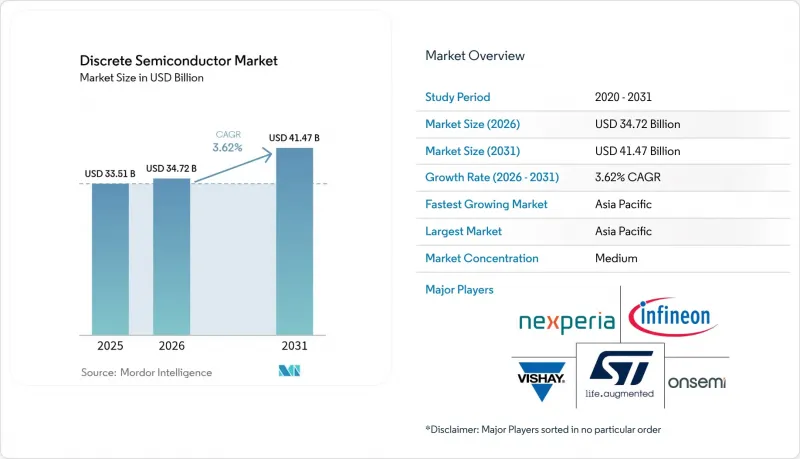
根據 Mordor Intelligence 估計,到 2026 年,離散半導體市值將達到 347.2 億美元,高於 2025 年的 335.1 億美元,預計到 2031 年將達到 414.7 億美元。
預計 2026 年至 2031 年的複合年成長率為 3.62%。
本報告按裝置類型(二極體、小型訊號電晶體及其他)、終端用戶產業(汽車、消費性電子及其他)、材料(矽、碳化矽、氮化鎵)、功率等級(低功率、中功率、高功率)和地區(北美、南美、歐洲、亞太、中東和非洲)進行細分。市場預測以美元計價。
全球離散半導體市場趨勢與洞察
汽車電氣化浪潮
電池式電動車和插電式混合動力車 (EV) 使用的離散半導體數量是內燃機汽車的 3 到 5 倍,這導致單車負載增加,並使離散半導體市場免受消費性電子市場波動的影響。高速開關 MOSFET 和 SiC 二極體在高壓 800V 驅動系統中至關重要,它們可以降低逆變器損耗並實現更輕的線束。汽車製造商與代工廠合作夥伴之間的長期採購協議確保了 AEC-Q101 認證裝置的穩定供應。馬達和執行器供應商的垂直整合收購有助於對驅動 IC、閘極模組和熱介面進行更嚴格的控制。隨著充電基礎設施向 350kW 功率方向發展,車載充電器正朝著高頻拓撲結構發展,這種結構有利於使用寬寬能隙分立元件以提高效率並節省基板空間。對認證週期和零缺陷的更高要求提高了准入門檻,使注重品質的供應商更具優勢。
SiC裝置和IGBT成本曲線的交點
從150毫米到200毫米的SiC晶圓、更薄的基板以及更高的外延良率正在推動每平方厘米成本的下降,使SiC MOSFET的價格更接近600-1200V級溝槽IGBT的價格水平。弗勞恩霍夫半導體產業技術研究所(Fraunhofer IISB)的「ThinSiCPower」等調查計畫表明,工程化基板和背面冷卻可以將裝置級成本降低25%。中國基板製造商已將6吋SiC晶圓的價格降至400美元以下,比2024年初的價格下降了30%。成本的下降正在擴大太陽能逆變器、工業驅動器和資料中心電源架等應用領域的潛在市場規模(TAM)。元件供應商正在將閘極驅動器ASIC和溫度感測器整合到半橋模組中,使系統設計人員能夠縮短認證週期和產品上市時間。
由於積體電路級整合,分立元件逐漸被淘汰。
目前,電源管理積體電路 (IC) 整合了低電壓 MOSFET、電流偵測分流器和保護電路,降低了智慧型手機和筆記型電腦的組件成本。晶片組架構將這一趨勢擴展到伺服器主機板,使設計人員能夠在單一封裝內整合氮化鎵 (GaN) 驅動晶片和邏輯叢集。在低功耗消費性電子產品中,價值鏈正從獨立的分立元件轉向單晶片穩壓器,導致銷售成長放緩。然而,分立元件在高功率範圍內仍然至關重要,因為將高壓開關和控制矽物理分離可以確保熱裕度和電磁相容性。因此,這種「蠶食效應」是不對稱的;它限制了 60V 以下低電流分立元件的應用,而對工作電壓高於 650V 的牽引逆變器和併網轉換器的影響有限。
細分市場分析
預計到2025年,功率MOSFET將佔據離散半導體市場33.95%的佔有率,年複合成長率達5.36%,主要得益於電動交通設備、資料中心電源架和可再生能源逆變器等應用領域對高速開關和低損耗拓樸結構的需求。離散半導體市場正受惠於溝槽閘極架構,該架構兼具低導通電阻(RDS(on))和Avalanche抗擾性,從而實現了48V伺服器背板中緊湊型DC-DC轉換器的應用。與鍵合線設計相比,銅纜夾和頂部冷卻封裝可將熱阻降低高達20K/W,從而延長裝置在重複電流尖峰下的使用壽命。肖特基二極體和超快整流器仍然是功率因數校正(PFC)階段的主要解決方案,但隨著多個查核點整合到碳化矽(SiC)半橋中,它們的佔有率正在穩步成長。
小訊號電晶體的需求保持穩定,主要集中在消費性物聯網應用領域,在這些應用中,成本和基板密度比單純的效率更為重要。閘流體在照明安定器領域的出貨量有所下降,但它們在電網側,尤其是在靜態開關和過壓保護方面,仍然發揮著重要作用。離散半導體市場持續呈現兩極化的趨勢:通用低壓元件和高性能大電流開關,後者價格較高。整合裝置製造商 (IDM) 透過將 MOSFET導線架與整合式閘極驅動器和電流偵測放大器結合,正在實現產品線多元化,從而縮短汽車牽引和工業伺服驅動器的設計週期。
到2025年,汽車應用將佔離散半導體市場佔有率的25.55%,到2031年將以4.86%的複合年成長率超越所有其他細分市場。電池驅動系統的普及將使牽引逆變器、汽車充電器和輔助幫浦中的功率開關數量加倍,即使在全球輕型汽車銷售波動的情況下,也能支撐其持續成長。在高級駕駛輔助系統(ADAS)領域,從雷射雷達到高解析度雷達,氮化鎵(GaN)分立放大器正被廣泛應用以擴展探測範圍,從而推動其應用量逐步增加。此外,嚴格的功能安全法規也使離散半導體市場受益,這些法規優先考慮底盤控制中分立元件的隔離,而非系統單晶片(SoC)的整合。
儘管消費性電子產品在出貨量方面仍保持第二的位置,但由於高度整合的電源管理積體電路(PMIC)蠶食了分立元件的需求,其成長率仍維持在個位數低位。通訊基礎設施的投資正在推動對高壓整流器和用於5G遠端無線電站的氮化鎵(GaN)射頻電晶體的需求。在工業自動化領域,用於變頻驅動器和不斷電系統(UPS)的IGBT和SiC二極體的應用仍然強勁。
區域分析
到2025年,亞太地區將以43.05%的市佔率主導離散半導體市場,並將持續維持最快的成長速度,到2031年複合年成長率將達到5.23%。中國政府主導的晶圓代工支持以及日本在材料和封裝領域的主導地位,都為持續的投資提供了支撐。亞洲各地的外包半導體組裝和測試中心(OSAT)正在擴大銅夾和模壓碳化矽(SiC)模組的生產規模,以滿足國內電動車和電源OEM廠商的需求。本地需求依然強勁,政府的碳中和藍圖促使政府為先進的逆變器和充電器計畫提供公共資金支持。
在北美,520億美元的《晶片與科學法案》正被用於將成熟的製程節點和寬能隙生產線遷回國內,但其成本結構仍比亞洲晶圓廠高出約35%。因此,離散半導體供應商正在採取「雙晶圓廠」策略,透過在美國和馬來西亞分別生產關鍵應用產品,來平衡地緣政治和經濟因素。美國一級汽車供應商和國防電子供應商優先考慮國內採購,以確保符合《國際武器貿易條例》(ITAR)和網路安全要求,這反過來又保障了區域晶圓廠的利基市場。
歐洲計畫透過「歐盟晶片法」在2030年前佔據全球半導體產能的20%,並專注於發展節能型功率元件,這也是「綠色交易」的優先事項。歐洲本土整合裝置製造商(IDM)正利用其地理位置接近性,毗鄰汽車製造商,並受益於支援採用碳化矽(SiC)的高效轉換器的電網現代化舉措,從而拓展業務。
另一方面,雖然中東、非洲和南美洲在整個離散半導體市場中所佔佔有率僅為個位數,但基礎設施建設和可再生能源的引入正在創造高成長的叢集,全球公司正透過分銷商網路和設計支援中心來滿足這些集群的需求。
其他好處
- Excel格式的市場預測(ME)表
- 3個月的分析師支持
目錄
第1章:引言
- 研究假設和市場定義
- 調查範圍
第2章:調查方法
第3章執行摘要
第4章 市場狀況
- 市場概覽
- 市場促進因素
- 汽車電氣化浪潮
- 可再生能源逆變器的需求
- 5G無線PA模組的廣泛應用
- SiC裝置和IGBT成本曲線的交點
- 電源模組供應鏈本地化
- 採用先進的銅夾包裝
- 市場限制因素
- 由於積體電路級整合,分立元件逐漸被淘汰。
- 與經濟週期相關的資本投資過剩風險
- 人們對碳化矽二極體熱失控可靠性的擔憂
- 歐盟關於待機功率損耗的嚴格生態設計法規
- 宏觀經濟因素對市場的影響
- 產業價值鏈分析
- 監理情勢
- 技術展望
- 波特五力分析
- 投資分析
第5章 市場規模與成長預測
- 依設備類型
- 二極體
- 小訊號電晶體
- 功率電晶體
- MOSFET功率電晶體
- IGBT功率電晶體
- 其他功率電晶體
- 整流器
- 閘流體
- 按最終用戶行業分類
- 車
- 家用電器
- 通訊基礎設施
- 產業
- 其他終端用戶產業
- 材料
- 矽
- 碳化矽(SiC)
- 氮化鎵(GaN)
- 按類型分類的額定輸出
- 低功率(低於20V)
- 中功率(20-600V)
- 高功率(超過 600V)
- 按地區
- 北美洲
- 美國
- 加拿大
- 墨西哥
- 南美洲
- 巴西
- 阿根廷
- 其他南美國家
- 歐洲
- 德國
- 英國
- 法國
- 俄羅斯
- 其他歐洲國家
- 亞太地區
- 中國
- 日本
- 印度
- 韓國
- 東南亞
- 其他亞太國家
- 中東和非洲
- 中東
- 沙烏地阿拉伯
- 阿拉伯聯合大公國
- 其他中東國家
- 非洲
- 南非
- 埃及
- 其他非洲地區
- 中東
- 北美洲
第6章 競爭情勢
- 市場集中度
- 策略趨勢
- 市佔率分析
- 公司簡介
- Infineon Technologies AG
- ON Semiconductor Corporation
- Vishay Intertechnology Inc.
- STMicroelectronics NV
- Nexperia BV
- Rohm Co., Ltd.
- Diodes Incorporated
- Mitsubishi Electric Corporation
- Fuji Electric Co., Ltd.
- Littelfuse Inc.
- Texas Instruments Incorporated
- Toshiba Electronic Devices & Storage Corporation
- ABB Ltd.
- Hitachi Energy Ltd.
- Eaton Corporation plc
- NXP Semiconductors NV
- Semikron Danfoss GmbH & Co. KG
- Renesas Electronics Corporation
- Microchip Technology Inc.
- Wolfspeed Inc.
- Qorvo Inc.
- WeEn Semiconductors Co., Ltd.
- Analog Devices Inc.
- Power Integrations Inc.
- Skyworks Solutions Inc.
- Alpha & Omega Semiconductor Ltd.
第7章 市場機會與未來展望
According to Mordor Intelligence, discrete semiconductor market size in 2026 is estimated at USD 34.72 billion, growing from 2025 value of USD 33.51 billion with 2031 projections showing USD 41.47 billion, growing at 3.62% CAGR over 2026-2031.
This report is Segmented by Device Type (Diode, Small-Signal Transistor, and More), End-User Vertical (Automotive, Consumer Electronics, and More), Material (Silicon, Silicon-Carbide, Gallium-Nitride), Power Rating (Low-Power, Mid-Power, High-Power), and Geography (North America, South America, Europe, Asia-Pacific, Middle East, and Africa). The Market Forecasts are Provided in Terms of Value (USD).
Global Discrete Semiconductor Market Trends and Insights
Automotive Electrification Wave
Battery-electric and plug-in hybrid vehicles embed 3-5 times more power discretes than internal-combustion models, lifting content per car and insulating the discrete semiconductor market from consumer-electronics cyclicality. High-voltage 800 V drivetrains rely on fast-switching MOSFETs and SiC diodes that cut inverter losses and enable lighter wiring looms. Long-term sourcing agreements between automakers and foundry partners ensure supply continuity for AEC-Q101-qualified devices. Vertical acquisitions by motor and actuator suppliers underpin tighter control over driver ICs, gate modules, and thermal interfaces. As charging infrastructure migrates to 350 kW rates, vehicle onboard chargers shift toward higher-frequency topologies that favor wide-bandgap discretes for efficiency and board-space savings. Certification cycles and zero-defect expectations raise entry barriers, keeping quality-focused vendors in a favorable position.
SiC Device Cost Curve Crossing IGBT
Cost reductions from 150 mm to 200 mm SiC wafer transition, substrate-thinning, and higher epitaxial yields lower USD/cm2 and move SiC MOSFETs toward parity with trench IGBTs in 600-1,200 V classes. Research programs such as Fraunhofer IISB's ThinSiCPower demonstrate 25% device-level cost cuts through engineered substrates and backside cooling. Chinese substrate houses have pushed 6-inch SiC wafer pricing below USD 400, a 30% drop versus early 2024. The falling cost curve broadens the total addressable market across photovoltaic inverters, industrial drives, and data-center power shelves. Device vendors are integrating gate-driver ASICs and temperature sensors into half-bridge modules, enabling system designers to shorten qualification timelines and accelerate time-to-market.
IC-Level Integration Cannibalising Discretes
Power-management ICs now embed low-voltage MOSFETs, current-sense shunts, and protection circuitry, shrinking the bill of materials in smartphones and laptops. Chiplet architectures extend this trend to server motherboards, letting designers integrate gallium-nitride driver die alongside logic clusters within a single package. For low-power consumer products, the value line migrates from stand-alone discretes toward monolithic regulators, tempering volume growth. Yet high-power zones maintain discrete relevance. Physical separation of high-voltage switches from control silicon safeguards thermal margins and electromagnetic compliance. Consequently, the cannibalization effect is asymmetric: it constrains sub-60 V low-current discretes but has limited reach into traction inverters or grid-tie converters that operate above 650 V.
Other drivers and restraints analyzed in the detailed report include:
- 5G Radio PA Module Proliferation
- Renewable-Energy Inverters Demand
- Cyclical Cap-Ex Over-Supply Risk
For complete list of drivers and restraints, kindly check the Table Of Contents.
Segment Analysis
Power MOSFETs held a 33.95% share of the discrete semiconductor market size in 2025 and are growing at a 5.36% CAGR as electrified transport, data-center power shelves, and renewable inverters demand fast-switching, low-loss topologies. The discrete semiconductor market benefits from trench-gate architectures that combine lower RDS(on) with avalanche ruggedness, enabling compact DC-DC converters in 48 V server backplanes. Copper-clip and top-side-cooling packages lower thermal resistance by as much as 20 K/W versus bond-wire designs, lengthening lifetime under repetitive current spikes. Schottky diodes and ultrafast rectifiers remain workhorse solutions in PFC stages, though their share grows modestly as integration packs multiple checkpoints inside SiC half-bridges.
Demand for small-signal transistors stabilizes around consumer IoT applications where cost and board density trump raw efficiency. Thyristor volumes fall in lighting ballasts yet sustain grid-side roles, particularly static switches and crowbar protection. The discrete semiconductor market continues to bifurcate between commodity low-voltage parts and performance-critical high-current switches that command price premiums. IDMs diversify by pairing MOSFET lead frames with integrated gate drivers and current-sense amplifiers, shortening design cycles for vehicle traction and industrial servo drives.
Automotive applications accounted for 25.55% of the discrete semiconductor market share in 2025, outpacing all other verticals with a 4.86% CAGR through 2031. Battery-electric propulsion multiplies the count of power switches in traction inverters, on-board chargers, and auxiliary pumps, supporting persistent unit growth even as global light-vehicle sales fluctuate. ADAS domains, from LiDAR to high-definition radar, integrate discrete GaN amplifiers to extend detection range, feeding incremental content growth. The discrete semiconductor market also benefits from stringent functional-safety regulations that favor discrete component isolation over SOC integration in chassis control.
Consumer electronics retain second-place volume but sit at low-single-digit growth because highly integrated PMICs cannibalize discrete sockets. Communication-infrastructure expenditure reinforces demand for high-voltage rectifiers and GaN RF transistors in 5G remote radio heads. Industrial automation remains a steady adopter of IGBTs and SiC diodes for variable-frequency drives and uninterruptible power supply systems.
Complete Report Scope:
- By Device Type
- Diode
- Small-Signal Transistor
- Power Transistor
- MOSFET Power Transistor
- IGBT Power Transistor
- Other Power Transistor
- Rectifier
- Thyristor
- By End-user Vertical
- Automotive
- Consumer Electronics
- Communication Infrastructure
- Industrial
- Other End-user Verticals
- By Material
- Silicon
- Silicon-Carbide (SiC)
- Gallium-Nitride (GaN)
- By Power Rating
- Low-power (<20 V)
- Mid-power (20 - 600 V)
- High-power (>600 V)
- By Geography
- North America
- United States
- Canada
- Mexico
- South America
- Brazil
- Argentina
- Rest of South America
- Europe
- Germany
- United Kingdom
- France
- Russia
- Rest of Europe
- Asia-Pacific
- China
- Japan
- India
- South Korea
- South-East Asia
- Rest of Asia-Pacific
- Middle East and Africa
- Middle East
- Saudi Arabia
- United Arab Emirates
- Rest of Middle East
- Africa
- South Africa
- Egypt
- Rest of Africa
- Middle East
- North America
Geography Analysis
Asia-Pacific dominated the discrete semiconductor market in 2025 with a 43.05% share and remains the fastest-growing region at a 5.23% CAGR through 2031. State-backed foundry incentives in China and Japan's stewardship in materials and packaging underpin sustained investment. Asian OSATs scale copper-clip and molded SiC modules that cater to domestic EV and power-supply OEM pipelines. Government carbon-neutrality roadmaps channel public funding toward advanced inverter and charger programs, keeping local demand robust.
North America leverages the USD 52 billion CHIPS and Science Act to reshore mature-node and wide-bandgap lines, yet cost structures remain about 35% higher than Asian fabs. Consequently, discrete semiconductor vendors adopt a "twin-fab" strategy, splitting critical-application output between U.S. and Malaysian sites to balance geopolitics and economics. Automotive Tier-1 and defense electronics suppliers in the United States value domestic sourcing for ITAR and cybersecurity compliance, giving regional fabs a protected niche.
Europe targets a 20% global semiconductor capacity share by 2030 through the EU Chips Act, emphasizing energy-efficient power devices for green-deal priorities. Local IDMs capitalize on automotive customer proximity and grid modernization initiatives that favor SiC-enabled high-efficiency converters.
Meanwhile, the Middle East and Africa, plus South America, together represent a single-digit percentage of the discrete semiconductor market, yet infrastructure roll-outs and renewable adoption generate high-growth micro-clusters that global players address through distributor networks and design-in support hubs.
- Infineon Technologies AG
- ON Semiconductor Corporation
- Vishay Intertechnology Inc.
- STMicroelectronics N.V.
- Nexperia B.V.
- Rohm Co., Ltd.
- Diodes Incorporated
- Mitsubishi Electric Corporation
- Fuji Electric Co., Ltd.
- Littelfuse Inc.
- Texas Instruments Incorporated
- Toshiba Electronic Devices & Storage Corporation
- ABB Ltd.
- Hitachi Energy Ltd.
- Eaton Corporation plc
- NXP Semiconductors N.V.
- Semikron Danfoss GmbH & Co. KG
- Renesas Electronics Corporation
- Microchip Technology Inc.
- Wolfspeed Inc.
- Qorvo Inc.
- WeEn Semiconductors Co., Ltd.
- Analog Devices Inc.
- Power Integrations Inc.
- Skyworks Solutions Inc.
- Alpha & Omega Semiconductor Ltd.
Additional Benefits:
- The market estimate (ME) sheet in Excel format
- 3 months of analyst support
TABLE OF CONTENTS
1 INTRODUCTION
- 1.1 Study Assumptions and Market Definition
- 1.2 Scope of the Study
2 RESEARCH METHODOLOGY
3 EXECUTIVE SUMMARY
4 MARKET LANDSCAPE
- 4.1 Market Overview
- 4.2 Market Drivers
- 4.2.1 Automotive electrification wave
- 4.2.2 Renewable-energy inverters demand
- 4.2.3 5 G radio PA module proliferation
- 4.2.4 SiC device cost curve crossing IGBT
- 4.2.5 Regionalization of power-module supply chains
- 4.2.6 Adoption of advanced copper clip packages
- 4.3 Market Restraints
- 4.3.1 IC-level integration cannibalising discretes
- 4.3.2 Cyclical cap-ex over-supply risk
- 4.3.3 Thermal-runaway reliability concerns in SiC diodes
- 4.3.4 Tight EU eco-design rules on standby losses
- 4.4 Impact of Macroeconomic Factors on the Market
- 4.5 Industry Value Chain Analysis
- 4.6 Regulatory Landscape
- 4.7 Technological Outlook
- 4.8 Porter's Five Forces Analysis
- 4.8.1 Bargaining Power of Suppliers
- 4.8.2 Bargaining Power of Buyers
- 4.8.3 Threat of New Entrants
- 4.8.4 Threat of Substitute Products
- 4.8.5 Intensity of Competitive Rivalry
- 4.9 Investment Analysis
5 MARKET SIZE AND GROWTH FORECASTS (VALUE)
- 5.1 By Device Type
- 5.1.1 Diode
- 5.1.2 Small-Signal Transistor
- 5.1.3 Power Transistor
- 5.1.3.1 MOSFET Power Transistor
- 5.1.3.2 IGBT Power Transistor
- 5.1.3.3 Other Power Transistor
- 5.1.4 Rectifier
- 5.1.5 Thyristor
- 5.2 By End-user Vertical
- 5.2.1 Automotive
- 5.2.2 Consumer Electronics
- 5.2.3 Communication Infrastructure
- 5.2.4 Industrial
- 5.2.5 Other End-user Verticals
- 5.3 By Material
- 5.3.1 Silicon
- 5.3.2 Silicon-Carbide (SiC)
- 5.3.3 Gallium-Nitride (GaN)
- 5.4 By Power Rating
- 5.4.1 Low-power (< 20 V)
- 5.4.2 Mid-power (20 - 600 V)
- 5.4.3 High-power (> 600 V)
- 5.5 By Geography
- 5.5.1 North America
- 5.5.1.1 United States
- 5.5.1.2 Canada
- 5.5.1.3 Mexico
- 5.5.2 South America
- 5.5.2.1 Brazil
- 5.5.2.2 Argentina
- 5.5.2.3 Rest of South America
- 5.5.3 Europe
- 5.5.3.1 Germany
- 5.5.3.2 United Kingdom
- 5.5.3.3 France
- 5.5.3.4 Russia
- 5.5.3.5 Rest of Europe
- 5.5.4 Asia-Pacific
- 5.5.4.1 China
- 5.5.4.2 Japan
- 5.5.4.3 India
- 5.5.4.4 South Korea
- 5.5.4.5 South-East Asia
- 5.5.4.6 Rest of Asia-Pacific
- 5.5.5 Middle East and Africa
- 5.5.5.1 Middle East
- 5.5.5.1.1 Saudi Arabia
- 5.5.5.1.2 United Arab Emirates
- 5.5.5.1.3 Rest of Middle East
- 5.5.5.2 Africa
- 5.5.5.2.1 South Africa
- 5.5.5.2.2 Egypt
- 5.5.5.2.3 Rest of Africa
- 5.5.5.1 Middle East
- 5.5.1 North America
6 COMPETITIVE LANDSCAPE
- 6.1 Market Concentration
- 6.2 Strategic Moves
- 6.3 Market Share Analysis
- 6.4 Company Profiles {(includes Global level Overview, Market level overview, Core Segments, Financials as available, Strategic Information, Market Rank/Share for key companies, Products and Services, and Recent Developments)}
- 6.4.1 Infineon Technologies AG
- 6.4.2 ON Semiconductor Corporation
- 6.4.3 Vishay Intertechnology Inc.
- 6.4.4 STMicroelectronics N.V.
- 6.4.5 Nexperia B.V.
- 6.4.6 Rohm Co., Ltd.
- 6.4.7 Diodes Incorporated
- 6.4.8 Mitsubishi Electric Corporation
- 6.4.9 Fuji Electric Co., Ltd.
- 6.4.10 Littelfuse Inc.
- 6.4.11 Texas Instruments Incorporated
- 6.4.12 Toshiba Electronic Devices & Storage Corporation
- 6.4.13 ABB Ltd.
- 6.4.14 Hitachi Energy Ltd.
- 6.4.15 Eaton Corporation plc
- 6.4.16 NXP Semiconductors N.V.
- 6.4.17 Semikron Danfoss GmbH & Co. KG
- 6.4.18 Renesas Electronics Corporation
- 6.4.19 Microchip Technology Inc.
- 6.4.20 Wolfspeed Inc.
- 6.4.21 Qorvo Inc.
- 6.4.22 WeEn Semiconductors Co., Ltd.
- 6.4.23 Analog Devices Inc.
- 6.4.24 Power Integrations Inc.
- 6.4.25 Skyworks Solutions Inc.
- 6.4.26 Alpha & Omega Semiconductor Ltd.
7 MARKET OPPORTUNITIES AND FUTURE OUTLOOK
- 7.1 White-space and Unmet-Need Assessment

 離散半導體市場規模、佔有率、趨勢和預測:按類型、最終用戶和地區分類(2026-2034 年)
 獨立顯示卡:市佔率分析、產業趨勢與統計及成長預測(2026-2031 年)北美獨立顯示卡市場:市佔率分析、產業趨勢與統計及成長預測(2026-2031 年)歐洲獨立顯示卡市場:市佔率分析、產業趨勢與統計及成長預測(2026-2031 年)英國獨立顯示卡市場:市佔率分析、產業趨勢與統計及成長預測(2026-2031)
 2026年全球射頻和微波小訊號電晶體市場報告2026年全球射頻微波功率電晶體市場報告
 離散半導體全球市場規模、佔有率、趨勢和成長分析報告(2026-2034)
 離散半導體市場:按類型、最終用戶和地區分類
 離散半導體市場分析及至2035年預測:按類型、產品、技術、應用、材料類型、裝置、最終用戶、功能、安裝模式和解決方案分類