


 |
市場調查報告書
商品編碼
2065580
獨立顯示卡:市佔率分析、產業趨勢與統計及成長預測(2026-2031 年)Discrete GPU - Market Share Analysis, Industry Trends & Statistics, Growth Forecasts (2026 - 2031) |
||||||

※ 本網頁內容可能與最新版本有所差異。詳細情況請與我們聯繫。
根據 Mordor Intelligence 預測,獨立 GPU 市場規模預計將在 2025 年達到 833.1 億美元,2026 年達到 960.6 億美元,到 2031 年達到 2,292.9 億美元,2026 年至 2031 年的複合年成長率為 19.01%。
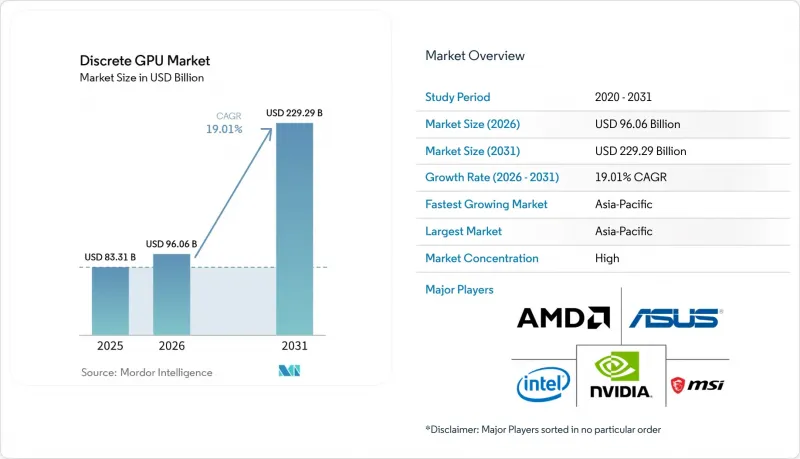
本報告按裝置應用(行動裝置和平板電腦、PC 和工作站、伺服器和資料中心加速器、遊戲主機和手持終端機、汽車/ADAS、其他)、記憶體類型(基於 GDDR 的 GPU 和基於 HBM 的 GPU)、效能等級(低成本 GPU(低於 100 美元)、主流 GPU(100-400 美元)、其他)以及地區進行細分。市場預測以價值(美元)表示。
全球獨立GPU市場趨勢與洞察
對基於離散加速器的AI訓練和推理的需求
人工智慧基礎設施的投資正在重塑獨立GPU市場格局,對即時推理的需求迅速成長,如今已成為與訓練並駕齊驅的主要採購驅動力。英偉達報告稱,其資料中心業務在2026會計年度貢獻了1,973億美元的收入,佔其總收入2,159億美元的近三分之一,凸顯了人工智慧工作負載如何顯著改變了主要供應商的銷售結構。該公司表示,推理業務目前在其資料中心業務中佔據了相當大的佔有率,表明支出重點正從模型建置轉向生產部署。 AMD也在瞄準類似的市場領域,其資料中心業務在2026年第一季的營收將達到57.5億美元,年增57%。這主要得益於超大規模超大規模資料中心業者的需求,包括Instinct的出貨量和Meta的部署。這對獨立GPU市場具有重大意義,因為推理業務將在雲端運算、企業級應用和主導運算專案中產生更廣泛、更持續的需求,而不再僅依賴少數訓練叢集。此外,這意味著競爭力現在不僅取決於晶片本身,而且還很大程度上取決於封裝、系統設計、互連和軟體支援。
提升高階遊戲和電競遊戲的影像品質。
高階遊戲市場依然是強勁需求的主要驅動力。這是因為高階買家既重視視覺質量,也重視能夠提升顯示卡長期效用的軟體功能。 NVIDIA 透過推出 GeForce RTX 5090(售價 1999 美元)、RTX 5080(售價 999 美元)、RTX 5070 Ti(售價 749 美元)和 RTX 5070(售價 549 美元),為其頂級遊戲產品樹立了價格標竿。 NVIDIA 也表示,超過 800 款遊戲和應用程式支援 RTX 和 DLSS 技術,這表明昇級需求不僅源自於硬體規格,也得益於強大的軟體基礎。這種軟體整合在獨立顯示卡市場至關重要,因為玩家傾向於留在能夠持續獲得各種功能和遊戲最佳化的平台上。因此,對神經渲染、射線追蹤和更高保真度的需求不斷成長,正在縮短舊款顯示卡在競技遊戲和休閒遊戲中的使用壽命。雖然 AI 加速器正在推動銷售成長,但遊戲在獨立 GPU 市場仍然佔據著重要地位,因為它繼續支撐著開發者工具、驅動程式生態系統以及整個技術堆疊的產品發布速度。
內存供應短缺和基板成本上漲
由於人工智慧加速器和遊戲顯示卡都在爭奪重疊的先進記憶體和封裝資源,獨立顯示卡市場持續面臨記憶體短缺的困境。 NVIDIA 的 GeForce RTX 50 系列進一步推動遊戲顯示卡向 GDDR7 記憶體轉型,提高了高階消費性產品的記憶體需求。三星宣布將於 2026 年開始為人工智慧計算提供商用 HBM4 內存,這證實了供應商正在擴大產能,同時也表明先進內存正以驚人的速度被加速器項目所採用。當 HBM 和高階顯存同時變得供不應求時,基板成本就會上升,低階獨立顯示卡的價格柔軟性也會降低。這種壓力對於採購量遠不及知名品牌的顯示卡合作夥伴來說尤其嚴重。即使終端用戶需求依然強勁,這也限制了供應商擴大非旗艦產品供應規模的速度。
細分市場分析
到2025年,伺服器和資料中心加速器將佔獨立GPU市場佔有率的38.42%,成為最大的設備應用領域。這一市場格局反映出,市場需求不再僅僅集中於模型訓練,而是與雲端運算、企業級應用以及自主運算環境中的生產推理應用日益緊密相關。 NVIDIA 2026會計年度的資料中心收入達到1,973億美元,顯示其支出已大幅轉向加速器系統。 AMD也報告稱,其2026年第一季的資料中心收入達到57.75億美元,這得益於其超大規模資料中心(包括Meta)中Instinct超大規模資料中心業者的推出。因此,獨立GPU市場的發展動力並非來自單一晶片,而是來自作為完整運算系統的伺服器平台,這些平台整合了晶片、封裝、網路和軟體。
PC 和工作站仍然是第二大收入來源,因為高階遊戲顯示卡和企業級工作站的價格仍然居高不下。聯想 ThinkStation P4 於 2026 年 5 月發布,其核心搭載 AMD Ryzen PRO 9000 系列處理器和 NVIDIA RTX PRO 6000 Blackwell 工作站版顯示卡,這表明工作站的需求正在向單機本地 AI 推理和高級視覺化方向轉變。雖然遊戲主機和掌上型遊戲機持續影響整個生態系統的視覺體驗,但它們並未直接推動獨立顯示卡市場的發展,而獨立顯卡市場在獨立顯示卡產業佔據了相當大的佔有率。隨著汽車運算需求的成長,汽車和 ADAS(高級駕駛輔助系統)應用正從小規模平台擴展,但行動裝置、平板電腦和其他嵌入式應用仍然受到散熱和功耗的限制。因此,獨立顯示卡市場繼續專注於那些效能密度和記憶體規模足以支撐額外硬體成本的細分市場。
區域分析
由於中國對人工智慧運算的巨大需求,以及在高階進口加速器供應有限的情況下,政府對國內替代方案的支持,中國仍然是市場的核心。 2026年初出口管制政策的調整並不會降低市場的複雜性,而先進晶片出貨相關的繁瑣手續也持續影響供應商進軍中國市場的方式。亞太地區在記憶體和先進組件的供應方面也扮演著重要角色。三星計劃於2026年推出商用HBM4,凸顯了該地區在加速器部署準備的重要性。日本和韓國仍然是高階遊戲和專業視覺化需求的關鍵供應來源,而印度和東南亞的需求也在不斷成長,這得益於雲端GPU的成長和遊戲用戶群的擴大。
北美仍然是獨立顯示卡的第二大市場,這主要得益於超大規模資料中心業者資料中心驅動的人工智慧投資、高階遊戲需求以及高階工作站的採購持續集中在該地區。 2025年9月,NVIDIA和英特爾宣佈建立多代合作夥伴關係,共同開發搭載NVIDIA RTX GPU晶片的客製化資料中心CPU和x86系統,進一步鞏固北美在未來平台整合中的地位。此外,NVIDIA和康寧於2026年5月宣佈建立多年合作夥伴關係,以擴大美國光連接製造能力,從而更直接地將GPU需求與國內人工智慧基礎設施部署聯繫起來。同時,出口管制法規持續影響區域通路策略,北美供應商仍需要遵守國際運輸法規。
歐洲獨立顯示卡市場呈現兩極化:一方面是西方主要市場成熟的遊戲和工作站市場,另一方面則是日益重視建構本土主導運算能力的市場。中東和非洲市場雖然絕對規模仍然較小,但海灣國家對人工智慧基礎設施的投資正在提升該地區在未來加速器部署中的重要性。以巴西和阿根廷為中心的南美洲市場在遊戲和內容創作領域的需求最為強勁,但對價格仍然高度敏感。在這三個地區,獨立顯示卡市場都受益於人工智慧和高階圖形的長期發展趨勢,但本地成長仍然高度依賴基礎設施建設資金、進口條件以及高階產品的供應。
其他好處:
- Excel格式的市場預測(ME)表
- 3個月的分析師支持
目錄
第1章:引言
- 研究假設和市場定義
- 調查範圍
第2章:調查方法
第3章執行摘要
第4章 市場狀況
- 市場概覽
- 市場促進因素
- 人工智慧訓練和推理領域對離散加速器的需求
- 提升高階遊戲和電競的視覺品質。
- 創作者和專業人士的全新視覺化工作站
- 筆記型電腦採用獨立顯示卡以滿足可攜式遊戲和人工智慧內容創作工作負載的需求
- 在桌面工作站上進行本地人工智慧推理
- 在中國境內進行GPU取代並建構「主權堆疊」。
- 市場限制因素
- 內存供應短缺和基板成本上漲
- 整合式顯示卡和高效能筆記型電腦正在給入門級獨立顯示卡的需求帶來壓力。
- 出口限制和中國獨特的進口限制正在造成產品組合扭曲。
- 高階系統中的電力、發熱和電源裝置升級所帶來的負擔。
- 產業價值鏈分析
- 監理情勢
- 技術展望
- 波特五力分析
第5章 市場規模與成長預測
- 透過設備應用程式
- 行動裝置和平板電腦
- 個人電腦和工作站
- 伺服器和資料中心加速器
- 遊戲主機和掌上型遊戲機
- 汽車/ADAS
- 其他嵌入式和邊緣設備
- 按記憶體類型
- 基於GDDR的GPU
- 基於HBM的GPU
- 性能等級
- 低成本GPU(100美元以下)
- 主流GPU(100-400美元)
- 高效能消費級GPU(400美元至1200美元)
- 資料中心/AI加速器GPU(超過1200美元)
- 按地區
- 北美洲
- 美國
- 加拿大
- 墨西哥
- 歐洲
- 德國
- 英國
- 法國
- 義大利
- 其他歐洲國家
- 亞太地區
- 中國
- 日本
- 韓國
- 印度
- 東南亞
- 其他亞太國家
- 中東和非洲
- 中東
- 沙烏地阿拉伯
- 阿拉伯聯合大公國
- 土耳其
- 其他中東國家
- 非洲
- 南非
- 奈及利亞
- 其他非洲國家
- 中東
- 南美洲
- 巴西
- 阿根廷
- 其他南美國家
- 北美洲
第6章 競爭情勢
- 市場集中度
- 策略趨勢
- 市佔率分析
- 公司簡介
- NVIDIA Corporation
- Advanced Micro Devices, Inc.
- Intel Corporation
- ASUSTeK Computer Inc.
- Micro-Star International Co., Ltd.
- GIGA-BYTE TECHNOLOGY Co., Ltd.
- ZOTAC Technology Limited
- SAPPHIRE Technology Limited
- TUL Corporation
- PNY Technologies, Inc.
- ASRock Inc.
- Colorful Technology Company Limited
- Palit Microsystems Ltd.
- InnoVISION Multimedia Limited
- Leadtek Research Inc.
- Sparkle Computer Co., Ltd.
- Moore Threads Intelligent Technology(Beijing)Co., Ltd.
- Biren Technology Co., Ltd.
第7章 市場機會與未來展望
According to Mordor Intelligence, the discrete GPU market size is projected to be USD 83.31 billion in 2025, USD 96.06 billion in 2026, and reach USD 229.29 billion by 2031, growing at a CAGR of 19.01% from 2026 to 2031.
This report is Segmented by Device Application (Mobile Devices and Tablets, Pcs and Workstations, Servers and Datacenter Accelerators, Gaming Consoles and Handhelds, Automotive / ADAS, and More), Memory Type (GDDR-Based GPUs, and HBM-Based GPUs), Performance Tier [Low-Cost GPUs (Less Than USD 100), Mainstream GPUs (USD 100-USD 400), and More}, and Geography. The Market Forecasts are Provided in Terms of Value (USD).
Global Discrete GPU Market Trends and Insights
AI Training and Inference Demand for Discrete Accelerators
The discrete GPU market is being reshaped by AI infrastructure spending, and live inference demand is now rising fast enough to stand beside training as a core buying driver. NVIDIA reported USD 197.3 billion in fiscal 2026 data center revenue out of total revenue of USD 215.9 billion, underscoring how deeply AI workloads have reshaped the revenue mix of the leading supplier. The same company indicated that inference accounted for a meaningful share of data center activity, suggesting that the spending base is shifting from model construction to production deployment. AMD is pursuing the same part of the market, as its data center segment reached USD 5.75 billion in Q1 2026, up 57% year over year, supported by Instinct shipments and hyperscaler demand, including Meta deployments. This matters for the discrete GPU market because inference creates broader, repeatable demand across clouds, enterprises, and sovereign compute programs, rather than relying on only a small number of training clusters. It also means competitive strength now depends on packaging, system design, interconnects, and software support as much as on the chip itself.
Premium Gaming and Esports Visual Fidelity Upgrades
Premium gaming remains a durable demand driver because higher-end buyers are paying for both visual quality and software features that extend the relevance of cards over time. NVIDIA launched the GeForce RTX 5090 at USD 1,999, the RTX 5080 at USD 999, the RTX 5070 Ti at USD 749, and the RTX 5070 at USD 549, which set the pricing anchor for the top end of the gaming stack. NVIDIA also stated that more than 800 games and applications use RTX and DLSS technologies, indicating that upgrade demand is supported by a deep software base rather than hardware specifications alone. In the discrete GPU market, this software tie-in matters because players tend to stay within platforms that preserve feature access and game optimization. Neural rendering, ray tracing, and higher fidelity requirements are therefore shortening the useful life of older cards in competitive and enthusiast gaming. This keeps gaming important to the discrete GPU market even while AI accelerators lead revenue growth, because gaming still supports developer tools, driver ecosystems, and product cadence across the wider stack.
Memory Supply Tightness and Rising Board Costs
The discrete GPU market continues to face memory tightness because AI accelerators and gaming boards are drawing from overlapping advanced memory and packaging resources. NVIDIA's GeForce RTX 50-series moved gaming cards further into GDDR7, which raised the baseline memory requirement for premium consumer products. Samsung began commercial HBM4 shipments in 2026 for AI computing, confirming that suppliers are expanding capacity but also showing how quickly advanced memory is being pulled into accelerator programs. When HBM and high-end graphics memory are in tight supply at the same time, board costs rise, and the lower end of the discrete GPU market loses pricing flexibility. That pressure is hardest on add-in-board partners that do not have the same purchasing scale as the largest brands. It also limits how quickly vendors can push supply beyond flagship products, even when end demand stays strong.
Other drivers and restraints analyzed in the detailed report include:
- Creator and Professional Visualization Workstation Refresh
- Laptop GPU Adoption for Portable Gaming and AI-Creation Workloads
- Integrated Graphics and Powerful Notebooks Squeezing Entry-Level GPU Demand
For complete list of drivers and restraints, kindly check the Table Of Contents.
Segment Analysis
Servers and datacenter accelerators accounted for 38.42% of the discrete GPU market in 2025, making them the largest device application segment. This position reflects demand that is no longer centered only on model training and is increasingly tied to production inference across cloud, enterprise, and sovereign compute environments. NVIDIA's fiscal 2026 data center revenue reached USD 197.3 billion, indicating how much spending has already shifted toward accelerator systems. AMD also reported USD 5.775 billion in Q1 2026 data center segment revenue, supported by Instinct deployments at hyperscalers, including Meta. The discrete GPU market is therefore being pulled by server platforms that combine silicon, packaging, networking, and software into full compute systems rather than by standalone chips alone.
PCs and workstations remained the second-largest revenue pool, as premium gaming cards and enterprise workstations continued to command high selling prices. Lenovo's ThinkStation P4 launch in May 2026, built around AMD Ryzen PRO 9000 Series processors and the NVIDIA RTX PRO 6000 Blackwell Workstation Edition, shows how workstation demand is moving toward local AI inference and advanced visualization in a single machine. Gaming consoles and handhelds still shape visual expectations across the wider ecosystem, but they do not contribute directly to the add-in-board channel that defines most of the discrete GPU industry. Automotive and ADAS applications are expanding from a small base as in-vehicle compute needs rise, while mobile devices, tablets, and other embedded uses remain constrained by thermal and power limits. This keeps the discrete GPU market concentrated in segments where performance density and memory scale justify the extra hardware cost.
Geography Analysis
China remains central to that position because it combines very large AI compute demand with policy support for domestic alternatives when access to the highest-end imported accelerators is restricted. The export review changes in early 2026 did not reduce complexity, and the documentary burden around advanced chip shipments continued to shape how vendors approached the China channel. Asia-Pacific also plays a critical role in supplying memory and advanced components, as Samsung's commercial HBM4 shipments in 2026 underscored the region's importance to accelerator readiness. Japan and South Korea remain important sources of premium gaming and professional visualization demand, while India and Southeast Asia are expanding through cloud GPU build-outs and a larger gaming user base.
North America remained the second-largest geography in the discrete GPU market because hyperscaler AI spending, premium gaming demand, and high-end workstation purchases all stayed concentrated in the region. NVIDIA and Intel announced a multi-generational collaboration in September 2025 to develop custom data center CPUs and x86 systems with NVIDIA RTX GPU chiplets, which reinforced North America's role in future platform integration. NVIDIA and Corning also announced a multiyear partnership in May 2026 to expand US optical connectivity manufacturing capacity, linking GPU demand more directly to domestic AI infrastructure deployment. At the same time, export review rules continued to affect regional channel strategy because North American vendors still had to manage compliance for international shipments.
Europe's discrete GPU market is split between a mature gaming and workstation base in major Western markets and a growing push toward sovereign AI compute capacity. The Middle East and Africa remain smaller in absolute size, but investment in AI infrastructure in the Gulf is improving the region's relevance to future accelerator deployment. South America is centered on Brazil and Argentina, where demand is strongest in gaming and content creation but remains highly price sensitive. Across all 3 of these regions, the discrete GPU market is benefiting from the same long-run AI and premium graphics trends, but local growth still depends heavily on infrastructure funding, import conditions, and the availability of higher-end products.
- NVIDIA Corporation
- Advanced Micro Devices, Inc.
- Intel Corporation
- ASUSTeK Computer Inc.
- Micro-Star International Co., Ltd.
- GIGA-BYTE TECHNOLOGY Co., Ltd.
- ZOTAC Technology Limited
- SAPPHIRE Technology Limited
- TUL Corporation
- PNY Technologies, Inc.
- ASRock Inc.
- Colorful Technology Company Limited
- Palit Microsystems Ltd.
- InnoVISION Multimedia Limited
- Leadtek Research Inc.
- Sparkle Computer Co., Ltd.
- Moore Threads Intelligent Technology (Beijing) Co., Ltd.
- Biren Technology Co., Ltd.
Additional Benefits:
- The market estimate (ME) sheet in Excel format
- 3 months of analyst support
TABLE OF CONTENTS
1 INTRODUCTION
- 1.1 Study Assumptions and Market Definition
- 1.2 Scope of the Study
2 RESEARCH METHODOLOGY
3 EXECUTIVE SUMMARY
4 MARKET LANDSCAPE
- 4.1 Market Overview
- 4.2 Market Drivers
- 4.2.1 AI Training and Inference Demand for Discrete Accelerators
- 4.2.2 Premium Gaming and Esports Visual Fidelity Upgrades
- 4.2.3 Creator and Professional Visualization Workstation Refresh
- 4.2.4 Laptop dGPU Adoption for Portable Gaming and AI-Creation Workloads
- 4.2.5 Local AI Inference on Deskside Workstations
- 4.2.6 China Domestic GPU Substitution and Sovereign Stack Buildout
- 4.3 Market Restraints
- 4.3.1 Memory Supply Tightness and Rising Board Costs
- 4.3.2 Integrated Graphics and Powerful Notebooks Squeezing Entry-Level dGPU Demand
- 4.3.3 Export Controls and China-Specific Import Restrictions Distorting Product Mix
- 4.3.4 Power, Thermals, and PSU Upgrade Burden at the High End
- 4.4 Industry Value Chain Analysis
- 4.5 Regulatory Landscape
- 4.6 Technological Outlook
- 4.7 Porter's Five Forces Analysis
- 4.7.1 Threat of New Entrants
- 4.7.2 Bargaining Power of Suppliers
- 4.7.3 Bargaining Power of Buyers
- 4.7.4 Threat of Substitutes
- 4.7.5 Competitive Rivalry
5 MARKET SIZE AND GROWTH FORECASTS (VALUE)
- 5.1 By Device Application
- 5.1.1 Mobile Devices and Tablets
- 5.1.2 PCs and Workstations
- 5.1.3 Servers and Datacenter Accelerators
- 5.1.4 Gaming Consoles and Handhelds
- 5.1.5 Automotive / ADAS
- 5.1.6 Other Embedded and Edge Devices
- 5.2 By Memory Type
- 5.2.1 GDDR-based GPUs
- 5.2.2 HBM-based GPUs
- 5.3 By Performance Tier
- 5.3.1 Low-Cost GPUs (Less than USD 100)
- 5.3.2 Mainstream GPUs (USD 100-USD 400)
- 5.3.3 High-Performance Consumer GPUs (USD 400-USD 1,200)
- 5.3.4 Data Center / AI Accelerator GPUs (Greater than USD 1,200)
- 5.4 By Geography
- 5.4.1 North America
- 5.4.1.1 United States
- 5.4.1.2 Canada
- 5.4.1.3 Mexico
- 5.4.2 Europe
- 5.4.2.1 Germany
- 5.4.2.2 United Kingdom
- 5.4.2.3 France
- 5.4.2.4 Italy
- 5.4.2.5 Rest of Europe
- 5.4.3 Asia-Pacific
- 5.4.3.1 China
- 5.4.3.2 Japan
- 5.4.3.3 South Korea
- 5.4.3.4 India
- 5.4.3.5 Southeast Asia
- 5.4.3.6 Rest of Asia-Pacific
- 5.4.4 Middle East and Africa
- 5.4.4.1 Middle East
- 5.4.4.1.1 Saudi Arabia
- 5.4.4.1.2 United Arab Emirates
- 5.4.4.1.3 Turkey
- 5.4.4.1.4 Rest of Middle East
- 5.4.4.2 Africa
- 5.4.4.2.1 South Africa
- 5.4.4.2.2 Nigeria
- 5.4.4.2.3 Rest of Africa
- 5.4.4.1 Middle East
- 5.4.5 South America
- 5.4.5.1 Brazil
- 5.4.5.2 Argentina
- 5.4.5.3 Rest of South America
- 5.4.1 North America
6 COMPETITIVE LANDSCAPE
- 6.1 Market Concentration
- 6.2 Strategic Moves
- 6.3 Market Share Analysis
- 6.4 Company Profiles (includes Global level Overview, Market level overview, Core Segments, Financials as available, Strategic Information, Market Rank/Share for key companies, Products and Services, and Recent Developments)
- 6.4.1 NVIDIA Corporation
- 6.4.2 Advanced Micro Devices, Inc.
- 6.4.3 Intel Corporation
- 6.4.4 ASUSTeK Computer Inc.
- 6.4.5 Micro-Star International Co., Ltd.
- 6.4.6 GIGA-BYTE TECHNOLOGY Co., Ltd.
- 6.4.7 ZOTAC Technology Limited
- 6.4.8 SAPPHIRE Technology Limited
- 6.4.9 TUL Corporation
- 6.4.10 PNY Technologies, Inc.
- 6.4.11 ASRock Inc.
- 6.4.12 Colorful Technology Company Limited
- 6.4.13 Palit Microsystems Ltd.
- 6.4.14 InnoVISION Multimedia Limited
- 6.4.15 Leadtek Research Inc.
- 6.4.16 Sparkle Computer Co., Ltd.
- 6.4.17 Moore Threads Intelligent Technology (Beijing) Co., Ltd.
- 6.4.18 Biren Technology Co., Ltd.
7 MARKET OPPORTUNITIES AND FUTURE OUTLOOK
- 7.1 White-Space and Unmet-Need Assessment

 離散半導體:市場佔有率分析、產業趨勢與統計及成長預測(2026-2031)
 離散半導體市場規模、佔有率、趨勢和預測:按類型、最終用戶和地區分類(2026-2034 年)北美獨立顯示卡市場:市佔率分析、產業趨勢與統計及成長預測(2026-2031 年)歐洲獨立顯示卡市場:市佔率分析、產業趨勢與統計及成長預測(2026-2031 年)英國獨立顯示卡市場:市佔率分析、產業趨勢與統計及成長預測(2026-2031)
 2026年全球射頻和微波小訊號電晶體市場報告2026年全球射頻微波功率電晶體市場報告
 離散半導體全球市場規模、佔有率、趨勢和成長分析報告(2026-2034)
 離散半導體市場:按類型、最終用戶和地區分類
 離散半導體市場分析及至2035年預測:按類型、產品、技術、應用、材料類型、裝置、最終用戶、功能、安裝模式和解決方案分類