


 |
市場調查報告書
商品編碼
2121990
個人護理包裝:市場佔有率分析、產業趨勢與統計、成長預測(2026-2031)Personal Care Packaging - Market Share Analysis, Industry Trends & Statistics, Growth Forecasts (2026 - 2031) |
||||||

※ 本網頁內容可能與最新版本有所差異。詳細情況請與我們聯繫。
據 Mordor Intelligence 稱,2025 年個人護理包裝市場價值為 251.4 億美元,預計到 2031 年將達到 321.2 億美元,而 2026 年為 262.8 億美元,預測期(2026-2031 年)的複合年成長率為 4.09%。
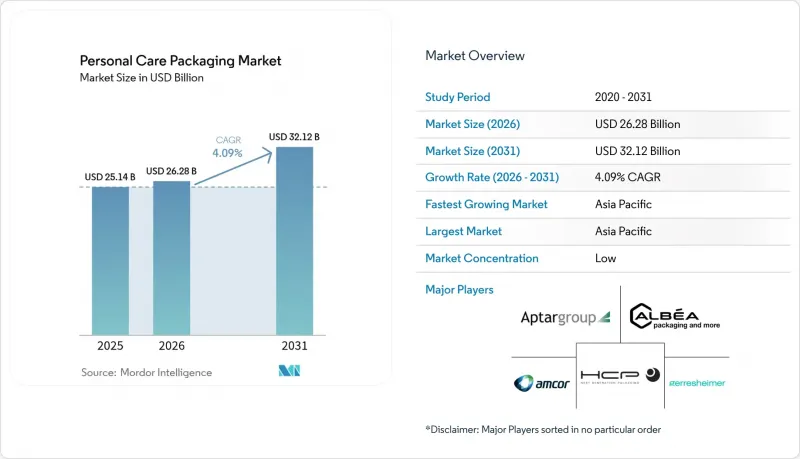
本報告按材料類型(塑膠、玻璃、金屬、紙/紙板)、包裝類型(軟包裝、硬包裝)、產品類型(瓶/罐、管/棒、泵/分配器、袋/小袋等)、應用領域(護膚、護髮品、口腔護理品、彩妝產品等)和地區進行細分。市場預測以美元計價。
全球個人護理包裝市場趨勢及洞察
新興市場美容產品的優質化
印度、巴西和中國的中產階級收入不斷成長,促使消費者選擇採用玻璃、鋁和優質塑膠等高品質包裝的品牌個人保健產品。預計到2025年,印度美容市場將成長12%,都市區消費者更更換帶有壓紋瓶、金屬罐和防篡改泵等高階產品。巴西品牌Natura擴大了其可重複填充玻璃容器項目,將產品的永久性作為永續發展的象徵,從而提升了其在貨架上的售價。在中國,男士護理精華液需要使用真空瓶來保護活性成分並提升品牌的科學形象,其在二線城市的銷售量增加了18%。因此,加工商的投資正轉向熱壓印、真空鍍膜和真空幫浦生產線,以滿足零售商對高階設計的需求,同時確保高利潤訂單的順利訂單。
全通路履約正在推動兼具保護性和運輸功能的包裝的發展。
至2025年,美妝相關電商將佔北美銷售額的35%,歐洲則為28%。包裝設計正朝著既能承受小包裹分揀過程,又能保持貨架展示美觀的方向發展。安姆科的雙層軟包裝袋已證明,它們可以用輕質薄膜取代薄而硬的瓶子,從而將直接送達消費者的包裝破損率降低40%。零售商也要求包裝在從門市展示轉移到運輸紙箱時無需額外緩衝,因此,帶有整合提手的可堆疊硬質瓶和在受力點加固邊角的包裝袋正變得越來越受歡迎。由於運費平均佔貨物總成本的8%至12%,托運人更傾向於能夠提高托盤裝載密度並減少基於體積重量的額外費用的設計。
聚烯和PET原料價格波動劇烈
2024年,聚乙烯和PET價格較上一季波動15-25%,擠壓了與60-90天銷售價格掛鉤的加工商的利潤空間。 PCR-PET的交易價格比原生PET溢價10-15%,進一步加劇了追求強制性再生材料含量的企業面臨的價格波動風險。缺乏對沖手段的中小型企業要么退出市場,要么合併。例如,三家歐洲管材製造商在2025年出售了其業務。由於價格飆升,資本投資停滯不前,導致新的擠出和吹塑成型線延遲投產,並削弱了供應柔軟性。 PCR-PET的交易價格比原生PET溢價10-15%,進一步加劇了追求強制性再生材料含量目標的企業面臨的價格波動風險。為了應對這種情況,品牌商簽訂了年度樹脂契約,優先考慮預算確定性,而犧牲了降低機會成本,這種策略導致短期柔軟性的喪失。
細分市場分析
到2025年,塑膠將佔銷售額的41.12%,預計到2031年將以4.89%的最高複合年成長率成長,這主要得益於消費後回收塑膠(PCR)和生物塑膠的整合,進一步鞏固其在個人護理包裝市場的主導地位。聚乙烯軟袋和軟管佔據主導地位,因為它們具有耐化學性和熱封強度,非常適合用於填充濃縮液。另一方面,聚丙烯在需要抗疲勞性的瓶蓋和泵頭方面表現出色。聚對苯二甲酸乙二醇酯(PET)在透明硬質瓶(用於保護香水)領域保持著市場佔有率,而聚氯乙烯(PVC)由於歐洲塑化劑轉型帶來的淘汰壓力,市場佔有率正在下降。甘蔗衍生聚乙烯和玉米衍生聚乳酸(PLA)佔塑膠市場佔有率的3%,受到那些願意支付兩位數溢價以在其包裝上體現永續性的品牌的青睞。
預計到2025年,玻璃將佔22%的市場佔有率,在高階香水市場佔據主導地位,其厚實的質感象徵著精湛的工藝。然而,電商運輸過程中易碎以及高昂的運輸成本阻礙了銷售量成長。鋁製包裝佔18%的市場佔有率,主要得益於除臭噴霧劑和旅行裝產品的普及,以及其「無限循環利用」的優勢。紙板佔19%的市場佔有率,主要用於可折疊紙盒,以展現品牌故事,但其易受潮的特性限制了其在初級包裝中的應用。儘管有上述趨勢,塑膠仍保持著個人護理包裝市場的中心地位,但生物基材料的日益普及正在拓展材料的選擇範圍,加工商也不斷豐富其擠出機產品線。
預計到2025年,硬質包裝將佔據62.76%的市場佔有率,憑藉其成熟的填充生產線基礎設施和商店覆蓋,仍將保持主導地位,尤其適用於護膚和護髮產品。整合式泵頭和氣霧閥能夠實現精準的容量分配,從而增強消費者對品牌的信心,並提升個人護理包裝市場中高價產品的受歡迎程度。軟包裝佔剩餘的37.24%,其複合年成長率(CAGR)為4.51%,高於市場平均水平,這主要得益於其在電商領域的耐用性、材料重量最多可減少70%,以及監管機構對較重硬質包裝產品徵收的環保調整費用。
安姆科的雙層壁包裝袋將隔離層和緩衝層合而為一,代表了產品線的下一步發展,無需單獨的內襯,破損率也降低了一半。消費者對補充裝平台的偏好正轉向更靈活的濃縮型產品,因為可重複使用的包裝袋能夠將運輸過程中產生的廢物分散到整個浴室使用週期中。同時,硬質容器製造商正透過減輕重量和採用繫繩式瓶蓋來遏制市場佔有率的下滑,以滿足歐盟指令的要求,同時又不影響消費者熟悉的使用者體驗。
區域分析
預計到2025年,亞太地區將佔據33.37%的市場佔有率,繼續保持其作為個人護理包裝市場基石的主導地位。在中國,可重複填充的玻璃容器正被廣泛應用於新型高階香水產品,吸引具有環保意識的消費者。同時,印度的都市區消費者也擴大選擇金屬泵式包裝來盛裝護膚和護髮產品。在東南亞,男士護理市場的兩位數成長推動了對鋁質噴霧罐的需求;而在日本,隨著人口老化,抗衰老產品對真空瓶的需求也在不斷成長。在韓國,以出口為導向的韓妝品牌指定使用能夠承受熱帶地區運輸的防潮包裝袋;澳洲迅速回應了30%消費後回收(PCR)的強制性要求,成為可追溯性技術在亞洲擴張前的試驗場。
預計到2025年,歐洲將佔據28%的市場佔有率,這主要得益於嚴格的消費後回收物(PCR)配額、瓶蓋緊固法規以及生態標籤審核,這些都迫使加工商與化學品回收企業建立合作關係。在德國和法國,店內補充裝區域正在不斷擴大,每次補充裝的材料用量減少了70%,並鼓勵消費者使用耐用容器。在義大利和西班牙,玻璃香水瓶被視為香水市場奢華感的象徵,但運輸成本和破損問題限制了單位產品的成長。在以波蘭主導的東歐,加工商的近岸外包策略,結合較低的人事費用和地理接近性,正在提升歐美品牌香水軟管和瓶蓋的產能。
到2025年,北美將佔全球銷售額的22%,而美國全通路需求正推動著無需額外緩衝即可從貨架直接送達家門口的包裝的普及。加拿大分階段禁止使用一次性塑膠製品的政策正在加速單一材料軟包裝和紙板的使用。墨西哥的近岸外包產能正在緩解美國品牌面臨的關稅和前置作業時間限制。各州法律的差異,特別是加州的SB 54法案和華盛頓州的包裝稅,增加了複雜性,促使各州採用全國範圍內最嚴格的標準,以避免產品組合分散。
預計到2031年,南美市場將以5.08%的複合年成長率成長,這主要得益於巴西在填充用玻璃容器方面的努力,以及阿根廷都市區將收入高所得於包裝精美的進口香水的需求。在中東(成長率為8%),市場的焦點是用於高檔香水的裝飾性玻璃容器和金屬蓋,土耳其是重要的轉運中心。非洲的市佔率為7%,由於小袋包裝價格實惠,因此目前主要依賴小袋。但隨著各地政府繼續禁止使用一次性塑膠製品,市場正在轉變為可重複密封、可重複使用的包裝袋。
其他好處:
- Excel格式的市場預測(ME)表
- 3個月的分析師支持
目錄
第1章:引言
- 研究假設和市場定義
- 調查範圍
第2章:調查方法
第3章執行摘要
第4章 市場狀況
- 市場概覽
- 市場促進因素
- 新興市場美容相關產品的優質化
- 全通路履約正在推動保護性包裝和即用型包裝的發展。
- 永續發展法規規定PCR含量必須達到30%以上。
- 允許在家中補充藥品的分發方式迅速普及。
- 採用邊緣人工智慧技術的填充線可降低 SKU 成本
- 東南亞男士護理市場呈現爆炸性成長
- 市場限制因素
- 聚烯和PET原料價格波動劇烈
- 歐盟及美國部分州已禁止使用一次性塑膠製品。
- 鋁和玻璃供應鏈中的瓶頸
- 固態型盥洗用品的興起取代了初級包裝
- 產業價值/價值鏈分析
- 監理情勢
- 技術展望
- 波特五力分析
- 宏觀經濟因素對市場的影響
第5章 市場規模與成長預測
- 材料類型
- 塑膠
- 聚乙烯
- 聚丙烯
- PET和PVC
- 聚苯乙烯
- 生物基塑膠
- 其他類型的塑膠材料
- 玻璃
- 金屬
- 紙張和紙板
- 塑膠
- 按包裝類型
- 靈活的
- 死板的
- 依產品類型
- 瓶子和罐子
- 管子和棍子
- 泵浦和分配器
- 小袋和小袋
- 蓋子和封口
- 其他產品類型
- 透過使用
- 護膚
- 護髮
- 口腔護理
- 化妝品
- 除臭劑和香水
- 嬰兒護理
- 其他用途
- 按地區
- 北美洲
- 美國
- 加拿大
- 墨西哥
- 南美洲
- 巴西
- 阿根廷
- 其他南美國家
- 歐洲
- 德國
- 法國
- 英國
- 義大利
- 西班牙
- 其他歐洲國家
- 亞太地區
- 中國
- 日本
- 印度
- 韓國
- 澳洲和紐西蘭
- 其他亞太國家
- 中東
- 沙烏地阿拉伯
- 阿拉伯聯合大公國
- 土耳其
- 其他中東國家
- 非洲
- 南非
- 奈及利亞
- 埃及
- 其他非洲國家
- 北美洲
第6章 競爭情勢
- 市場集中度
- 策略趨勢
- 市佔率分析
- 公司簡介
- Albea SA
- HCP Packaging Group
- Gerresheimer AG
- Amcor plc
- AptarGroup, Inc.
- Cosmopak USA LLC
- Quadpack Industries, SA
- Libo Cosmetics Co., Ltd.
- Mpack Poland sp. z oo
- POLITECH SP. Z OO
- Rieke Corporation(TriMas Corporation)
- Berlin Packaging LLC
- MKTG Industry SRL
- Silgan Holdings, Inc.
- Stoelzle Oberglas GmbH
- EPL Limited
- Verescence Inc.
- Apackaging Group LLC
- Heinz-Glass GmbH & Ko. KGaA
- Roetell Group
- Vitro SAB De CV
- Vidraria Anchieta Ltda.
- Lumson SpA
第7章 市場機會與未來展望
According to Mordor Intelligence, the personal care packaging market size was valued at USD 25.14 billion in 2025 and is estimated to grow from USD 26.28 billion in 2026 to reach USD 32.12 billion by 2031, at a CAGR of 4.09% during the forecast period (2026-2031).
This report is Segmented by Material Type (Plastic, Glass, Metal, and Paper and Paperboard), Packaging Format (Flexible, and Rigid), Product Type (Bottles and Jars, Tubes and Sticks, Pumps and Dispensers, Pouches and Sachets, and More), Application (Skin Care, Hair Care, Oral Care, Make-Up Products, and More), and Geography. The Market Forecasts are Provided in Terms of Value (USD).
Global Personal Care Packaging Market Trends and Insights
Premiumization Of Beauty SKUs In Emerging Markets
Rising middle-class incomes in India, Brazil, and China steer shoppers toward branded personal-care products packaged in glass, aluminum, and premium plastics that signal quality. India's beauty sector grew 12% in 2025 as urban consumers traded up to embossed bottles, metallized jars, and tamper-evident pumps. Brazilian brand Natura scaled refillable glass programs that position permanence as proof of sustainability, fostering premium shelf pricing. In China, tier-2 cities recorded an 18% surge in male-grooming serums that require airless dispensers to protect active ingredients and reinforce scientific branding. Converter investment therefore tilts to hot-stamping, vacuum-metallization, and airless-pump lines that deliver higher-margin orders while satisfying retailer calls for luxury aesthetics.
Omni-Channel Fulfilment Driving Protective And Ship-Ready Packs
Beauty e-commerce reached 35% of North American sales and 28% in Europe during 2025, shifting packaging design toward variants that survive parcel sorting while remaining shelf-presentable. Amcor's dual-wall flexible pouch reduced breakage rates by 40% in direct-to-consumer shipments, proving that thin, rigid bottles can be replaced with lighter films. Retailers also demand packs that migrate from store display to mailing carton without extra void fill, promoting stackable rigid bottles with integrated handles and pouches reinforced at stress corners.As freight averages 8-12% of landed cost, shippers favor designs that boost pallet density and reduce dimensional weight fees.
Volatile Polyolefin and PET Feed-Stock Prices
Polyethylene and PET swung 15-25% quarter-over-quarter during 2024, compressing margins for converters locked into 60-90-day selling prices. PCR PET trades at a 10-15% premium to virgin PET, magnifying volatility for firms pursuing recycled-content mandates. Smaller players without hedging tools exited or merged, evidenced by three European tube makers that sold out in 2025. Capital-spending pauses follow price spikes, delaying the installation of new extrusion or blow-molding lines and crimping supply responsiveness. PCR PET trades at a 10-15% premium to virgin, compounding volatility for firms chasing recycled-content mandates. Brands respond by signing annual resin contracts that sacrifice opportunistic savings for budgeting certainty, yet the strategy stifles short-term flexibility.
Other drivers and restraints analyzed in the detailed report include:
- Sustainability Rules Mandating More Than 30% PCR Content
- Rapid Adoption Of Refill-At-Home Dispensing Formats
- Single-Use Plastics Bans Across The EU And Select US States
For complete list of drivers and restraints, kindly check the Table Of Contents.
Segment Analysis
Plastics generated 41.12% of 2025 revenue and, aided by PCR and bio-resin integration, are on track for the fastest 4.89% CAGR to 2031, reinforcing their primacy in the personal care packaging market. Polyethylene pouches and squeeze tubes dominate because chemical resistance and heat-seal strength align with concentrate refills, while polypropylene excels in closures and pumps that require fatigue resilience. PET maintains share for clear rigid bottles that protect fragrances, even as PVC recedes under European phase-out pressure tied to plasticizer migration. Sugarcane-based polyethylene and corn-origin PLA pick up 3% of the plastics segment, favored by brands willing to pay double-digit premiums to flag sustainability on-pack.
Glass, accounting for 22% in 2025, wins in prestige fragrance where heft signals craftsmanship, yet e-commerce breakage and higher freight hinder volume scaling. Aluminum's 18% foothold, driven by deodorant aerosols and travel formats, benefits from narratives of infinite recyclability. Paperboard's 19% share centers on folding cartons that tell brand stories, though moisture sensitivity curtails primary-pack usage. Together, these dynamics keep plastics at the core of the personal care packaging market, but rising bio-derived options broaden material choices and encourage converters to diversify their extruder portfolios.
Rigid units accounted for 62.76% of the 2025 value and maintain dominance due to established filling-line infrastructure and shelf presence vital to skin and hair care. Integrated pumps and aerosol valves bolster brand trust through precise dosing, supporting higher price points within the personal care packaging market. Flexible packs, the remaining 37.24%, outpace the market at 4.51% CAGR, fueled by e-commerce durability, material-weight savings of up to 70%, and regulatory eco-modulation fees that penalize heavy, rigid items.
Amcor's dual-wall pouch that merges barrier and cushioning layers proves the next step, eliminating separate inserts while halving breakage claims. Refill platform preferences further tilt toward flexible concentrates, as multi-use pouches amortize freight emissions across several bathroom cycles. Meanwhile, rigid producers mitigate share erosion by pushing lightweighting and tethered-cap compliance to satisfy EU directives without sacrificing consumer familiarity.
Complete Report Scope:
- By Material Type
- Plastic
- Polyethylene
- Polypropylene
- PET and PVC
- Polystyrene
- Bio-Based Plastics
- Other Plastic Material Types
- Glass
- Metal
- Paper and Paperboard
- Plastic
- By Packaging Format
- Flexible
- Rigid
- By Product Type
- Bottles and Jars
- Tubes and Sticks
- Pumps and Dispensers
- Pouches and Sachets
- Caps and Closures
- Other Product Types
- By Application
- Skin Care
- Hair Care
- Oral Care
- Make-Up Products
- Deodorants and Fragrances
- Baby Care
- Other Applications
- By Geography
- North America
- United States
- Canada
- Mexico
- South America
- Brazil
- Argentina
- Rest of South America
- Europe
- Germany
- France
- United Kingdom
- Italy
- Spain
- Rest of Europe
- Asia-Pacific
- China
- Japan
- India
- South Korea
- Australia and New Zealand
- Rest of Asia-Pacific
- Middle East
- Saudi Arabia
- United Arab Emirates
- Turkey
- Rest of Middle East
- Africa
- South Africa
- Nigeria
- Egypt
- Rest of Africa
- North America
Geography Analysis
Asia-Pacific held 33.37% in 2025 and remains the anchor of the personal care packaging market. China's premium fragrance launches adopt refillable glass to court eco-minded shoppers, while India's urban consumers trade up to metallized pumps across skin and hair care. Southeast Asia's double-digit growth in male grooming drives aluminum aerosol can lines, while Japan's aging society supports anti-aging airless dispensers. South Korea's export-oriented K-beauty labels specify moisture-barrier pouches that withstand tropical transits, and Australia moves early on 30% PCR mandates, serving as a proving ground for traceability tech before Asia-wide rollout.
Europe controlled 28% in 2025, shaped by strict PCR quotas, tethered-cap rules, and eco-label audits that force converters into chemical-recycling alliances. Germany and France scale in-store refill aisles, cutting per-use material by 70% and binding shoppers to durable containers. Italy and Spain rely on glass flacons to express luxury in fragrance clusters, but freight and breakage temper unit growth. Eastern Europe, led by Poland, attracts converter nearshoring that pairs lower labor cost with regional proximity, adding tube and closure capacity for Western brands.
North America contributed 22% of revenue in 2025, with US omni-channel demands spurring packs that move from shelf to doorstep without extra void fill. Canada's phased single-use plastics ban accelerates mono-material flexibles and paperboard. Mexico's nearshored capacity alleviates tariff and lead-time constraints for US brands. Divergent state laws, notably California's SB 54 and Washington's packaging tax, raise complexity, prompting nationwide adoption of the toughest standard to avoid fragmented portfolios.
South America, forecast to rise 5.08% CAGR through 2031, benefits from Brazil's refillable glass initiatives and Argentina's aspirational urban buyers who invest income in imported fragrances that command elevated pack values. The Middle East, at 8%, focuses on ornate glass and metallized closures for luxury scents, with Turkey as a converter hub. Africa's 7% share of the market relies heavily on sachets for affordability, yet municipal bans on single-use plastics are nudging markets toward resealable, multi-use pouches.
- Albea S.A.
- HCP Packaging Group
- Gerresheimer AG
- Amcor plc
- AptarGroup, Inc.
- Cosmopak USA LLC
- Quadpack Industries, S.A.
- Libo Cosmetics Co., Ltd.
- Mpack Poland sp. z o.o.
- POLITECH SP. Z O.O.
- Rieke Corporation (TriMas Corporation)
- Berlin Packaging LLC
- MKTG Industry SRL
- Silgan Holdings, Inc.
- Stoelzle Oberglas GmbH
- EPL Limited
- Verescence Inc.
- Apackaging Group LLC
- Heinz-Glass GmbH & Ko. KGaA
- Roetell Group
- Vitro SAB De CV
- Vidraria Anchieta Ltda.
- Lumson S.p.A
Additional Benefits:
- The market estimate (ME) sheet in Excel format
- 3 months of analyst support
TABLE OF CONTENTS
1 INTRODUCTION
- 1.1 Study Assumptions and Market Definition
- 1.2 Scope of the Study
2 RESEARCH METHODOLOGY
3 EXECUTIVE SUMMARY
4 MARKET LANDSCAPE
- 4.1 Market Overview
- 4.2 Market Drivers
- 4.2.1 Premiumization of Beauty SKUs in Emerging Markets
- 4.2.2 Omni-Channel Fulfilment Driving Protective and Ship-Ready Packs
- 4.2.3 Sustainability Rules Mandating More Than 30% PCR Content
- 4.2.4 Rapid Adoption of Refill-at-Home Dispensing Formats
- 4.2.5 Edge-AI Enabled Filling Lines Cutting SKU Cost
- 4.2.6 Explosive Growth of Male Grooming in Southeast Asia
- 4.3 Market Restraints
- 4.3.1 Volatile Polyolefin and PET Feedstock Prices
- 4.3.2 Single-Use Plastics Bans Across the EU and Select US States
- 4.3.3 Supply-Chain Chokepoints in Aluminium and Glass
- 4.3.4 Rise of Solid-Format Toiletries Replacing Primary Packs
- 4.4 Industry Value / Supply-Chain Analysis
- 4.5 Regulatory Landscape
- 4.6 Technological Outlook
- 4.7 Porter's Five Forces Analysis
- 4.7.1 Threat of New Entrants
- 4.7.2 Bargaining Power of Buyers
- 4.7.3 Bargaining Power of Suppliers
- 4.7.4 Threat of Substitute Products
- 4.7.5 Intensity of Competitive Rivalry
- 4.8 Impact of Macroeconomic Factors on the Market
5 MARKET SIZE AND GROWTH FORECASTS (VALUE)
- 5.1 By Material Type
- 5.1.1 Plastic
- 5.1.1.1 Polyethylene
- 5.1.1.2 Polypropylene
- 5.1.1.3 PET and PVC
- 5.1.1.4 Polystyrene
- 5.1.1.5 Bio-Based Plastics
- 5.1.1.6 Other Plastic Material Types
- 5.1.2 Glass
- 5.1.3 Metal
- 5.1.4 Paper and Paperboard
- 5.1.1 Plastic
- 5.2 By Packaging Format
- 5.2.1 Flexible
- 5.2.2 Rigid
- 5.3 By Product Type
- 5.3.1 Bottles and Jars
- 5.3.2 Tubes and Sticks
- 5.3.3 Pumps and Dispensers
- 5.3.4 Pouches and Sachets
- 5.3.5 Caps and Closures
- 5.3.6 Other Product Types
- 5.4 By Application
- 5.4.1 Skin Care
- 5.4.2 Hair Care
- 5.4.3 Oral Care
- 5.4.4 Make-Up Products
- 5.4.5 Deodorants and Fragrances
- 5.4.6 Baby Care
- 5.4.7 Other Applications
- 5.5 By Geography
- 5.5.1 North America
- 5.5.1.1 United States
- 5.5.1.2 Canada
- 5.5.1.3 Mexico
- 5.5.2 South America
- 5.5.2.1 Brazil
- 5.5.2.2 Argentina
- 5.5.2.3 Rest of South America
- 5.5.3 Europe
- 5.5.3.1 Germany
- 5.5.3.2 France
- 5.5.3.3 United Kingdom
- 5.5.3.4 Italy
- 5.5.3.5 Spain
- 5.5.3.6 Rest of Europe
- 5.5.4 Asia-Pacific
- 5.5.4.1 China
- 5.5.4.2 Japan
- 5.5.4.3 India
- 5.5.4.4 South Korea
- 5.5.4.5 Australia and New Zealand
- 5.5.4.6 Rest of Asia-Pacific
- 5.5.5 Middle East
- 5.5.5.1 Saudi Arabia
- 5.5.5.2 United Arab Emirates
- 5.5.5.3 Turkey
- 5.5.5.4 Rest of Middle East
- 5.5.6 Africa
- 5.5.6.1 South Africa
- 5.5.6.2 Nigeria
- 5.5.6.3 Egypt
- 5.5.6.4 Rest of Africa
- 5.5.1 North America
6 COMPETITIVE LANDSCAPE
- 6.1 Market Concentration
- 6.2 Strategic Moves
- 6.3 Market Share Analysis
- 6.4 Company Profiles (includes Global Level Overview, Market Level Overview, Core Segments, Financials as available, Strategic Information, Market Rank/Share, Products and Services, Recent Developments)
- 6.4.1 Albea S.A.
- 6.4.2 HCP Packaging Group
- 6.4.3 Gerresheimer AG
- 6.4.4 Amcor plc
- 6.4.5 AptarGroup, Inc.
- 6.4.6 Cosmopak USA LLC
- 6.4.7 Quadpack Industries, S.A.
- 6.4.8 Libo Cosmetics Co., Ltd.
- 6.4.9 Mpack Poland sp. z o.o.
- 6.4.10 POLITECH SP. Z O.O.
- 6.4.11 Rieke Corporation (TriMas Corporation)
- 6.4.12 Berlin Packaging LLC
- 6.4.13 MKTG Industry SRL
- 6.4.14 Silgan Holdings, Inc.
- 6.4.15 Stoelzle Oberglas GmbH
- 6.4.16 EPL Limited
- 6.4.17 Verescence Inc.
- 6.4.18 Apackaging Group LLC
- 6.4.19 Heinz-Glass GmbH & Ko. KGaA
- 6.4.20 Roetell Group
- 6.4.21 Vitro SAB De CV
- 6.4.22 Vidraria Anchieta Ltda.
- 6.4.23 Lumson S.p.A
7 MARKET OPPORTUNITIES AND FUTURE OUTLOOK
- 7.1 White-Space and Unmet-Need Assessment

 南美洲個人護理包裝市場:市場佔有率分析、產業趨勢與統計及成長預測(2026-2031 年)美國個人保健產品包裝:市場佔有率分析、產業趨勢與統計及成長預測(2026-2031)中國個人護理包裝:市場佔有率分析、產業趨勢與統計及成長預測(2026-2031年)
 全球個人護理包裝市場,2025-2032年
 個人護理包裝市場預測至2034年-按產品類型、包裝形式、材料和地區分類的全球分析個人護理包裝市場規模、佔有率、成長率及全球產業分析:按類型、應用和地區分類,預測2026-2034年
 個人護理包裝市場分析及預測(至2035年):按類型、產品類型、材料類型、應用、技術、最終用戶、製程、組件和功能分類
 個人護理包裝市場規模、佔有率和成長分析(按材料、產品類型、應用、包裝類型和地區分類)-2026-2033年產業預測個人護理包裝市場-2026-2031年預測中東和非洲的個人護理包裝:市場佔有率分析、行業趨勢和成長預測(2025-2030)