


 |
市場調查報告書
商品編碼
2121989
紙包裝:市場佔有率分析、產業趨勢與統計、成長預測(2026-2031)Paper Packaging - Market Share Analysis, Industry Trends & Statistics, Growth Forecasts (2026 - 2031) |
||||||

※ 本網頁內容可能與最新版本有所差異。詳細情況請與我們聯繫。
據 Mordor Intelligence 稱,2025 年紙包裝市場價值為 4588 億美元,預計到 2031 年將達到 6017.3 億美元,而 2026 年為 4799.6 億美元,預測期(2026-2031 年)的複合年成長率為 4.62%。
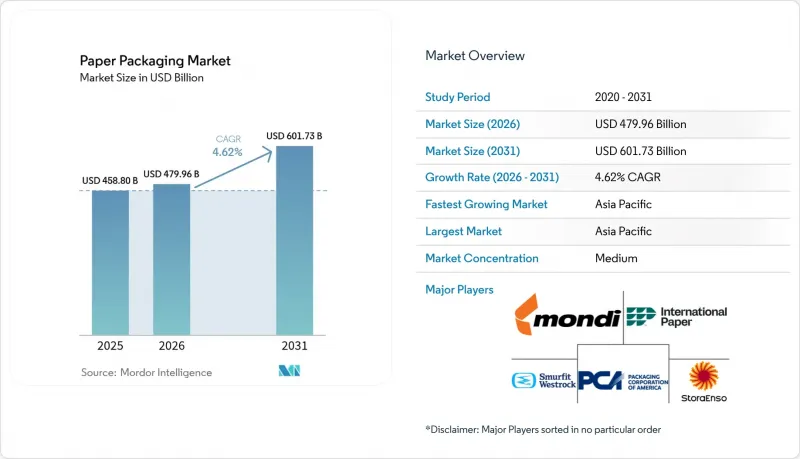
本報告按等級(瓦楞紙板原紙[固態漂白硫酸漿等]和箱板[白面牛皮紙襯裡等])、產品(折疊紙盒、瓦楞紙箱等)、終端用戶行業(食品、飲料、醫療保健、個人護理、家居用品等)、包裝類型(硬質、半硬質、軟質等)和地區細分。市場預測以美元計價。
全球紙包裝市場趨勢與洞察
阻隔塗層紙板解決方案的發展正在推動高階應用。
基於生物聚合物和奈米纖維素的先進防潮、防氧和防油塗層正在提升紙張的性能,同時保持其可回收性。實驗室測試表明,纖維素奈米纖維塗層可將氧氣透過率降低90%以上,並使彎曲耐久性比未塗層紙板增加一倍。美國食品藥物管理局(FDA)已確認,含全氟烷基和多氟烷基物質(PFAS)的防油劑已從食品接觸市場撤出,市場需求正轉向更安全的化學物質。在歐洲,多家加工商正快速實現硼酸交聯聚乙烯醇塗層的工業化生產,這種塗層具有優異的水蒸氣阻隔性能,並符合可堆肥標準。隨著品牌商尋求在不影響保存期限的前提下替代塑膠的方案,高品質的阻隔塗層紙板正成為即食食品、冷凍食品和個人保健產品禮品包裝的標準選擇,從而提升了紙質包裝市場的價值。
電子商務帶來的紙板需求激增,促使企業重新評估生產優先事項。
全球線上零售持續超越實體店面通路,每個小包裹都需要能夠承受自動化運輸的保護性、可堆疊的外包裝。目前,瓦楞紙箱約佔電商包裹總量的80%,鞏固了其作為「最後一公里」物流基石的地位。在以中國和印度為中心的龐大亞洲市場,預計到2024年小包裹將增加數百億件,這將推動瓦楞紙板工廠的擴張,並引入專為網路商店大規模生產而設計的高速數位印刷生產線。生產配置正朝向輕量化瓦楞形狀轉變,這種形狀既能保持抗壓強度,又能降低運輸成本。為了滿足電商日益成長的需求,一體化製造商優先提高瓦楞紙板原紙的產量,而非印刷用紙。這種需求支撐著成熟經濟體和新興經濟體紙包裝市場的穩定成長。
監測森林砍伐情況對傳統的供應鏈結構提出了挑戰。
歐盟關於森林砍伐的法規要求進口商在2025年底前對所有木質原料提供包裹等級的可追溯性認證。佔歐盟特種紙漿進口量60%的美國牛皮紙漿,現在必須包含由第三方機構檢驗的地理座標。衛星監測和產銷監管鏈(CoC)審核會增加採購成本,並可能導致運輸延誤。缺乏先進數據系統的中小型造紙廠可能會被擁有認證森林的大型垂直整合企業搶佔市場佔有率,這可能會改變紙包裝市場的競爭格局。從長遠來看,更嚴格的原產地法規可能會收緊依賴進口紙漿的市場的供應,從而抑制該行業的成長潛力。
細分市場分析
由於強大的瓦楞紙板基礎設施及其在電子商務配送中的核心地位,預計到2025年,箱板紙將佔據紙包裝市場54.12%的佔有率。同時,紙盒紙板預計將以7.05%的複合年成長率成長,成為所有纖維等級中成長率最高的。隨著高階產品滲透到食品和個人保健產品包裝套中,使用紙盒紙板的紙包裝市場規模預計將會擴大。加工商正在透過將閒置的印刷紙生產設備改造為適用於生產固體漂白硫酸漿(SBS)和折疊盒用紙板的塗佈機頭來提高設備運轉率。折疊盒用紙板因其與高清數位印刷的兼容性而越來越受到商店的青睞,其改進的分散式阻隔功能也使其能夠進入冷藏食品領域。同時,箱板紙生產商正在投資輕質牛皮紙內襯,以減輕運輸重量並提高永續性評級。原生紙漿和再生紙漿的混合最佳化了強度重量比,保持了箱板紙的競爭力,鞏固了其在紙包裝市場中的核心地位。
瓦楞紙板的成長前景吸引了大量資本,推動歐洲和北美產能的快速擴張,預計到2026年新增產量將超過100萬噸。食品接觸適用性認證和符合製藥運作標準提高了瓦楞紙板的噸值,尤其是在固態漂白級瓦楞紙板方面。歐盟多個國家禁止使用黑色塑膠,進一步刺激了市場需求,因為高階糖果甜點和化妝品包裝正轉向使用白色瓦楞紙板。奈米黏土等性能增強添加劑可在不影響可回收性的前提下提高瓦楞紙板的防潮性能,從而減少對塑膠薄膜的依賴。隨著零售品牌尋求能夠傳達品質和永續性的單一材料包裝,瓦楞紙板正成為紙包裝市場最大的受益者之一。
瓦楞紙箱憑藉其無與倫比的防護強度和在運輸、工業和食品管道的廣泛應用,預計到2025年將佔據紙質包裝市場61.48%的佔有率。同時,受個性化圖案、需要快速回應的季節性宣傳活動以及小批量生產的推動,可折疊瓦楞紙箱預計將超越整體市場成長率,以5.12%的複合年成長率成長。整合到模切機中的數位列印頭正在為大規模客製化鋪平道路,無需高昂的庫存成本,並縮短了設定時間。由於其美觀柔軟性且形狀適合商店展示,可折疊紙盒在高級化妝品、營養補充劑和植物來源食品行業中備受青睞。
儘管瓦楞紙板製造商正利用內部印刷和高色彩技術來保持品牌吸引力,但折疊紙盒在紋理和壓紋方面仍然具有優勢。在消費性電子配件領域,塑膠吸塑包裝正逐漸被帶有模塑纖維嵌件的加固紙盒所取代,這吸引了注重永續發展的消費者。借鑒自軟包裝袋的創新「撕條」開口設計進一步提升了便利性。這些設計和技術的進步正在推動紙質包裝市場佔有率的穩定成長。
區域分析
預計到2025年,亞太地區將以47.62%的市佔率引領紙包裝市場,並在2031年之前維持5.51%的複合年成長率。快速的都市化、中產階級購買力的提升以及大規模的食品配送生態系統,正在支撐南亞和東南亞的紡織品需求。區域企業正利用成本效益高的綜合工廠模式,將種植園與內部加工設施結合,以縮短前置作業時間。地方政府透過對節能機械提供關稅退稅等措施,鼓勵對永續包裝進行投資,進一步加速了產能的擴張。
北美仍然是創新中心,推動了數位印刷技術的應用,並主導了奈米纖維素的商業化試點。多個州掩埋法規增加了對可作為生活垃圾回收的包裝的需求,從而提振了國內箱板紙的需求。美國也擁有豐富的軟木資源,確保了原生紙漿的穩定供應,可用於與進口再生紙(OCC)混合。同時,在歐洲,嚴格的可回收性目標和不斷擴大的生產者延伸責任(EPR)機制的引入,創造了一個可預測的政策環境,鼓勵設備持續現代化。德國和斯堪地那維亞國家的造紙廠正在從石化燃料鍋爐過渡到生質能鍋爐,在能源價格飆升的情況下,減少了範圍1排放並提高了成本競爭力。
拉丁美洲和中東及非洲目前合計僅佔全球總合佔有率的一小部分,但這兩個地區的成長率均高於全球平均。巴西紙漿生產商正將其業務整合到紙板製造等下游流程中,以降低大宗商品價格波動所帶來的風險。同時,波灣合作理事會(GCC)成員國正在提高瓦楞紙板產能,以滿足日益成長的電子商務需求。在非洲,由於回收網路不發達,再生纖維的供應受到阻礙,但國際發展計畫正在資助試點資源回收設施,為未來的循環經濟奠定基礎。這些區域趨勢增強了紙包裝市場多元化的需求基礎,從而支撐了其長期韌性。
其他好處:
- Excel格式的市場預測(ME)表
- 3個月的分析師支持
目錄
第1章:引言
- 研究假設和市場定義
- 調查範圍
第2章:調查方法
第3章執行摘要
第4章 市場狀況
- 市場概覽
- 市場促進因素
- 開發阻隔塗層紙板解決方案
- 電子商務導致紙箱需求增加
- 品牌所有者轉向單一材料包裝
- 強制性生產者延伸責任制(EPR)
- 奈米纖維素阻隔技術的突破性進展
- 加工廠現場數位印刷的經濟效益
- 市場限制因素
- 監測森林砍伐和纖維供應
- 再生纖維價格波動
- 逐步淘汰 PFAS「永久性化學物質」的相關成本
- 新興市場物流業的復甦有限。
- 產業價值鏈分析
- 監理情勢
- 技術展望
- 波特五力分析
- 世界廢紙產量統計數據
- 再生紙 - 產量
- 廢紙-進口價值和進口量
- 廢紙-出口價值與出口量
- 主要國家的再生紙產量
- 紙板匯出/匯入場景
- 出口
- 進口
第5章 市場規模與成長預測
- 按年級
- 紙板
- 固態漂白硫酸漿(SBS)
- 未漂白硫酸紙漿(SUS)
- 折疊紙板(FBB)
- 法院再生板(CRB)
- 無塗布再生紙板(URB)
- 其他等級的紙板
- 貨櫃紙板
- 白色頂部 Craftliner
- 其他牛皮紙襯墊
- 白色頂部測試襯墊
- 其他測試襯墊
- 半化學蝕刻
- 回放笛聲
- 紙板
- 依產品
- 折疊紙箱
- 瓦楞紙箱
- 其他產品
- 按最終用戶行業分類
- 食物
- 飲料
- 衛生保健
- 個人護理
- 居家照護
- 電氣和電子設備
- 其他終端用戶產業
- 按包裝類型
- 硬紙板(紙板、厚紙)
- 半硬質(可折疊紙盒)
- 撓性紙(小袋子、包裝紙)
- 模塑纖維和紙漿
- 按地區
- 北美洲
- 美國
- 加拿大
- 墨西哥
- 南美洲
- 巴西
- 阿根廷
- 其他南美國家
- 歐洲
- 英國
- 德國
- 法國
- 義大利
- 西班牙
- 俄羅斯
- 其他歐洲國家
- 亞太地區
- 中國
- 日本
- 印度
- 韓國
- 澳洲
- 其他亞太國家
- 中東和非洲
- 中東
- 阿拉伯聯合大公國
- 沙烏地阿拉伯
- 土耳其
- 其他中東國家
- 非洲
- 南非
- 奈及利亞
- 其他非洲國家
- 中東
- 北美洲
第6章 競爭情勢
- 市場集中度
- 策略趨勢
- 市佔率分析
- 公司簡介
- International Paper Company
- Smurfit Westrock plc
- Mondi plc
- Packaging Corporation of America
- Stora Enso Oyj
- Graphic Packaging International, LLC
- Nippon Paper Industries Co. Ltd.
- Sonoco Products Company
- Oji Holdings Corporation
- Georgia-Pacific LLC
- Nine Dragons Paper Holdings
- Lee & Man Paper Manufacturing
- Sappi Limited
- Ilim Group
- Klabin SA
- Asia Pulp & Paper(APP)
第7章 市場機會與未來展望
According to Mordor Intelligence, the paper packaging market size was valued at USD 458.8 billion in 2025 and estimated to grow from USD 479.96 billion in 2026 to reach USD 601.73 billion by 2031, at a CAGR of 4.62% during the forecast period (2026-2031).
This report is Segmented by Grade (Cartonboard [Solid Bleached Sulphate, and More], and Containerboard [White-Top Kraftliner, and More]), Product (Folding Cartons, Corrugated Boxes, and More), End-User Industry (Food, Beverage, Healthcare, Personal Care, Household Care, and More), Packaging Format (Rigid, Semi-Rigid, Flexible, and More), and Geography. The Market Forecasts are Provided in Terms of Value (USD).
Global Paper Packaging Market Trends and Insights
Development of Barrier-Coated Paperboard Solutions Drive Premium Applications
Advanced water-, oxygen-, and grease-barrier coatings based on bio-polymers and nano-cellulose are elevating paper's performance while preserving its recyclability. Laboratory trials show that cellulose nanofibril coatings can reduce oxygen transmission by more than 90% and double folding endurance compared with uncoated board. The U.S. Food & Drug Administration confirmed that grease-proofing agents containing PFAS have exited the food-contact market, shifting demand toward safer chemistries. In Europe, several converters are fast-tracking industrial runs of boric-acid-cross-linked poly(vinyl alcohol) coatings that deliver robust water vapor protection and meet compostability standards. As brand owners pursue plastic replacement without compromising shelf life, premium barrier-coated board is becoming the default for ready-to-eat foods, frozen meals, and personal-care gift packs, boosting value growth in the paper packaging market.
E-Commerce Corrugated Demand Surge Reshapes Production Priorities
Global online retail continues to outperform brick-and-mortar channels, and each parcel requires protective, stackable outer packaging that can withstand automated handling. Corrugated cases now account for an estimated 80% of e-commerce shipments, cementing their role as the workhorse for last-mile logistics. Asian mega-markets led by China and India added double-digit billions of parcels in 2024, prompting box-plant expansions and high-speed digital print lines dedicated to web-shop volumes. The production mix is shifting toward lightweight fluting profiles that cut freight costs yet retain compression strength, and integrated producers are prioritizing incremental containerboard tonnage over graphic paper grades to keep pace with e-commerce pull-through. This demand foundation underpins steady volume growth for the paper packaging market in both mature and emerging economies.
Deforestation Scrutiny Challenges Traditional Supply-Chain Structures
The EU Deforestation Regulation obliges importers to demonstrate plot-level traceability for all wood-based inputs by the end of 2025. U.S. Kraft pulp, representing 60% of EU specialty-grade imports, must now carry geo-coordinates verified by third parties. Implementing satellite monitoring and chain-of-custody audits raises procurement costs and risks of shipment delays. Smaller mills lacking sophisticated data systems may cede share to vertically integrated majors with certified forests, altering competitive balances within the paper packaging market. Over time, tighter provenance rules could squeeze supply and curb the sector's growth potential in markets that rely on imported fiber.
Other drivers and restraints analyzed in the detailed report include:
- Brand-Owner Migration Toward Mono-Material Packaging Architectures
- Extended Producer Responsibility Mandates Accelerate Market Transformation
- Volatile Recycled-Fiber Pricing Creates Margin Compression Pressures
For complete list of drivers and restraints, kindly check the Table Of Contents.
Segment Analysis
Containerboard held a 54.12% paper packaging market share in 2025, supported by deep corrugated infrastructure and its central role in e-commerce shipping. Meanwhile, cartonboard is registering a 7.05% CAGR, the fastest among fiber grades. The paper packaging market size for cartonboard applications is projected to rise, reflecting premium penetration in food and personal-care sleeves. Converters are refitting idle graphic-paper machines with coating heads suited to Solid Bleached Sulfate and Folding Boxboard production, improving asset utilization. Folding Boxboard's compatibility with high-definition digital print elevates shelf appeal, while dispersion-barrier upgrades enable chilled-food entry. At the same time, containerboard producers are investing in lightweight kraftliner to cut shipping mass, enhancing sustainability credentials. Virgin-recycled blends optimize strength-to-weight ratios and keep containerboard competitive, ensuring it remains the volume backbone of the paper packaging market.
Cartonboard's growth profile attracts capital for rapid European and North American capacity expansions, with start-ups exceeding 1 million tons by 2026. Food-contact certification and pharmaceutical clean-room compliance boost value per ton, particularly for solid-bleached grades. Regulatory bans on black plastics in several EU countries redirect premium confectionery and cosmetic packs to white cartonboard formats, lifting demand further. Performance-enhancing additives such as nano-clays deliver moisture barriers without compromising recyclability, reducing reliance on plastic films. As retail brands demand mono-material packs that convey quality and sustainability, cartonboard emerges as the prime beneficiary within the paper packaging market.
Corrugated boxes occupied 61.48% of the paper packaging market in 2025 owing to their unmatched protective strength and versatility across shipping, industrial, and grocery channels. Folding cartons, however, are forecast to outpace overall growth, expanding at a 5.12% CAGR on the back of personalized graphics, quick-response seasonal campaigns, and smaller lot sizes. Digital printheads integrated into die-cutters reduce changeover times, paving the way for mass-customization without costly inventories. Premium beauty, nutraceuticals, and plant-based foods all favor folding cartons for their aesthetic flexibility and shelf-ready formats.
Corrugated producers respond with inside-print and high-color capabilities to keep hold of branding real estate, but folding cartons maintain an edge in tactile finishes and embossing. Consumer-electronics accessories increasingly shift from plastic clamshells to reinforced cartons married with molded-fiber inserts, capturing sustainability-minded shoppers. Novel tear-strip opening features borrowed from flexible pouches further boost convenience. These design and technology advances underpin steady share migration within the broader paper packaging market.
Complete Report Scope:
- By Grade
- Cartonboard
- Solid Bleached Sulphate (SBS)
- Solid Unbleached Sulphate (SUS)
- Folding Boxboard (FBB)
- Coated Recycled Board (CRB)
- Uncoated Recycled Board (URB)
- Other Cartonboard Grades
- Containerboard
- White-top Kraftliner
- Other Kraftliners
- White-top Testliner
- Other Testliners
- Semi-chemical Fluting
- Recycled Fluting
- Cartonboard
- By Product
- Folding Cartons
- Corrugated Boxes
- Other Products
- By End-User Industry
- Food
- Beverage
- Healthcare
- Personal Care
- Household Care
- Electrical and Electronics
- Other End-User Industries
- By Packaging Format
- Rigid (Corrugated, Solid Board)
- Semi-rigid (Folding Cartons)
- Flexible Paper (Sachets, Wraps)
- Molded Fibre and Pulp
- By Geography
- North America
- United States
- Canada
- Mexico
- South America
- Brazil
- Argentina
- Rest of South America
- Europe
- United Kingdom
- Germany
- France
- Italy
- Spain
- Russia
- Rest of Europe
- Asia Pacific
- China
- Japan
- India
- South Korea
- Australia
- Rest of Asia Pacific
- Middle East and Africa
- Middle East
- United Arab Emirates
- Saudi Arabia
- Turkey
- Rest of Middle East
- Africa
- South Africa
- Nigeria
- Rest of Africa
- Middle East
- North America
Geography Analysis
Asia-Pacific led the paper packaging market with a 47.62% revenue share in 2025 and is projected to record a 5.51% CAGR to 2031. Rapid urbanization, expanding middle-class purchasing power, and large-scale food-delivery ecosystems underpin fiber demand in South and Southeast Asia. Regional players leverage cost-efficient integrated mills that pair plantation forests with in-house converting, shortening lead times for export-oriented customers. Local governments incentivize sustainable-pack investments through duty rebates on energy-efficient machinery, further accelerating capacity additions.
North America remains an innovation nucleus, driving digital-print adoption and spearheading nano-cellulose pilot commercialization. Tightening landfill legislation in several states spurs demand for curbside-recyclable packs, bolstering domestic containerboard offtake. The United States also benefits from abundant softwood resources, ensuring steady virgin-fiber availability to blend with imported OCC. Meanwhile, Europe's stringent recyclability targets and EPR rollouts create a predictable policy environment that favors continuous equipment upgrades. German and Scandinavian mills transition from fossil to biomass boilers, reducing Scope 1 emissions and sharpening cost competitiveness despite high energy prices.
Latin America and the Middle East and Africa collectively hold modest shares today, yet both regions register above-global average growth. Brazilian pulp producers integrate downstream into cartonboard to mitigate commodity cycles, while Gulf Cooperation Council economies add corrugated capacity to serve expanding e-commerce hubs. Africa's underdeveloped collection network hinders recycled-fiber supply, but international development programs are funding pilot materials-recovery facilities, laying groundwork for future circularity. Collectively, these regional trajectories reinforce the diversified demand base that supports the long-term resilience of the paper packaging market.
- International Paper Company
- Smurfit Westrock plc
- Mondi plc
- Packaging Corporation of America
- Stora Enso Oyj
- Graphic Packaging International, LLC
- Nippon Paper Industries Co. Ltd.
- Sonoco Products Company
- Oji Holdings Corporation
- Georgia-Pacific LLC
- Nine Dragons Paper Holdings
- Lee & Man Paper Manufacturing
- Sappi Limited
- Ilim Group
- Klabin S.A.
- Asia Pulp & Paper (APP)
Additional Benefits:
- The market estimate (ME) sheet in Excel format
- 3 months of analyst support
TABLE OF CONTENTS
1 INTRODUCTION
- 1.1 Study Assumptions and Market Definition
- 1.2 Scope of the Study
2 RESEARCH METHODOLOGY
3 EXECUTIVE SUMMARY
4 MARKET LANDSCAPE
- 4.1 Market Overview
- 4.2 Market Drivers
- 4.2.1 Development of barrier-coated paperboard solutions
- 4.2.2 Rise in e-commerce corrugated demand
- 4.2.3 Brand-owner shift toward mono-material packs
- 4.2.4 Extended Producer Responsibility (EPR) mandates
- 4.2.5 Nano-cellulose barrier breakthroughs
- 4.2.6 Converting-plant on-site digital printing economics
- 4.3 Market Restraints
- 4.3.1 Deforestation and fibre-supply scrutiny
- 4.3.2 Volatile recycled-fibre pricing
- 4.3.3 PFAS "forever-chemicals" phase-out costs
- 4.3.4 Limited recovery logistics in emerging markets
- 4.4 Industry Value Chain Analysis
- 4.5 Regulatory Landscape
- 4.6 Technological Outlook
- 4.7 Porter's Five Forces Analysis
- 4.7.1 Bargaining Power of Suppliers
- 4.7.2 Bargaining Power of Buyers
- 4.7.3 Threat of New Entrants
- 4.7.4 Threat of Substitutes
- 4.7.5 Intensity of Competitive Rivalry
- 4.8 Global Recovered Paper Production Statistics
- 4.8.1 Recovered Paper - Production Quantity
- 4.8.2 Recovered Paper - Import Value and Quantity
- 4.8.3 Recovered Paper - Export Value and Quantity
- 4.8.4 Recovered Paper Production - Leading Countries
- 4.9 Cartonboard EXIM Scenario
- 4.9.1 Exports (Value and Volume)
- 4.9.2 Imports (Value and Volume)
5 MARKET SIZE AND GROWTH FORECASTS (VALUE)
- 5.1 By Grade
- 5.1.1 Cartonboard
- 5.1.1.1 Solid Bleached Sulphate (SBS)
- 5.1.1.2 Solid Unbleached Sulphate (SUS)
- 5.1.1.3 Folding Boxboard (FBB)
- 5.1.1.4 Coated Recycled Board (CRB)
- 5.1.1.5 Uncoated Recycled Board (URB)
- 5.1.1.6 Other Cartonboard Grades
- 5.1.2 Containerboard
- 5.1.2.1 White-top Kraftliner
- 5.1.2.2 Other Kraftliners
- 5.1.2.3 White-top Testliner
- 5.1.2.4 Other Testliners
- 5.1.2.5 Semi-chemical Fluting
- 5.1.2.6 Recycled Fluting
- 5.1.1 Cartonboard
- 5.2 By Product
- 5.2.1 Folding Cartons
- 5.2.2 Corrugated Boxes
- 5.2.3 Other Products
- 5.3 By End-User Industry
- 5.3.1 Food
- 5.3.2 Beverage
- 5.3.3 Healthcare
- 5.3.4 Personal Care
- 5.3.5 Household Care
- 5.3.6 Electrical and Electronics
- 5.3.7 Other End-User Industries
- 5.4 By Packaging Format
- 5.4.1 Rigid (Corrugated, Solid Board)
- 5.4.2 Semi-rigid (Folding Cartons)
- 5.4.3 Flexible Paper (Sachets, Wraps)
- 5.4.4 Molded Fibre and Pulp
- 5.5 By Geography
- 5.5.1 North America
- 5.5.1.1 United States
- 5.5.1.2 Canada
- 5.5.1.3 Mexico
- 5.5.2 South America
- 5.5.2.1 Brazil
- 5.5.2.2 Argentina
- 5.5.2.3 Rest of South America
- 5.5.3 Europe
- 5.5.3.1 United Kingdom
- 5.5.3.2 Germany
- 5.5.3.3 France
- 5.5.3.4 Italy
- 5.5.3.5 Spain
- 5.5.3.6 Russia
- 5.5.3.7 Rest of Europe
- 5.5.4 Asia Pacific
- 5.5.4.1 China
- 5.5.4.2 Japan
- 5.5.4.3 India
- 5.5.4.4 South Korea
- 5.5.4.5 Australia
- 5.5.4.6 Rest of Asia Pacific
- 5.5.5 Middle East and Africa
- 5.5.5.1 Middle East
- 5.5.5.1.1 United Arab Emirates
- 5.5.5.1.2 Saudi Arabia
- 5.5.5.1.3 Turkey
- 5.5.5.1.4 Rest of Middle East
- 5.5.5.2 Africa
- 5.5.5.2.1 South Africa
- 5.5.5.2.2 Nigeria
- 5.5.5.2.3 Rest of Africa
- 5.5.5.1 Middle East
- 5.5.1 North America
6 COMPETITIVE LANDSCAPE
- 6.1 Market Concentration
- 6.2 Strategic Moves
- 6.3 Market Share Analysis
- 6.4 Company Profiles (includes Global level Overview, Market level overview, Core Segments, Financials as available, Strategic Information, Market Rank/Share, Products and Services, Recent Developments)
- 6.4.1 International Paper Company
- 6.4.2 Smurfit Westrock plc
- 6.4.3 Mondi plc
- 6.4.4 Packaging Corporation of America
- 6.4.5 Stora Enso Oyj
- 6.4.6 Graphic Packaging International, LLC
- 6.4.7 Nippon Paper Industries Co. Ltd.
- 6.4.8 Sonoco Products Company
- 6.4.9 Oji Holdings Corporation
- 6.4.10 Georgia-Pacific LLC
- 6.4.11 Nine Dragons Paper Holdings
- 6.4.12 Lee & Man Paper Manufacturing
- 6.4.13 Sappi Limited
- 6.4.14 Ilim Group
- 6.4.15 Klabin S.A.
- 6.4.16 Asia Pulp & Paper (APP)
7 MARKET OPPORTUNITIES AND FUTURE OUTLOOK
- 7.1 White-space and Unmet-Need Assessment

 2026-2034年全球再生紙包裝中礦物油烴(MOSH/MOAH)轉型市場規模、佔有率、趨勢和成長分析報告
 越南紙包裝市場:市場佔有率分析、產業趨勢與統計及成長預測(2026-2031年)
 原生紙包裝市場預測至2034年-全球產品類型、紙張類型、材料類型、包裝形式、應用、最終用戶和地區分析中東和非洲紙包裝市場:市場佔有率分析、行業趨勢和統計數據以及成長預測(2026-2031 年)印尼紙包裝:市場佔有率分析、產業趨勢與統計及成長預測(2026-2031)義大利紙包裝市場:市場佔有率分析、產業趨勢與統計、成長預測(2026-2031)亞太地區紙包裝市場:市佔率分析、產業趨勢與統計及成長預測(2026-2031年)印度紙包裝市場:市場佔有率分析、產業趨勢與統計及成長預測(2026-2031)日本紙包裝市場:市場佔有率分析、產業趨勢與統計及成長預測(2026-2031)北美紙包裝:市佔率分析、產業趨勢與統計及成長預測(2026-2031 年)