


 |
市場調查報告書
商品編碼
2121758
義大利紙包裝市場:市場佔有率分析、產業趨勢與統計、成長預測(2026-2031)Italy Paper Packaging - Market Share Analysis, Industry Trends & Statistics, Growth Forecasts (2026 - 2031) |
||||||

※ 本網頁內容可能與最新版本有所差異。詳細情況請與我們聯繫。
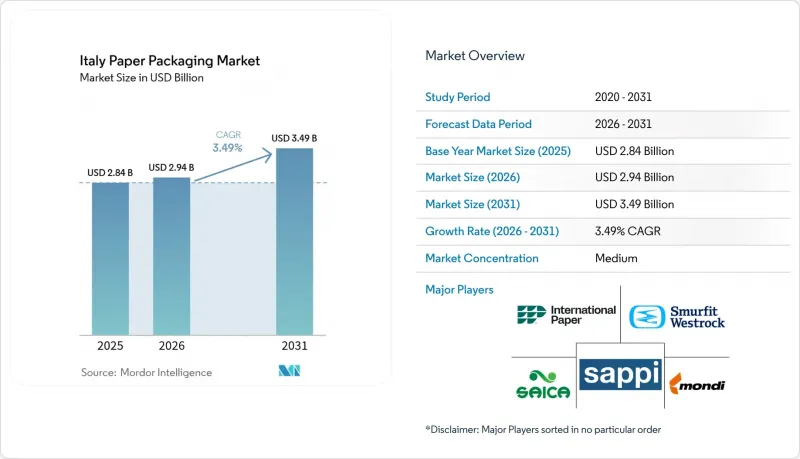
據 Mordor Intelligence 稱,義大利紙包裝市場預計到 2026 年價值 29.4 億美元,高於 2025 年的 28.4 億美元,預計到 2031 年將達到 34.9 億美元。
預計從 2026 年到 2031 年,其複合年成長率將達到 3.49%。
本報告按原料(原生紙漿、再生紙漿等)、產品類型(瓦楞紙箱、折疊式紙盒等)、終端用戶行業(食品飲料、醫療製藥等)以及包裝級別(初級包裝、二級包裝、三級包裝)進行細分。市場預測以美元計價。
義大利紙包裝市場趨勢與洞察
電子商務小包裹量激增
2024年,義大利電子商務銷售額達到382億歐元(413億美元),年增5%。家居生活類商品銷售額也成長了12%,達到44億歐元(48億美元)。這一成長帶動了瓦楞紙板和尺寸合適的包裝材料需求翻番,以保護商品在多樞紐末端配送網路中的安全。光是食品和雜貨電商的銷售額就成長了46億歐元(50億美元),增幅達8%,凸顯了市場對防潮紙本解決方案日益成長的需求。北部地區的物流中心,尤其是Lombardia和威尼托地區的履約中心,正面臨產能瓶頸,促使中小企業採用自動化線上包裝站。 CMC Packaging Automation與Mondi在2024年的合作,標誌著電商領域正朝著高擴充性和材料效率的瓦楞紙箱方向發展。預計這些因素將使義大利紙包裝市場的年複合成長率(CAGR)預期值上調0.8%。
歐盟逐步淘汰一次性塑膠製品的計畫正在加速替代進程。
義大利將歐盟一次性塑膠指令納入國內法,正在擴大可回收紡織杯、餐飲包裝和購物袋的市場。成熟的紡織品供應鏈和義大利全國紡織品協會 (CONAI) 建立的全國協調體系簡化了品牌合規流程,並推動了快餐店和零售商採用紙製品。義大利紙包裝回收率高達 87.3%,超過歐盟 73.9% 的平均水平,這印證了紙製品解決方案的製度化合規性。可預測的合規時間表使加工商更容易規劃資本投資,而生產者延伸責任制 (EPR) 下的收費則對不可回收材料進行處罰。由此產生的替代動力將使義大利紙包裝市場的預期複合年成長率提高 0.6%。
斯堪的納維亞半島供應衝擊導致牛皮紙漿價格波動
2024年第二季度,造紙廠停產和能源價格飆升共同推高了斯堪的納維亞半島的紙漿成本,使其達到歷史新高。比勒魯德在2024年證券報告中指出,紙漿、物流和電力成本整體承壓,凸顯了義大利進口商利潤率面臨的壓力。依賴原生紙漿的義大利造紙廠面臨著要么承受這種壓力,要么在高價值細分市場中失去市場佔有率的風險。此外,再生紙漿價格上漲,縮小了再生紙漿和原生紙漿之間的價格差距。這種衝擊導致義大利紙包裝市場預計複合年成長率下降了0.7個百分點。
細分市場分析
在義大利紙包裝市場,預計到2025年,再生纖維將佔60.83%的市場。這主要得益於義大利完善的全國性回收體係以及Comieco公司所經營的品管體系。原生纖維在對食品級品質和強度要求極高的應用中仍然發揮著重要作用,而複合板材則被應用於流質食品和無菌包裝等細分市場。預計到2031年,源自小麥秸稈、稻殼和橄欖籽的農業殘餘纖維將以5.22%的複合年成長率高速成長,這反映了義大利的研究津貼以及周邊地區豐富的農產品資源。
回收材料的流動正在降低義大利對北歐波動性進口的依賴,並鞏固其在循環經濟領域的聲譽。 Comieco 的物流網路能夠有效控制紙包的含水量,從而提高每噸紙的產量。在綠色金融獎勵的支持下,農業殘餘物的利用率不斷提高,預計將減少碳排放,並為農業部門創造新的收入來源。義大利紙包裝市場正蓬勃發展,加工商們正嘗試將農業殘餘物衍生的內襯用於折疊紙盒和瓦楞紙板,這在不影響印刷品質的前提下,是對再生紙漿的補充。
預計到2025年,瓦楞紙箱將佔銷售額的41.88%,成為全通路物流和重工業產品出口的標準運輸方式。同時,受高階食品、化妝品和家居用品等產品對高品質圖案和結構細節的需求不斷成長的推動,折疊式紙箱預計將以4.66%的複合年成長率實現最高成長。
為了滿足電商個人化小批量生產的需求,瓦楞紙板廠正在升級生產流程,採用高速數位印刷和人工智慧控制的模切技術。同時,以Cartotecnica Moderna等公司為首的折疊紙盒製造商,正利用金屬化清漆和觸感塗層來提升產品在商店的吸引力。軟性紙包裝和模塑紙漿托盤的應用範圍正在不斷擴大,涵蓋攜帶式零食和電子產品緩衝包裝等領域;而液體紙盒則順應了常溫飲料市場「減少塑膠用量」的趨勢。這種多元化的產品組合意味著,義大利紙包裝市場正在從通用產品到高階利基市場等眾多領域創造價值。
其他好處:
- Excel格式的市場預測(ME)表
- 3個月的分析師支持
目錄
第1章:引言
- 研究假設和市場定義
- 調查範圍
第2章:調查方法
第3章執行摘要
第4章 市場狀況
- 市場概覽
- 市場促進因素
- 電子商務小包裹量激增
- 歐盟逐步淘汰一次性塑膠製品,正加速替代品的採用。
- 各公司的淨零排放藍圖正在製定紡織材料規範。
- 隨著自有品牌食品業務的擴張,對經濟實惠的紙盒的需求也日益成長。
- 一家義大利中小企業採用了人工智慧平台來確定最佳包裝箱尺寸。
- 纖維複合材料阻隔技術,使流質食品能夠在室溫下儲存。
- 市場限制因素
- 斯堪的納維亞半島供應衝擊導致牛皮紙漿價格波動
- FIT6實施後,義大利造紙廠的電價上漲。
- 當地居民反對在待開發區位置興建瓦楞紙板廠。
- 用於食品的再生纖維供應有限。
- 產業價值鏈分析
- 波特五力分析
- 宏觀經濟因素對市場的影響
- 監理情勢
- 技術展望
第5章 市場規模與成長預測
- 材料
- 原生光纖
- 再生纖維
- 農業殘餘纖維
- 複合材料/多層紙板
- 依產品類型
- 瓦楞紙箱
- 折疊紙箱
- 軟性紙包裝
- 液體紙盒
- 模製紙漿托盤
- 其他產品類型
- 按最終用戶行業分類
- 食品/飲料
- 醫療和藥品
- 個人護理和居家護理
- 電子與電機工程
- 工業與物流
- 其他終端用戶產業
- 按包裝級別
- 初級包裝
- 二級包裝
- 三級包裝
第6章 競爭情勢
- 市場集中度
- 策略趨勢
- 市佔率分析
- 公司簡介
- International Paper Company
- Sappi Limited
- Smurfit WestRock
- Mondi plc
- Saica Group SA
- Seda International Packaging Group SpA
- Tetra Pak International SA
- Pro-Gest SpA
- Reno De Medici SpA
- Cascades Inc.
- Stora Enso Oyj
- Graphic Packaging Holding Company
- Mayr-Melnhof Karton AG
- Huhtamaki Oyj
- Burgo Group SpA
- Lucart SpA
- GD SpA
- Box Marche SpA
第7章 市場機會與未來展望
According to Mordor Intelligence, Italy paper packaging market size in 2026 is estimated at USD 2.94 billion, growing from 2025 value of USD 2.84 billion with 2031 projections showing USD 3.49 billion, growing at 3.49% CAGR over 2026-2031.
This report is Segmented by Material (Virgin Fibre, Recycled Fibre, and More), Product Type (Corrugated Boxes, Folding Cartons, and More), End-User Industry (Food and Beverage, Healthcare and Pharmaceuticals, and More), and Packaging Level (Primary, Secondary, and Tertiary). The Market Forecasts are Provided in Terms of Value (USD).
Italy Paper Packaging Market Trends and Insights
E-commerce Parcel Volume Boom
Italian e-commerce product sales reached EUR 38.2 billion (USD 41.3 billion) in 2024, growing 5% year over year, and home-living categories climbed 12% to EUR 4.4 billion (USD 4.8 billion). The surge multiplies demand for corrugated and right-sized packs that protect goods through multi-hub last-mile networks. Food and grocery e-commerce alone added EUR 4.6 billion (USD 5 billion) at 8% growth, necessitating moisture-resistant paper solutions. Northern fulfillment centers-especially in Lombardy and Veneto-face capacity constraints, prompting SMEs to integrate automated inline pack stations. CMC Packaging Automation's 2024 partnership with Mondi typifies the shift to scalable, material-efficient e-commerce boxes. These factors translate into a measurable +0.8% uplift to the forecast CAGR for the Italy paper packaging market.
EU Single-Use Plastic Phase-Outs Accelerating Substitution
Italy's transposition of the EU Single-Use Plastics Directive widens the addressable space for recyclable fiber-based cups, food-service wraps, and carrier bags. Established fiber supply chains and nationwide CONAI coordination simplify compliance for brands, amplifying paper uptake in quick-service restaurants and retail outlets. Italy's 87.3% paper packaging recycling rate exceeds the EU average of 73.9%, underscoring the systemic fit of paper solutions. Predictable compliance timelines allow converters to sequence capex, while extended producer responsibility fees penalize non-recyclable substrates. Resulting substitution momentum contributes a +0.6% contribution to CAGR forecasts for the Italy paper packaging market.
Kraft Pulp Price Volatility Tied to Nordic Supply Shocks
Nordic pulp costs spiked to record highs in Q2 2024, as mill outages collided with heightened energy tariffs. Billerud flagged persistent cost pressures across pulp, logistics, and power in its 2024 filings, spotlighting margin compression for Italian importers. Italian mills with exposure to virgin-fiber grades absorb the squeeze or risk ceding share in value segments. Secondary effects elevate recovered-fiber pricing, shrinking the differential between recycled and virgin inputs. The turbulence subtracts 0.7 percentage points from the forecast CAGR for the Italy paper packaging market.
Other drivers and restraints analyzed in the detailed report include:
- Corporate Net-Zero Roadmaps Locking-in Fiber-Based Specs
- Private-Label Grocery Expansion Demanding Cost-Effective Cartons
- Rising Electricity Prices for Italian Mills Post-FIT6
For complete list of drivers and restraints, kindly check the Table Of Contents.
Segment Analysis
The Italy paper packaging market shows recycled fiber commanding 60.83% share in 2025, leveraging a mature nationwide collection and Comieco-run quality scheme. Virgin fiber retains roles in food-grade and strength-critical uses, while composite boards service liquid food and aseptic niches. Agricultural-residue fiber-covering wheat straw, rice husk, and olive-pit derivatives register the highest 5.22% CAGR through 2031, reflecting Italian research grants and proximity to diverse crops.
Recycled streams reduce reliance on volatile Nordic imports and anchor Italy's circular-economy reputation. Comieco logistics networks keep bale moisture under control, boosting yield per ton. Agricultural-residue scale-ups, underwritten by green-finance incentives, promise lower embedded carbon and new agrarian revenue streams. The Italy paper packaging market size expansion benefits as converters trial residue-based liners in folding cartons and corrugated fluting, supplementing recycled furnish without compromising print fidelity.
Corrugated boxes delivered 41.88% of 2025 sales, surfacing as the default carrier in omni-channel logistics and heavy industrial exports. Folding cartons, however, post the swiftest 4.66% CAGR, propelled by gourmet foods, cosmetics, and household-care SKUs that seek premium graphics and structural nuances.
Corrugated plants upgrade to high-speed digital printing and AI-guided die-cutting to meet short production runs demanded by e-commerce personalization. Folding carton converters, led by firms such as Cartotecnica Moderna, harness metallized varnishes and tactile finishes to elevate shelf appeal. Flexible paper packs and molded-pulp trays expand into on-the-go snacks and consumer electronics cushioning, while liquid cartons ride the anti-plastic wave in shelf-stable beverages. The multi-track product matrix ensures the Italy paper packaging market captures value across commodity and premium niches.
Complete Report Scope:
- By Material
- Virgin Fibre
- Recycled Fibre
- Agricultural-residue Fibre
- Composite / Multilayer Paperboard
- By Product Type
- Corrugated Boxes
- Folding Cartons
- Flexible Paper Packaging
- Liquid Cartons
- Molded-pulp Trays
- Other Product Types
- By End-User Industry
- Food and Beverage
- Healthcare and Pharmaceuticals
- Personal and Household Care
- Electronics and Electrical
- Industrial and Logistics
- Other End-User Industries
- By Packaging Level
- Primary Packaging
- Secondary Packaging
- Tertiary Packaging
List of Companies Covered in this Report:
- International Paper Company
- Sappi Limited
- Smurfit WestRock
- Mondi plc
- Saica Group S.A.
- Seda International Packaging Group S.p.A.
- Tetra Pak International S.A.
- Pro-Gest S.p.A.
- Reno De Medici S.p.A.
- Cascades Inc.
- Stora Enso Oyj
- Graphic Packaging Holding Company
- Mayr-Melnhof Karton AG
- Huhtamaki Oyj
- Burgo Group S.p.A.
- Lucart S.p.A.
- G.D S.p.A.
- Box Marche S.p.A.
Additional Benefits:
- The market estimate (ME) sheet in Excel format
- 3 months of analyst support
TABLE OF CONTENTS
1 INTRODUCTION
- 1.1 Study Assumptions and Market Definition
- 1.2 Scope of the Study
2 RESEARCH METHODOLOGY
3 EXECUTIVE SUMMARY
4 MARKET LANDSCAPE
- 4.1 Market Overview
- 4.2 Market Drivers
- 4.2.1 E-commerce parcel volume boom
- 4.2.2 EU single-use plastic phase-outs accelerating substitution
- 4.2.3 Corporate net-zero roadmaps locking-in fibre-based specs
- 4.2.4 Private-label grocery expansion demanding cost-effective cartons
- 4.2.5 AI-driven box-right-sizing platforms adopted by Italian SMEs
- 4.2.6 Fibre-composite barrier tech enabling shelf-stable liquid foods
- 4.3 Market Restraints
- 4.3.1 Kraft pulp price volatility tied to Nordic supply shocks
- 4.3.2 Rising electricity prices for Italian mills post-FIT6
- 4.3.3 Local opposition to green-field corrugator sites
- 4.3.4 Limited availability of food-grade recycled fibre streams
- 4.4 Industry Value Chain Analysis
- 4.5 Porter's Five Forces Analysis
- 4.5.1 Threat of New Entrants
- 4.5.2 Bargaining Power of Consumers
- 4.5.3 Bargaining Power of Suppliers
- 4.5.4 Threat of Substitute Products
- 4.5.5 Intensity of Competitive Rivalry
- 4.6 The Impact of Macroeconomic Factors on the Market
- 4.7 Regulatory Landscape
- 4.8 Technological Outlook
5 MARKET SIZE AND GROWTH FORECASTS (VALUE)
- 5.1 By Material
- 5.1.1 Virgin Fibre
- 5.1.2 Recycled Fibre
- 5.1.3 Agricultural-residue Fibre
- 5.1.4 Composite / Multilayer Paperboard
- 5.2 By Product Type
- 5.2.1 Corrugated Boxes
- 5.2.2 Folding Cartons
- 5.2.3 Flexible Paper Packaging
- 5.2.4 Liquid Cartons
- 5.2.5 Molded-pulp Trays
- 5.2.6 Other Product Types
- 5.3 By End-User Industry
- 5.3.1 Food and Beverage
- 5.3.2 Healthcare and Pharmaceuticals
- 5.3.3 Personal and Household Care
- 5.3.4 Electronics and Electrical
- 5.3.5 Industrial and Logistics
- 5.3.6 Other End-User Industries
- 5.4 By Packaging Level
- 5.4.1 Primary Packaging
- 5.4.2 Secondary Packaging
- 5.4.3 Tertiary Packaging
6 COMPETITIVE LANDSCAPE
- 6.1 Market Concentration
- 6.2 Strategic Moves
- 6.3 Market Share Analysis
- 6.4 Company Profiles (includes Global level Overview, Market level overview, Core Segments, Financials as available, Strategic Information, Market Rank/Share for key companies, Products and Services, and Recent Developments)
- 6.4.1 International Paper Company
- 6.4.2 Sappi Limited
- 6.4.3 Smurfit WestRock
- 6.4.4 Mondi plc
- 6.4.5 Saica Group S.A.
- 6.4.6 Seda International Packaging Group S.p.A.
- 6.4.7 Tetra Pak International S.A.
- 6.4.8 Pro-Gest S.p.A.
- 6.4.9 Reno De Medici S.p.A.
- 6.4.10 Cascades Inc.
- 6.4.11 Stora Enso Oyj
- 6.4.12 Graphic Packaging Holding Company
- 6.4.13 Mayr-Melnhof Karton AG
- 6.4.14 Huhtamaki Oyj
- 6.4.15 Burgo Group S.p.A.
- 6.4.16 Lucart S.p.A.
- 6.4.17 G.D S.p.A.
- 6.4.18 Box Marche S.p.A.
7 MARKET OPPORTUNITIES AND FUTURE OUTLOOK
- 7.1 White-space and Unmet-need Assessment

 2026-2034年全球再生紙包裝中礦物油烴(MOSH/MOAH)轉型市場規模、佔有率、趨勢和成長分析報告
 越南紙包裝市場:市場佔有率分析、產業趨勢與統計及成長預測(2026-2031年)
 原生紙包裝市場預測至2034年-全球產品類型、紙張類型、材料類型、包裝形式、應用、最終用戶和地區分析紙包裝:市場佔有率分析、產業趨勢與統計、成長預測(2026-2031)中東和非洲紙包裝市場:市場佔有率分析、行業趨勢和統計數據以及成長預測(2026-2031 年)印尼紙包裝:市場佔有率分析、產業趨勢與統計及成長預測(2026-2031)亞太地區紙包裝市場:市佔率分析、產業趨勢與統計及成長預測(2026-2031年)印度紙包裝市場:市場佔有率分析、產業趨勢與統計及成長預測(2026-2031)日本紙包裝市場:市場佔有率分析、產業趨勢與統計及成長預測(2026-2031)北美紙包裝:市佔率分析、產業趨勢與統計及成長預測(2026-2031 年)