


 |
市場調查報告書
商品編碼
2120515
北美紙包裝:市佔率分析、產業趨勢與統計及成長預測(2026-2031 年)North America Paper Packaging - Market Share Analysis, Industry Trends & Statistics, Growth Forecasts (2026 - 2031) |
||||||

※ 本網頁內容可能與最新版本有所差異。詳細情況請與我們聯繫。
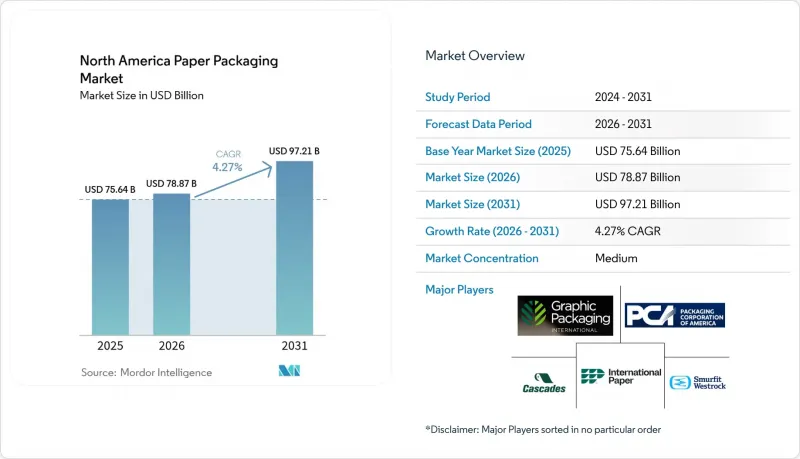
據 Mordor Intelligence 稱,2025 年北美紙包裝市場價值為 756.4 億美元,預計到 2031 年將達到 972.1 億美元,而 2026 年為 788.7 億美元,預測期(2026-2031 年)的複合年成長率為 4.27%。
本報告按材料類型(牛皮紙、紙板等)、產品類型(軟包裝、硬包裝)、包裝形式(初級包裝、二級包裝等)、最終用途行業(食品、飲料、醫療保健/製藥等)和地區(美國、加拿大、墨西哥)進行細分。市場預測以美元(USD)計價。
北美紙包裝市場趨勢與洞察
電子商務的快速發展正在推動對瓦楞紙箱的需求。
線上零售的爆炸性成長進一步推動了北美紙包裝市場的發展,預計2024年瓦楞紙箱出貨量將成長18%。如今,直接面對消費者的品牌正在尋找尺寸合適、能夠體現品牌形象、保護產品並展現環保責任感的紙箱。國際紙業的電子商務部門在2024年第四季實現了25%的成長,充分證明了這一成長勢頭的強勁。數位印刷機無需冗長的設定時間即可實現高品質印刷,從而能夠以經濟高效的方式製作季節性和網紅行銷主導的包裝設計。靠近終端用戶的履約中心縮短了交貨時間,並將需求集中在都市區,使當地的紙板廠受益。嵌入瓦楞紙板表面的智慧條碼和NFC標籤創建了資料循環,有助於改善庫存計劃並增強售後互動。
一次性塑膠製品相關法規的變化
加州SB 54法案規定,到2032年一次性塑膠包裝的使用量必須減少65%。加拿大的全國性禁令已導致常見的塑膠製品從商店上消失,消費者需求轉向紡織品解決方案。加上美國12個州實施的生產者延伸責任制(EPR)法律,預計到2027年,這些措施將為北美紙包裝市場創造23億美元的額外固定需求。隨著PFAS法規重塑餐飲服務業,擁有阻隔塗層專業知識的加工商正獲得先發優勢。監管的確定性正在加速對永續造紙廠的資本投資,使大型企業相對於仍依賴傳統薄膜複合製程的小規模競爭對手獲得領先優勢。
纖維供應波動與森林砍伐風險
2024年紙漿價格22%的波動是由於不列顛哥倫比亞省的野火以及旨在保護生物多樣性的伐木配額收緊所致。原生紙漿供應的減少迫使造紙公司更依賴再生紙(OCC),但隨著電商瓦楞紙箱在家庭中的使用時間延長,回收量難以跟上供應速度。因此,北美紙包裝市場被迫承受不斷上漲的原料成本,而這些成本最終會轉嫁到成品價格上。認證系統增加了遵循成本,而颶風襲擊美國東南部森林等物流中斷事件迫使加工商實現跨區域採購多元化。庫存緩衝可以緩解衝擊,但在利潤率敏感的環境下,這會佔用大量資金。
細分市場分析
到2025年,瓦楞紙板將佔北美紙包裝市場53.92%的佔有率,鞏固其作為電履約基石的地位。紙板雖然規模較小,但預計成長速度最快,複合年成長率將達到6.07%,這主要得益於高階品牌採用能夠傳達永續性和視覺吸引力的精美紙盒。預計到2031年,紙板產品在北美紙包裝市場的佔有率將顯著成長。諸如Billerud公司的「FibreForm」等阻隔塗層紙板,其透氧滲透性標準如今已可與以往僅在塑膠中才能達到的標準相媲美,使其得以進入生鮮食品和冷藏食品的配銷通路。瓦楞紙板製造商正利用使用再生材料的義務,銷售含有大量廢棄消費包裝的內襯紙,但纖維短缺和再生紙(OCC)價格波動正給利潤率帶來壓力。
輕質微瓦楞紙板、先進的澱粉基黏合劑和人工智慧驅動的瓦楞紙板生產設備,使紙箱製造商能夠在不影響層壓強度的前提下減輕材料重量,從而降低品牌所有者的運輸成本。紙板加工商正在利用紫外線油墨系統和無箔金屬化技術來提升觸感,同時保持包裝的可回收性,從而擴大紙質包裝在北美化妝品和營養補充劑行業的吸引力。大型垂直整合公司以低成本水平獲得紙漿,而獨立紙箱製造商則正在建立採購合作夥伴關係以降低供應風險。
2025年,軟包裝在北美紙包裝市場佔54.05%的佔有率。這主要得益於快速包裝、立式袋和小袋作為多層薄膜的替代品而受到青睞。此細分市場的複合年成長率(CAGR)為4.97%,這主要歸功於加工商將熱封塗層整合到包裝中,使其密封強度與聚乙烯(PE)相當。在商店需要堅固耐用和抗衝擊的場合,硬包裝(例如折疊紙盒和瓦楞紙托盤)仍然至關重要。然而,隨著品牌追求減少材料用量和提高包裝開啟便利性,市場需求正轉向軟包裝。
Mondi的單一材料阻隔紙使零食生產商無需使用鋁和EVOH,從而簡化了回收流程,並提升了其品牌的環保形象。同時,硬質包裝生產商正透過精密模切和嵌套設計進行創新,顯著減少了包裝空隙,並降低了北美紙包裝市場每次運輸對環境的影響。這兩個產品類型都在探索數位化裝飾技術,以實現大規模生產的個人化,但由於庫存風險極低,軟質包裝在季節性SKU中佔據了主導地位。
其他好處:
- Excel格式的市場預測(ME)表
- 3個月的分析師支持
目錄
第1章:引言
- 研究假設和市場定義
- 調查範圍
第2章:調查方法
第3章執行摘要
第4章 市場狀況
- 市場概覽
- 市場促進因素
- 電子商務的快速發展正在推高對瓦楞紙箱的需求。
- 一次性塑膠製品相關法規的轉變
- 品牌在永續包裝方面的舉措
- 數位印刷技術實現了大規模客製化。
- 冷鏈食材自煮包隔熱材料的需求
- 紡織品在計算範圍 3 排放量方面具有優勢。
- 市場限制因素
- 纖維供應波動與森林砍伐風險
- 與輕質軟塑膠產品的競爭
- 再生紙廠的能源價格衝擊
- 貨車短缺正成為貨櫃板材供應的瓶頸。
- 宏觀經濟因素對市場的影響
- 產業價值鏈分析
- 監理情勢
- 技術展望
- 波特五力分析
第5章 市場規模與成長預測
- 材料類型
- 牛皮紙
- 紙板
- 紙板
- 其他材料類型
- 依產品類型
- 軟性紙包裝
- 小袋和袋子
- 包裹和薄膜
- 其他軟性紙包裝
- 硬紙包裝材料
- 折疊式紙箱
- 瓦楞紙箱
- 其他硬紙包裝
- 軟性紙包裝
- 按包裝類型
- 初級包裝
- 二級包裝
- 三級包裝/運輸包裝
- 按最終用途行業分類
- 食物
- 飲料
- 醫療和藥品
- 個人護理化妝品
- 工業和電子設備
- 其他終端用戶產業
- 國家
- 美國
- 加拿大
- 墨西哥
第6章 競爭情勢
- 市場集中度
- 策略趨勢
- 市佔率分析
- 公司簡介
- International Paper Company
- Smurfit WestRock
- Packaging Corporation of America
- Graphic Packaging Holding Company
- Cascades Inc.
- Georgia-Pacific LLC
- Sonoco Products Company
- Amcor plc
- Mondi plc
- Clearwater Paper Corporation
- Sealed Air Corporation
- ProAmpac Holdings Inc.
- Pratt Industries Inc.
- Huhtamaki Oyj
- Pactiv Evergreen Inc.
- Reynolds Group Holdings Ltd.
- Kruger Packaging LP
- Stora Enso Oyj
第7章 市場機會與未來展望
According to Mordor Intelligence, the North America paper packaging market size was valued at USD 75.64 billion in 2025 and estimated to grow from USD 78.87 billion in 2026 to reach USD 97.21 billion by 2031, at a CAGR of 4.27% during the forecast period (2026-2031).
This report is Segmented by Material Type (Kraft Paper, Paperboard, and More), Product Type (Flexible Paper Packaging, Rigid Paper Packaging), Packaging Format (Primary Packaging, Secondary Packaging, and More), End-Use Industry (Food, Beverage, Healthcare and Pharmaceuticals, and More), and Geography (United States, Canada, Mexico). The Market Forecasts are Provided in Terms of Value (USD).
North America Paper Packaging Market Trends and Insights
E-commerce Boom Elevates Corrugated-Box Demand
Explosive online retail growth lifted corrugated-box shipments by 18% in 2024 and continues to reinforce the North America paper packaging market. Direct-to-consumer brands now demand right-sized, brandable boxes that protect products while showcasing eco-credentials. International Paper's e-commerce segment expanded 25% in Q4 2024, underscoring the scale of this tailwind. Digital presses allow high-graphics runs without lengthy setups, enabling seasonal or influencer-driven artwork at low cost. Fulfillment centers nearer to end consumers shorten delivery windows and concentrate demand around urban hubs, advantaging local sheet plants. Smart codes and NFC tags embedded on corrugated surfaces create data loops that improve inventory planning and enhance post-purchase engagement.
Regulatory Shift from Single-Use Plastics
California's SB 54 requires a 65% reduction in single-use plastic packaging by 2032, and Canada's nationwide ban has already removed common plastic items from shelves, redirecting volumes toward fiber solutions. Together with Extended Producer Responsibility laws in 12 U.S. states, these measures generate an additional USD 2.3 billion in captive demand by 2027 for the North America paper packaging market. Converters with barrier-coating expertise gain first-mover advantage as PFAS restrictions reshape food service formats. Governance certainty accelerates capital commitments in sustainable mills, giving scale players a head start over smaller rivals still reliant on legacy film laminates.
Fiber-Supply Volatility and Deforestation Risk
Pulp price swings of 22% in 2024 stemmed from wildfires in British Columbia and tighter harvest quotas aimed at biodiversity protection. Virgin supply dips force mills to rely more on OCC, yet recycling streams struggle to keep pace as e-commerce boxes circulate longer inside households. The North America paper packaging market thus absorbs higher raw-material costs that ripple into finished goods pricing. Certification schemes raise compliance expenses, while logistics disruptions-such as hurricanes hitting Southeast U.S. forests-compel converters to diversify sources across regions. Inventory buffers mitigate shocks but tie up capital in a margin-sensitive environment.
Other drivers and restraints analyzed in the detailed report include:
- Brand Push for Sustainable Packaging
- Digital Printing Enables Mass-Customization
- Lightweight Flexible-Plastic Competition
For complete list of drivers and restraints, kindly check the Table Of Contents.
Segment Analysis
Corrugated board controlled 53.92% of the North America paper packaging market in 2025, cementing its position as the backbone of e-commerce fulfillment. Paperboard, while smaller, is slated for the fastest expansion at 6.07% CAGR as premium brands adopt high-graphics cartons that communicate sustainability and shelf appeal. The North America paper packaging market size attributable to paperboard formats is projected to widen noticeably through 2031. Barrier-coated grades, such as Billerud's FibreForm, now match oxygen-transmission benchmarks formerly exclusive to plastic, opening entree into fresh produce and chilled-food channels. Corrugated manufacturers leverage recycled-content mandates to market high-post-consumer liners, but fiber scarcity and OCC volatility put pressure on margins.
Lightweight micro-fluting, advanced starch adhesives, and AI-guided corrugators help box plants trim material weight without sacrificing stacking strength, translating into freight savings for brand owners. Paperboard converters bank on UV-ink systems and foil-free metallization to elevate tactile cues while keeping packs recyclable, broadening the North America paper packaging market appeal among cosmetics and nutraceuticals. Vertically integrated majors secure pulp at cost while independent carton makers strike sourcing alliances to buffer supply risk.
Flexible paper formats retained a 54.05% share of the North America paper packaging market in 2025, buoyed by quick-service wraps, stand-up pouches, and sachets that replace multilayer films. The segment's 4.97% CAGR underscores its relevance as converters integrate heat-sealable coatings that rival PE's seal strength. Rigid options like folding cartons and corrugated trays remain indispensable where on-shelf rigidity and impact resistance rule. However, demand bleeds toward flexibles when brands pursue material reduction and unboxing convenience.
Monomaterial barrier papers from Mondi let snack makers forego aluminum or EVOH, simplifying recycling streams and enhancing brand sustainability scores. Conversely, rigid producers innovate through precision die-cutting and nested designs that slash void ratios, reducing the North America paper packaging market size footprint per shipped item. Both product classes explore digital embellishment to unlock personalization at volume, but flexibles capture the lion's share of seasonal SKUs thanks to minimal inventory risk.
Complete Report Scope:
- By Material Type
- Kraft Paper
- Paperboard
- Corrugated Board
- Other Material Types
- By Product Type
- Flexible Paper Packaging
- Pouches and Bags
- Wraps and Films
- Other Flexible Paper Packaging
- Rigid Paper Packaging
- Folding Carton
- Corrugated Boxes
- Other Rigid Paper Packaging
- Flexible Paper Packaging
- By Packaging Format
- Primary Packaging
- Secondary Packaging
- Tertiary / Transit Packaging
- By End-Use Industry
- Food
- Beverage
- Healthcare and Pharmaceuticals
- Personal Care and Cosmetics
- Industrial and Electronic
- Other End-Use Industries
- By Country
- United States
- Canada
- Mexico
List of Companies Covered in this Report:
- International Paper Company
- Smurfit WestRock
- Packaging Corporation of America
- Graphic Packaging Holding Company
- Cascades Inc.
- Georgia-Pacific LLC
- Sonoco Products Company
- Amcor plc
- Mondi plc
- Clearwater Paper Corporation
- Sealed Air Corporation
- ProAmpac Holdings Inc.
- Pratt Industries Inc.
- Huhtamaki Oyj
- Pactiv Evergreen Inc.
- Reynolds Group Holdings Ltd.
- Kruger Packaging L.P.
- Stora Enso Oyj
Additional Benefits:
- The market estimate (ME) sheet in Excel format
- 3 months of analyst support
TABLE OF CONTENTS
1 INTRODUCTION
- 1.1 Study Assumptions and Market Definition
- 1.2 Scope of the Study
2 RESEARCH METHODOLOGY
3 EXECUTIVE SUMMARY
4 MARKET LANDSCAPE
- 4.1 Market Overview
- 4.2 Market Drivers
- 4.2.1 E-commerce boom elevates corrugated-box demand
- 4.2.2 Regulatory shift from single-use plastics
- 4.2.3 Brand push for sustainable packaging
- 4.2.4 Digital printing enables mass-customisation
- 4.2.5 Cold-chain meal-kit insulation needs
- 4.2.6 Scope-3 emissions accounting favours fibre
- 4.3 Market Restraints
- 4.3.1 Fibre-supply volatility and deforestation risk
- 4.3.2 Lightweight flexible-plastic competition
- 4.3.3 Energy-price shocks for recycled mills
- 4.3.4 Railcar shortages bottleneck containerboard
- 4.4 Impact of Macroeconomic Factors on the Market
- 4.5 Industry Value Chain Analysis
- 4.6 Regulatory Landscape
- 4.7 Technological Outlook
- 4.8 Porter's Five Forces Analysis
- 4.8.1 Bargaining Power of Suppliers
- 4.8.2 Bargaining Power of Buyers
- 4.8.3 Threat of New Entrants
- 4.8.4 Threat of Substitutes
- 4.8.5 Intensity of Competitive Rivalry
5 MARKET SIZE AND GROWTH FORECASTS (VALUE)
- 5.1 By Material Type
- 5.1.1 Kraft Paper
- 5.1.2 Paperboard
- 5.1.3 Corrugated Board
- 5.1.4 Other Material Types
- 5.2 By Product Type
- 5.2.1 Flexible Paper Packaging
- 5.2.1.1 Pouches and Bags
- 5.2.1.2 Wraps and Films
- 5.2.1.3 Other Flexible Paper Packaging
- 5.2.2 Rigid Paper Packaging
- 5.2.2.1 Folding Carton
- 5.2.2.2 Corrugated Boxes
- 5.2.2.3 Other Rigid Paper Packaging
- 5.2.1 Flexible Paper Packaging
- 5.3 By Packaging Format
- 5.3.1 Primary Packaging
- 5.3.2 Secondary Packaging
- 5.3.3 Tertiary / Transit Packaging
- 5.4 By End-Use Industry
- 5.4.1 Food
- 5.4.2 Beverage
- 5.4.3 Healthcare and Pharmaceuticals
- 5.4.4 Personal Care and Cosmetics
- 5.4.5 Industrial and Electronic
- 5.4.6 Other End-Use Industries
- 5.5 By Country
- 5.5.1 United States
- 5.5.2 Canada
- 5.5.3 Mexico
6 COMPETITIVE LANDSCAPE
- 6.1 Market Concentration
- 6.2 Strategic Moves
- 6.3 Market Share Analysis
- 6.4 Company Profiles {(includes Global-level Overview, Market-level Overview, Core Segments, Financials as available, Strategic Information, Market Rank/Share for key companies, Products and Services, and Recent Developments)}
- 6.4.1 International Paper Company
- 6.4.2 Smurfit WestRock
- 6.4.3 Packaging Corporation of America
- 6.4.4 Graphic Packaging Holding Company
- 6.4.5 Cascades Inc.
- 6.4.6 Georgia-Pacific LLC
- 6.4.7 Sonoco Products Company
- 6.4.8 Amcor plc
- 6.4.9 Mondi plc
- 6.4.10 Clearwater Paper Corporation
- 6.4.11 Sealed Air Corporation
- 6.4.12 ProAmpac Holdings Inc.
- 6.4.13 Pratt Industries Inc.
- 6.4.14 Huhtamaki Oyj
- 6.4.15 Pactiv Evergreen Inc.
- 6.4.16 Reynolds Group Holdings Ltd.
- 6.4.17 Kruger Packaging L.P.
- 6.4.18 Stora Enso Oyj
7 MARKET OPPORTUNITIES AND FUTURE OUTLOOK
- 7.1 White-space and Unmet-need Assessment

 2026-2034年全球再生紙包裝中礦物油烴(MOSH/MOAH)轉型市場規模、佔有率、趨勢和成長分析報告
 越南紙包裝市場:市場佔有率分析、產業趨勢與統計及成長預測(2026-2031年)
 原生紙包裝市場預測至2034年-全球產品類型、紙張類型、材料類型、包裝形式、應用、最終用戶和地區分析紙包裝:市場佔有率分析、產業趨勢與統計、成長預測(2026-2031)中東和非洲紙包裝市場:市場佔有率分析、行業趨勢和統計數據以及成長預測(2026-2031 年)印尼紙包裝:市場佔有率分析、產業趨勢與統計及成長預測(2026-2031)義大利紙包裝市場:市場佔有率分析、產業趨勢與統計、成長預測(2026-2031)亞太地區紙包裝市場:市佔率分析、產業趨勢與統計及成長預測(2026-2031年)印度紙包裝市場:市場佔有率分析、產業趨勢與統計及成長預測(2026-2031)日本紙包裝市場:市場佔有率分析、產業趨勢與統計及成長預測(2026-2031)