

 |
市場調查報告書
商品編碼
2120580
日本紙包裝市場:市場佔有率分析、產業趨勢與統計及成長預測(2026-2031)Japan Paper Packaging - Market Share Analysis, Industry Trends & Statistics, Growth Forecasts (2026 - 2031) |
||||||

※ 本網頁內容可能與最新版本有所差異。詳細情況請與我們聯繫。
根據 Mordor Intelligence 預測,日本紙包裝市場規模預計將在 2026 年達到 267.6 億美元,到 2031 年達到 351.6 億美元,複合年成長率為 5.61%。
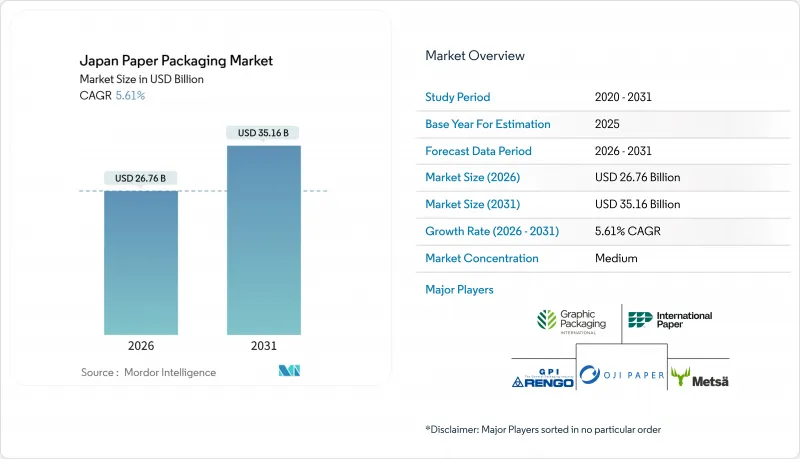
本報告按材料類型(原生紙板、再生紙板、牛皮紙等)、產品類型(軟包裝、硬包裝)、包裝形式(初級包裝、二級包裝、三級/運輸包裝)和最終用途行業(飲料、醫療保健/製藥等)進行細分。市場預測以價值(美元)表示。
日本紙包裝市場趨勢與洞察
塑膠包裝相關法規
日本的《塑膠資源回收法》於2022年4月生效。該法規定地方政府必須擴大塑膠製品的分類回收範圍,並要求銷售一次性塑膠製品的企業減少塑膠使用或採取替代措施。環境省的設計指南建議採用能夠最大限度減少或消除塑膠使用的設計方案,獲得認證的產品在政府採購中享有優先權。雖然這些法規增加了塑膠基材的合規成本,但大多數紙質替代品不受食品接觸塑膠正面表列的限制。因此,超級市場和便利商店擴大使用阻隔塗層紙製作刀叉餐具、吸管和托盤,這正在加速日本紙包裝市場的需求成長。
擴大電子商務履約包裝
預計2024會計年度,日本B2C(企業對消費者)電子商務市場規模將達到26.1兆日圓(約1,800億美元),使其電子商務佔比達到9.8%。日本郵政控股公司計劃在2025會計年度將其「Yu-Packet」服務的銷售額提升至1,600億日圓(約11億美元),並投資2,700億日元(約19億美元)用於小型包裹分類機和機械臂。這些自動化分類中心需要瓦楞紙板和紙質信封,即使在高速分類機中也能保持運輸順暢,不易被壓扁。書籍、電子產品和家居用品等高滲透率品類的需求量最大,這推動了日本紙質包裝處理量的成長,也要求加工商確保包裝尺寸精準、表面易於條碼讀取以及覆膜強度。
原料成本上漲
根據王子控股的預測,長纖維牛皮紙漿的價格預計將從2025會計年度的每噸570美元上漲至2027會計年度的每噸610美元,這將給服務於價格敏感型瓦楞紙板客戶的加工商帶來壓力。儘管日本的再生紙回收率超過80%,但由於報紙發行量下降,高品質再生紙的供應量正在減少,而對東南亞國協的出口也是價格波動的一個因素。因此,造紙商正在轉向生產特種紙,雖然特種紙的成本增加可以透過專有塗層來彌補,但這給他們在日本紙包裝市場通用紙領域的利潤率帶來了壓力。
細分市場分析
預計到2025年,再生紙板將佔日本紙包裝市場佔有率的45.34%,這主要得益於地方政府回收效率的提高以及品牌方積極推廣使用廢舊材料。特種紙市場預計到2031年將以每年6.32%的速度成長。與複合薄膜相比,諸如凸版印刷的「GL-XP」等阻隔塗層基材可減少高達35%的二氧化碳排放,擴大了特種紙在日本紙包裝市場的佔有率。日本製紙株式會社的「SHIELDPLUS」無需使用鋁或聚對苯二甲酸乙二醇酯(PVDC)即可實現與薄膜相當的氧氣和水蒸氣阻隔性能,可用於保護乾貨和糖果甜點。由於污染風險,可追溯纖維更受青睞,原生紙板在醫藥和化妝品產業仍佔有一定地位。模塑紙漿雖然市場規模較小,但正吸引尋求發泡聚苯乙烯替代品的電子產品製造商的注意。供應限制和較長的成型週期限制了其對日本紙包裝市場成長的貢獻。
此外,日本紙包裝市場的擴張也與原生紙板密切相關,因為厚生勞動省的正面表列收緊了對食品接觸材料可用物質的監管。高純度牛皮紙專為快餐店包裝而設計,具有無氟耐油性,特州東海製紙株式會社的目標是每年生產7000至8000噸此類紙張。雖然再生紙儲量豐富,但由於污染隱患,其直接接觸食品的用途受到限制,市場需求正轉向二次包裝和運輸包裝。
到2025年,硬紙製品將佔銷售額的55.32%,成為領先的產品類別。然而,隨著單一材質的包裝袋和包裝紙被塑膠複合材料取代,預計到2031年,軟包裝紙製品將以每年6.64%的速度成長。 DNP的高阻隔紙張氧氣透過率低於0.5 cc m⁻² days⁻¹ atm,再製漿率高達85%,使咖啡和糖果甜點品牌能夠滿足歐洲的回收要求。折疊紙盒正受益於優質化,壓紋和多面板結構提高了單位附加價值。瓦楞紙箱雖然面臨商品化趨勢,但大尺寸和加固型瓦楞紙箱在工業出口中仍能獲得溢價。在日本紙包裝市場,軟包裝的市場規模正在不斷擴大。這是由於熱封塗佈技術的進步,提高了加工性能和密封速度,紙張正在乾粉混合物、香辛料和零食的包裝袋市場站穩腳跟,而薄膜曾經是這個市場的主導力量。
加工廠的自動化正在加速軟包裝的普及。伺服驅動的製袋機和雷射劃線生產線已將設定時間從90分鐘縮短至20分鐘以內,從而實現了季節性口味和限量版SKU的經濟型小批量生產。隨著粉狀飲料、香辛料和糖果甜點等季度促銷產品的增多,加工商正在積極投資改造套件,以適應更薄的牛皮紙,並在每分鐘300包的速度下保持密封強度,這進一步拉大了紙袋與傳統塑膠複合材料產品之間的性能差距。
其他好處:
- Excel格式的市場預測(ME)表
- 3個月的分析師支持
目錄
第1章:引言
- 研究假設和市場定義
- 調查範圍
第2章:調查方法
第3章執行摘要
第4章 市場狀況
- 市場概覽
- 產業規模、價值鏈分析
- 市場促進因素
- 食品和飲料行業的需求增加
- 塑膠包裝相關法規
- 擴大電子商務履約包裝
- 為簡便食品增值
- 智慧紙包裝(NFC、QR)的出現
- 各公司為確保淨零採購所做的努力
- 市場限制因素
- 原料成本上漲
- 印刷紙製造商減少產能分配
- 老化的物流基礎設施造成了瓶頸。
- 造紙廠技術純熟勞工短缺
- 宏觀經濟因素對市場的影響
- 監理情勢
- 技術展望
- 波特五力分析
第5章 市場規模與成長預測
- 材料類型
- 原生紙板
- 再生紙板
- 牛皮紙
- 特種紙
- 模塑紙漿
- 依產品類型
- 軟性紙包裝
- 小袋和袋子
- 包裹和薄膜
- 其他軟性紙包裝
- 硬紙包裝
- 折疊盒
- 瓦楞紙箱
- 其他硬紙包裝
- 軟性紙包裝
- 按包裝類型
- 初級包裝
- 二級包裝
- 三級包裝/運輸包裝
- 按最終用途行業分類
- 食物
- 飲料
- 醫療和藥品
- 個人護理化妝品
- 產業
- 其他終端用戶產業
第6章 競爭情勢
- 市場集中度
- 策略趨勢
- 市佔率分析
- 公司簡介
- Oji Paper Co., Ltd.
(王子控股株式會社)
- Rengo Co., Ltd.
- 日本製紙株式會社
- 大王製紙株式會社
- Graphic Packaging International LLC
- 國際紙業公司
- 帕克公司
- 凸版印刷株式會社(包裝業務)
- 東洋制菓集團控股有限公司
- 北越株式會社
- 斯莫菲特·韋斯特羅克
- 丸紅造紙株式會社
- 精工包裝株式會社
- 三菱造紙有限公司
- 共同印刷株式會社
- 日本麻台株式會社
- 中越紙業株式會社
- Tomoku Co., Ltd.
- 昭和包裝株式會社
- 梅薩集團
第7章 市場機會與未來展望
According to Mordor Intelligence, Japan paper packaging market size stands at USD 26.76 billion in 2026 and is projected to reach USD 35.16 billion by 2031, reflecting a 5.61% CAGR.
This report is Segmented by Material Type (Virgin Paperboard, Recycled Paperboard, Kraft Paper, and More), Product Type (Flexible Paper Packaging, and Rigid Paper Packaging), Packaging Format (Primary Packaging, Secondary Packaging, and Tertiary/Transit Packaging), and End-Use Industry (Beverage, Healthcare and Pharmaceuticals, and More). The Market Forecasts are Provided in Terms of Value (USD).
Japan Paper Packaging Market Trends and Insights
Regulations On Plastic-Based Packaging
Japan's Plastic Resource Circulation Act became effective in April 2022. It obliges municipalities to expand the collection of sorted plastic items and requires businesses that distribute single-use plastic products to adopt reduction or substitution measures. The Ministry of the Environment's design guidelines favor low-plastic or plastic-free designs, and certified products receive preferential treatment in government procurement. These rules raise compliance costs for plastic substrates while exempting most paper equivalents from the positive-list restrictions that govern food-contact plastics. As a result, supermarkets and convenience stores are switching to barrier-coated paper for cutlery, straws, and trays, thereby accelerating demand in the Japanese paper packaging market.
Expansion Of E-Commerce Fulfillment Packaging
Business-to-consumer e-commerce reached JPY 26.1 trillion (USD 180 billion) in fiscal 2024 and lifted Japan's e-commerce ratio to 9.8%. Japan Post Holdings plans Yu-Packet revenue of JPY 160 billion (USD 1.1 billion) by fiscal 2025 and is investing JPY 270 billion (USD 1.9 billion) in small-parcel sorters and robotic arms. These automated hubs require corrugated and paper mailers that feed smoothly through high-speed sorters without crushing. Demand is strongest in high-penetration categories, such as books, electronics, and household goods, which bolsters volumes in the Japanese paper packaging market and pressures converters to deliver precise dimensions, barcode-friendly surfaces, and stack strength.
Rising Raw Material Costs
Oji Holdings forecasts long-fiber kraft pulp to rise from USD 570 per tonne in fiscal 2025 to USD 610 by fiscal 2027, squeezing converters that serve price-sensitive corrugated customers. Although Japan's recovered-paper rate exceeds 80%, the pool of high-grade waste is diminishing due to falling newspaper volumes, and exports to ASEAN buyers add volatility. Converters therefore shift toward specialty papers where unique coatings justify pass-through pricing, but commodity segments of the Japan paper packaging market face margin compression.
Other drivers and restraints analyzed in the detailed report include:
- Increasing Demand From The Food And Beverage Sector
- Premiumization Of Convenience Foods
- Shrinking Graphic Paper Mills' Capacity Allocation
For complete list of drivers and restraints, kindly check the Table Of Contents.
Segment Analysis
Recycled paperboard held 45.34% of the Japan paper packaging market share in 2025, underpinned by municipal collection efficiencies and brand commitments to post-consumer content. Specialty grades are forecast to rise by 6.32% annually through 2031. The Japan paper packaging market size for specialty paper is growing as barrier-coated substrates, such as Toppan's GL-X-P, reduce carbon emissions by up to 35% compared to laminated films. Nippon Paper's SHIELDPLUS achieves near-film oxygen and water vapor resistance without the use of aluminum or PVDC, thereby protecting dry foods and confectionery. Virgin board retains a foothold in pharma and cosmetics, where contamination risk drives preference for traceable fiber. Molded pulp, while small, appeals to electronics firms looking to replace expanded polystyrene. Supply limitations and long mold-cycle times temper its contribution to Japan paper packaging market growth.
Japan paper packaging market size expansion is also linked to virgin board as the Ministry of Health, Labour and Welfare's positive list tightens allowable substances in food-contact materials. High-purity kraft papers are engineered with fluorine-free grease resistance for quick-service restaurant wraps, and Tokushu Tokai Paper targets a capacity of 7,000-8,000 tonnes per year for these grades. Recycled streams, although voluminous, face contamination challenges that restrict direct contact uses, channeling demand into secondary and transit packaging.
Rigid formats led revenue with 55.32% share in 2025, yet flexible paper is projected to grow 6.64% per year to 2031 as mono-material pouches and wraps displace plastic laminates. DNP's high-barrier sheet maintains oxygen transmission below 0.5 cc m-2 day-1 atm and achieves 85% repulpability, enabling coffee and confectionery brands to meet Europe's recyclability mandates. Folding cartons benefit from premiumization, with embossing and multi-panel structures lifting value per unit. Corrugated boxes face commoditization, but large-format and reinforced versions earn premiums for industrial exports. The Japan paper packaging market size for flexible formats gains as heat-sealable coatings improve machineability and sealing speed, positioning paper for dry-mix, spice, and snack pouches that were once film-centric.
Automation within converting halls accelerates the uptake of flexible formats because servo-driven pouch makers and laser scoring lines reduce changeover time from 90 minutes to under 20, enabling economical short runs for seasonal flavors and limited-edition SKUs. As more beverage powders, spices, and confectionery products rotate through quarterly promotions, converters justify capital expenditures on retrofit kits that handle thinner kraft and maintain seal integrity at 300 packs per minute, thereby widening the performance gap between paper-based pouches and legacy plastic laminates.
Complete Report Scope:
- By Material Type
- Virgin Paperboard
- Recycled Paperboard
- Kraft Paper
- Specialty Paper
- Molded Pulp
- By Product Type
- Flexible Paper Packaging
- Pouches and Bags
- Wraps and Films
- Other Flexible Paper Packaging
- Rigid Paper Packaging
- Folding Carton
- Corrugated Boxes
- Other Rigid Paper Packaging
- Flexible Paper Packaging
- By Packaging Format
- Primary Packaging
- Secondary Packaging
- Tertiary / Transit Packaging
- By End-Use Industry
- Food
- Beverage
- Healthcare and Pharmaceuticals
- Personal Care and Cosmetics
- Industrial
- Other End-Use Industries
List of Companies Covered in this Report:
- Oji Paper Co., Ltd. (Oji Holdings Corporation)
- Rengo Co., Ltd.
- Nippon Paper Industries Co., Ltd.
- Daio Paper Corporation
- Graphic Packaging International, LLC
- International Paper Company
- THE PACK CORPORATION
- Toppan Inc. (Packaging)
- Toyo Seikan Group Holdings, Ltd.
- Hokuetsu Corporation
- Smurfit WestRock
- Marubeni Paper Recycle Co., Ltd.
- Seiko Packaging Co., Ltd.
- Mitsubishi Paper Mills Limited
- Kyodo Printing Co., Ltd.
- Nihon Matai Co., Ltd.
- Chuetsu Pulp & Paper Co., Ltd.
- Tomoku Co., Ltd.
- Showa Packaging Co., Ltd.
- Metsa Group
Additional Benefits:
- The market estimate (ME) sheet in Excel format
- 3 months of analyst support
TABLE OF CONTENTS
1 INTRODUCTION
- 1.1 Study Assumptions and Market Definition
- 1.2 Scope of the Study
2 RESEARCH METHODOLOGY
3 EXECUTIVE SUMMARY
4 MARKET LANDSCAPE
- 4.1 Market Overview
- 4.2 Industry Value, Supply-Chain Analysis
- 4.3 Market Drivers
- 4.3.1 Increasing Demand from the Food and Beverage Sector
- 4.3.2 Regulations on Plastic-based Packaging
- 4.3.3 Expansion of E-commerce Fulfillment Packaging
- 4.3.4 Premiumization of Convenience Foods
- 4.3.5 Emergence of Smart Paper Packaging (NFC, QR)
- 4.3.6 Corporate Net-Zero Procurement Commitments
- 4.4 Market Restraints
- 4.4.1 Rising Raw Material Costs
- 4.4.2 Shrinking Graphic Paper Mills' Capacity Allocation
- 4.4.3 Aged Logistics Infrastructure Creating Bottlenecks
- 4.4.4 Skilled Labor Shortages in Paper Converting Plants
- 4.5 Impact of Macroeconomic Factors on the Market
- 4.6 Regulatory Landscape
- 4.7 Technological Outlook
- 4.8 Porter's Five Forces Analysis
- 4.8.1 Bargaining Power of Suppliers
- 4.8.2 Bargaining Power of Buyers
- 4.8.3 Threat of New Entrants
- 4.8.4 Threat of Substitute Products
- 4.8.5 Intensity of Competitive Rivalry
5 MARKET SIZE AND GROWTH FORECASTS (VALUE)
- 5.1 By Material Type
- 5.1.1 Virgin Paperboard
- 5.1.2 Recycled Paperboard
- 5.1.3 Kraft Paper
- 5.1.4 Specialty Paper
- 5.1.5 Molded Pulp
- 5.2 By Product Type
- 5.2.1 Flexible Paper Packaging
- 5.2.1.1 Pouches and Bags
- 5.2.1.2 Wraps and Films
- 5.2.1.3 Other Flexible Paper Packaging
- 5.2.2 Rigid Paper Packaging
- 5.2.2.1 Folding Carton
- 5.2.2.2 Corrugated Boxes
- 5.2.2.3 Other Rigid Paper Packaging
- 5.2.1 Flexible Paper Packaging
- 5.3 By Packaging Format
- 5.3.1 Primary Packaging
- 5.3.2 Secondary Packaging
- 5.3.3 Tertiary / Transit Packaging
- 5.4 By End-Use Industry
- 5.4.1 Food
- 5.4.2 Beverage
- 5.4.3 Healthcare and Pharmaceuticals
- 5.4.4 Personal Care and Cosmetics
- 5.4.5 Industrial
- 5.4.6 Other End-Use Industries
6 COMPETITIVE LANDSCAPE
- 6.1 Market Concentration
- 6.2 Strategic Moves
- 6.3 Market Share Analysis
- 6.4 Company Profiles (includes Global Level Overview, Market Level Overview, Core Segments, Financials as available, Strategic Information, Market Rank, Products and Services, and Recent Developments)
- 6.4.1 Oji Paper Co., Ltd.
(Oji Holdings Corporation)
- 6.4.2 Rengo Co., Ltd.
- 6.4.3 Nippon Paper Industries Co., Ltd.
- 6.4.4 Daio Paper Corporation
- 6.4.5 Graphic Packaging International, LLC
- 6.4.6 International Paper Company
- 6.4.7 THE PACK CORPORATION
- 6.4.8 Toppan Inc. (Packaging)
- 6.4.9 Toyo Seikan Group Holdings, Ltd.
- 6.4.10 Hokuetsu Corporation
- 6.4.11 Smurfit WestRock
- 6.4.12 Marubeni Paper Recycle Co., Ltd.
- 6.4.13 Seiko Packaging Co., Ltd.
- 6.4.14 Mitsubishi Paper Mills Limited
- 6.4.15 Kyodo Printing Co., Ltd.
- 6.4.16 Nihon Matai Co., Ltd.
- 6.4.17 Chuetsu Pulp & Paper Co., Ltd.
- 6.4.18 Tomoku Co., Ltd.
- 6.4.19 Showa Packaging Co., Ltd.
- 6.4.20 Metsa Group
7 MARKET OPPORTUNITIES AND FUTURE OUTLOOK
- 7.1 White-Space and Unmet-Need Assessment

 2026-2034年全球再生紙包裝中礦物油烴(MOSH/MOAH)轉型市場規模、佔有率、趨勢和成長分析報告
 越南紙包裝市場:市場佔有率分析、產業趨勢與統計及成長預測(2026-2031年)
 原生紙包裝市場預測至2034年-全球產品類型、紙張類型、材料類型、包裝形式、應用、最終用戶和地區分析紙包裝:市場佔有率分析、產業趨勢與統計、成長預測(2026-2031)中東和非洲紙包裝市場:市場佔有率分析、行業趨勢和統計數據以及成長預測(2026-2031 年)印尼紙包裝:市場佔有率分析、產業趨勢與統計及成長預測(2026-2031)義大利紙包裝市場:市場佔有率分析、產業趨勢與統計、成長預測(2026-2031)亞太地區紙包裝市場:市佔率分析、產業趨勢與統計及成長預測(2026-2031年)印度紙包裝市場:市場佔有率分析、產業趨勢與統計及成長預測(2026-2031)北美紙包裝:市佔率分析、產業趨勢與統計及成長預測(2026-2031 年)