


 |
市場調查報告書
商品編碼
2121941
非洲汽車產業:市場佔有率分析、產業趨勢與統計、成長預測(2026-2031)Africa Automotive - Market Share Analysis, Industry Trends & Statistics, Growth Forecasts (2026 - 2031) |
||||||

※ 本網頁內容可能與最新版本有所差異。詳細情況請與我們聯繫。
據 Mordor Intelligence 稱,非洲汽車市場規模預計在 2026 年達到 226.3 億美元,高於 2025 年的 215.5 億美元,預計到 2031 年將達到 289.3 億美元。
預計從 2026 年到 2031 年,年複合成長率將達到 5.03%。
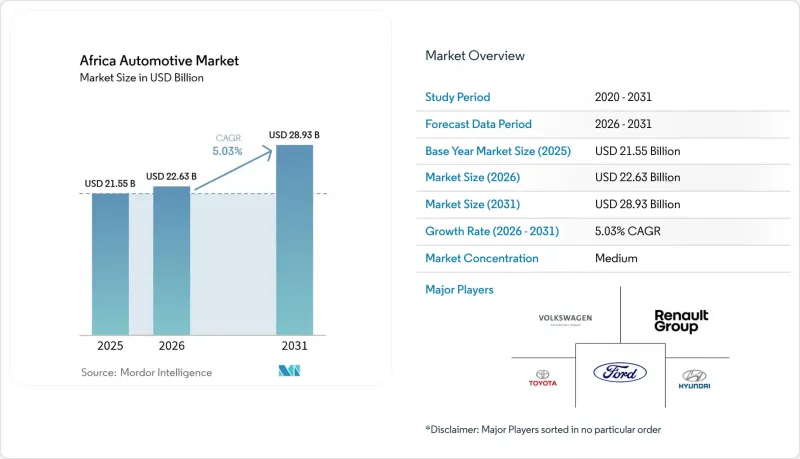
本報告按車輛類型(乘用車、商用車)、駕駛方式(內燃機等)、應用領域(個人、車隊、租賃等)、銷售管道(整車進口、散裝/散裝組裝等)以及國家/地區(南非、摩洛哥、阿爾及利亞、埃及、奈及利亞、加納、肯亞等)進行細分。市場預測以價值(美元)和銷售(輛)為單位呈現。
非洲汽車市場趨勢與洞察
非洲都市區中產階級乘用車擁有量增加
汽車擁有率與收入成長密切相關,預計到2060年,非洲的中產階級人口將達到11億人。這將逐步提升人們對個人交通工具的需求。高需求買家傾向於選擇入門級和緊湊型乘用車,這些車型兼顧了經濟性和都市區實用性。長期汽車貸款和訂閱模式等金融創新正在提高汽車的可及性,進一步強化了非洲汽車市場需求的上升週期。
非洲大陸自由貿易區關稅下調將刺激區域內貿易。
在非洲大陸自由貿易區(AfCFTA)框架下,90%商品的關稅正在逐步取消,除開發中國家外,大多數國家需要在五年內完成過渡。汽車製造商預計將透過在區域內採購零件來降低投入成本,而明確的原產地規則將鼓勵本地價值創造,有助於享受優惠關稅。目前已有46個國家提交了優惠方案,貿易自由化正在切實降低全散件組裝(CKD)的成本。非關稅壁壘的改革(包括海關業務數位化、標準統一和邊境程序簡化)預計將創造200億美元的額外貿易額,將直接惠及非洲汽車市場。
港口長期擁擠及內陸物流瓶頸
德班港和拉各斯港是全球車輛吞吐量最低的港口之一,導致車輛停留時間和倉儲費用增加。鐵路利用率低和車輛老化導致運輸方式轉向公路,但高昂的通行費和安全風險推高了車輛到港成本。對於CKD(全散裝組裝)組裝,零件到貨不穩定阻礙了準時生產;對於出口商而言,錯過出貨日期損害了供應商的可靠性。除非持續的走廊開發和一站式海關系統能夠帶來實際的效率提升,否則物流摩擦將繼續阻礙非洲汽車市場的發展。
細分市場分析
到2025年,乘用車仍將主導非洲汽車市場,佔66.58%的市場佔有率,這反映了個人出行在大都會地區的吸引力。然而,隨著非洲大陸自由貿易協定(AfCFTA)下貨運量的成長以及電子商務的快速發展,人們的關注點正轉向廂式貨車、皮卡和重型卡車,預計這些車型的複合年成長率將達到8.36%,超過乘用車。輕型商用車受益於「最後一公里」貨運量的成長,而中型和重型卡車則透過統一的海關通道運輸區域間貿易的貨物。礦業公司正在快速試行使用電池電動自動卸貨卡車,預示著未來重型車隊將迎來新的替換機會。
商用車組裝正利用政府的獎勵政策,免除底盤和動力總成進口關稅,從而縮小與二手市場二手進口車的價格差距。全球生產基地的轉移也是一個關鍵因素。預計摩洛哥到2024年將生產61.4萬輛汽車,超過南非。這正在打造一個強大的供應商基礎,可以轉化為貨運平台。隨著物流營運商營運的規範化,車輛更換週期正在縮短,從而保持了非洲汽車市場這一細分領域的成長勢頭。
即使到了2025年,內燃機汽車預計仍將保持90.68%的市場佔有率,這主要得益於價格合理的燃油和完善的維護網路。然而,在新的中國車型上市以及盧安達、肯亞和埃及等國的財政激勵措施的推動下,電池式電動車預計將實現10.12%的複合年成長率。從日本進口的二手混合動力汽車讓消費者能夠提前體驗電動動力系統,而電動車零件的關稅豁免則降低了商用車隊的整體擁有成本。
儘管由於電網穩定性的限制,主要都會大都會圈以外地區的普及速度較為緩慢,但在銅帶地區的礦山,離網太陽能和電池儲能系統正在被應用,為電動皮卡提供動力。未來,隨著電池成本的下降和充電基礎設施的擴展,電動皮卡的普及速度可能會更快,並有可能逐步削弱內燃機在非洲汽車市場的主導地位。
其他好處:
- Excel格式的市場預測(ME)表
- 3個月的分析師支持
目錄
第1章:引言
- 研究假設和市場定義
- 調查範圍
第2章:調查方法
第3章執行摘要
第4章 市場狀況
- 市場概覽
- 市場促進因素
- 非洲都市區中產階級汽車擁有量的成長
- 加大對中國OEM CKD/SKD(如比亞迪、奇瑞)的投資
- 非洲大陸自由貿易區關稅削減刺激了區域內貿易。
- 叫車和最後一公里配送車輛的擴張
- 海外韓國人透過金融科技匯款平台購買汽車的數量激增。
- 銅礦帶國家礦業領域的電動車試驗計畫正在推動對電動皮卡的需求。
- 市場限制因素
- 港口長期擁擠及內陸物流瓶頸
- 由於外匯波動,CKD試劑盒的進口成本增加了。
- 二手車大量湧入灰色市場,抑制了對新車的需求。
- 西非ISO認證汽車用鋼材軋延產能短缺
- 價值供應鏈分析
- 監理情勢
- 技術趨勢(內燃機汽車、油電混合車、純電動車、燃料電池電動車)
- 波特五力模型
第5章 市場規模、成長預測與交易量(2019-2030 年)
- 車輛類型
- 搭乘用車
- 掀背車
- 轎車
- SUV/跨界車
- MPV 和其他
- 商用車輛
- 輕型商用車(LCV)
- 中型和大型卡車
- 巴士和長途汽車
- 搭乘用車
- 透過驅動系統
- 內燃機(ICE)
- 混合動力電動車(HEV)
- 電池式電動車(BEV)
- 替代燃料(CNG/LPG、靈活燃料汽車、燃料電池電動車)
- 按最終用途
- 個人所有
- 車隊和租賃
- 叫車/出行服務供應商
- 政府和機構
- 按銷售管道
- 整車進口(CBU)
- 半成品車輛/全散件組裝(SKD/CKD)
- 進口二手車
- 國家
- 南非
- 摩洛哥
- 阿爾及利亞
- 埃及
- 奈及利亞
- 迦納
- 肯亞
- 其他非洲國家
第6章 競爭情勢
- 市場集中度
- 策略趨勢
- 市佔率分析
- 公司簡介
- Toyota Motor Corporation
- Volkswagen AG
- Groupe Renault
- Hyundai Motor Company
- Ford Motor Company
- Daimler Truck AG
- Volvo Group
- Isuzu Motors Ltd
- Tata Motors Ltd
- Ashok Leyland
- Innoson Vehicle Manufacturing Co.
- Stellantis(Peugeot, Opel)
- Nissan Motor Co.
- Kia Corporation
- BAIC Group
- Chery Automobile Co.
- BYD Auto
- Geely Automobile Holdings
- Great Wall Motor(Haval)
- Guangzhou Automobile Group(GAC)
第7章 市場機會與未來展望
According to Mordor Intelligence, Africa automotive market size in 2026 is estimated at USD 22.63 billion, growing from 2025 value of USD 21.55 billion with 2031 projections showing USD 28.93 billion, growing at 5.03% CAGR over 2026-2031.
This report is Segmented by Vehicle Type (Passenger Cars and Commercial Vehicles), Propulsion Type (ICE, and More), End-Use (Personal, Fleet and Leasing, and More), Sales Channel (CBU, SKD/CKD, and More), and by Country (South Africa, Morocco, Algeria, Egypt, Nigeria, Ghana, Kenya, Rest of Africa). Market Forecasts are Provided in Terms of Value (USD) and Volume in (Units).
Africa Automotive Market Trends and Insights
Rising Passenger-Car Ownership Among Africa's Urban Middle Class
Vehicle ownership closely tracks income gains, and Africa's middle class is projected to swell toward 1.1 billion people by 2060. Driving incremental demand for personal mobility. Aspirational buyers gravitate toward entry-level and compact passenger models that balance affordability with urban practicality. Financing innovations such as longer-tenor auto loans and subscription models improve affordability, reinforcing the upward demand cycle across the Africa automotive market.
AfCFTA Tariff Reductions Stimulating Intra-Regional Trade
The African Continental Free Trade Area (AfCFTA) will phase out tariffs on 90% of goods, with most non-LDC nations obliged to comply within five years. Automotive OEMs stand to gain lower input costs on regional parts procurement, while clear rules of origin encourage local value addition that unlocks preferential tariffs. Forty-six countries have already submitted concession schedules, translating trade liberalization into tangible cost relief for CKD operations. Non-tariff barrier reforms-customs digitization, harmonized standards, and streamlined border procedures-are expected to release an extra USD 20 billion in trade value, a direct boon for the Africa automotive market.
Chronic Port Congestion and Inland Logistics Bottlenecks
Durban and Lagos ports rank among the world's slowest for automotive throughput, inflating dwell times and demurrage fees. Rail under-utilization and aging rolling stock shift traffic onto roads where high tolls and security risks push up landed vehicle costs. For CKD assemblers, inconsistent component arrivals disrupt just-in-time production, while exporters face missed sailing windows that erode supplier credibility. Unless ongoing corridor upgrades and single-window customs systems deliver measurable efficiencies, logistics friction will remain a drag on the Africa automotive market.
Other drivers and restraints analyzed in the detailed report include:
- Expansion of Ride-Hailing and Last-Mile Delivery Fleets
- Mining-Sector EV Pilot Programs in Copper-Belt Nations
- Currency Volatility Elevating Import Costs for CKD Kits
For complete list of drivers and restraints, kindly check the Table Of Contents.
Segment Analysis
Passenger cars dominated the Africa automotive market with a 66.58% share in 2025, reflecting personal mobility's appeal across sprawling urban centers. However, freight growth under AfCFTA and booming e-commerce pivot attention toward vans, pickups, and heavy trucks that are forecast to outpace passenger models at an 8.36% CAGR. Light commercial vehicles benefit from last-mile parcel volumes, whereas medium and heavy trucks haul regionally traded goods under harmonized customs corridors. Mining firms quickly test battery-electric dumpers, signaling future substitution opportunities in heavy-duty fleets.
Commercial vehicle assemblers leverage government incentives that waive import duties on chassis and drivetrains, narrowing price gaps versus grey-market used imports. Global production reallocations also matter: Morocco surpassed South Africa in 2024 with 614,000 units, creating a deep supplier base that can pivot toward freight platforms. As logistics players formalize operations, fleet replenishment cycles shorten, sustaining momentum in this segment of the Africa automotive market.
Internal combustion engines retained a 90.68% share in 2025, underscoring affordable fuel and servicing ecosystems. Nevertheless, battery electrics are projected to post a 10.12% CAGR on the back of Chinese OEM launches and fiscal incentives in Rwanda, Kenya, and Egypt. Pre-owned hybrid imports from Japan seed early consumer familiarity with electrified drivetrains, while duty exemptions on EV components lower the total cost of ownership for commercial fleets.
Grid stability constraints slow rollout outside major metros, yet copper-belt mining sites deploy off-grid solar-battery hubs to power electric pickups. Over time, diminishing battery costs and wider charging corridors could unlock a steeper adoption curve, gradually trimming ICE dominance in the African automotive market.
Complete Report Scope:
- By Vehicle Type
- Passenger Cars
- Hatchback
- Sedan
- SUV & Crossover
- MPV & Others
- Commercial Vehicles
- Light Commercial Vehicles (LCV)
- Medium & Heavy Trucks
- Buses & Coaches
- Passenger Cars
- By Propulsion Type
- Internal Combustion Engine (ICE)
- Hybrid Electric Vehicle (HEV)
- Battery Electric Vehicle (BEV)
- Alternative Fuels (CNG/LPG, Flex-fuel, FCEV)
- By End-Use
- Personal Ownership
- Fleet & Leasing
- Ride-hailing / Mobility Service Providers
- Government & Institutional
- By Sales Channel
- Completely Built-up Imports (CBU)
- Semi/Completely Knocked-down Assembly (SKD/CKD)
- Used-Vehicle Imports
- By Country
- South Africa
- Morocco
- Algeria
- Egypt
- Nigeria
- Ghana
- Kenya
- Rest of Africa
List of Companies Covered in this Report:
- Toyota Motor Corporation
- Volkswagen AG
- Groupe Renault
- Hyundai Motor Company
- Ford Motor Company
- Daimler Truck AG
- Volvo Group
- Isuzu Motors Ltd
- Tata Motors Ltd
- Ashok Leyland
- Innoson Vehicle Manufacturing Co.
- Stellantis (Peugeot, Opel)
- Nissan Motor Co.
- Kia Corporation
- BAIC Group
- Chery Automobile Co.
- BYD Auto
- Geely Automobile Holdings
- Great Wall Motor (Haval)
- Guangzhou Automobile Group (GAC)
Additional Benefits:
- The market estimate (ME) sheet in Excel format
- 3 months of analyst support
TABLE OF CONTENTS
1 Introduction
- 1.1 Study Assumptions and Market Definition
- 1.2 Scope of the Study
2 Research Methodology
3 Executive Summary
4 Market Landscape
- 4.1 Market Overview
- 4.2 Market Drivers
- 4.2.1 Rising Passenger-Car Ownership Among Africa's Urban Middle Class
- 4.2.2 Growing Chinese OEM CKD/SKD Investments (E.G., BYD, Chery)
- 4.2.3 AFCFTA Tariff Reductions Stimulating Intra-Regional Trade
- 4.2.4 Expansion of Ride-Hailing and Last-Mile Delivery Fleets
- 4.2.5 Surge in Diaspora-Financed Vehicle Purchases Via Fintech Remittance Platforms
- 4.2.6 Mining-Sector EV Pilot Programs in Copper-Belt Nations Driving Demand for Electric Pickups
- 4.3 Market Restraints
- 4.3.1 Chronic Port Congestion and Inland Logistics Bottlenecks
- 4.3.2 Currency Volatility Elevating Import Costs for CKD Kits
- 4.3.3 Grey-Market Used-Vehicle Influx Curbing New-Car Demand
- 4.3.4 Shortage Of ISO-Certified Auto-Grade Steel Rolling Capacity in West Africa
- 4.4 Value / Supply-Chain Analysis
- 4.5 Regulatory Landscape
- 4.6 Technological Outlook (ICE, Hybrid, BEV, FCEV)
- 4.7 Porter's Five Forces
- 4.7.1 Bargaining Power of Suppliers
- 4.7.2 Bargaining Power of Buyers/Consumers
- 4.7.3 Threat of New Entrants
- 4.7.4 Threat of Substitute Products
- 4.7.5 Intensity of Competitive Rivalry
5 Market Size and Growth Forecasts (Value in (USD) and Volume in (Units), 2019-2030)
- 5.1 By Vehicle Type
- 5.1.1 Passenger Cars
- 5.1.1.1 Hatchback
- 5.1.1.2 Sedan
- 5.1.1.3 SUV & Crossover
- 5.1.1.4 MPV & Others
- 5.1.2 Commercial Vehicles
- 5.1.2.1 Light Commercial Vehicles (LCV)
- 5.1.2.2 Medium & Heavy Trucks
- 5.1.2.3 Buses & Coaches
- 5.1.1 Passenger Cars
- 5.2 By Propulsion Type
- 5.2.1 Internal Combustion Engine (ICE)
- 5.2.2 Hybrid Electric Vehicle (HEV)
- 5.2.3 Battery Electric Vehicle (BEV)
- 5.2.4 Alternative Fuels (CNG/LPG, Flex-fuel, FCEV)
- 5.3 By End-Use
- 5.3.1 Personal Ownership
- 5.3.2 Fleet & Leasing
- 5.3.3 Ride-hailing / Mobility Service Providers
- 5.3.4 Government & Institutional
- 5.4 By Sales Channel
- 5.4.1 Completely Built-up Imports (CBU)
- 5.4.2 Semi/Completely Knocked-down Assembly (SKD/CKD)
- 5.4.3 Used-Vehicle Imports
- 5.5 By Country
- 5.5.1 South Africa
- 5.5.2 Morocco
- 5.5.3 Algeria
- 5.5.4 Egypt
- 5.5.5 Nigeria
- 5.5.6 Ghana
- 5.5.7 Kenya
- 5.5.8 Rest of Africa
6 Competitive Landscape
- 6.1 Market Concentration
- 6.2 Strategic Moves
- 6.3 Market Share Analysis
- 6.4 Company Profiles (includes Global level Overview, Market level overview, Core Segments, Financials as available, Strategic Information, Market Rank/Share for key companies, Products & Services, and Recent Developments)
- 6.4.1 Toyota Motor Corporation
- 6.4.2 Volkswagen AG
- 6.4.3 Groupe Renault
- 6.4.4 Hyundai Motor Company
- 6.4.5 Ford Motor Company
- 6.4.6 Daimler Truck AG
- 6.4.7 Volvo Group
- 6.4.8 Isuzu Motors Ltd
- 6.4.9 Tata Motors Ltd
- 6.4.10 Ashok Leyland
- 6.4.11 Innoson Vehicle Manufacturing Co.
- 6.4.12 Stellantis (Peugeot, Opel)
- 6.4.13 Nissan Motor Co.
- 6.4.14 Kia Corporation
- 6.4.15 BAIC Group
- 6.4.16 Chery Automobile Co.
- 6.4.17 BYD Auto
- 6.4.18 Geely Automobile Holdings
- 6.4.19 Great Wall Motor (Haval)
- 6.4.20 Guangzhou Automobile Group (GAC)
7 Market Opportunities & Future Outlook

 拉丁美洲汽車產業的成長機會,2026年推動全球汽車市場發展的關鍵趨勢:2026 年展望
 撒哈拉以南非洲汽車產業:市場佔有率分析、產業趨勢與統計及成長預測(2026-2031 年)南美汽車市場:市場佔有率分析、產業趨勢與統計、成長預測(2026-2031)北美汽車市場:市場佔有率分析、產業趨勢與統計、成長預測(2026-2031)
 2034年汽車銷售市場預測-按車輛類型、驅動方式、所有權類型、價格範圍、自動化程度、銷售管道和地區分類的全球分析
 2026年全球汽車市場報告中國汽車市場展望(2026年)2026年東協汽車產業的成長機遇
 越南汽車塗料市場(2025)