


 |
市場調查報告書
商品編碼
2121935
歐洲金屬罐:市場佔有率分析、產業趨勢與統計、成長預測(2026-2031)Europe Metal Cans - Market Share Analysis, Industry Trends & Statistics, Growth Forecasts (2026 - 2031) |
||||||

※ 本網頁內容可能與最新版本有所差異。詳細情況請與我們聯繫。
據 Mordor Intelligence 稱,2025 年歐洲金屬罐市場價值為 194.9 億美元,預計到 2031 年將達到 222.1 億美元,而 2026 年為 199.2 億美元,預測期(2026-2031 年)複合年成長率為 2.20%。
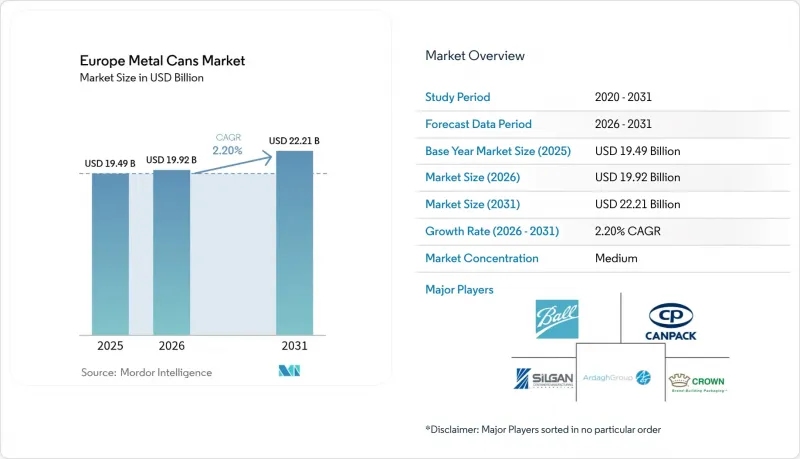
本報告按材料類型(鋁、鋼)、最終用戶(食品、飲料、氣霧罐及其他)、結構(兩片式、三片式)、容量(250毫升以下、251-500毫升、500毫升以上)和國家/地區(英國、德國、法國、西班牙、義大利、波蘭及其他歐洲國家)進行細分。市場預測以美元計價。
歐洲金屬罐市場趨勢與洞察
金屬包裝回收率高
歐洲鋁製飲料罐76%的回收率和鋼製包裝80.5%的回收率凸顯了循環經濟的無可比擬的優勢,引起了注重碳排放的消費者和監管機構的共鳴。歐洲鋁包裝集團(European Aluminium Packaging Group)提出的罐底100%採用再生材料的計劃,可將生命週期排放量減少高達95%,為尋求快速減碳的品牌所有者提供了強力的價值提案。完善的押金返還制度確保了德國98%的罐子得到回收,從而提供了穩定的原料供應,緩解了原生金屬價格的波動。歐盟委員會的目標是到2030年實現23.2%的循環材料使用率,金屬的無限循環利用使歐洲金屬罐市場在與塑膠和玻璃替代品的競爭中佔據優勢。與回收率掛鉤的生產者責任費進一步提升了金屬在成本結構中的優勢,從而提振了長期需求。
歐盟循環經濟法規將在2025年至2030年間收緊
《包裝及包裝廢棄物法規》於2025年2月生效,規定到2030年所有包裝都必須從設計之初就具備可回收性,並設定了再生材料含量的最低標準。目前已符合法規要求的單層金屬罐將獲得明顯的競爭優勢,而多層塑膠罐則將面臨重新設計的成本和技術挑戰。 2040年將人均包裝廢棄物減少15%的額外要求將鼓勵採用更薄的鋁罐和薄壁鋼罐,從而透過遵守法規實現材料效率和成本降低。生產者延伸責任制下的收費將統一,消除目前分散的收費系統,並促進跨境物流。標準化的標籤法規將鼓勵採用更簡潔、方便消費者分類的罐體設計,進一步提高回收率,並鞏固歐洲金屬罐市場。
繫繩蓋的鋁瓶的普及
歐盟的《一次性塑膠指令》規定飲料瓶蓋必須固定在瓶身上,而可重複密封的鋁瓶自然符合這項要求,同時又有別於傳統的易拉罐,因此越來越受歡迎。可口可樂和百事可樂已經成功贏得了消費者對這種新便利的認可,預計到2025年中期,歐洲將部署超過4億個可重複密封的瓶蓋。由於瓶裝飲料可以隨時隨地重新密封,它們正在銷售量一些小眾市場(例如風味水和能量飲料)中易拉罐的市場佔有率。纖細瓶身帶來的高階質感也是推動這一趨勢的重要因素,這對為傳統罐裝設計的生產線構成了挑戰。雖然兩種包裝都具有很高的可回收性,但瓶裝飲料的功能優勢預計將在短期內減緩歐洲金屬易拉罐市場的成長。
細分市場分析
鋁材憑藉其輕質、耐腐蝕的特性以及在飲料行業的強大地位,預計到2025年將佔銷售額的68.31%。同時,隨著氫合金永續性評級的提高,預計到2031年,鋼鐵的複合年成長率將達到3.11%。波爾公司在2024年向歐洲、中東和非洲地區(EMEA)出貨了360億個鋁製容器,佔該地區罐體出貨量的39%,凸顯了鋁材的規模經濟效益。從以金額為準來看,鋁材仍是歐洲金屬罐市場的基石,但隨著預計新增1.72億噸綠色產能,鋼鐵的復甦正在為尋求減少範圍3排放的食品和氣霧劑填充商提供更多材料選擇。
隨著鋼鐵與電弧爐的結合日益緊密,能源消耗可降低30%,並透過磁選實現完全循環經濟,使「60天從罐到罐」的口號成為現實。同時,歐洲鋁包裝集團致力於使用100%回收材料,進一步強化了金屬無限可回收的訊息。材料間的競爭正在推動創新。鋁罐壁更薄、開口更易開啟,而鋼罐則具有更好的成型性和與漆料的高相容性。如此一來,兩種材料憑藉其獨特的性能,滿足了不同終端用戶的需求,從而共同建構了歐洲金屬罐市場。
受精釀啤酒、能量飲料和即飲雞尾酒等產品的強勁成長勢頭推動,飲料品類預計到2025年將佔總銷售額的46.85%,而食品罐頭預計到2031年將保持3.68%的複合年成長率。歐洲每年消費約930億份罐裝飲料,這構成了高速兩片式鋁罐灌裝生產線的需求基礎,而這些生產線正是歐洲金屬罐市場規模的基石。在Crown Holdings,合約條款的改善和高附加價值產品的推出,使得其飲料罐業務在2024年的收入成長了62%,從而確保了永續的盈利。
食品罐頭長期以來因其過時的設計而備受詬病,如今正透過諸如光面印刷、易撕箔塗層和再封功能等創新技術進行革新,從而提升其在商店上的吸引力。五年的保存期限有助於減少食物廢棄物,而歐盟的目標是到2030年將食物浪費減少50%,因此減少食物浪費至關重要。寵物食品產業也轉向使用金屬罐,以更好地保留營養成分並拓展高階無穀物產品線,從而促進銷售成長。這些因素共同推動了先前表現欠佳的細分市場的成長,並平衡了歐洲金屬罐市場——該市場歷來嚴重偏向飲料產業。
其他好處:
- Excel格式的市場預測(ME)表
- 3個月的分析師支持
目錄
第1章:引言
- 研究假設和市場定義
- 調查範圍
第2章:調查方法
第3章執行摘要
第4章 市場狀況
- 市場概覽
- 市場促進因素
- 金屬包裝回收率高
- 2025年至2030年間,歐盟將加強對循環經濟的監管。
- 精釀啤酒釀造商和即飲雞尾酒生產商正在從PET瓶轉向易拉罐。
- 鋼鐵製造商引入低碳合金可減少範圍 3 的排放。
- 歐盟27國存款返還計畫(DRS)的協調統一
- 電子商務中家用護理產品填充用氣霧罐的成長
- 市場限制因素
- 繫繩蓋的鋁瓶的普及
- 歐洲軋延鋁溢價的波動
- 品牌所有者為減少材料厚度(減量化)所做的努力正在影響製造工廠的運轉率。
- 逐步淘汰環氧樹脂罐內襯中的 PFAS 的相關成本。
- 產業供應鏈分析
- 監理情勢
- 技術展望
- 波特五力分析
第5章 市場規模與成長預測
- 依材料類型
- 鋁
- 鋼
- 最終用戶
- 食物
- 蔬菜
- 水果
- 寵物食品
- 湯和調味料
- 其他
- 飲料
- 酒精
- 非酒精性
- 氣霧罐
- 其他
- 食物
- 按結構
- 2 件
- 3 件
- 按產能
- 250毫升或以下
- 251~500 ml
- 超過500毫升
- 國家
- 英國
- 德國
- 法國
- 西班牙
- 義大利
- 波蘭
- 其他歐洲國家
第6章 競爭情勢
- 市場集中度
- 策略趨勢
- 市佔率分析
- 公司簡介
- Ball Corporation
- Ardagh Group SA
- Crown Holdings, Inc.
- Silgan Holdings Inc.
- CANPACK Spolka Akcyjna
- Massilly Holding SAS
- Tgp Tecnocap Group Partecipazioni Srl
- Tata Steel Europe Limited
- ASA Group
- Eurobox Metal Packaging
- Nampak Plastics Europe Limited
- Impress Metal Packaging Ltd.
- Trivium Packaging BV
- Envases Europe A/S
- Colep Packaging Portugal, SA
- Greif, Inc.
- Pano Verschluss GmbH
- DS Containers, Inc.
- CPMC Ltd
- Toyo Seikan Co., Ltd.
第7章 市場機會與未來展望
According to Mordor Intelligence, the Europe metal cans market size was valued at USD 19.49 billion in 2025 and estimated to grow from USD 19.92 billion in 2026 to reach USD 22.21 billion by 2031, at a CAGR of 2.20% during the forecast period (2026-2031).
This report is Segmented by Material Type (Aluminum, and Steel), End-User (Food, Beverage, Aerosol Cans, and Other End-Users), Structure (2-Piece, and 3-Piece), Capacity (Up To 250 Ml, 251-500 Ml, and More Than 500 Ml), and Country (United Kingdom, Germany, France, Spain, Italy, Poland, and Rest of Europe). The Market Forecasts are Provided in Terms of Value (USD).
Europe Metal Cans Market Trends and Insights
High recyclability rates of metal packaging
Europe's 76% aluminum beverage-can recycling rate and 80.5% steel-pack recovery underscore an unmatched circular advantage that resonates with carbon-conscious consumers and regulators alike. The European Aluminium Packaging Group's push to reach 100% recycled content for can ends lowers life-cycle emissions by up to 95%, creating a strong value proposition for brand owners seeking quick carbon wins. Robust deposit-return systems, Germany already collects 98% of cans-ensuring a steady feedstock that cushions against primary-metal price swings. As the European Commission targets a 23.2% circular-material-use rate by 2030, metal's infinite recycling loop positions the Europe metal cans market ahead of plastic and glass substitutes. Producer-responsibility fees linked to recycled content further tilt cost structures in favor of metal, reinforcing long-term demand.
EU circular-economy regulations tightening in 2025-30
The Packaging and Packaging Waste Regulation that took effect in February 2025 obliges every package to be "recyclable by design" by 2030 and imposes minimum recycled-content thresholds. Metal cans, being mono-material and already compliant, gain a clear competitive edge while multi-layer plastics face redesign costs and technical hurdles. Additional requirements to trim packaging waste 15% per capita by 2040 incentivize down-gauged aluminum and thin-wall steel formats, aligning material efficiency with compliance savings. Extended-producer-responsibility levies will be harmonized, ending today's patchwork of fees and easing cross-border logistics. Standardized labeling rules favor the simple composition of cans, which consumers can sort easily, further enhancing collection rates and reinforcing the European metal cans market.
Proliferation of tethered-cap aluminum bottles
The EU Single-Use Plastics Directive now requires beverage closures to stay attached, accelerating the appeal of re-sealable aluminum bottles that natively comply while distinguishing themselves from conventional cans. Coca-Cola and PepsiCo rolled out more than 400 million tethered closures in Europe by mid-2025, habituating consumers to the new ergonomics. Because bottles enable on-the-go re-closure, they siphon volume from single-serve cans in flavored water and energy-drink niches. Premium perception of slender bottle silhouettes reinforces this drift, challenging can fill-lines geared for traditional formats. Although both packages recycle well, the functional edge of bottles subtracts incremental growth from the Europe metal cans market in the near term.
Other drivers and restraints analyzed in the detailed report include:
- PET-to-can conversion by craft brewers and RTD cocktails
- Steelmakers' low-carbon alloy launches cut Scope 3 emissions
- Volatility in European rolled-aluminum premiums
For complete list of drivers and restraints, kindly check the Table Of Contents.
Segment Analysis
Aluminum captured 68.31% of 2025 revenue thanks to its low weight, corrosion resistance, and entrenched beverage relationships, while steel is on course for a 3.11% CAGR to 2031 as hydrogen-based alloys broaden its sustainability credentials. Ball Corporation shipped 36 billion aluminum containers in EMEA during 2024, equal to a 39% share of regional can volumes, underscoring aluminum's scale economics. In value terms, aluminum remains the linchpin of the European metal cans market; yet steel's renaissance, powered by anticipated 172 Mt of green capacity, is widening the material choice for food and aerosol fillers looking to cut Scope 3 emissions.
Steel's closer coupling with electric-arc furnaces slashes energy use by 30% and permits full circularity through magnetic separation, making "can-to-can in 60 days" a realistic slogan. Simultaneously, the European Aluminium Packaging Group targets 100% recycled content, reinforcing metal's infinite recyclability narrative. Cross-material competition spurs innovation: aluminum down-gauging and easy-open ends meet steel's improved formability and lacquer compatibility. Both substrates thus consolidate the European metal cans market by offering distinct performance ladders that satisfy diverging end-use needs.
Beverages retained 46.85% of 2025 turnover, propelled by craft brewing, energy drinks, and RTD cocktail momentum, whereas food cans are expected to chart a 3.68% CAGR through 2031. Europe drinks close to 93 billion canned servings yearly, anchoring filler demand for high-speed 2-piece aluminum lines that underpin the Europe metal cans market size. Crown Holdings saw beverage-can income climb 62% in 2024 on stronger contract terms and value-added ends, confirming sustained profitability.
Food cans, long criticized for dated aesthetics, are rejuvenating via glossy lithography, peel-foil membranes, and reseal features that lift shelf appeal. Their five-year shelf life combats food waste, a priority as the EU targets a 50% cut by 2030. Pet food's switch to metal for nutrient retention and premium grain-free lines magnifies volume. Combined, these forces inject growth into a traditionally slower segment, balancing portfolio reliance that historically skewed toward beverages within the European metal cans market.
Complete Report Scope:
- By Material Type
- Aluminum
- Steel
- By End-User
- Food
- Vegetables
- Fruits
- Pet Food
- Soups and Condiments
- Other Food Cans
- Beverage
- Alcoholic
- Non-Alcoholic
- Aerosol Cans
- Other End-users
- Food
- By Structure
- 2-piece
- 3-piece
- By Capacity
- Up to 250 ml
- 251 - 500 ml
- More than 500 ml
- By Country
- United Kingdom
- Germany
- France
- Spain
- Italy
- Poland
- Rest of Europe
List of Companies Covered in this Report:
- Ball Corporation
- Ardagh Group S.A.
- Crown Holdings, Inc.
- Silgan Holdings Inc.
- CANPACK Spolka Akcyjna
- Massilly Holding SAS
- Tgp Tecnocap Group Partecipazioni S.r.l.
- Tata Steel Europe Limited
- ASA Group
- Eurobox Metal Packaging
- Nampak Plastics Europe Limited
- Impress Metal Packaging Ltd.
- Trivium Packaging B.V.
- Envases Europe A/S
- Colep Packaging Portugal, S.A.
- Greif, Inc.
- Pano Verschluss GmbH
- DS Containers, Inc.
- CPMC Ltd
- Toyo Seikan Co., Ltd.
Additional Benefits:
- The market estimate (ME) sheet in Excel format
- 3 months of analyst support
TABLE OF CONTENTS
1 INTRODUCTION
- 1.1 Study Assumptions and Market Definition
- 1.2 Scope of the Study
2 RESEARCH METHODOLOGY
3 EXECUTIVE SUMMARY
4 MARKET LANDSCAPE
- 4.1 Market Overview
- 4.2 Market Drivers
- 4.2.1 High recyclability rates of metal packaging
- 4.2.2 EU circular-economy regulations tightening in 2025-30
- 4.2.3 PET-to-can conversion by craft brewers and RTD cocktails
- 4.2.4 Steelmakers' low-carbon alloy launches cut Scope-3 emissions
- 4.2.5 Deposit-Return-Scheme (DRS) harmonisation across EU-27
- 4.2.6 Aerosol can growth in e-commerce home-care refills
- 4.3 Market Restraints
- 4.3.1 Proliferation of tethered-cap aluminium bottles
- 4.3.2 Volatility in European rolled-aluminium premiums
- 4.3.3 Brand owner down-gauging hitting mill utilisation rates
- 4.3.4 PFAS phase-out costs for epoxy can-linings
- 4.4 Industry Supply-Chain Analysis
- 4.5 Regulatory Landscape
- 4.6 Technological Outlook
- 4.7 Porter's Five Forces Analysis
- 4.7.1 Bargaining Power of Suppliers
- 4.7.2 Bargaining Power of Buyers
- 4.7.3 Threat of New Entrants
- 4.7.4 Threat of Substitutes
- 4.7.5 Intensity of Competitive Rivalry
5 MARKET SIZE AND GROWTH FORECASTS (VALUE)
- 5.1 By Material Type
- 5.1.1 Aluminum
- 5.1.2 Steel
- 5.2 By End-User
- 5.2.1 Food
- 5.2.1.1 Vegetables
- 5.2.1.2 Fruits
- 5.2.1.3 Pet Food
- 5.2.1.4 Soups and Condiments
- 5.2.1.5 Other Food Cans
- 5.2.2 Beverage
- 5.2.2.1 Alcoholic
- 5.2.2.2 Non-Alcoholic
- 5.2.3 Aerosol Cans
- 5.2.4 Other End-users
- 5.2.1 Food
- 5.3 By Structure
- 5.3.1 2-piece
- 5.3.2 3-piece
- 5.4 By Capacity
- 5.4.1 Up to 250 ml
- 5.4.2 251 - 500 ml
- 5.4.3 More than 500 ml
- 5.5 By Country
- 5.5.1 United Kingdom
- 5.5.2 Germany
- 5.5.3 France
- 5.5.4 Spain
- 5.5.5 Italy
- 5.5.6 Poland
- 5.5.7 Rest of Europe
6 COMPETITIVE LANDSCAPE
- 6.1 Market Concentration
- 6.2 Strategic Moves
- 6.3 Market Share Analysis
- 6.4 Company Profiles (includes Global level Overview, Market level overview, Core Segments, Financials as available, Strategic Information, Market Rank/Share for key companies, Products and Services, and Recent Developments)
- 6.4.1 Ball Corporation
- 6.4.2 Ardagh Group S.A.
- 6.4.3 Crown Holdings, Inc.
- 6.4.4 Silgan Holdings Inc.
- 6.4.5 CANPACK Spolka Akcyjna
- 6.4.6 Massilly Holding SAS
- 6.4.7 Tgp Tecnocap Group Partecipazioni S.r.l.
- 6.4.8 Tata Steel Europe Limited
- 6.4.9 ASA Group
- 6.4.10 Eurobox Metal Packaging
- 6.4.11 Nampak Plastics Europe Limited
- 6.4.12 Impress Metal Packaging Ltd.
- 6.4.13 Trivium Packaging B.V.
- 6.4.14 Envases Europe A/S
- 6.4.15 Colep Packaging Portugal, S.A.
- 6.4.16 Greif, Inc.
- 6.4.17 Pano Verschluss GmbH
- 6.4.18 DS Containers, Inc.
- 6.4.19 CPMC Ltd
- 6.4.20 Toyo Seikan Co., Ltd.
7 MARKET OPPORTUNITIES AND FUTURE OUTLOOK
- 7.1 White-space and Unmet-Need Assessment

 印度金屬罐市場:市場佔有率分析、產業趨勢與統計、成長預測(2026-2031)中東和非洲金屬罐市場:市場佔有率分析、行業趨勢和統計數據以及成長預測(2026-2031 年)金屬罐:市場佔有率分析、產業趨勢與統計、成長預測(2026-2031)
 金屬罐和玻璃瓶市場:2026-2032年全球市場預測(按包裝類型、材料、蓋子類型、容量、最終用戶和分銷管道分類)
 金屬罐市場報告:趨勢、預測及競爭分析(至2035年)
 金屬罐市場規模、佔有率、趨勢和預測:按材料類型、製造方法、罐型和地區分類,2026-2034年金屬罐、桶、鼓和桶市場:依材質、產品類型、容量、終端用戶產業和銷售管道分類-2026-2032年全球市場預測北美金屬罐市場:市場佔有率分析、產業趨勢與統計及成長預測(2026-2031 年)
 金屬罐市場規模、佔有率和趨勢分析報告:按材料、產品、蓋類型、應用、地區和細分市場預測(2026-2033 年)美國金屬罐:市場佔有率分析、產業趨勢與統計、成長預測(2026-2031)