


 |
市場調查報告書
商品編碼
2113616
中東和非洲金屬罐市場:市場佔有率分析、行業趨勢和統計數據以及成長預測(2026-2031 年)Middle-East And Africa Metal Cans - Market Share Analysis, Industry Trends & Statistics, Growth Forecasts (2026 - 2031) |
||||||

※ 本網頁內容可能與最新版本有所差異。詳細情況請與我們聯繫。
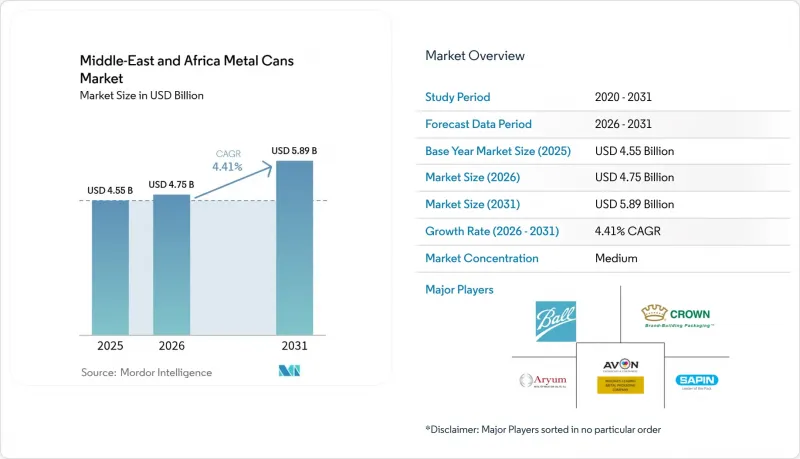
預計中東和非洲的金屬罐市場將從 2025 年的 45.5 億美元成長到 2026 年的 47.5 億美元,然後從 2026 年到 2031 年以 4.41% 的複合年成長率成長,到 2031 年達到 58.9 億美元。
本報告依材質(鋁、鋼)、罐體結構(兩片式、三片式、一體式氣霧罐)、容量/尺寸(250毫升以下、250-500毫升、500-1000毫升、1000毫升以上)、生產流程終端(D&I等)、用戶(食品及食品細分、市場預測以美元(USD)計價。
中東及非洲金屬罐市場趨勢及洞察
可支配收入的增加和現代零售業的擴張正在推動對預包裝食品和飲料的需求。
埃及、沙烏地阿拉伯和南非中產階級的壯大推動了包裝必需品和高檔即飲飲料消費的成長。預計到2024年,埃及加工食品出口額將達61億美元,年增21%。這反映出市場對堅固耐用的金屬包裝的需求日益成長,以保護產品在高運量運輸路線上的安全。大賣場連鎖店正在擴張,提供具有防篡改功能和更長保存期限的優質罐裝產品。埃及「2030願景」的目標是70%的工業產品實現國內生產,這將為國內罐頭生產商創造新的需求。一些新產品,例如用沙烏地阿拉伯椰棗調味的可樂,就是品牌利用鋁箔印刷包裝在琳瑯滿目的貨架上脫穎而出的典型例子。石油收入的成長也促進了人們對金屬包裝的接受度提高,儘管金屬包裝價格略高,但其保存期限更長。
政府的永續性政策正在促進鋁罐回收。
在肯亞,將於2025年5月生效的《生產者延伸責任法》(EPR法案)將要求易拉罐製造商註冊並資助廢棄回收計畫。在南非,類似的法規自2021年起生效,要求生產者責任組織資助全國性的回收網路。阿拉伯聯合大公國(阿拉伯聯合大公國)正透過阿拉伯聯合大公國環球鋁業公司(Emirates Global Aluminium)正在建造的價值9,000萬美元的回收綜合設施來支持這一政策趨勢,該設施預計將於2025年5月完成50%。這些法規將增加再生金屬原料的供應,使鋁在循環利用方面比多層塑膠更具優勢,同時為加工商提供符合品牌ESG目標的低碳鋁坯。
價格敏感型食品產業的柔軟性塑膠替代品
由於許多農村地區的消費者仍以單價作為購買決策的主要依據,輕巧的包裝袋對於番茄醬和米等主食來說具有優勢。像UFlex這樣的供應商每年在阿拉伯聯合大公國生產4萬噸薄膜,在埃及生產11.4萬噸薄膜,銷售鍍鋁雙向拉伸聚酯薄膜(BOPET)。這種薄膜的阻隔性與罐頭相當,但重量更輕。塞內加爾對加工食品徵收35%的進口關稅,進一步加劇了成本壓力,迫使填充商轉向更便宜的基材。為了遏制市場佔有率的下滑,罐頭製造商正著重強調100%可回收性、不影響食品風味以及在偏遠地區的物流鏈中防止盜竊。
細分市場分析
2025年,鋁在中東和非洲金屬罐市場仍佔據70.76%的佔有率。由於其100%可回收和優異的重量強度比,鋁的表現顯著優於鋼。鋁卓越的循環利用特性符合新的生產者延伸責任制(EPR)計畫和品牌的脫碳目標,促使生產商將資本投資轉向鋁坯鑄造和內部廢料回收。阿拉伯聯合大公國環球鋁業公司(Emirates Global Aluminium)正在建造中的回收中心正是這一轉變的象徵,它承諾為該地區提供低碳原料,從而進一步減輕罐體重量。鋼罐仍然用於大型食品罐和工業罐,因為在這些領域,抗衝擊性彌補了重量增加的缺點,但其長期吸引力受到雙酚A(BPA)替代法規和不斷上漲的運輸成本的限制。諾貝麗斯(Novelis)預測,到2031年,對鋁製飲料罐的需求將以每年4%的速度成長,這進一步增強了該公司對這種合金未來前景的信心。
中東和非洲地區的鋁罐市場預計將在2031年前以5.27%的強勁複合年成長率成長,這主要得益於海灣合作理事會(GCC)總額達93.2億美元的採礦契約,這些契約保障了上游供應。監管激勵措施,例如降低高可回收包裝的生產者責任延伸(EPR)費用,正在推動飲料、製藥和化妝品行業對這種合金的採用。鋼鐵的未來取決於成本競爭力以及一些特定應用,例如用於工業醬料的蒸餾三片式罐。在這些應用中,鋼板厚度和抗凹陷性仍然是重要的考慮因素。
兩片式結構憑藉其高效的材料利用率和煉鐵工藝,適用於大規模生產的可樂和能量飲料,預計到2025年將佔據54.12%的市場佔有率。其較薄的罐壁減輕了運輸重量,這對於處理日益成長的飲料銷量的電經銷商是一項顯著優勢。同時,單體氣霧罐的複合年成長率高達6.18%,這主要得益於新興都市區個人護理、家居和藥品噴霧產品的日益普及。波爾公司每年生產12億個鋁質噴霧罐,其中大部分都獲得了鋁管理舉措(ASI)的認證,深受環保意識強的消費者青睞。三片式設計仍在使用,尤其是當罐體高度超過設計限制(D&I)時,常用於奶粉罐和大容量食用油包裝。
氣霧劑產業的創新重點在於醫用吸入器極其光滑的內塗層和尺寸精度。隨著中東和非洲藥局非處方成藥貨架的擴大,專業公司正在應用等離子氟聚合物塗層來徹底消除藥物交互作用並確保精確的劑量控制。這加速了對符合GMP標準的鋁製容器的需求,並為高度自動化的擠出生產線創造了商機。同時,加工商也正在改進兩片式生產線,以實現更高的延伸率,從而生產出深受Z世代咖啡愛好者歡迎的纖細型250毫升罐裝產品。
其他好處:
- Excel格式的市場預測(ME)表
- 3個月的分析師支持
目錄
第1章:引言
- 研究假設和市場定義
- 調查範圍
第2章:調查方法
第3章執行摘要
第4章 市場狀況
- 市場概覽
- 市場促進因素
- 可支配收入的增加和現代零售業的發展正在推動對包裝食品和飲料的需求。
- 政府的永續性法規正在促進鋁罐回收。
- 海灣合作理事會國家飲料罐生產能力的擴張降低了它們對進口的依賴。
- Z世代消費者對即飲能量飲料和罐裝咖啡的熱愛
- 清真認證罐頭食品在中東和非洲內部貿易中出口激增。
- 電子商務的成長推動了對防凹陷、輕量包裝的需求。
- 市場限制因素
- 價格敏感型食品產業的柔軟性塑膠替代品
- 由於地緣政治供應風險,原生鋁溢價波動很大。
- 撒哈拉以南非洲廢金屬收集系統的脆弱性。
- 關於含雙酚A/全氟烷基物質的罐頭內襯的監管不確定性
- 產業價值鏈分析
- 監理情勢
- 技術展望
- 波特五力分析
- 宏觀經濟因素對市場的影響
- 中東金屬產業的產業現狀
第5章 市場規模與成長預測
- 材料類型
- 鋁
- 鋼
- 고민하
- 兩件套
- 3 件
- 單體氣霧劑
- 按生產能力/規模
- 少於250毫升
- 250~500 ml
- 500~1,000 ml
- 大於1000毫升
- 透過製造程序
- 無人機與鋼鐵(D&I)
- 繪製與重繪 (DRD)
- 衝擊擠壓
- 按最終用戶行業分類
- 食物
- 飲料
- 個人護理化妝品
- 製藥
- 油漆和工業化學品
- 汽車用液體和潤滑劑
- 其他終端用戶產業
- 按地區
- 中東和非洲
- 中東
- 沙烏地阿拉伯
- 阿拉伯聯合大公國
- 土耳其
- 其他中東國家
- 非洲
- 南非
- 奈及利亞
- 埃及
- 其他非洲國家
- 中東
- 中東和非洲
第6章 競爭情勢
- 市場集中度
- 策略趨勢
- 市佔率分析
- 公司簡介
- ARYUM Metal Aluminyum Tup Sanayi ve Ticaret AS
- Ball Corporation
- Crown Holdings, Inc.
- SAPIN Saudi Arabian Packaging Industry Co. Ltd.
- Avon Crowncaps and Containers Nigeria Ltd.
- Nampak Limited
- CANPACK SA
- Middle East Metal Can LLC
- Gulf Cans Industries LLC
- CanSmart(Pty)Ltd.
- Ardagh Group SA
- Silgan Containers LLC
- Trivium Packaging BV
- CCL Industries Inc.
- Novelis Inc.
- Toyo Seikan Group Holdings, Ltd.
- Mahmood Saeed Beverage Cans and Ends Industry Co. Ltd.
- ORG Technology Co., Ltd.
- Hindustan Tin Works Limited
- Sidel Group
第7章 市場機會與未來展望
According to Mordor Intelligence, the middle-East and Africa metal cans market size is expected to grow from USD 4.55 billion in 2025 to USD 4.75 billion in 2026 and is forecast to reach USD 5.89 billion by 2031 at 4.41% CAGR over 2026-2031.
This report is Segmented by Material Type (Aluminium, and Steel), Can Structure (Two-Piece, Three-Piece, and Monobloc Aerosol), Capacity/Size (<=250 Ml, 250-500 Ml, 500-1, 000 Ml, and >1, 000 Ml), Manufacturing Process (D&I, and More), End-User Industry (Food, Beverage, Personal Care and Cosmetics, and More), and Geography. The Market Forecasts are Provided in Terms of Value (USD).
Middle-East And Africa Metal Cans Market Trends and Insights
Rising Disposable Income and Modern Retail Boost Packaged FandB Demand
Middle-class expansion across Egypt, Saudi Arabia, and South Africa funnels higher spending into packaged staples and indulgent ready-to-drink beverages. Egypt's processed-food exports climbed to USD 6.1 billion in 2024, up 21%, underscoring escalating production volumes that favor robust metal protection for shipping-intensive routes. Hypermarket chains proliferate, stocking premium canned products that promise tamper evidence and long shelf life. Vision 2030 aims for 70% industrial localization, channeling fresh demand to domestic can makers. New offerings like a Saudi date-sweetened cola illustrate brand use of lithographed aluminum to differentiate on crowded shelves. Rising oil income cushions further translate into greater acceptance of slightly dearer yet longer-lasting metal packaging.
Government Sustainability Mandates Spur Aluminium-Can Recycling
Kenya's Extended Producer Responsibility (EPR) law, effective May 2025, obliges can producers to register and finance post-use collection programs. South Africa has enforced similar rules since 2021, pushing Producer Responsibility Organizations to fund national recycling networks. The UAE supports this policy wave through Emirates Global Aluminium's USD 90 million recycling complex, already 50% complete by May 2025. These statutes lift recovered-metal feedstock availability, granting aluminum a circularity edge over multilayer plastics while supplying converters with lower-carbon billet that meets brand ESG goals.
Flexible Plastics Substitution in Price-Sensitive Food Segments
Large rural populations still base purchase decisions on unit cost, giving lightweight pouches an edge for staples like tomato paste or rice. Suppliers such as UFlex run 40,000 TPA film in the UAE and 114,000 TPA in Egypt, marketing metallized BOPET that mimics the barrier levels of cans at lower material weight. Senegal's 35% import tariffs on processed foods accentuate cost pressures, steering fillers to cheaper substrates. To stem share loss, can makers emphasize 100% recyclability, flavor neutrality and resistance to pilferage in remote logistics chains.
Other drivers and restraints analyzed in the detailed report include:
- Expansion of GCC Beverage-Can Capacity Lowers Import Reliance
- RTD Energy Drinks and Canned Coffee Adoption by Gen-Z Consumers
- Volatile Primary-Aluminium Premiums Amid Geopolitical Supply Risk
For complete list of drivers and restraints, kindly check the Table Of Contents.
Segment Analysis
Aluminum retained 70.76% of the Middle-East and Africa metal cans market share in 2025, vastly outstripping steel thanks to its 100% recyclability and favorable weight-to-strength ratio. Aluminum's superior circularity aligns with new EPR schemes and brand decarbonization targets, prompting producers to channel capex into billet casting and in-house scrap recovery. Emirates Global Aluminium's half-built recycling hub highlights this pivot, promising regional access to low-carbon feed that could unlock further lightweighting. Steel continues serving large-format food and industrial cans where impact resistance outweighs weight penalties; yet BPA substitute rules and higher freight costs curb its longer-term appeal. Novelis projects 4% annual demand growth for aluminum beverage sheet through 2031, underscoring confidence in the alloy's trajectory.
The Middle-East and Africa metal cans market size for aluminum is projected to expand alongside a robust 5.27% CAGR to 2031, supported by GCC mining deals totaling USD 9.32 billion that assure upstream supply. Regulatory carrots such as reduced EPR fees for high-recycled-content packs reinforce alloy uptake in beverage, pharmaceutical, and cosmetic lines. Steel's future hinges on cost leadership and niche applications like retortable 3-piece cans for industrial sauces, where thickness and dent resistance remain critical.
Two-piece designs delivered 54.12% share in 2025 due to their material-efficient draw and iron process that suits high-volume colas and energy drinks. Their thinner walls lower shipping mass, a boon for e-commerce distributors now handling rising beverage traffic. Monobloc aerosol cans, however, post the fastest 6.18% CAGR as personal care, household, and pharmaceutical sprays proliferate across emerging urban centers. Ball Corporation produces 1.2 billion aluminum aerosols annually, most carrying the Aluminum Stewardship Initiative certification that resonates with eco-minded shoppers. Three-piece formats survive where can height exceeds D&I limits, notably in powdered milk tins and bulk edible-oil packs.
Aerosol innovation centers on ultra-smooth internal coatings and dimensional accuracy for medical inhalers. Specialist firms apply plasma fluorocarbon layers to ensure zero drug interaction and accurate dosage control as Middle-East and Africa pharmacies broaden OTC shelves, demand for GMP-compliant aluminum canisters accelerates, widening the opportunity pool for highly automated extrusion lines. Converters simultaneously refine two-piece lines with taller draw ratios, enabling slim 250 ml cans popular among Gen-Z coffee drinkers.
Complete Report Scope:
- By Material Type
- Aluminium
- Steel
- By Can Structure
- Two-Piece
- Three-Piece
- Monobloc Aerosol
- By Capacity / Size
- <=250 ml
- 250-500 ml
- 500-1,000 ml
- >1,000 ml
- By Manufacturing Process
- Drawn and Ironed (D&I)
- Drawn and Redrawn (DRD)
- Impact Extrusion
- By End-User Industry
- Food
- Beverage
- Personal Care and Cosmetics
- Pharmaceuticals
- Paints and Industrial Chemicals
- Automotive Fluids and Lubricants
- Other End-User Industries
- By Geography
- Middle East and Africa
- Middle East
- Saudi Arabia
- United Arab Emirates
- Turkey
- Rest of Middle East
- Africa
- South Africa
- Nigeria
- Egypt
- Rest of Africa
- Middle East
- Middle East and Africa
List of Companies Covered in this Report:
- ARYUM Metal Aluminyum Tup Sanayi ve Ticaret A.S.
- Ball Corporation
- Crown Holdings, Inc.
- SAPIN Saudi Arabian Packaging Industry Co. Ltd.
- Avon Crowncaps and Containers Nigeria Ltd.
- Nampak Limited
- CANPACK S.A.
- Middle East Metal Can LLC
- Gulf Cans Industries LLC
- CanSmart (Pty) Ltd.
- Ardagh Group S.A.
- Silgan Containers LLC
- Trivium Packaging B.V.
- CCL Industries Inc.
- Novelis Inc.
- Toyo Seikan Group Holdings, Ltd.
- Mahmood Saeed Beverage Cans and Ends Industry Co. Ltd.
- ORG Technology Co., Ltd.
- Hindustan Tin Works Limited
- Sidel Group
Additional Benefits:
- The market estimate (ME) sheet in Excel format
- 3 months of analyst support
TABLE OF CONTENTS
1 INTRODUCTION
- 1.1 Study Assumptions and Market Definition
- 1.2 Scope of the Study
2 RESEARCH METHODOLOGY
3 EXECUTIVE SUMMARY
4 MARKET LANDSCAPE
- 4.1 Market Overview
- 4.2 Market Drivers
- 4.2.1 Rising disposable income and modern retail boost packaged FandB demand
- 4.2.2 Government sustainability mandates spur aluminium-can recycling
- 4.2.3 Expansion of GCC beverage-can capacity lowers import reliance
- 4.2.4 RTD energy drinks and canned coffee adoption by Gen-Z consumers
- 4.2.5 Halal-certified canned-food export surge within intra-MEA trade
- 4.2.6 E-commerce growth drives demand for dent-resistant lightweight packs
- 4.3 Market Restraints
- 4.3.1 Flexible plastics substitution in price-sensitive food segments
- 4.3.2 Volatile primary-aluminium premiums amid geopolitical supply risk
- 4.3.3 Weak post-consumer metal-collection systems in Sub-Saharan Africa
- 4.3.4 Regulatory uncertainty over BPA/PFAS can-linings
- 4.4 Industry Value Chain Analysis
- 4.5 Regulatory Landscape
- 4.6 Technological Outlook
- 4.7 Porter's Five Forces Analysis
- 4.7.1 Bargaining Power of Suppliers
- 4.7.2 Bargaining Power of Buyers/Consumers
- 4.7.3 Threat of New Entrants
- 4.7.4 Threat of Substitute Products
- 4.7.5 Intensity of Competitive Rivalry
- 4.8 The Impact of Macroeconomic Factors on the Market
- 4.9 Middle-East Metal Industry Landscape
5 MARKET SIZE AND GROWTH FORECASTS (VALUE)
- 5.1 By Material Type
- 5.1.1 Aluminium
- 5.1.2 Steel
- 5.2 By Can Structure
- 5.2.1 Two-Piece
- 5.2.2 Three-Piece
- 5.2.3 Monobloc Aerosol
- 5.3 By Capacity / Size
- 5.3.1 <=250 ml
- 5.3.2 250-500 ml
- 5.3.3 500-1,000 ml
- 5.3.4 >1,000 ml
- 5.4 By Manufacturing Process
- 5.4.1 Drawn and Ironed (D&I)
- 5.4.2 Drawn and Redrawn (DRD)
- 5.4.3 Impact Extrusion
- 5.5 By End-User Industry
- 5.5.1 Food
- 5.5.2 Beverage
- 5.5.3 Personal Care and Cosmetics
- 5.5.4 Pharmaceuticals
- 5.5.5 Paints and Industrial Chemicals
- 5.5.6 Automotive Fluids and Lubricants
- 5.5.7 Other End-User Industries
- 5.6 By Geography
- 5.6.1 Middle East and Africa
- 5.6.1.1 Middle East
- 5.6.1.1.1 Saudi Arabia
- 5.6.1.1.2 United Arab Emirates
- 5.6.1.1.3 Turkey
- 5.6.1.1.4 Rest of Middle East
- 5.6.1.2 Africa
- 5.6.1.2.1 South Africa
- 5.6.1.2.2 Nigeria
- 5.6.1.2.3 Egypt
- 5.6.1.2.4 Rest of Africa
- 5.6.1.1 Middle East
- 5.6.1 Middle East and Africa
6 COMPETITIVE LANDSCAPE
- 6.1 Market Concentration
- 6.2 Strategic Moves
- 6.3 Market Share Analysis
- 6.4 Company Profiles (includes Global level Overview, Market level overview, Core Segments, Financials as available, Strategic Information, Market Rank/Share for key companies, Products and Services, and Recent Developments)
- 6.4.1 ARYUM Metal Aluminyum Tup Sanayi ve Ticaret A.S.
- 6.4.2 Ball Corporation
- 6.4.3 Crown Holdings, Inc.
- 6.4.4 SAPIN Saudi Arabian Packaging Industry Co. Ltd.
- 6.4.5 Avon Crowncaps and Containers Nigeria Ltd.
- 6.4.6 Nampak Limited
- 6.4.7 CANPACK S.A.
- 6.4.8 Middle East Metal Can LLC
- 6.4.9 Gulf Cans Industries LLC
- 6.4.10 CanSmart (Pty) Ltd.
- 6.4.11 Ardagh Group S.A.
- 6.4.12 Silgan Containers LLC
- 6.4.13 Trivium Packaging B.V.
- 6.4.14 CCL Industries Inc.
- 6.4.15 Novelis Inc.
- 6.4.16 Toyo Seikan Group Holdings, Ltd.
- 6.4.17 Mahmood Saeed Beverage Cans and Ends Industry Co. Ltd.
- 6.4.18 ORG Technology Co., Ltd.
- 6.4.19 Hindustan Tin Works Limited
- 6.4.20 Sidel Group
7 MARKET OPPORTUNITIES AND FUTURE OUTLOOK
- 7.1 White-space and Unmet-Need Assessment

 印度金屬罐市場:市場佔有率分析、產業趨勢與統計、成長預測(2026-2031)歐洲金屬罐:市場佔有率分析、產業趨勢與統計、成長預測(2026-2031)金屬罐:市場佔有率分析、產業趨勢與統計、成長預測(2026-2031)
 金屬罐和玻璃瓶市場:2026-2032年全球市場預測(按包裝類型、材料、蓋子類型、容量、最終用戶和分銷管道分類)
 金屬罐市場報告:趨勢、預測及競爭分析(至2035年)
 金屬罐市場規模、佔有率、趨勢和預測:按材料類型、製造方法、罐型和地區分類,2026-2034年金屬罐、桶、鼓和桶市場:依材質、產品類型、容量、終端用戶產業和銷售管道分類-2026-2032年全球市場預測北美金屬罐市場:市場佔有率分析、產業趨勢與統計及成長預測(2026-2031 年)
 金屬罐市場規模、佔有率和趨勢分析報告:按材料、產品、蓋類型、應用、地區和細分市場預測(2026-2033 年)美國金屬罐:市場佔有率分析、產業趨勢與統計、成長預測(2026-2031)