


 |
市場調查報告書
商品編碼
2121596
農業薄膜:市場佔有率分析、產業趨勢與統計、成長預測(2026-2031)Agricultural Films - Market Share Analysis, Industry Trends & Statistics, Growth Forecasts (2026 - 2031) |
||||||

※ 本網頁內容可能與最新版本有所差異。詳細情況請與我們聯繫。
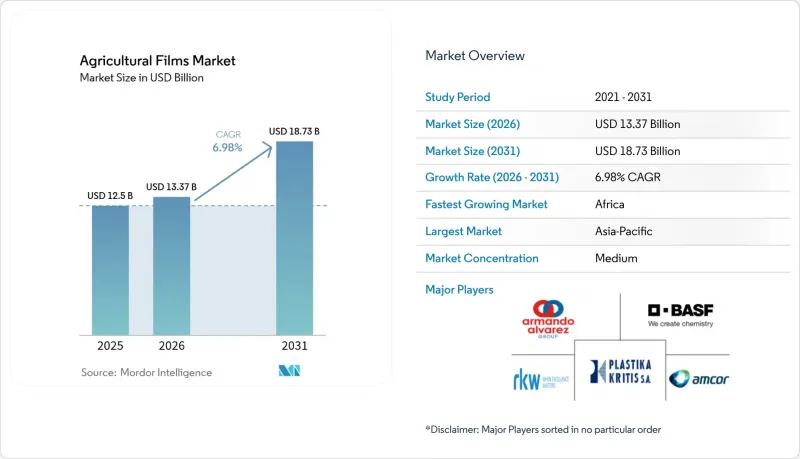
根據 Mordor Intelligence 預測,農業薄膜市場規模將從 2025 年的 125 億美元成長到 2026 年的 133.7 億美元,然後在 2031 年達到 187.3 億美元,2026 年至 2031 年的複合年成長率為 6.98%。
本報告按類型(低密度聚乙烯、線性低密度聚乙烯、高密度聚苯乙烯、再生材料及其他)、厚度(80毫米及以下和80毫米以上)、應用(溫室、覆蓋、青貯及其他應用)和地區(北美、南美、歐洲、亞太地區以及中東和非洲)進行細分。市場預測以美元計價。
全球農業薄膜市場趨勢及洞察
溫室栽培技術的廣泛應用
保護性栽培技術正從高價值園藝作物擴展到主糧作物,使產量提高25%至40%,並保障全年穩定供應。自動化和人工智慧驅動的氣候控制減少了勞動力投入,使中型生產商也能進入這一領域。以基質為基礎的栽培系統消除了土壤傳播疾病的風險,需要具有卓越防水性能的無菌屏障膜,從而推動了對多層聚乙烯(PE)結構的需求。大麻、營養補充品作物和藥用作物需要高規格薄膜,以最佳化波長控制、保溫和漫射光分佈。不列顛哥倫比亞省的溫室經營者預測,到2025年,採用可再生能源將進一步降低營運成本,並使蔬菜產量提高18%。
利用地膜覆蓋減少水分蒸發正變得越來越流行。
在乾旱地區,塑膠地膜可減少30-50%的灌溉需求,日益支持保護性耕作中的再生農業實踐。全球塑膠地膜消費量超過200萬噸,其中大部分集中在亞洲,在那裡集約化蔬菜種植系統十分普遍。反射性地膜可降低土壤表面溫度4-6 度C,並延長高溫脅迫氣候下的種植期。可生物分解的創新產品符合有機認證要求,並減少了地膜回收所需的人工,但高昂的成本仍然是其廣泛應用的一大障礙。將可變速率地膜撒佈機與精密農業數據結合,使生產者能夠最佳化地膜厚度和鋪設位置,從而更好地實現提高資源利用效率的目標。中國關於使用更厚地膜以提高其可回收性的指南,正在推動材料科學領域研發能夠承受多次循環的高強度配方。
對溫室基礎設施的大量初始投資
高科技溫室的建造成本為每平方公尺2500至4000美元,而低科技溫室的建造成本僅為每平方公尺400至500美元,這使得小規模農戶的初始投資負擔極為沉重。除了建設成本外,氣候控制、施肥灌溉和能源系統等費用可能佔到年收入的40%,因此,當農產品價格下跌時,維持盈利將變得十分困難。由於缺乏抵押品和高利率,融資管道有限,尤其是新興經濟體。設備租賃模式和「按需付費」服務合約可以減輕融資負擔,但強力的農業推廣支援不可或缺。不同作物的財務可行性各不相同;香菇可以確保內部收益率,但在相同的成本結構下,甜瓜仍然無利可圖。
細分市場分析
到2025年,低密度聚乙烯(LDPE)將佔據農業薄膜市場42.75%的佔有率。這主要得益於其良好的性價比以及易於擠出成型為覆蓋材料的特性。該材料之所以佔據市場主導地位,是因為它具有卓越的光學透明度和延展性,從而最大限度地減少了安裝過程中的機械應力。產業向永續性的轉型正在推動再生材料市場在2031年實現8.35%的複合年成長率,這主要得益於多層結構設計的發展,這些設計在不影響與作物接觸功能的情況下融入了再生材料。相容劑的化學進步使得提高PCR(再生聚乙烯)的比例成為可能,從而緩解了先前阻礙再生聚乙烯應用的異味和凝膠問題。
線性低密度聚乙烯 (LLDPE) 可提供青貯飼料使用者所需的抗穿刺性,而乙烯-醋酸乙烯酯共聚物則為高檔溫室薄膜提供優異的光擴散性能。高密度聚苯乙烯和聚醯胺等特殊樹脂可滿足結構剛性和耐溶劑性等特殊需求,但成本仍較高。隨著對薄膜需求的不斷成長,對即使在減薄後仍能保持拉伸強度的高熔體強度等級材料的需求也日益增加,這可以降低每公頃樹脂用量,並減少塑膠對環境的整體影響。
區域分析
預計到2025年,亞太地區將佔全球農用薄膜市場佔有率的37.10%。這主要得益於中國龐大的溫室面積以及印度、日本和韓國的補貼現代化計畫。區域製造商擁有成本優勢,並能在地採購採購穩定劑和擠出成型機,以實現產品快速改進。國內技術創新主要集中在擴散膜的研發上,旨在最佳化作物光合效率,同時應對高強度太陽輻射。政府旨在減少塑膠廢棄物的各項計畫正在加速開發更厚、可回收的地膜,並加強樹脂生產商與農業研究機構之間的區域性研究合作。
非洲是成長最快的地區,預計到2031年複合年成長率將達到8.85%,這得益於園藝產品出口的不斷成長和優惠的貿易激勵措施。肯亞的鮮切花產業注重保護性栽培,透過引導周邊經濟體採用溫室栽培模式,推動了它們的發展。南非的生質塑膠利用《非洲成長與機會法案》(AGOA)提供的關稅豁免,為當地薄膜加工商提供具有成本競爭力的可生物分解材料。儘管成長潛力巨大,但薄膜收集和回收基礎設施的嚴重不足限制了循環經濟的實現。
歐洲和北美是成熟且充滿活力的市場,永續性法規正推動材料技術的不斷進步。歐盟委員會2025年修訂的《食品接觸材料法規》提出了更嚴格的純度標準,迫使薄膜生產商改進添加劑配方和污染控制規程。在中東,投資正朝著提高水資源利用效率和實現全年生產的方向發展,採用高擴散性覆蓋物,並在封閉回路型系統中結合使用淡化水或再生水。同時,南美洲和大洋洲的利基市場青睞符合出口主導農業品質要求的特殊覆蓋物和青貯飼料產品。
其他好處:
- Excel格式的市場預測(ME)表
- 3個月的分析師支持
目錄
第1章:引言
- 研究假設和市場定義
- 調查範圍
第2章:調查方法
第3章執行摘要
第4章 市場狀況
- 市場概覽
- 市場促進因素
- 溫室種植日益普及。
- 利用覆蓋物抑制水分蒸發的方法越來越普遍。
- 政府對保護性耕作的補貼
- 對光選擇性頻譜薄膜的需求正在激增。
- 農場層面向含再生材料薄膜的過渡
- 將排碳權貨幣化應用於可生物分解薄膜
- 市場限制因素
- 溫室基礎設施的初始投資相對較高。
- 聚乙烯薄膜處置相關的環境問題
- 乙烯原料價格波動
- 缺乏標準化的薄膜回收和物流系統
- 監理情勢
- 技術展望
- 波特五力模型
第5章 市場規模與成長預測
- 依產品類型
- 低密度聚乙烯
- 線型低密度聚乙烯
- 高密度聚苯乙烯
- 乙烯-醋酸乙烯酯/乙烯-丙烯酸丁酯
- 再生材料(再生聚乙烯)
- 其他類型(聚丙烯農用薄膜、聚醯胺農用薄膜、乙烯-乙烯醇共聚物樹脂和PVC)
- 按厚度
- 80微米或更小
- 80~150µm
- 150微米或以上
- 透過使用
- 溫室
- 覆蓋
- 青貯飼料
- 其他用途(低矮隧道、燻蒸)
- 按地區
- 北美洲
- 美國
- 加拿大
- 墨西哥
- 其他北美國家
- 南美洲
- 巴西
- 阿根廷
- 其他南美國家
- 歐洲
- 德國
- 英國
- 法國
- 西班牙
- 義大利
- 俄羅斯
- 其他歐洲國家
- 亞太地區
- 中國
- 印度
- 日本
- 澳洲
- 其他亞太國家
- 中東
- 沙烏地阿拉伯
- 阿拉伯聯合大公國
- 其他中東國家
- 非洲
- 南非
- 埃及
- 其他非洲國家
- 北美洲
第6章 競爭情勢
- 市場集中度
- 策略趨勢
- 市佔率分析
- 公司簡介
- Berry Global Inc.(Amcor)
- Armando Alvarez Group
- BASF SE
- Novamont SpA
- Polifilm Group
- Ginegar Plastic Products
- Trioplast Industrier
- NDVECO Group
- Plastika Kritis SA
- Exxon Mobil Corporation
- Kuraray Co.
- AB Rani Plast Oy
- RKW Group
- Group Barbier
- Coveris Holding
第7章 市場機會與未來展望
According to Mordor Intelligence, the agricultural films market size is expected to grow from USD 12.50 billion in 2025 to USD 13.37 billion in 2026 and is forecast to reach USD 18.73 billion by 2031 at 6.98% CAGR over 2026-2031.
This report is Segmented by Type (Low-Density Polyethylene, Linear Low-Density Polyethylene, High-Density Polyethylene, Reclaims, and More), by Thickness (Up To 80 Mm and More), by Application (Greenhouse, Mulching, Silage, and Other Applications), and by Geography (North America, South America, Europe, Asia-Pacific, Middle East, and Africa). The Market Forecasts are Provided in Terms of Value (USD).
Global Agricultural Films Market Trends and Insights
Rising adoption of greenhouse cultivation
Protected cultivation now extends from high-value horticulture to staple crops, delivering yield increases of 25-40% and supporting year-round supply continuity. Automation and artificial-intelligence climate controls lower labor inputs, enabling mid-scaled growers to enter the segment. Substrate-based systems eliminate soil-borne disease vectors and require sterile barrier films with superior impermeability, spurring demand for multilayer PE structures. Cannabis, nutraceutical, and pharmaceutical crops command premium film specifications that optimize wavelength management, thermal retention, and diffused light distribution. Greenhouse operators in British Columbia forecast an 18% vegetable-output lift by 2025 through renewable-energy integration that further lowers operational overhead.
Growing popularity of mulching to curb evaporation
Plastic mulch films cut irrigation volumes 30-50% in arid zones and increasingly underpin regeneration practices within conservation agriculture. Global consumption has surpassed 2 million metric tons, with Asia accounting for the bulk due to intensive vegetable systems. Reflective films lower soil-surface temperatures 4-6 °C, extending cropping windows in heat-stressed climates. Biodegradable innovations meet organic-certification needs and reduce labor associated with film retrieval, though elevated cost remains an adoption hurdle. Variable-rate mulch applicators paired with precision agriculture data help growers optimize film thickness and placement, reinforcing resource-efficiency goals. Chinese directives mandating thicker mulch to improve recyclability push material science toward higher-strength formulations that withstand multiple cycles.
High initial investment in greenhouse infrastructure
Hi-tech greenhouses demand USD 2,500-4,000 per m2 compared with USD 400-500 for low-tech counterparts, posing steep upfront barriers for smallholders. Beyond construction, climate controls, fertigation, and energy systems can consume 40% of annual revenue, challenging profitability when produce prices fall. Limited collateral and high interest rates restrict access to credit, especially in frontier economies. Equipment leasing models and pay-as-you-grow service contracts ease the capital strain but require robust extension support. Financial viability varies by crop, and shiitake mushrooms yield internal returns, yet melons remain unprofitable under identical cost structures.
Other drivers and restraints analyzed in the detailed report include:
- Government subsidies for protected cultivation
- Surge in demand for photo-selective spectral films
- Environmental concerns over disposal of PE films
For complete list of drivers and restraints, kindly check the Table Of Contents.
Segment Analysis
Low-Density Polyethylene held 42.75% agricultural films market share in 2025, underpinned by its balanced cost-to-performance ratio and ease of extrusion into covers. The material's dominance stems from superior optical clarity and elongation properties that minimize mechanical stress during installation. The industry's pivot to sustainability is catalyzing an 8.35% CAGR for Reclaims through 2031, aided by multilayer designs that embed recycled content without compromising crop-facing functionality. Chemical advances in compatibilizers allow higher PCR ratios, mitigating odor and gel issues that historically constrained recycled-PE uptake.
Linear-Low-Density Polyethylene adds puncture resistance requested by silage users, while Ethyl Vinyl Acetate copolymers impart enhanced light diffusion for premium greenhouse films. High-density polyethylene and specialized resins, such as polyamide, address niche requirements for structural rigidity and solvent resistance, but remain cost-limited. Rising demand for downgauged films drives the need for high-melt-strength grades that sustain tensile integrity at reduced thickness, thereby compressing resin usage metric tons per hectare and lowering the overall plastic footprint.
Complete Report Scope:
- By Product Type
- Low-Density Polyethylene
- Linear Low-Density Polyethylene
- High-Density Polyethylene
- Ethyl Vinyl Acetate / Ethylene Butyl Acrylate
- Reclaims (Recycled PE)
- Other Types (Polypropylene Agricultural Films, Polyamide Agricultural Films, Ethylene Vinyl-Alcohol Copolymer Resins, and PVC)
- By Thickness
- Up to 80 µm
- 80-150 µm
- Above 150 µm
- By Application
- Greenhouse
- Mulching
- Silage
- Other Applications (Low Tunnels, Fumigation)
- By Geography
- North America
- United States
- Canada
- Mexico
- Rest of North America
- South America
- Brazil
- Argentina
- Rest of South America
- Europe
- Germany
- United Kingdom
- France
- Spain
- Italy
- Russia
- Rest of Europe
- Asia-Pacific
- China
- India
- Japan
- Australia
- Rest of Asia-Pacific
- Middle East
- Saudi Arabia
- United Arab Emirates
- Rest of Middle East
- Africa
- South Africa
- Egypt
- Rest of Africa
- North America
Geography Analysis
Asia-Pacific held 37.10% of the agricultural films market in 2025, driven by extensive greenhouse acreage in China and subsidy-backed modernization programs in India, Japan, and South Korea. Regional manufacturers have cost advantages and benefit from a localized supply of stabilizer additives and extrusion machinery, enabling rapid product iteration. Domestic innovation focuses on diffusive films that counteract high solar-irradiation intensity while optimizing crop photosynthetic efficiency. Government programs targeting plastic waste reduction prompt the development of thicker, recyclable mulch variants, cementing local research collaborations between resin producers and agricultural institutes.
Africa represents the fastest-growing territory with a projected 8.85% CAGR through 2031, supported by horticultural export expansion and favorable trade preferences. Kenya's floriculture valorizes protected cultivation, generating and guiding neighboring economies toward greenhouse models. South African bioplastics leverage duty-free access under the African Growth and Opportunity Act, offering cost-competitive biodegradable inputs for regional film converters. Despite growth potential, endemic infrastructure gaps in film retrieval and recycling constrain circular-economy ambitions.
Europe and North America illustrate mature yet dynamic markets where sustainability regulation spurs continual material advancement. The European Commission's 2025 update to food-contact regulations imposes stricter purity thresholds, compelling film formulators to refine additive packages and contamination-control protocols. Middle East investments in water-efficiency and year-round production use high-diffusion covers paired with desalinated or recycled water in closed-loop systems, while South American and Oceanian niche segments favor specialty mulch and silage products aligned with export-driven produce quality requirements.
- Berry Global Inc. (Amcor)
- Armando Alvarez Group
- BASF SE
- Novamont SpA
- Polifilm Group
- Ginegar Plastic Products
- Trioplast Industrier
- NDVECO Group
- Plastika Kritis SA
- Exxon Mobil Corporation
- Kuraray Co.
- AB Rani Plast Oy
- RKW Group
- Group Barbier
- Coveris Holding
Additional Benefits:
- The market estimate (ME) sheet in Excel format
- 3 months of analyst support
TABLE OF CONTENTS
1 Introduction
- 1.1 Study Assumptions and Market Definition
- 1.2 Scope of the Study
2 Research Methodology
3 Executive Summary
4 Market Landscape
- 4.1 Market Overview
- 4.2 Market Drivers
- 4.2.1 Rising adoption of greenhouse cultivation
- 4.2.2 Growing popularity of mulching to curb evaporation
- 4.2.3 Government subsidies for protected cultivation
- 4.2.4 Surge in demand for photo-selective spectral films
- 4.2.5 Farm-level shift toward recycled-content films
- 4.2.6 Carbon-credit monetization for biodegradable films
- 4.3 Market Restraints
- 4.3.1 High initial investment in greenhouse infrastructure
- 4.3.2 Environmental concerns over disposal of PE films
- 4.3.3 Volatility in ethylene feedstock pricing
- 4.3.4 Lack of standardized film recovery logistics
- 4.4 Regulatory Landscape
- 4.5 Technological Outlook
- 4.6 Porter's Five Forces
- 4.6.1 Bargaining Power of Suppliers
- 4.6.2 Bargaining Power of Buyers
- 4.6.3 Threat of New Entrants
- 4.6.4 Threat of Substitute Products
- 4.6.5 Intensity of Competitive Rivalry
5 Market Size and Growth Forecasts (Value)
- 5.1 By Product Type
- 5.1.1 Low-Density Polyethylene
- 5.1.2 Linear Low-Density Polyethylene
- 5.1.3 High-Density Polyethylene
- 5.1.4 Ethyl Vinyl Acetate / Ethylene Butyl Acrylate
- 5.1.5 Reclaims (Recycled PE)
- 5.1.6 Other Types (Polypropylene Agricultural Films, Polyamide Agricultural Films, Ethylene Vinyl-Alcohol Copolymer Resins, and PVC)
- 5.2 By Thickness
- 5.2.1 Up to 80 µm
- 5.2.2 80-150 µm
- 5.2.3 Above 150 µm
- 5.3 By Application
- 5.3.1 Greenhouse
- 5.3.2 Mulching
- 5.3.3 Silage
- 5.3.4 Other Applications (Low Tunnels, Fumigation)
- 5.4 By Geography
- 5.4.1 North America
- 5.4.1.1 United States
- 5.4.1.2 Canada
- 5.4.1.3 Mexico
- 5.4.1.4 Rest of North America
- 5.4.2 South America
- 5.4.2.1 Brazil
- 5.4.2.2 Argentina
- 5.4.2.3 Rest of South America
- 5.4.3 Europe
- 5.4.3.1 Germany
- 5.4.3.2 United Kingdom
- 5.4.3.3 France
- 5.4.3.4 Spain
- 5.4.3.5 Italy
- 5.4.3.6 Russia
- 5.4.3.7 Rest of Europe
- 5.4.4 Asia-Pacific
- 5.4.4.1 China
- 5.4.4.2 India
- 5.4.4.3 Japan
- 5.4.4.4 Australia
- 5.4.4.5 Rest of Asia-Pacific
- 5.4.5 Middle East
- 5.4.5.1 Saudi Arabia
- 5.4.5.2 United Arab Emirates
- 5.4.5.3 Rest of Middle East
- 5.4.6 Africa
- 5.4.6.1 South Africa
- 5.4.6.2 Egypt
- 5.4.6.3 Rest of Africa
- 5.4.1 North America
6 Competitive Landscape
- 6.1 Market Concentration
- 6.2 Strategic Moves
- 6.3 Market Share Analysis
- 6.4 Company Profiles (Includes Global Level Overview, Market Level Overview, Core Segments, Financials as Available, Strategic Information, Market Rank/Share for Key Companies, Products and Services, and Recent Developments)
- 6.4.1 Berry Global Inc. (Amcor)
- 6.4.2 Armando Alvarez Group
- 6.4.3 BASF SE
- 6.4.4 Novamont SpA
- 6.4.5 Polifilm Group
- 6.4.6 Ginegar Plastic Products
- 6.4.7 Trioplast Industrier
- 6.4.8 NDVECO Group
- 6.4.9 Plastika Kritis SA
- 6.4.10 Exxon Mobil Corporation
- 6.4.11 Kuraray Co.
- 6.4.12 AB Rani Plast Oy
- 6.4.13 RKW Group
- 6.4.14 Group Barbier
- 6.4.15 Coveris Holding
7 Market Opportunities and Future Outlook

 全球農業薄膜市場規模、佔有率、趨勢和成長分析報告(2026-2034年)
 南美洲農業薄膜:市場佔有率分析、產業趨勢與統計及成長預測(2026-2031 年)北美農業薄膜:市佔率分析、產業趨勢與統計及成長預測(2026-2031 年)非洲農業薄膜:市場佔有率分析、產業趨勢與統計及成長預測(2026-2031 年)
 農業薄膜市場:按類型、聚合物類型、薄膜厚度、應用和銷售管道分類-2026-2032年全球市場預測
 農業薄膜市場規模、佔有率和成長分析:按薄膜類型、材料、應用、最終用戶、分銷管道和地區分類-2026-2033年產業預測
 農業薄膜市場機會、成長要素、產業趨勢分析及2026-2035年預測
 全球農業薄膜市場(至2031年):按類型(低密度聚乙烯、線性低密度聚乙烯、乙烯-醋酸乙烯酯共聚物、再生材料、高密度聚乙烯)、應用(溫室薄膜(傳統溫室、小型隧道)、地膜(黑色地膜、透明地膜))、青貯薄膜(青貯拉伸膜)和地區分類
 農業薄膜和黏合劑市場規模、佔有率和成長分析:按薄膜類型、材料、應用、通路和地區分類-2026-2033年產業預測
 2026年全球反射多層膜市場報告