


 |
市場調查報告書
商品編碼
2113259
非洲農業薄膜:市場佔有率分析、產業趨勢與統計及成長預測(2026-2031 年)Africa Agricultural Film - Market Share Analysis, Industry Trends & Statistics, Growth Forecasts (2026 - 2031) |
||||||

※ 本網頁內容可能與最新版本有所差異。詳細情況請與我們聯繫。
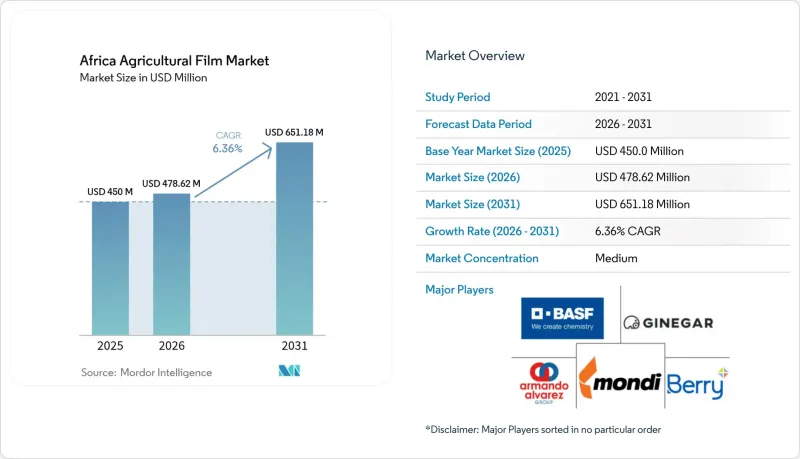
根據 Mordor Intelligence 預測,非洲農業薄膜市場規模將從 2025 年的 4.5 億美元成長到 2026 年的 4.7862 億美元,然後在 2031 年達到 6.5118 億美元,2026 年至 2031 年的複合年成長率為 6.36%。
本報告按類型(例如,低密度聚乙烯 (LDPE)、線性低密度聚乙烯 (LLDPE))、應用(例如,地膜覆蓋)、膜厚(例如,小於 80 微米)和地區(例如,南非)進行分類。市場預測以美元計價。
非洲農業電影市場的趨勢與洞察
日益成長的糧食需求和提高農業生產力的必要性
在非洲,穀物是主食,玉米、小麥和米最為重要,但玉米的消費量最高。對大多數肯亞人來說,玉米是維持日常生活的主要食物來源。儘管非洲的穀物消費量持續成長,但產量仍顯著偏低,導致進口缺口擴大,並增加了對地膜和溫室覆蓋等增產技術的需求。第三個非洲農業發展綜合規劃(CAADP)藍圖協調了整個非洲大陸的政策,優先發展能夠減少水分壓力和縮短生長週期的增產工具。衣索比亞實現了小麥自給自足,並減少了10億美元的進口,這鼓勵了贊比亞和莫三比克開展類似的實施計畫。農用薄膜可以改善土壤保水性和作物冠層下的微氣候,使農民即使在不可預測的天氣條件下也能克服產量不足的問題。這種持續存在的供需缺口使得農用薄膜成為面臨糧食不安全問題的全部區域必不可少的投入品。
非洲溫室種植面積迅速增加。
在摩洛哥,4萬公頃的溫室投入運作,年產園藝作物200萬噸,這顯示該國正朝著保護性栽培方式轉型。荷蘭和摩洛哥公司之間的技術合作,提供了一種可提高產量和水分利用效率的擴散型聚乙烯覆蓋膜。在類似的乾旱地區進行的研究表明,使用最佳化的擴散膜後,黃瓜產量可達12.3公斤/平方米,這印證了專用覆蓋膜在農業生產中的益處。肯亞和南非也在實施類似的溫室系統,以應對日益加劇的降雨變化。隨著溫室面積的擴大,對具有抗紫外線、隔熱和高透光滲透性的薄膜的需求也持續成長。
假冒偽劣膠片充斥著非官方市場。
非官方貿易管道的存在使得大量劣質農用薄膜湧入奈及利亞和肯亞。這些不合格產品的湧入削弱了農民對農業薄膜的信心,並損害了現有品牌的聲譽。對奈及利亞塑膠市場的研究表明,監管方面仍然存在缺陷,使得未經認證的進口產品能夠規避品管措施。假薄膜的快速劣化會導致作物減產,進而使農民未來不願購買此類產品,阻礙了合法生產商的銷售成長。
細分市場分析
到2025年,低密度聚乙烯(LDPE)將佔據非洲農業薄膜市場的42.35%。這一主導地位歸功於其成熟的供應鏈、優異的柔軟性以及適用於低張力安裝方法。標準LDPE等級的產品廣泛應用於不同地區的覆蓋和隧道栽培,從奈及利亞半乾旱地區的玉米種植區到南非的葡萄酒產區均有應用。線性低密度和高密度品種滿足青貯飼料和草捆包裝的需求,而乙烯-醋酸乙烯酯共聚物和乙烯-丙烯酸丁酯共聚物則為需要高透光率的溫室屋頂提供了解決方案。
生物分解薄膜雖然市佔率較小,但正以10.12%的複合年成長率成長。這一成長得益於EN17033標準的明確規定以及捐助者資助的氣候智慧型試驗計畫。玉米和番茄種植的田間試驗表明,其產量與低密度聚乙烯(LDPE)相當,並透過降低迴收成本提高了整體成本效益。新型材料配方將聚(3-羥基丁酸酯-共-3-羥基戊酸酯)和澱粉與回收的LDPE結合,以實現結構強度和可控分解。製造商正在開發奈米黏土屏障和硬脂酸等表面處理技術,以提高保水性和土壤呼吸作用,減少種植時的壓力,並加速植物生長週期。含有回收材料的薄膜成長速度較慢,但正吸引著致力於透過農業塑膠廢棄物再利用建構循環經濟的合作社的關注。
其他好處:
- Excel格式的市場預測(ME)表
- 3個月的分析師支持
目錄
第1章:引言
- 研究假設和市場定義
- 調查範圍
第2章:調查方法
第3章執行摘要
第4章 市場狀況
- 市場概覽
- 市場促進因素
- 日益成長的糧食需求和提高農業生產力的必要性
- 非洲溫室種植面積迅速增加。
- 多層薄膜和防垂流添加劑的產品創新
- 政府對農業薄膜的補貼
- 園藝產品出口叢集的快速擴張
- 可生物分解和可堆肥薄膜標準的出現。
- 市場限制因素
- 非官方市場充斥著低劣的盜版電影。
- 農民對正確使用薄膜的認知不足,技術訓練也不夠。
- 原油衍生聚合物原料價格的波動
- 小規模本地回收基礎設施
- 監理情勢
- 技術展望
- 波特五力分析
第5章 市場規模與成長預測
- 按類型
- 低密度聚乙烯(LDPE)
- 線型低密度聚乙烯(LLDPE)
- 高密度聚苯乙烯(HDPE)
- 乙烯-醋酸乙烯酯/乙烯-丙烯酸丁酯
- 可生物分解薄膜
- 回收材料
- 透過使用
- 覆蓋
- 溫室
- 青貯飼料及確保
- 按薄膜厚度
- 小於80微米
- 80-120微米
- 超過120微米
- 按地區
- 南非
- 摩洛哥
- 埃及
- 其他非洲國家
第6章 競爭情勢
- 市場集中度
- 策略趨勢
- 市佔率分析
- 公司簡介
- Berry Global, Inc.(Amcor plc)
- Ginegar Plastic Products Ltd.
- BASF SE
- Armando Alvarez SA
- Novamont SpA(Versalis SpA)
- Gundle Plastics Group(Pty)Ltd(Winhold(Pty)Ltd.)
- Polifilm Extrusion GmbH
- Ampa Plastics Group(Pty)Ltd(Evonik Industries AG)
- Polywrap Development(PTY)Ltd.
- Qingdao Kingchuan Yuanrong International Trading Co., Ltd
- Mondi PLC
- INDEVCO Group SAL
- Shakti Industries Limited
- UFlex Limited
- Nile Drip(HWA Group)
第7章 市場機會與未來展望
According to Mordor Intelligence, the Africa agricultural film market size is expected to grow from USD 450.0 million in 2025 to USD 478.62 million in 2026 and is forecast to reach USD 651.18 million by 2031 at 6.36% CAGR over 2026-2031.
This report is Segmented by Type (Low-Density Polyethylene (LDPE), Linear Low-Density Polyethylene (LLDPE), and More), by Application (Mulching, and More), by Film Thickness (Less Than 80 Microns, and More), and by Geography (South Africa, and More). The Market Forecasts are Provided in Terms of Value (USD).
Africa Agricultural Film Market Trends and Insights
Raising Food Demand and Need for Higher Farm Productivity
In Africa, cereals are staple foods, with maize, wheat, and rice being the most important, and maize leading in consumption. Maize constitutes the primary daily subsistence need for most Kenyans. While Africa's cereal consumption continues to rise, production remains significantly lower, widening the import gap and increasing the demand for yield-boosting technologies such as mulch and greenhouse covers. The third Comprehensive African Agriculture Development Programme (CAADP) roadmap aligns continental policies to prioritize productivity tools that reduce water stress and shorten growth cycles. Ethiopia's achievement of wheat self-sufficiency, which eliminated USD 1 billion in imports, has encouraged similar adoption programs in Zambia and Mozambique. Agricultural films enhance soil moisture retention and canopy microclimate, enabling farmers to overcome yield deficits during unpredictable weather conditions. This ongoing supply-demand gap establishes agricultural films as essential inputs across food-insecure regions.
Surging Greenhouse Cultivation Acreage Across Africa
Morocco operates 40,000 hectares of greenhouses, producing 2 million metric tons of horticultural output, demonstrating the transition to protected cultivation. Technology partnerships between Dutch and Moroccan companies provide diffusive polyethylene covers that improve yield and water-use efficiency. Research in similar arid regions indicates cucumber yields of 12.3 kg/m2 under optimized diffusive films, confirming the agricultural benefits of specialized covers. Kenya and South Africa implement comparable greenhouse systems, driven by the need to adapt to increasing rainfall variability. The expansion of greenhouse area maintains consistent demand for UV-stable, thermally insulated, and high-light-transmission films.
Counterfeit Low-Grade Films Flooding Informal Markets
The presence of informal trading routes enables significant volumes of low-quality agricultural films to enter Nigeria and Kenya. This influx of substandard products reduces farmer trust in film effectiveness and damages established brand value. Studies of Nigeria's plastics market indicate persistent regulatory gaps that enable uncertified imports to circumvent quality control measures. The rapid degradation of counterfeit films leads to crop losses, which discourages farmers from making future purchases and limits the sales growth of legitimate manufacturers.
Other drivers and restraints analyzed in the detailed report include:
- Product Innovations in Multilayer Films and Anti-Drip Additives
- Government Subsidies on Agricultural Film
- Low Farmer Awareness and Limited Technical Training on Proper Film Use
For complete list of drivers and restraints, kindly check the Table Of Contents.
Segment Analysis
Low-density polyethylene (LDPE) maintains 42.35% of the Africa agricultural film market share in 2025. This dominance stems from established supply chains, proven flexibility, and suitability for low-tension installation methods. Standard LDPE grades support mulching and tunnel applications across diverse regions, from Nigeria's semi-arid maize cultivation areas to South Africa's wine regions. Linear-low and high-density variants address silage and bale wrapping requirements, while ethyl vinyl acetate and ethylene butyl acrylate copolymers provide solutions for greenhouse roofs requiring high light transmission.
Biodegradable films, despite their smaller market presence, are growing at a 10.12% CAGR. This growth is driven by clear regulations under EN17033 and climate-smart pilot programs supported by donor funding. Field trials in maize and tomato cultivation demonstrate yields comparable to LDPE while eliminating collection costs, improving overall cost efficiency. New material formulations combine poly (3-hydroxybutyrate-co-3-hydroxyvalerate) or starch with recycled LDPE to achieve both structural strength and controlled degradation. Manufacturers are developing nanoclay barriers and stearic-acid-surface treatments to improve water retention and soil respiration, reducing transplant stress and accelerating plant growth cycles. Recycled-content films, though experiencing slower growth, appeal to cooperatives focused on creating circular economies through the reuse of agricultural plastic waste.
Complete Report Scope:
- By Type
- Low-Density Polyethylene (LDPE)
- Linear Low-Density Polyethylene (LLDPE)
- High-Density Polyethylene (HDPE)
- Ethyl Vinyl Acetate / Ethylene Butyl Acrylate
- Biodegradable Films
- Reclaims
- By Application
- Mulching
- Greenhouse
- Silage and Ensiling
- By Film Thickness
- Less Than 80 Microns
- 80-120 Microns
- More Than 120 Microns
- By Geography
- South Africa
- Morocco
- Egypt
- Rest of Africa
List of Companies Covered in this Report:
- Berry Global, Inc. (Amcor plc)
- Ginegar Plastic Products Ltd.
- BASF SE
- Armando Alvarez S.A.
- Novamont S.p.A. (Versalis S.p.A.)
- Gundle Plastics Group (Pty) Ltd (Winhold (Pty) Ltd.)
- Polifilm Extrusion GmbH
- Ampa Plastics Group (Pty) Ltd (Evonik Industries AG)
- Polywrap Development (PTY) Ltd.
- Qingdao Kingchuan Yuanrong International Trading Co., Ltd
- Mondi PLC
- INDEVCO Group S.A.L.
- Shakti Industries Limited
- UFlex Limited
- Nile Drip (HWA Group)
Additional Benefits:
- The market estimate (ME) sheet in Excel format
- 3 months of analyst support
TABLE OF CONTENTS
1 Introduction
- 1.1 Study Assumptions and Market Definition
- 1.2 Scope of the Study
2 Research Methodology
3 Executive Summary
4 Market Landscape
- 4.1 Market Overview
- 4.2 Market Drivers
- 4.2.1 Raising Food Demand and Need for Higher Farm Productivity
- 4.2.2 Surging Greenhouse Cultivation Acreage Across Africa
- 4.2.3 Product Innovations in Multilayer Films and Anti-Drip Additives
- 4.2.4 Government Subsidies on Agricultural Film
- 4.2.5 Rapid Expansion of Horticulture Export Clusters
- 4.2.6 Emergence of Biodegradable and Compostable Film Standards
- 4.3 Market Restraints
- 4.3.1 Counterfeit Low-Grade Films Flooding Informal Markets
- 4.3.2 Low Farmer Awareness and Limited Technical Training on Proper Film Use
- 4.3.3 Volatility in Crude-Derived Polymer Feedstock Prices
- 4.3.4 Sub-Scale Local Recycling Infrastructure
- 4.4 Regulatory Landscape
- 4.5 Technological Outlook
- 4.6 Porter's Five Forces Analysis
- 4.6.1 Bargaining Power of Suppliers
- 4.6.2 Bargaining Power of Buyers
- 4.6.3 Threat of New Entrants
- 4.6.4 Threat of Substitute Products
- 4.6.5 Intensity of Competitive Rivalry
5 Market Size and Growth Forecasts (Value)
- 5.1 By Type
- 5.1.1 Low-Density Polyethylene (LDPE)
- 5.1.2 Linear Low-Density Polyethylene (LLDPE)
- 5.1.3 High-Density Polyethylene (HDPE)
- 5.1.4 Ethyl Vinyl Acetate / Ethylene Butyl Acrylate
- 5.1.5 Biodegradable Films
- 5.1.6 Reclaims
- 5.2 By Application
- 5.2.1 Mulching
- 5.2.2 Greenhouse
- 5.2.3 Silage and Ensiling
- 5.3 By Film Thickness
- 5.3.1 Less Than 80 Microns
- 5.3.2 80-120 Microns
- 5.3.3 More Than 120 Microns
- 5.4 By Geography
- 5.4.1 South Africa
- 5.4.2 Morocco
- 5.4.3 Egypt
- 5.4.4 Rest of Africa
6 Competitive Landscape
- 6.1 Market Concentration
- 6.2 Strategic Moves
- 6.3 Market Share Analysis
- 6.4 Company Profiles (Includes Global Level Overview, Market Level Overview, Core Segments, Financials as Available, Strategic Information, Market Rank/Share for Key Companies, Products and Services, and Recent Developments)
- 6.4.1 Berry Global, Inc. (Amcor plc)
- 6.4.2 Ginegar Plastic Products Ltd.
- 6.4.3 BASF SE
- 6.4.4 Armando Alvarez S.A.
- 6.4.5 Novamont S.p.A. (Versalis S.p.A.)
- 6.4.6 Gundle Plastics Group (Pty) Ltd (Winhold (Pty) Ltd.)
- 6.4.7 Polifilm Extrusion GmbH
- 6.4.8 Ampa Plastics Group (Pty) Ltd (Evonik Industries AG)
- 6.4.9 Polywrap Development (PTY) Ltd.
- 6.4.10 Qingdao Kingchuan Yuanrong International Trading Co., Ltd
- 6.4.11 Mondi PLC
- 6.4.12 INDEVCO Group S.A.L.
- 6.4.13 Shakti Industries Limited
- 6.4.14 UFlex Limited
- 6.4.15 Nile Drip (HWA Group)
7 Market Opportunities and Future Outlook

 金屬化多層膜市場:全球市場預測,2026-2032年
 農業薄膜和黏合劑市場規模、佔有率和趨勢分析報告:按原料、應用、地區和細分市場分類的預測(2026-2033 年)
 全球農業薄膜市場規模、佔有率、趨勢和成長分析報告(2026-2034年)
 農業薄膜:市場佔有率分析、產業趨勢與統計、成長預測(2026-2031)南美洲農業薄膜:市場佔有率分析、產業趨勢與統計及成長預測(2026-2031 年)北美農業薄膜:市佔率分析、產業趨勢與統計及成長預測(2026-2031 年)
 農業薄膜市場規模、佔有率和成長分析:按薄膜類型、材料、應用、最終用戶、分銷管道和地區分類-2026-2033年產業預測
 農業薄膜市場機會、成長要素、產業趨勢分析及2026-2035年預測
 全球農業薄膜市場(至2031年):按類型(低密度聚乙烯、線性低密度聚乙烯、乙烯-醋酸乙烯酯共聚物、再生材料、高密度聚乙烯)、應用(溫室薄膜(傳統溫室、小型隧道)、地膜(黑色地膜、透明地膜))、青貯薄膜(青貯拉伸膜)和地區分類
 農業薄膜和黏合劑市場規模、佔有率和成長分析:按薄膜類型、材料、應用、通路和地區分類-2026-2033年產業預測