


 |
市場調查報告書
商品編碼
2101931
農業薄膜市場機會、成長要素、產業趨勢分析及2026-2035年預測Agricultural Films Market Opportunity, Growth Drivers, Industry Trend Analysis, and Forecast 2026 - 2035 |
||||||

全球農業薄膜市場預計到 2025 年將達到 139 億美元,年複合成長率為 3.9%,預計到 2035 年將達到 207 億美元。
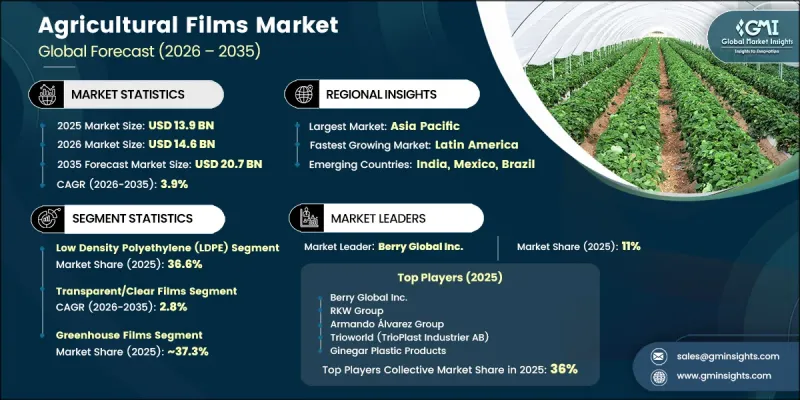
全球對提高農業生產力、最佳化資源利用和增強農業系統應對氣候變遷能力的需求不斷成長,推動了市場擴張。農業薄膜作為功能性覆蓋物,在現代農業技術中的應用日益廣泛,有助於調節溫度、濕度和光照等關鍵環境條件。它們在精密農業領域的重要性日益凸顯,尤其是在溫室生產系統、園藝企業和高價值作物種植。這些薄膜能夠提高產量,同時最佳化投入使用,因為覆蓋解決方案有助於雜草控制、土壤水分保持和土壤溫度穩定,最終減少灌溉需求。此外,溫室覆蓋物創造了一個可控的生長環境,使作物能夠持續種植,不受外部氣候變遷的影響。使用這些材料還有助於減少對化學肥料和農藥的過度依賴,從而促進更有效率、更永續的農業實踐。採用可生物分解產品進一步加強了永續性工作,減少了農田上塑膠的長期累積。
| 市場範圍 | |
|---|---|
| 開始年份 | 2025 |
| 預測期 | 2026-2035 |
| 上市時的市場規模 | 139億美元 |
| 預測金額 | 207億美元 |
| 複合年成長率 | 3.9% |
預計到 2035 年,低密度聚乙烯 (LDPE) 市場將以 2.5% 的複合年成長率成長。這種材料因其高透明度、柔軟性和易加工性而廣受歡迎,使其成為溫室薄膜和受控栽培環境等對耐久性和透光性要求較高的應用的理想選擇。
預計到2025年,透明薄膜市佔率將達到24.3%,並在2026年至2035年間以2.8%的複合年成長率成長。此類別涵蓋多種薄膜,旨在滿足不同的農業需求。透明薄膜因其高透光性而被廣泛應用於溫室栽培,透光率高有利於光合作用,從而提高植物生長性能。相較之下,不透明和黑色薄膜主要用於地膜覆蓋,以抑制雜草生長並提高土壤保水效率。
預計2035年,北美農用薄膜市場將以5.6%的複合年成長率成長。該地區的需求主要受塑膠薄膜種植系統的普及推動,薄膜種植方法已廣泛應用於商業農業實踐中,尤其是在特色作物產區。市場消費主要來自美國,聚乙烯地膜在美國已常規用於草莓、辣椒、番茄和甜瓜等作物的生產。
目錄
第1章:調查方法和範圍
第2章執行摘要
第3章 行業洞察
- 產業生態系分析
- 供應商情況
- 利潤率
- 每個階段增加的價值
- 影響價值鏈的因素
- 中斷
- 影響產業的因素
- 促進因素
- 對優質糧食作物日益成長的需求正在推動市場成長。
- 與傳統農業技術相比,該產品具有很高的成本效益,這推動了市場對該產品的需求。
- 擴大可生物分解農業薄膜的使用
- 產業潛在風險與挑戰
- 與污染和可回收性相關的問題
- 溫室基礎設施的安裝和維護成本很高
- 市場機遇
- 生物分解薄膜技術的快速發展
- 精密農業和智慧農業的擴展
- 促進因素
- 成長潛力分析
- 監理情勢
- 波特的分析
- PESTLE分析
- 價格趨勢
- 按地區
- 按成分
- 未來市場趨勢
- 技術與創新展望
- 最新科技趨勢
- 新興技術
- 專利趨勢
- 貿易統計
- 主要進口國
- 主要出口國
- 永續性和環境方面
- 永續計劃
- 減少廢棄物策略
- 生產中的能源效率
- 具有環保意識的舉措
- 考慮碳足跡
第4章 競爭情勢
- 介紹
- 企業市佔率分析
- 按地區
- 北美洲
- 歐洲
- 亞太地區
- LATAM
- 中東和非洲
- 按地區
- 企業矩陣分析
- 主要市場公司的競爭分析
- 競爭定位矩陣
- 主要進展
- 併購
- 夥伴關係和聯盟
- 新產品發布
- 業務拓展計劃
第5章 市場估算與預測:依原料分類,2022-2035年
- 低密度聚乙烯(LDPE)
- 線型低密度聚乙烯(LLDPE)
- 高密度聚苯乙烯(HDPE)
- 乙烯-醋酸乙烯酯共聚物/乙烯-丙烯酸丁酯(EVA/EBA)
- 回收材料
- 其他
第6章 市場估算與預測:依薄膜類型分類,2022-2035年
- 透明/清澈薄膜
- 不透明/黑色薄膜
- 彩色膠片
- 紫外線穩定薄膜
- 紅外線/熱膜
- 防霧膜
- 可生物分解薄膜
- 其他
第7章 市場估計與預測:依應用領域分類,2022-2035年
- 溫室薄膜
- 多重膠片
- 青貯膜
- 隧道膜
- 纏繞/打包膜
- 灌溉膜
- 燻蒸膜
- 其他
第8章 市場估計與預測:依地區分類,2022-2035年
- 北美洲
- 美國
- 加拿大
- 歐洲
- 德國
- 英國
- 法國
- 西班牙
- 義大利
- 其他歐洲國家
- 亞太地區
- 中國
- 印度
- 日本
- 澳洲
- 韓國
- 其他亞太國家
- 拉丁美洲
- 巴西
- 墨西哥
- 阿根廷
- 其他拉丁美洲國家
- 中東和非洲
- 沙烏地阿拉伯
- 南非
- UAE
- 其他中東和非洲國家
第9章:公司簡介
- Berry Global Inc.
- RKW Group
- Armando Alvarez Group
- Dow Inc.
- Coveris
- Trioworld(TrioPlast Industrier AB)
- Groupe Barbier
- AB Rani Plast Oy
- Polifilm Group
- Ginegar Plastic Products
- Plastika Kritis SA
- Novamont SpA
- BioBag International
- FKuR Kunststoff GmbH
The Global Agricultural Films Market was valued at USD 13.9 billion in 2025 and is estimated to grow at a CAGR of 3.9% to reach USD 20.7 billion by 2035.
Market expansion is driven by the rising global demand for improved agricultural productivity, better resource optimization, and stronger climate resilience in farming systems. Agricultural films are increasingly used as functional coverings in modern cultivation practices, helping regulate key environmental conditions such as temperature, humidity levels, and light exposure. Their importance is rising in precision agriculture applications, particularly in greenhouse production systems, horticulture operations, and high-value crop cultivation. These films support higher yield outcomes while optimizing input usage, as mulch-based solutions help suppress weed growth, retain soil moisture, and stabilize soil temperature, ultimately reducing irrigation requirements. In parallel, greenhouse covering solutions enable controlled growing environments that support continuous cultivation regardless of external climatic variations. The use of these materials also contributes to reduced dependence on excessive fertilizers and pesticides, encouraging more efficient and sustainable farming practices. The adoption of biodegradable variants is further strengthening sustainability initiatives by reducing long-term plastic accumulation in agricultural soils.
| Market Scope | |
|---|---|
| Start Year | 2025 |
| Forecast Year | 2026-2035 |
| Start Value | $13.9 Billion |
| Forecast Value | $20.7 Billion |
| CAGR | 3.9% |
The low-density polyethylene (LDPE) segment is projected to grow at a CAGR of 2.5% through 2035. This material remains widely preferred due to its strong clarity, flexible nature, and ease of processing, making it highly suitable for greenhouse film applications and controlled cultivation environments where durability and light transmission are essential.
The transparent and clear films segment accounted for 24.3% share in 2025 and is expected to grow at a CAGR of 2.8% from 2026 to 2035. This category includes a wide range of film types designed to meet diverse agricultural requirements. Transparent films are extensively used in greenhouse farming due to their high light transmission properties, which support photosynthesis and enhance plant growth performance. In contrast, opaque and black films are primarily used in mulching applications to suppress weed growth and improve soil moisture retention efficiency.
North America Agricultural Films Market is projected to grow at a CAGR of 5.6% through 2035. The region's demand is strongly influenced by the widespread use of plasticulture systems, particularly across specialty crop-producing regions, where film-based cultivation methods are extensively integrated into commercial farming practices. Market consumption is largely driven by the United States, where polyethylene mulch films are routinely used in the production of crops such as strawberries, peppers, tomatoes, and melons.
Major players operating in the global agricultural films industry include Dow Inc., BASF SE, ExxonMobil Corporation, Berry Global Group Inc., RKW Group, Plastika Kritis SA, Armando Alvarez Group, Trioworld/Trioplast Industrier AB, Coveris Holdings, Barbier Group, Ginegar Plastic Products Ltd., Polifilm Group, Agriplast SRL, Novamont SpA, and AB Rani Plast Oy. The key strategies adopted by companies in the agricultural films market focus on expanding sustainable and biodegradable film portfolios to align with environmental regulations and reduce plastic waste concerns. Manufacturers are investing in material innovation to enhance film durability, UV resistance, and thermal performance for longer field usage cycles. Strategic collaborations with agricultural cooperatives and distributors are strengthening market penetration across key farming regions. Companies are also scaling production capacity to meet rising global demand for greenhouse and mulch applications. In addition, continuous R&D efforts are directed toward improving product efficiency, cost-effectiveness, and compatibility with precision agriculture systems, while enhancing recycling and circular economy integration within the value chain.
Table of Contents
Chapter 1 Methodology & Scope
- 1.1 Market scope and definition
- 1.2 Research design
- 1.2.1 Research approach
- 1.2.2 Data collection methods
- 1.3 Data mining sources
- 1.3.1 Global
- 1.3.2 Regional/Country
- 1.4 Base estimates and calculations
- 1.4.1 Base year calculation
- 1.4.2 Key trends for market estimation
- 1.5 Primary research and validation
- 1.5.1 Primary sources
- 1.6 Forecast model
- 1.7 Research assumptions and limitations
Chapter 2 Executive Summary
- 2.1 Industry 360° synopsis
- 2.2 Key market trends
- 2.2.1 Regional
- 2.2.2 Raw Material
- 2.2.3 Film Type
- 2.2.4 Application
- 2.3 TAM Analysis, 2026-2035
- 2.4 CXO perspectives: Strategic imperatives
- 2.4.1 Executive decision points
- 2.4.2 Critical success factors
- 2.5 Future Outlook and Strategic Recommendations
Chapter 3 Industry Insights
- 3.1 Industry ecosystem analysis
- 3.1.1 Supplier landscape
- 3.1.2 Profit margin
- 3.1.3 Value addition at each stage
- 3.1.4 Factor affecting the value chain
- 3.1.5 Disruptions
- 3.2 Industry impact forces
- 3.2.1 Growth drivers
- 3.2.1.1 Growing demand for high-quality food crops is driving the market growth
- 3.2.1.2 Cost effective over conventional farming techniques is boosting the product demand
- 3.2.1.3 Increased use of biodegradable agricultural films
- 3.2.2 Industry pitfalls and challenges
- 3.2.2.1 Contamination and recyclability issues
- 3.2.2.2 high installation & maintenance costs for greenhouse infrastructure
- 3.2.3 Market opportunities
- 3.2.3.1 Rapid growth in biodegradable film technologies
- 3.2.3.2 Expansion of precision agriculture & smart farming
- 3.2.1 Growth drivers
- 3.3 Growth potential analysis
- 3.4 Regulatory landscape
- 3.4.1 North America
- 3.4.2 Europe
- 3.4.3 Asia Pacific
- 3.4.4 Latin America
- 3.4.5 Middle East & Africa
- 3.5 Porter's analysis
- 3.6 PESTEL analysis
- 3.7 Price trends
- 3.7.1 By region
- 3.7.2 By Raw Material
- 3.8 Future market trends
- 3.9 Technology and Innovation landscape
- 3.9.1 Current technological trends
- 3.9.2 Emerging technologies
- 3.10 Patent Landscape
- 3.11 Trade statistics (HS code)
- 3.11.1 Major importing countries
- 3.11.2 Major exporting countries
- 3.12 Sustainability and environmental aspects
- 3.12.1 Sustainable practices
- 3.12.2 Waste reduction strategies
- 3.12.3 Energy efficiency in production
- 3.12.4 Eco-friendly initiatives
- 3.13 Carbon footprint consideration
Chapter 4 Competitive Landscape, 2025
- 4.1 Introduction
- 4.2 Company market share analysis
- 4.2.1 By region
- 4.2.1.1 North America
- 4.2.1.2 Europe
- 4.2.1.3 Asia Pacific
- 4.2.1.4 LATAM
- 4.2.1.5 MEA
- 4.2.1 By region
- 4.3 Company matrix analysis
- 4.4 Competitive analysis of major market players
- 4.5 Competitive positioning matrix
- 4.6 Key developments
- 4.6.1 Mergers & acquisitions
- 4.6.2 Partnerships & collaborations
- 4.6.3 New Product Launches
- 4.6.4 Expansion Plans
Chapter 5 Market Estimates and Forecast, By Raw Material, 2022-2035 (USD Billion) (Kilo Tons)
- 5.1 Key trends
- 5.2 Low density polyethylene (LDPE)
- 5.3 Linear low-density polyethylene (LLDPE)
- 5.4 High density polyethylene (HDPE)
- 5.5 Ethylene vinyl acetate/ ethylene butyl acrylate (EVA/EBA)
- 5.6 Reclaims
- 5.7 Others
Chapter 6 Market Estimates and Forecast, By Film Type, 2022-2035 (USD Billion) (Kilo Tons)
- 6.1 Key trends
- 6.2 Transparent/Clear Films
- 6.3 Opaque/Black Films
- 6.4 Colored/Tinted Films
- 6.5 UV-Stabilized Films
- 6.6 Infrared/Thermal Films
- 6.7 Anti-Fog Films
- 6.8 Biodegradable Films
- 6.9 Others
Chapter 7 Market Estimates and Forecast, By Application, 2022-2035 (USD Billion) (Kilo Tons)
- 7.1 Key trends
- 7.2 Greenhouse Films
- 7.3 Mulch Films
- 7.4 Silage Films
- 7.5 Tunnel Films
- 7.6 Wrap/Bale Films
- 7.7 Irrigation Films
- 7.8 Fumigation Films
- 7.9 Others
Chapter 8 Market Estimates and Forecast, By Region, 2022-2035 (USD Billion) (Kilo Tons)
- 8.1 Key trends
- 8.2 North America
- 8.2.1 U.S.
- 8.2.2 Canada
- 8.3 Europe
- 8.3.1 Germany
- 8.3.2 UK
- 8.3.3 France
- 8.3.4 Spain
- 8.3.5 Italy
- 8.3.6 Rest of Europe
- 8.4 Asia Pacific
- 8.4.1 China
- 8.4.2 India
- 8.4.3 Japan
- 8.4.4 Australia
- 8.4.5 South Korea
- 8.4.6 Rest of Asia Pacific
- 8.5 Latin America
- 8.5.1 Brazil
- 8.5.2 Mexico
- 8.5.3 Argentina
- 8.5.4 Rest of Latin America
- 8.6 Middle East and Africa
- 8.6.1 Saudi Arabia
- 8.6.2 South Africa
- 8.6.3 UAE
- 8.6.4 Rest of Middle East and Africa
Chapter 9 Company Profiles
- 9.1 Berry Global Inc.
- 9.2 RKW Group
- 9.3 Armando Alvarez Group
- 9.4 Dow Inc.
- 9.5 Coveris
- 9.6 Trioworld (TrioPlast Industrier AB)
- 9.7 Groupe Barbier
- 9.8 AB Rani Plast Oy
- 9.9 Polifilm Group
- 9.10 Ginegar Plastic Products
- 9.11 Plastika Kritis S.A.
- 9.12 Novamont S.p.A.
- 9.13 BioBag International
- 9.14 FKuR Kunststoff GmbH

 金屬化多層膜市場:全球市場預測,2026-2032年
 農業薄膜和黏合劑市場規模、佔有率和趨勢分析報告:按原料、應用、地區和細分市場分類的預測(2026-2033 年)
 全球農業薄膜市場規模、佔有率、趨勢和成長分析報告(2026-2034年)
 農業薄膜:市場佔有率分析、產業趨勢與統計、成長預測(2026-2031)南美洲農業薄膜:市場佔有率分析、產業趨勢與統計及成長預測(2026-2031 年)北美農業薄膜:市佔率分析、產業趨勢與統計及成長預測(2026-2031 年)非洲農業薄膜:市場佔有率分析、產業趨勢與統計及成長預測(2026-2031 年)
 農業薄膜市場規模、佔有率和成長分析:按薄膜類型、材料、應用、最終用戶、分銷管道和地區分類-2026-2033年產業預測
 全球農業薄膜市場(至2031年):按類型(低密度聚乙烯、線性低密度聚乙烯、乙烯-醋酸乙烯酯共聚物、再生材料、高密度聚乙烯)、應用(溫室薄膜(傳統溫室、小型隧道)、地膜(黑色地膜、透明地膜))、青貯薄膜(青貯拉伸膜)和地區分類
 農業薄膜和黏合劑市場規模、佔有率和成長分析:按薄膜類型、材料、應用、通路和地區分類-2026-2033年產業預測