


 |
市場調查報告書
商品編碼
2113276
北美農業薄膜:市佔率分析、產業趨勢與統計及成長預測(2026-2031 年)North America Agricultural Films - Market Share Analysis, Industry Trends & Statistics, Growth Forecasts (2026 - 2031) |
||||||

※ 本網頁內容可能與最新版本有所差異。詳細情況請與我們聯繫。
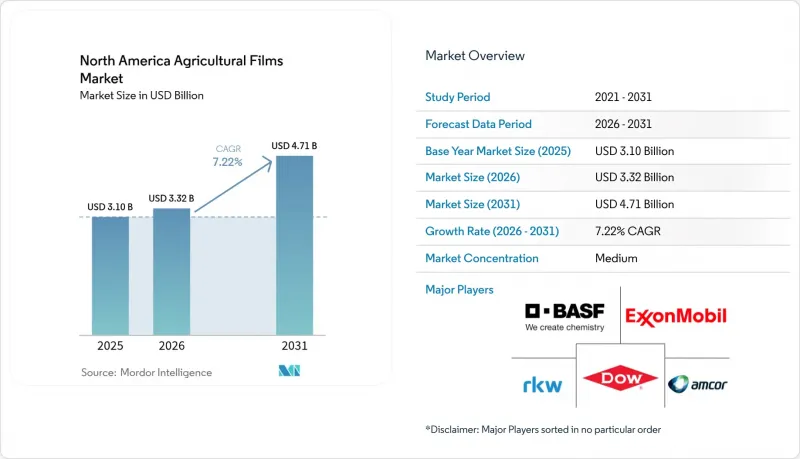
據 Mordor Intelligence 稱,2025 年北美農業薄膜市場價值 31 億美元,預計到 2031 年將從 2026 年的 33.2 億美元成長至 47.1 億美元,預測期(2026-2031 年)複合年成長率為 7.22%。
本報告按類型(低密度聚乙烯、線性低密度聚乙烯、高密度聚苯乙烯、乙烯-醋酸乙烯酯共聚物、乙烯-丙烯酸丁酯共聚物等)、應用(地膜、溫室覆蓋物等)、厚度(80微米或以下等)和地區(美國、加拿大等)進行分類。市場預測以美元(USD)計價。
北美農業薄膜市場趨勢及洞察
在耕地面積不斷減少的情況下,提高產量的需求日益成長。
隨著農業集約化程度的提高,農民面臨雙重挑戰:一方面,由於都市化和氣候變遷導致耕地減少;另一方面,又要養活不斷成長的人口。這推動了農業薄膜的應用。自2020年以來,土地用途轉換加速,生產者擴大採用地膜,這種地膜可使特種作物增產15%至25%,並減少高達40%的用水量。這種多層產品能夠調節土壤溫度並保持水分,即使在氣候變遷加劇的情況下,也能實現全年多次播種。即使原物料價格上漲,這些性能提升仍然極具吸引力,因為每英畝產量的增加足以抵消地膜的成本。
企業淨零排放承諾正在加速可回收薄膜的需求。
隨著食品公司設定再生材料使用和碳減排目標,企業永續性措施正在重塑採購優先事項。像安姆科(Amcor plc)這樣的品牌所有者已承諾在2030年使用30%的再生材料,這項再生材料使用目標正在整個供應鏈中產生連鎖反應。化學回收試點計畫已證實再生膜具有抗污染性,為廢棄農用薄膜開闢了新的市場。雖然再生樹脂的成本高於原生樹脂,但食品公司願意支付溢價以履行其環保承諾,這推動了再生薄膜市場兩位數的成長。
該州嚴格禁止使用一次性塑膠製品
加州參議院第54號法案規定,到2032年一次性塑膠的使用量必須減少25%,這使得農業薄膜在擬議法規下處於灰色地帶。紐約州和華盛頓州也在推動類似的法律體制,這些框架可能會限制傳統聚乙烯薄膜在農業領域的應用。生產者責任組織帶來的合規成本和行政負擔增加了薄膜生產商和經銷商的營運複雜性。各州法規的疊加導致市場碎片化,並使全國性供應商的分銷策略和庫存管理變得困難。
細分市場分析
預計到2025年,低密度聚乙烯(LDPE)在北美農業薄膜市場將維持41.12%的佔有率,這得益於其成熟的供應鏈以及薄膜生產商和農業終端用戶對加工技術的熟悉程度。同時,再生薄膜正成為成長最快的細分市場,預計到2031年將維持10.02%的年複合成長率(CAGR),這主要受企業永續發展政策和監管壓力推動,這些壓力促使企業採用循環經濟模式。線性低密度聚乙烯(LDPE)和高密度聚苯乙烯)用於需要高抗穿刺性和阻隔性的特殊應用,尤其是在青貯和燻蒸領域。乙烯-醋酸乙烯酯共聚物(EVA)和乙烯-丙烯酸丁酯共聚物(EBA)則面向高階溫室覆蓋應用,這些應用需要透光性和耐久性,因此價格也更高。
儘管目前可堆肥薄膜市場佔有率較小,但隨著法律規範的完善和成本溢價的縮小,其成長潛力巨大。BASF公司的「ecovio」地膜技術提供了一種可堆肥的替代方案,既能解決廢棄物問題,又能維持農業生產性能。諾瓦蒙特公司的「Mater-Bi」生質塑膠平台在有機農業應用中日益普及,其土壤可堆肥性為該領域帶來了競爭優勢。該領域向生物基含量更高、機械性能更優方向發展,正在解決先前阻礙其廣泛應用的性能瓶頸。
其他好處:
- Excel格式的市場預測(ME)表
- 3個月的分析師支持
目錄
第1章:引言
- 研究假設和市場定義
- 調查範圍
第2章:調查方法
第3章執行摘要
第4章 市場狀況
- 市場概覽
- 市場促進因素
- 隨著耕地面積減少,提高產量的需求也日益增加。
- 環境控制農業和垂直溫室的擴張
- 大規模酪農養殖導致青貯飼料需求增加
- 企業實現淨零排放的承諾正在加速對可回收薄膜的需求。
- 採用整合物聯網感測器的智慧紫外線選擇性薄膜。
- 州政府津貼可生物分解地膜示範試驗
- 市場限制因素
- 各州對一次性塑膠製品製定了嚴格的法規
- 乙烯原料價格波動
- 高價值多層薄膜在農場層級的投資報酬率 (ROI) 較低。
- 受污染農業塑膠回收物流的挑戰
- 監理情勢
- 技術展望
- 波特五力分析
第5章 市場規模與成長預測
- 按類型
- 低密度聚乙烯(LDPE)
- 線型低密度聚乙烯(LLDPE)
- 高密度聚苯乙烯(HDPE)
- 乙烯-醋酸乙烯酯共聚物和乙烯-丙烯酸丁酯
- 再生膜
- 可生物分解薄膜
- 透過使用
- 覆蓋
- 溫室覆層
- 青貯飼料和草捆的包裝膜
- 燻蒸
- 按厚度
- 80微米或更小
- 81-150微米
- 150微米或以上
- 按地區
- 美國
- 加拿大
- 墨西哥
- 其他北美國家
第6章 競爭情勢
- 市場集中度
- 策略趨勢
- 市佔率分析
- 公司簡介
- Amcor plc
- Exxon Mobil Corporation
- Dow Inc.
- BASF SE
- Armando Alvarez Group
- RKW Group
- Coveris
- Trioworld
- Novamont SpA
- Rani Group
- Ginegar Plastic Products Ltd.
- Polifilm Group
- Sigma Plastics Group
第7章 市場機會與未來展望
According to Mordor Intelligence, the North America agricultural films market size was valued at USD 3.10 billion in 2025 and estimated to grow from USD 3.32 billion in 2026 to reach USD 4.71 billion by 2031, at a CAGR of 7.22% during the forecast period (2026-2031).
This report is Segmented by Type (Low-Density Polyethylene, Linear Low-Density Polyethylene, High-Density Polyethylene, Ethylene Vinyl Acetate, Ethylene Butyl Acrylate, and More), by Application (Mulching, Greenhouse Covering, and More), by Thickness (Up To 80 Micron, and More), and by Geography (United States, Canada, and More). The Market Forecasts are Provided in Terms of Value (USD).
North America Agricultural Films Market Trends and Insights
Growing need to maximize yields on shrinking arable land
Agricultural intensification drives film adoption as farmers confront the dual challenge of feeding growing populations while losing productive acreage to urbanization and climate impacts. Farmland conversion has accelerated since 2020, prompting growers to deploy mulch films that can lift specialty-crop yields 15-25% and cut water use up to 40%. Multi-layer products regulate soil temperature and retain moisture, allowing multiple crop cycles each year despite higher climate volatility. These performance gains are attractive even when feedstock prices rise, because the incremental revenue per acre still offsets film costs.
Corporate net-zero pledges accelerating demand for recyclable films
Corporate sustainability commitments reshape procurement priorities as food companies establish recycled content targets and carbon reduction goals. Brand owners such as Amcor plc pledge 30% recycled content by 2030, cascading recycled-material targets down the supply chain. Chemical-recycling pilots promise contamination tolerance, opening a new outlet for used farm films. Although recycled resin costs exceed virgin prices, food companies pay premiums to validate environmental claims, sustaining double-digit growth in recycled films.
Stringent state bans on single-use plastics
California Senate Bill 54 requires a 25% cut in single-use plastics by 2032, and draft rules leave agricultural films in a gray area. New York and Washington in the United States pursue similar legislative frameworks that could restrict conventional polyethylene film usage in agricultural applications. Compliance costs and administrative burdens associated with producer responsibility organizations add operational complexity for film manufacturers and distributors. The regulatory patchwork across states creates market fragmentation that complicates distribution strategies and inventory management for national suppliers.
Other drivers and restraints analyzed in the detailed report include:
- Adoption of smart, UV-selective films integrating IoT sensors
- State incentives for compostable mulch film trials
- Volatile ethylene feedstock prices
For complete list of drivers and restraints, kindly check the Table Of Contents.
Segment Analysis
Low-density polyethylene is anticipated to maintain a 41.12% share of the North America agricultural films market in 2025, benefiting from established supply chains and processing familiarity among film manufacturers and farming end-users. Recycled films emerge as the fastest-growing segment at 10.02% CAGR through 2031, driven by corporate sustainability mandates and regulatory pressures for circular economy adoption. Linear low-density polyethylene and high-density polyethylene serve specialized applications requiring enhanced puncture resistance and barrier properties, particularly in silage and fumigation applications. Ethylene vinyl acetate and ethylene butyl acrylate copolymers target premium greenhouse covering applications where light transmission and durability command higher pricing.
The compostable films segment, while representing a small current share, demonstrates significant growth potential as regulatory frameworks evolve and cost premiums narrow. BASF SE's ecovio mulch film technology showcases compostable alternatives that eliminate disposal concerns while maintaining agronomic performance. Novamont S.p.A.'s Mater-Bi bioplastic platform gains traction in organic farming applications, where soil compostability provides competitive advantages. The segment's evolution toward higher biobased content and improved mechanical properties addresses historical performance limitations that constrained adoption.
Complete Report Scope:
- By Type
- Low-Density Polyethylene (LDPE)
- Linear Low-Density Polyethylene (LLDPE)
- High-Density Polyethylene (HDPE)
- Ethylene Vinyl Acetate and Ethylene Butyl Acrylate
- Recycled Films
- Compostable Films
- By Application
- Mulching
- Greenhouse Covering
- Silage and Bale Wrap
- Fumigation
- By Thickness
- Up to 80 Micron
- 81 to 150 Micron
- Above 150 Micron
- By Geography
- United States
- Canada
- Mexico
- Rest of North America
List of Companies Covered in this Report:
- Amcor plc
- Exxon Mobil Corporation
- Dow Inc.
- BASF SE
- Armando Alvarez Group
- RKW Group
- Coveris
- Trioworld
- Novamont S.p.A.
- Rani Group
- Ginegar Plastic Products Ltd.
- Polifilm Group
- Sigma Plastics Group
Additional Benefits:
- The market estimate (ME) sheet in Excel format
- 3 months of analyst support
TABLE OF CONTENTS
1 Introduction
- 1.1 Study Assumptions and Market Definition
- 1.2 Scope of the Study
2 Research Methodology
3 Executive Summary
4 Market Landscape
- 4.1 Market Overview
- 4.2 Market Drivers
- 4.2.1 Growing need to maximize yields on shrinking arable land
- 4.2.2 Expansion of controlled-environment agriculture and vertical greenhouses
- 4.2.3 Rising silage demand from large-scale dairy operations
- 4.2.4 Corporate net-zero pledges accelerating demand for recyclable films
- 4.2.5 Adoption of smart, UV-selective films integrating IoT sensors
- 4.2.6 State incentives for compostable mulch film trials
- 4.3 Market Restraints
- 4.3.1 Stringent state bans on single-use plastics
- 4.3.2 Volatile ethylene feedstock prices
- 4.3.3 Slow farm-level ROI on premium multi-layer films
- 4.3.4 Recycling logistics gaps for contaminated agri-plastics
- 4.4 Regulatory Landscape
- 4.5 Technological Outlook
- 4.6 Porter's Five Forces Analysis
- 4.6.1 Threat of New Entrants
- 4.6.2 Bargaining Power of Buyers
- 4.6.3 Bargaining Power of Suppliers
- 4.6.4 Threat of Substitutes
- 4.6.5 Intensity of Competitive Rivalry
5 Market Size and Growth Forecasts (Value)
- 5.1 By Type
- 5.1.1 Low-Density Polyethylene (LDPE)
- 5.1.2 Linear Low-Density Polyethylene (LLDPE)
- 5.1.3 High-Density Polyethylene (HDPE)
- 5.1.4 Ethylene Vinyl Acetate and Ethylene Butyl Acrylate
- 5.1.5 Recycled Films
- 5.1.6 Compostable Films
- 5.2 By Application
- 5.2.1 Mulching
- 5.2.2 Greenhouse Covering
- 5.2.3 Silage and Bale Wrap
- 5.2.4 Fumigation
- 5.3 By Thickness
- 5.3.1 Up to 80 Micron
- 5.3.2 81 to 150 Micron
- 5.3.3 Above 150 Micron
- 5.4 By Geography
- 5.4.1 United States
- 5.4.2 Canada
- 5.4.3 Mexico
- 5.4.4 Rest of North America
6 Competitive Landscape
- 6.1 Market Concentration
- 6.2 Strategic Moves
- 6.3 Market Share Analysis
- 6.4 Company Profiles (Includes Global Level Overview, Market Level Overview, Core Segments, Financials as Available, Strategic Information, Market Rank/Share, Products and Services, and Recent Developments)
- 6.4.1 Amcor plc
- 6.4.2 Exxon Mobil Corporation
- 6.4.3 Dow Inc.
- 6.4.4 BASF SE
- 6.4.5 Armando Alvarez Group
- 6.4.6 RKW Group
- 6.4.7 Coveris
- 6.4.8 Trioworld
- 6.4.9 Novamont S.p.A.
- 6.4.10 Rani Group
- 6.4.11 Ginegar Plastic Products Ltd.
- 6.4.12 Polifilm Group
- 6.4.13 Sigma Plastics Group
7 Market Opportunities and Future Outlook

 金屬化多層膜市場:全球市場預測,2026-2032年
 農業薄膜和黏合劑市場規模、佔有率和趨勢分析報告:按原料、應用、地區和細分市場分類的預測(2026-2033 年)
 全球農業薄膜市場規模、佔有率、趨勢和成長分析報告(2026-2034年)
 農業薄膜:市場佔有率分析、產業趨勢與統計、成長預測(2026-2031)南美洲農業薄膜:市場佔有率分析、產業趨勢與統計及成長預測(2026-2031 年)非洲農業薄膜:市場佔有率分析、產業趨勢與統計及成長預測(2026-2031 年)
 農業薄膜市場規模、佔有率和成長分析:按薄膜類型、材料、應用、最終用戶、分銷管道和地區分類-2026-2033年產業預測
 農業薄膜市場機會、成長要素、產業趨勢分析及2026-2035年預測
 全球農業薄膜市場(至2031年):按類型(低密度聚乙烯、線性低密度聚乙烯、乙烯-醋酸乙烯酯共聚物、再生材料、高密度聚乙烯)、應用(溫室薄膜(傳統溫室、小型隧道)、地膜(黑色地膜、透明地膜))、青貯薄膜(青貯拉伸膜)和地區分類
 農業薄膜和黏合劑市場規模、佔有率和成長分析:按薄膜類型、材料、應用、通路和地區分類-2026-2033年產業預測