


 |
市場調查報告書
商品編碼
2113585
南美洲農業薄膜:市場佔有率分析、產業趨勢與統計及成長預測(2026-2031 年)South America Agricultural Films - Market Share Analysis, Industry Trends & Statistics, Growth Forecasts (2026 - 2031) |
||||||

※ 本網頁內容可能與最新版本有所差異。詳細情況請與我們聯繫。
根據 Mordor Intelligence 預測,南美農業薄膜市場規模將從 2025 年的 5.4 億美元成長到 2026 年的 5.7467 億美元,然後在 2031 年達到 7.8492 億美元,2026 年至 2031 年的複合年成長率為 6.42%。
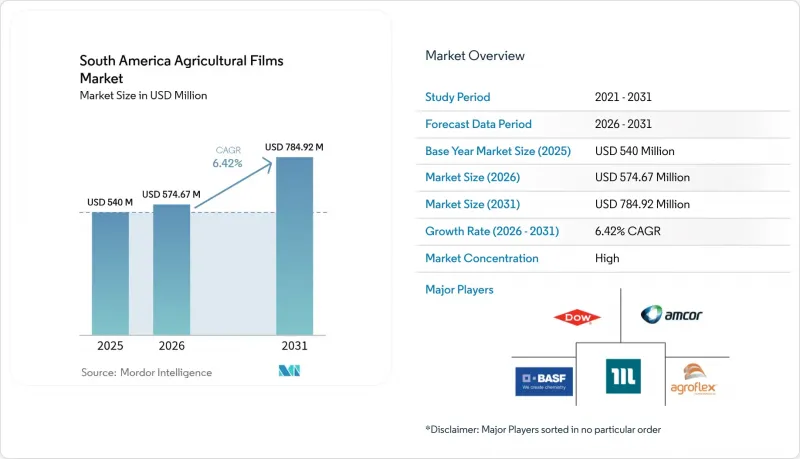
本報告按類型(低密度聚乙烯、線性低密度聚乙烯、高密度聚苯乙烯等)、應用(溫室覆蓋物、青貯飼料和拉伸膜、地膜、燻蒸和太陽能消毒等)以及地區(巴西、阿根廷等)進行細分。市場預測以價值(美元)表示。
南美洲農業薄膜市場趨勢與洞察
溫室農業的廣泛應用
在巴西內陸和阿根廷郊區,用於種植番茄、辣椒和黃瓜的中型溫室設施正在迅速增加。這主要是由於都市區對全年新鮮農產品的需求不斷成長,以及需要採取措施應對難以預測的降雨。預計到2023年,智利的溫室番茄產量將達18萬噸,主要集中在科金博、瓦爾帕萊索和都會區。在這些地區,種植者使用添加了防滴漏劑的低密度聚乙烯(LDPE)和乙烯-乙烯基/乙烯-丁基丙烯酸酯(EVA/EBA)薄膜,以最大限度地降低病害爆發的風險。雖然這些設施的資本密集度通常比露天種植系統高出30%至40%,但可以透過當地推廣服務機構促成的聯合採購模式和租賃協議來抵消這項成本優勢。 2024 年發表在《自然食品》雜誌上的一項衛星測繪研究表明,南美洲溫帶地區的溫室面積正以每年 12% 的速度成長,超過了全球平均水平,這表明對薄膜的需求將持續存在。
透過保護性栽培擴大園藝作物出口
為了滿足北美和歐洲買家嚴格的植物檢疫和外觀標準,以出口為導向的漿果、葡萄和酪梨產業正在轉向塑膠薄膜覆蓋種植。秘魯藍莓出口額預計到2024年將達到15億美元,其位於拉利伯塔德和伊卡地區的2.3萬公頃農田透過地膜下滴灌技術,用水量減少了40%,商品產量提高了25%。智利葡萄產業佔全球鮮食葡萄出口的9%,目前正從露天種植轉向網罩和部分覆蓋系統,以保護果實免受冰雹和日灼的侵害。這一趨勢推動了對高強度溫室聚乙烯薄膜的需求。這些作物的高價足以彌補專用薄膜的額外成本,從而形成良性循環:出口收入為塑膠薄膜種植的進一步推廣提供資金。
有關環境問題和塑膠廢棄物的法律法規
巴西於2024年11月頒布的第12688號法令強制要求對塑膠包裝進行逆向物流,規定到2026年回收率達到32%,再生材料含量達到22%,併計劃到2040年將回收率提高到50%。這些法規迫使加工商投資建造機械回收基礎設施並採購廢舊塑膠,根據行業估計,這將導致生產成本增加10%至15%。諸如用於標註再生材料含量的ISO 14021標準和用於可堆肥性的EN 13432標準等合規框架正逐漸成為事實上的市場准入要求,這使得擁有專門永續發展團隊的大型企業更具優勢。在阿根廷和哥倫比亞,預算限制了環境部門對薄膜廢棄物流動進行審計的能力,導致實施進度存在不確定性。因此,各地的監管情況不盡相同,使得區域供應鏈規劃更加複雜。
細分市場分析
到2025年,低密度聚乙烯(LDPE)將佔據南美農業薄膜市場41.95%的佔有率。這主要得益於其成本優勢、易於加工以及在巴西草莓產區和阿根廷溫室蔬菜種植區地膜和青貯應用中的成熟應用經驗。 LDPE的優勢體現在其用途廣泛,以及針對其熔體流動特性最佳化的擠出成型設備的成功應用。由於其抗穿刺性,LDPE是青貯包裝膜的理想選擇,因為即使是微小的撕裂也會影響厭氧發酵,導致飼料腐敗。
預計到2031年,可生物分解和生物基薄膜市場將以11.10%的複合年成長率成長,這主要得益於Braschem公司生物基聚乙烯(bio-PE)產能的擴張——預計到2024年將達到19.1萬噸,以及巴西強制性再生材料含量要求帶來的監管利好。雖然有機認證農場由於收穫後去除薄膜需要耗費大量人力和成本,正在加速向可生物分解薄膜的過渡,但要實現主流市場應用,進一步降低成本以及開展田間試驗以證明其農業性能與傳統薄膜相當仍然至關重要。在智利和巴西,符合EN 17033和ISO 17033土壤生物分解標準正逐漸成為市場准入的最低要求,這一趨勢有利於擁有配方技術和第三方認證的供應商。
其他好處:
- Excel格式的市場預測(ME)表
- 3個月的分析師支持
目錄
第1章:引言
- 研究假設和市場定義
- 調查範圍
第2章:調查方法
第3章執行摘要
第4章 市場狀況
- 市場概覽
- 市場促進因素
- 溫室種植正變得越來越普遍。
- 透過保護性栽培促進園藝作物出口成長
- 政府對氣候智慧型農業的支持措施
- 擴大高價值漿果和酪梨的種植面積。
- 生物分解/生物聚乙烯薄膜產能的提升
- 農業技術領域為塑膠農業新創公司資金籌措
- 市場限制因素
- 有關環境問題和塑膠廢棄物的法律法規
- 與傳統地板材料相比,初始成本較高
- 乙烯原料供應鏈的波動性
- 除了巴西東南部內陸地區外,農民採用這種技術的情況並不普遍。
- 監理情勢
- 技術展望
- 波特五力分析
第5章 市場規模與成長預測
- 按類型
- 低密度聚乙烯(LDPE)
- 線型低密度聚乙烯(LLDPE)
- 高密度聚苯乙烯(HDPE)
- 乙酸乙酯/乙烯-丁基丙烯酸乙烯酯共聚物(EVA/EBA)
- 可生物分解/生物基薄膜
- 透過使用
- 溫室覆層
- 青貯飼料和拉伸膜
- 多重膠片
- 燻蒸和土壤消毒
- 其他
- 按地區
- 巴西
- 阿根廷
- 智利
- 哥倫比亞
- 其他南美國家
第6章 競爭情勢
- 策略趨勢
- 市佔率分析
- 公司簡介
- Dow Inc.
- Berry Global Inc.
- BASF SE
- Manupackaging Deutschland GmbH & Co. KG
- Agroflex Industria de Plasticos Ltda.
- Novamont SpA
- RKW SE
- Trioplast Industrier AB
- Armando Alvarez SA
- Polifilm Extrusion GmbH
- Groupe Barbier SAS
- Ginegar Plastic Products Ltd.
- Braskem SA
- Coveris Management GmbH
- Plastika Kritis SA
第7章 市場機會與未來展望
According to Mordor Intelligence, the South America agricultural films market size is expected to grow from USD 540 million in 2025 to USD 574.67 million in 2026 and is forecast to reach USD 784.92 million by 2031 at 6.42% CAGR over 2026-2031.
This report is Segmented by Type (Low-Density Polyethylene, Linear Low-Density Polyethylene, High-Density Polyethylene, and More), by Application (Greenhouse Covering, Silage and Stretch Wrap, Mulching Films, Fumigation and Solarization, and More), and by Geography (Brazil, Argentina, and More). The Market Forecasts are Provided in Terms of Value (USD).
South America Agricultural Films Market Trends and Insights
Rising Adoption of Greenhouse Farming
Mid-sized greenhouse installations for tomatoes, peppers, and cucumbers are proliferating across Brazil's interior and Argentina's peri-urban zones, driven by urban demand for year-round fresh produce and the need to buffer against erratic rainfall. Chile's greenhouse tomato production reached 180,000 metric tons in 2023, primarily concentrated in Coquimbo, Valparaiso, and the Metropolitan Region, where growers utilize Low-Density Polyethylene (LDPE) and Ethyl Vinyl Acetate/Ethylene Butyl Acrylate (EVA/EBA) films with anti-drip additives to minimize disease pressure. The capital intensity of these structures, typically 30 to 40% above bare-soil systems, is being offset by cooperative purchasing models and leasing arrangements brokered through regional extension services. Satellite mapping studies published in Nature Food during 2024 identified a 12% annual increase in greenhouse footprint across South America's temperate zones, a rate that outpaces global averages and signals sustained film demand.
Growth of Protected Horticulture Exports
Export-oriented berry, grape, and avocado sectors are shifting to plasticulture to meet stringent phytosanitary and cosmetic standards imposed by North American and European buyers. Peru's blueberry exports totaled USD 1.5 billion in 2024, sourced from 23,000 hectares in La Libertad and Ica, where drip irrigation under mulch films reduces water consumption by 40% and lifts marketable yields by 25%. Chile's grape sector, which accounts for 9% of global fresh table grape exports, is transitioning from open-field to netted and partially covered systems that shield fruit from hail and sunburn, a trend that increases demand for greenhouse-grade polyethylene with enhanced tensile strength. The premium pricing these crops command justifies the incremental cost of specialty films, creating a virtuous cycle where export revenue funds further plasticulture adoption.
Environmental Concerns and Plastic-Waste Legislation
Brazil's Decree 12,688, enacted in November 2024, mandates reverse logistics for plastic packaging, requiring a 32% recovery rate and 22% recycled content by 2026, with the goal of escalating to 50% recovery by 2040 . These regulations compel converters to invest in mechanical-recycling infrastructure and source post-consumer resin, raising production costs by 10 to 15% according to industry estimates. Compliance frameworks such as ISO 14021 for recycled-content claims and EN 13432 for compostability are becoming de facto market-entry requirements, favoring larger players with dedicated sustainability teams. The enforcement timeline remains uncertain in Argentina and Colombia, where budget constraints limit the capacity of environmental agencies to audit film waste streams, creating a patchwork regulatory landscape that complicates regional supply-chain planning.
Other drivers and restraints analyzed in the detailed report include:
- Government Incentives for Climate-Smart Agriculture
- Expansion of High-Value Berry and Avocado Crops
- High Initial Cost Versus Conventional Coverings
For complete list of drivers and restraints, kindly check the Table Of Contents.
Segment Analysis
Low-Density Polyethylene (LDPE) captured 41.95% of the South America agricultural films market size in 2025, underpinned by its cost advantage, ease of processing, and proven performance in mulching and silage applications across Brazil's strawberry belt and Argentina's greenhouse vegetable zones. The dominance of Low-Density Polyethylene (LDPE) reflects its versatility across multiple applications and the installed base of extrusion equipment optimized for its melt-flow characteristics. Low-Density Polyethylene (LDPE) puncture resistance makes it the preferred choice for silage wrap, where a single tear can compromise anaerobic fermentation and lead to feed spoilage.
Biodegradable and bio-based films, which are projected to advance at an 11.10% CAGR through 2031, are driven by Braskem's bio-PE capacity expansion to 191 kilotons in 2024 and regulatory tailwinds from Brazil's recycled-content mandates. The shift toward biodegradable films is accelerating in organic-certified operations, where post-harvest film removal is labor-intensive and costly, but mainstream adoption hinges on further cost reductions and field trials demonstrating equivalent agronomic performance. Compliance with EN 17033 and ISO 17033 standards for soil biodegradability is emerging as a baseline requirement for market access in Chile and Brazil, a dynamic that favors suppliers with formulation expertise and third-party certification.
Complete Report Scope:
- By Type
- Low-Density Polyethylene (LDPE)
- Linear Low-Density Polyethylene (LLDPE)
- High-Density Polyethylene (HDPE)
- Ethyl Vinyl Acetate / Ethylene Butyl Acrylate (EVA/EBA)
- Biodegradable/Bio-based Films
- By Application
- Greenhouse Covering
- Silage and Stretch Wrap
- Mulching Films
- Fumigation and Solarization
- Others
- By Geography
- Brazil
- Argentina
- Chile
- Colombia
- Rest of South America
List of Companies Covered in this Report:
- Dow Inc.
- Berry Global Inc.
- BASF SE
- Manupackaging Deutschland GmbH & Co. KG
- Agroflex Industria de Plasticos Ltda.
- Novamont S.p.A.
- RKW SE
- Trioplast Industrier AB
- Armando Alvarez S.A.
- Polifilm Extrusion GmbH
- Groupe Barbier SAS
- Ginegar Plastic Products Ltd.
- Braskem S.A.
- Coveris Management GmbH
- Plastika Kritis S.A.
Additional Benefits:
- The market estimate (ME) sheet in Excel format
- 3 months of analyst support
TABLE OF CONTENTS
1 INTRODUCTION
- 1.1 Study Assumptions and Market Definition
- 1.2 Scope of the Study
2 RESEARCH METHODOLOGY
3 EXECUTIVE SUMMARY
4 MARKET LANDSCAPE
- 4.1 Market Overview
- 4.2 Market Drivers
- 4.2.1 Rising adoption of greenhouse farming
- 4.2.2 Growth of protected horticulture exports
- 4.2.3 Government incentives for climate-smart agriculture
- 4.2.4 Expansion of high-value berry and avocado crops
- 4.2.5 Emergence of biodegradable/Bio-PE film capacity
- 4.2.6 Agri-tech financing for plasticulture start-ups
- 4.3 Market Restraints
- 4.3.1 Environmental concerns and plastic-waste legislation
- 4.3.2 High initial cost versus conventional coverings
- 4.3.3 Supply-chain volatility in ethylene feedstocks
- 4.3.4 Slow farmer adoption outside Brazil's south-east interiors
- 4.4 Regulatory Landscape
- 4.5 Technological Outlook
- 4.6 Porter's Five Forces Analysis
- 4.6.1 Bargaining Power of Suppliers
- 4.6.2 Bargaining Power of Buyers
- 4.6.3 Threat of New Entrants
- 4.6.4 Threat of Substitutes
- 4.6.5 Intensity of Competitive Rivalry
5 MARKET SIZE AND GROWTH FORECASTS (VALUE)
- 5.1 By Type
- 5.1.1 Low-Density Polyethylene (LDPE)
- 5.1.2 Linear Low-Density Polyethylene (LLDPE)
- 5.1.3 High-Density Polyethylene (HDPE)
- 5.1.4 Ethyl Vinyl Acetate / Ethylene Butyl Acrylate (EVA/EBA)
- 5.1.5 Biodegradable/Bio-based Films
- 5.2 By Application
- 5.2.1 Greenhouse Covering
- 5.2.2 Silage and Stretch Wrap
- 5.2.3 Mulching Films
- 5.2.4 Fumigation and Solarization
- 5.2.5 Others
- 5.3 By Geography
- 5.3.1 Brazil
- 5.3.2 Argentina
- 5.3.3 Chile
- 5.3.4 Colombia
- 5.3.5 Rest of South America
6 COMPETITIVE LANDSCAPE
- 6.1 Strategic Moves
- 6.2 Market Share Analysis
- 6.3 Company Profiles (Includes Global Level Overview, Market Level Overview, Core Segments, Financials as Available, Strategic Information, Market Rank/Share, Products and Services, Recent Developments)
- 6.3.1 Dow Inc.
- 6.3.2 Berry Global Inc.
- 6.3.3 BASF SE
- 6.3.4 Manupackaging Deutschland GmbH & Co. KG
- 6.3.5 Agroflex Industria de Plasticos Ltda.
- 6.3.6 Novamont S.p.A.
- 6.3.7 RKW SE
- 6.3.8 Trioplast Industrier AB
- 6.3.9 Armando Alvarez S.A.
- 6.3.10 Polifilm Extrusion GmbH
- 6.3.11 Groupe Barbier SAS
- 6.3.12 Ginegar Plastic Products Ltd.
- 6.3.13 Braskem S.A.
- 6.3.14 Coveris Management GmbH
- 6.3.15 Plastika Kritis S.A.
7 MARKET OPPORTUNITIES AND FUTURE OUTLOOK

 全球農業薄膜市場規模、佔有率、趨勢和成長分析報告(2026-2034年)
 農業薄膜:市場佔有率分析、產業趨勢與統計、成長預測(2026-2031)北美農業薄膜:市佔率分析、產業趨勢與統計及成長預測(2026-2031 年)非洲農業薄膜:市場佔有率分析、產業趨勢與統計及成長預測(2026-2031 年)
 農業薄膜市場:按類型、聚合物類型、薄膜厚度、應用和銷售管道分類-2026-2032年全球市場預測
 農業薄膜市場規模、佔有率和成長分析:按薄膜類型、材料、應用、最終用戶、分銷管道和地區分類-2026-2033年產業預測
 農業薄膜市場機會、成長要素、產業趨勢分析及2026-2035年預測
 全球農業薄膜市場(至2031年):按類型(低密度聚乙烯、線性低密度聚乙烯、乙烯-醋酸乙烯酯共聚物、再生材料、高密度聚乙烯)、應用(溫室薄膜(傳統溫室、小型隧道)、地膜(黑色地膜、透明地膜))、青貯薄膜(青貯拉伸膜)和地區分類
 農業薄膜和黏合劑市場規模、佔有率和成長分析:按薄膜類型、材料、應用、通路和地區分類-2026-2033年產業預測
 2026年全球反射多層膜市場報告