


 |
市場調查報告書
商品編碼
2121523
亞太地區水產飼料:市場佔有率分析、產業趨勢與統計、成長預測(2026-2031)Asia-Pacific Aqua Feed - Market Share Analysis, Industry Trends & Statistics, Growth Forecasts (2026 - 2031) |
||||||

※ 本網頁內容可能與最新版本有所差異。詳細情況請與我們聯繫。
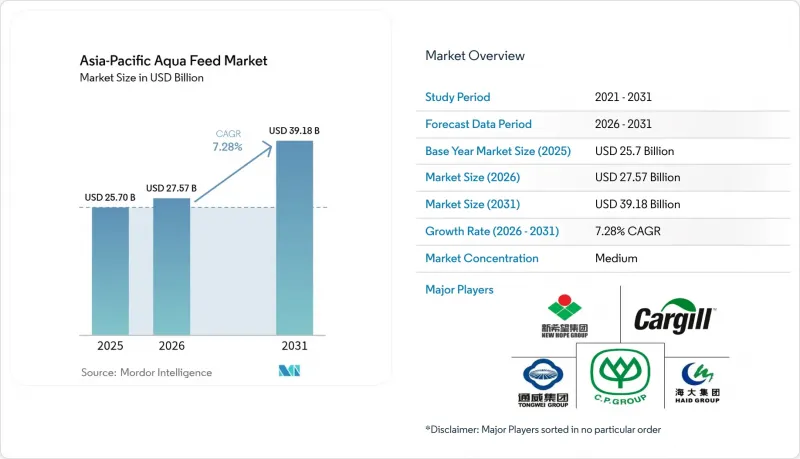
據 Mordor Intelligence 稱,亞太地區水產飼料市場預計到 2026 年將達到 275.7 億美元,高於 2025 年的 257 億美元,預計到 2031 年將達到 391.8 億美元。
預計從 2026 年到 2031 年,其複合年成長率將達到 7.28%。
本報告按物種(魚類、甲殼類動物等)、原料(大豆粕、魚粉、魚油等)、形態(顆粒、膨化飼料等)和地區(中國、印度、印尼等)進行分類。市場預測以美元計價。
亞太地區水產飼料市場趨勢與洞察
中國和印度水產養殖生產的擴張
2024年中國水產養殖產量較上年略有成長,這印證了北京政府旨在實現國內蛋白質來源多元化的政策努力。印度也關注類似領域,但每年都會遭受疾病造成的損失。因此,隨著水產養殖池放養密度的增加和蝦類養殖場的擴張,飼料生產商必須提高氨基酸組成的精確度,並提供增強免疫力的添加劑。越南和泰國對本地供應鏈的投資正受益於區域加工中心對部分激增的原料飼料需求的吸收。中國農業農村部實施的更嚴格的原料標準提高了合規門檻,有利於那些能夠證明營養成分一致性和可追溯性的生產商。
收入成長推動了水產品消費量的成長。
亞太地區水產品需求蓬勃發展,這主要得益於中產階級購買力的增強以及快速都市化帶來的飲食結構變化。上海、孟買和雅加達等城市的消費者正在引領高階消費趨勢,他們追求消化率、風味和保存期限更高的飼料。隨著養殖戶獲得更高的收購價格,他們也增加了對功能性添加劑的預算投入,以保護養殖魚類的健康,從而形成了一個良性循環,促使養殖戶加大對優質複合飼料的投入。印尼設定的200萬噸蝦產量目標正在提振當地的蝦苗孵化場,但考慮到基礎設施的不足,這項計畫顯得過於樂觀。
魚粉和魚油價格波動
預計2024年魚粉現貨價格平均將在每噸1504美元至1882美元之間波動,這將導致利潤率劇烈波動,並使庫存計劃變得複雜。亞洲小規模魚粉加工廠缺乏避險手段,正迫切尋找豆粕的替代品,但肉食性魚類仍需要高濃度的海洋胺基酸。魚油價格的波動與魚粉價格的波動密切相關,這促使人們嘗試引入藻類油脂,儘管其初始成本較高。越南和泰國的出口商與全球買家談判價格的空間有限,加劇了這種不穩定的局面。各種替代品的出現正在加速微生物和昆蟲油脂的研發,這些油脂能夠在保持必需脂肪酸組成的同時,緩解價格衝擊。
細分市場分析
預計到2025年,魚飼料將佔亞太地區水產養殖飼料市場佔有率的51.35%,進一步鞏固了其在亞太地區水產養殖飼料市場中佔據的絕對主導地位。鯉魚、吳郭魚、鯰魚以及各種海水魚支撐著中國龐大的養殖規模,每種魚類都需要獨特的胺基酸比例才能達到最佳飼料轉換率。亞太地區甲殼類水產飼料市場目前規模仍較小,但由於越南、泰國和印尼等國的蝦類養殖場集約化養殖並採用高蛋白飼料,該市場正迅速擴張。甲殼類市場預計將呈現最高的成長率,2026年至2031年的複合年成長率(CAGR)預計為8.22%,反映出強勁的需求動能。
對於軟體動物而言,預計來自中國沿海綜合水產養殖企業的穩定訂單將主要來自雙殼類動物,這些企業透過雙殼類動物循環利用過剩營養物質。雖然鰻魚和觀賞魚等新興市場仍屬於小眾市場,但其高價位使得專業生產者能夠獲得更高的利潤。精準飼料技術的進步,使飼料轉換率高達20%,有助於水產養殖戶縮短投餵時間,同時提高魚苗存活率。生產商正在調整維生素和礦物質配方以適應水溫波動,從而減輕壓力相關疾病的發生。最終,魚類品種的多樣性正在為客製化飼料創造利基市場,這些飼料既能永續地提高產量,又能保護生產商免受商品價格壓力的影響。
其他好處:
- Excel格式的市場預測(ME)表
- 3個月的分析師支持
目錄
第1章:引言
- 市場分析與定義的前提條件
- 分析範圍
第2章 分析方法
第3章執行摘要
第4章 市場狀況
- 市場概覽
- 市場促進因素
- 中國和印度水產養殖生產的擴張
- 收入成長帶動水產品消費量增加
- 營養均衡、種子專用配方的進展。
- 擴大擠壓水產飼料的使用範圍以提高消化率
- 政府推廣綜合多營養級水產養殖
- 擴大近海網箱養殖
- 市場限制因素
- 魚粉和魚油價格波動
- 因疫情爆發,出院量暫時減少
- 飼料磷排放的監管限制
- 與單細胞蛋白替代品的競爭
- 監理情勢
- 技術展望
- 波特五力分析
第5章:預測市場規模與成長率
- 按品種
- 魚
- 甲殼類動物
- 軟體動物
- 其他(鰻魚等)
- 按成分
- 大豆粕
- 魚粉
- 魚油
- 功能性添加劑
- 其他(玉米蛋白等)
- 按形狀
- 顆粒
- 擠壓飼料
- 粉狀飼料
- 液態飼料
- 國家
- 中國
- 印度
- 印尼
- 越南
- 泰國
- 其他亞太國家
第6章 競爭情勢
- 市場集中度
- 策略趨勢
- 市佔率分析
- 公司簡介
- Charoen Pokphand Foods PCL
- Cargill, Inc.
- Tongwei Group Co., Ltd.
- SHV Holdings
- New Hope Group
- ADM
- Alltech
- Guangdong HAID Group Co., Ltd.
- Aller Aqua A/S
- Thai Union Feedmill Public Company Limited.
- De Heus Animal Nutrition
- Avanti Feeds Limited
- IFB Agro Industries Ltd
- Schouw & Co.,(Biomar)
- Maruichi Co., Ltd.(Dainichi)
- Godrej Agrovet Limited
- Ridley Corporation Limited.
- Kemin Industries, Inc.
第7章 市場機會與未來展望
According to Mordor Intelligence, Asia-Pacific aquafeed market size in 2026 is estimated at USD 27.57 billion, growing from 2025 value of USD 25.7 billion with 2031 projections showing USD 39.18 billion, growing at 7.28% CAGR over 2026-2031.
This report is Segmented by Species (Fish, Crustaceans, and More), Ingredient (Soybean Meal, Fishmeal, Fish-Oil, and More), Form (Pellets, Extruded Feed, and More), and Geography (China, India, Indonesia, and More). The Market Forecasts are Provided in Terms of Value (USD).
Asia-Pacific Aqua Feed Market Trends and Insights
Intensifying Aquaculture Production in China and India
China's aquaculture output in 2024 represented a modest year-over-year rise and underscores Beijing's policy commitment to diversifying national protein sources. India mirrors that focus but wrestles with disease-linked losses each year. Larger pond stocking densities and expanding shrimp estates, therefore, compel feed makers to deliver higher amino-acid precision and stronger immune additives. Local supply chain investments in Vietnam and Thailand benefit as regional processing hubs capture a portion of surging raw-feed demand. Enforcement of stricter ingredient standards by China's Ministry of Agriculture and Rural Affairs raises compliance hurdles, favoring producers that can document nutrient consistency and traceability.
Rising Seafood Consumption Driven by Income Growth
Seafood demand in the Asia-Pacific is flourishing, lifted by swelling middle-class wallets and fast-urbanizing diets. Domestic buyers across Shanghai, Mumbai, and Jakarta fuel a premium shift that rewards feed with superior digestibility, flavor, and shelf-life performance. As producers command higher farm-gate prices, they allocate bigger budgets toward functional additives that protect stock health, reinforcing a virtuous spending loop for quality formulations. Indonesia's goal of 2 million metric tons of shrimp output galvanizes local hatcheries, even if timelines appear optimistic in light of infrastructure gaps.
Volatile Fishmeal and Fish-Oil Prices
Spot fishmeal averaged USD 1,504 to USD 1,882 per metric ton in 2024, whipsawing margins and complicating inventory planning. Smaller Asian mills lacking hedging tools scramble for soybean meal substitutions, but carnivorous species still require concentrated marine amino acids. Fish-oil turbulence echoes meal swings and fuels algae-oil pilots despite higher upfront costs. Vietnamese and Thai exporters face thin price flexibility against global buyers, magnifying the squeeze. Broad substitution accelerates R&D toward microbial and insect oils that soothe price shocks but retain essential fatty-acid profiles.
Other drivers and restraints analyzed in the detailed report include:
- Advances in Nutritionally Balanced, Species-Specific Formulations
- Increasing Adoption of Extruded Aquafeed for Improved Digestibility
- Disease Outbreaks Leading to Temporary Stocking Cuts
For complete list of drivers and restraints, kindly check the Table Of Contents.
Segment Analysis
Fish diets generated 51.35% of the Asia-Pacific aquafeed market share in 2025, confirming the segment's volume supremacy within the Asia-Pacific aquafeed market. Carp, tilapia, catfish, and diverse marine finfish underpin China's mammoth output, with each species requiring unique amino-acid ratios to hit optimal feed-conversion benchmarks. The Asia-Pacific aquafeed market size attached to crustaceans remains smaller today, yet is rising quickly as shrimp estates in Vietnam, Thailand, and Indonesia pursue intensification and higher protein feeds. Crustaceans are estimated to grow at the highest rate, with an estimated CAGR of 8.22% from 2026 to 2031, reflecting strong demand momentum.
Mollusk feed sees steady orders from Chinese coastal polyculture schemes that recycle excess nutrients through bivalves. Emerging eel and ornamental species stay in niche but command premium prices, enabling specialty manufacturers to charge higher margins. Precision-nutrition gains, delivering up to 20% feed-conversion efficiencies, allow growers to trim feeding days while lifting survival rates. Producers calibrate vitamin and mineral packs against water-temperature swings to mitigate stress-related diseases. Ultimately, wide species variety ensures sustained tonnage growth while inviting tailored feed niches that cushion producers from commodity price pressure.
Complete Report Scope:
- By Species
- Fish
- Crustaceans
- Mollusks
- Others (Eels, etc.)
- By Ingredient
- Soybean Meal
- Fishmeal
- Fish-oil
- Functional Additives
- Others (Corn Gluten, etc.)
- By Form
- Pellets
- Extruded Feed
- Powdered Meal
- Liquid Feed
- By Country
- China
- India
- Indonesia
- Vietnam
- Thailand
- Rest of Asia-Pacific
List of Companies Covered in this Report:
- Charoen Pokphand Foods PCL
- Cargill, Inc.
- Tongwei Group Co., Ltd.
- SHV Holdings
- New Hope Group
- ADM
- Alltech
- Guangdong HAID Group Co., Ltd.
- Aller Aqua A/S
- Thai Union Feedmill Public Company Limited.
- De Heus Animal Nutrition
- Avanti Feeds Limited
- IFB Agro Industries Ltd
- Schouw & Co., (Biomar)
- Maruichi Co., Ltd. (Dainichi)
- Godrej Agrovet Limited
- Ridley Corporation Limited.
- Kemin Industries, Inc.
Additional Benefits:
- The market estimate (ME) sheet in Excel format
- 3 months of analyst support
TABLE OF CONTENTS
1 Introduction
- 1.1 Study Assumptions and Market Definition
- 1.2 Scope of the Study
2 Research Methodology
3 Executive Summary
4 Market Landscape
- 4.1 Market Overview
- 4.2 Market Drivers
- 4.2.1 Intensifying aquaculture production in China and India
- 4.2.2 Rising seafood consumption driven by income growth
- 4.2.3 Advances in nutritionally-balanced, species-specific formulations
- 4.2.4 Increasing adoption of extruded aquafeed for improved digestibility
- 4.2.5 Government push for integrated multi-trophic aquaculture
- 4.2.6 Expansion of offshore cage farming
- 4.3 Market Restraints
- 4.3.1 Volatile fishmeal and fish-oil prices
- 4.3.2 Disease outbreaks leading to temporary stocking cuts
- 4.3.3 Regulatory caps on phosphorus discharge from feed
- 4.3.4 Competition from single-cell protein alternatives
- 4.4 Regulatory Landscape
- 4.5 Technological Outlook
- 4.6 Porter's Five Forces
- 4.6.1 Threat of New Entrants
- 4.6.2 Bargaining Power of Suppliers
- 4.6.3 Bargaining Power of Buyers
- 4.6.4 Threat of Substitutes
- 4.6.5 Intensity of Competitive Rivalry
5 Market Size and Growth Forecasts (Value)
- 5.1 By Species
- 5.1.1 Fish
- 5.1.2 Crustaceans
- 5.1.3 Mollusks
- 5.1.4 Others (Eels, etc.)
- 5.2 By Ingredient
- 5.2.1 Soybean Meal
- 5.2.2 Fishmeal
- 5.2.3 Fish-oil
- 5.2.4 Functional Additives
- 5.2.5 Others (Corn Gluten, etc.)
- 5.3 By Form
- 5.3.1 Pellets
- 5.3.2 Extruded Feed
- 5.3.3 Powdered Meal
- 5.3.4 Liquid Feed
- 5.4 By Country
- 5.4.1 China
- 5.4.2 India
- 5.4.3 Indonesia
- 5.4.4 Vietnam
- 5.4.5 Thailand
- 5.4.6 Rest of Asia-Pacific
6 Competitive Landscape
- 6.1 Market Concentration
- 6.2 Strategic Moves
- 6.3 Market Share Analysis
- 6.4 Company Profiles (Includes Global Level Overview, Market Level Overview, Core Segments, Financials as Available, Strategic Information, Market Rank/Share for Key Companies, Products and Services, and Recent Developments)
- 6.4.1 Charoen Pokphand Foods PCL
- 6.4.2 Cargill, Inc.
- 6.4.3 Tongwei Group Co., Ltd.
- 6.4.4 SHV Holdings
- 6.4.5 New Hope Group
- 6.4.6 ADM
- 6.4.7 Alltech
- 6.4.8 Guangdong HAID Group Co., Ltd.
- 6.4.9 Aller Aqua A/S
- 6.4.10 Thai Union Feedmill Public Company Limited.
- 6.4.11 De Heus Animal Nutrition
- 6.4.12 Avanti Feeds Limited
- 6.4.13 IFB Agro Industries Ltd
- 6.4.14 Schouw & Co., (Biomar)
- 6.4.15 Maruichi Co., Ltd. (Dainichi)
- 6.4.16 Godrej Agrovet Limited
- 6.4.17 Ridley Corporation Limited.
- 6.4.18 Kemin Industries, Inc.
7 Market Opportunities and Future Outlook

 中國水產飼料:市場佔有率分析、產業趨勢與統計及成長預測(2026-2031年)水產飼料:市場佔有率分析、產業趨勢與統計、成長預測(2026-2031)歐洲水產飼料:市場佔有率分析、產業趨勢與統計及成長預測(2026-2031)
 水產養殖飼料市場:2026-2032年全球市場預測(依飼料種類、食材種類、原料來源種類、目標魚類、水產養殖系統、水產養殖環境、飼料配方、最終使用者和分銷管道分類)微藻類水產飼料:市場佔有率分析、行業趨勢和統計數據以及成長預測(2026-2031 年)
 水產飼料市場報告:按魚類品種、原料、添加劑、產品形式和地區分類(2026-2034 年)
 水生幼蟲飼料市場規模、佔有率和成長分析:按類型、應用、配方/形式、配銷通路、物種、地區和行業預測,2026-2033年
 水產養殖飼料酵素市場規模、佔有率和成長分析:按酵素類型、酵素形態、水生動物和地區分類-2026-2033年產業預測
 水產飼料市場規模、佔有率、成長和全球產業分析:按類型、應用和地區分類,並對 2026-2034 年進行洞察和預測。全球飼料市場規模、佔有率、趨勢和成長分析報告(2026-2034年)