


 |
市場調查報告書
商品編碼
2114112
中國水產飼料:市場佔有率分析、產業趨勢與統計及成長預測(2026-2031年)China Aqua Feed - Market Share Analysis, Industry Trends & Statistics, Growth Forecasts (2026 - 2031) |
||||||

※ 本網頁內容可能與最新版本有所差異。詳細情況請與我們聯繫。
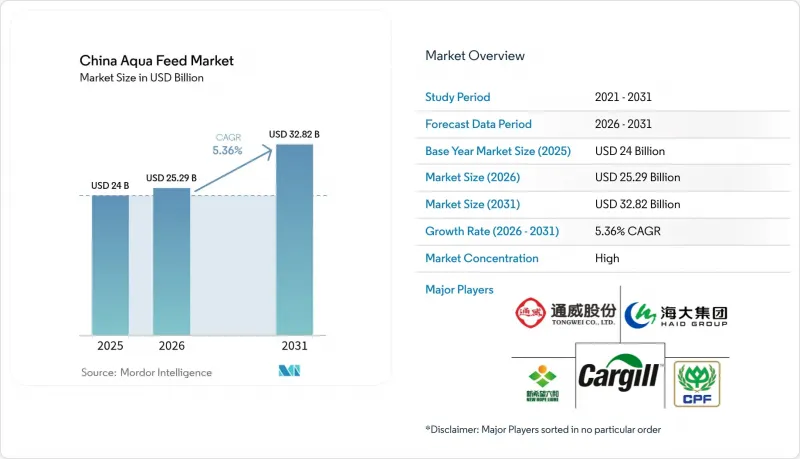
根據 Mordor Intelligence 估計,中國水產飼料市場在 2026 年的價值將達到 252.9 億美元,高於 2025 年的 240 億美元,預計到 2031 年將達到 328.2 億美元。
預計從 2026 年到 2031 年,年複合成長率將達到 5.36%。
本報告依目標動物(魚類、甲殼類動物等)、原料(穀物、魚粉、大豆粕等)及形態(顆粒、膨化飼料等)進行分類。市場預測以美元計價。
中國水產養殖飼料市場趨勢及洞察
人均國內水產品消費量成長
2024年,都市區居民水產品消費量達41.6公斤,較2020年成長9.5%。這主要得益於低溫運輸網路的完善延長了海鮮的保存期限,以及電子商務通路的拓展。消費者對蝦、吳郭魚和鮭魚等魚類的需求正在成長,這些魚類需要高營養、高魚粉含量的飼料,從而推高了優質複合飼料的噸位收益。沿海居民的海鮮消費量已超過50公斤,而內陸居民的平均消費量僅30公斤,顯示中部省份的海鮮市場仍有銷售量潛力。 「大食計畫」的補貼正在抵消養殖池現代化改造的成本,並鼓勵養殖戶改用可縮短養殖週期的優質膨化飼料。京東生鮮等電商平台2024年的水產品銷售額年增30%,印證了物流主導的消費模式轉變。
政府的「雙循環」政策支持農業技術
「十四五」規劃撥款150億元人民幣(約21億美元)用於飼料廠自動化、種苗改良及循環水養殖系統等領域的補貼,加速技術推廣應用。多個省份的試點計畫結合物聯網感測器和自動投餵系統,累計使示範農場的人事費用降低40%,飼料轉換率提高15%。監管機構規定,到2026年,市售飼料中80%必須符合國家品質標準,這將淘汰小規模飼料廠,加速產業結構調整。通威和廣東海德集團利用這些激勵措施,推出了年產能超過10萬噸的擠壓生產線,節能約25%。注重國內原料自給自足的政策促進了大豆壓榨產能的擴大和昆蟲蛋白示範計畫的建設,為企業抵禦進口價格波動提供了緩衝。
魚粉和大豆價格波動
2024年,厄爾尼諾現象導致鳀魚捕撈配額減少,秘魯魚粉價格在每噸1500至1600美元之間波動,第二季度價格飆升使加工商的利潤率下降了200至300個基點。由於巴西收成前景不確定性以及中美政策變化,大豆粕價格在每噸450至550美元之間波動,迫使庫存週期為30天的煉油廠重新分配營運資金。大型企業透過避險和長期合約確保供應,而小型和獨立企業則面臨嚴重的現金流問題,加速了產業整合。
細分市場分析
受湖北、湖南和江西三省強勁需求的支撐,魚飼料預計到2025年將佔銷售額的45.60%。甲殼類飼料是成長最快的品類,預計年複合成長率將達到7.45%,主要得益於廣東和廣西壯族自治區闆對蝦養殖的集約發展。在中國水產飼料市場,甲殼類飼料的市場規模預計將超過草食性魚類飼料。這是因為出口溢價使得較高的魚粉含量成為合理選擇。吳郭魚飼料預計到2024年產量將達180萬噸,出口前景依然良好,但疾病風險將對利潤率構成壓力。山東省陸基鮭魚養殖場的產量已達1.5萬噸,需要高蛋白複合飼料,其價格比鯉魚飼料高出30%,代表著一個具有巨大成長潛力的細分市場。青海和甘肅兩省的鱒魚飼料雖然規模不大,但由於冷水魚獨特的脂質成分,價格卻居高不下。儘管軟體動物和其他物種的飼料需求總佔比不到10%,但微藻類添加劑正迎來新的發展機會。
得益於育種技術的進步,2024年核准的改良鯉魚和吳郭魚品種的飼料轉換率提高了8%至10%。同時,在甲殼類飼料,企業正努力在維持魚粉含量超過25%的同時,兼顧獲利能力。投資於物種特異性研究和合作育種計畫的企業,可以進入一個營養精準度更高、價格更優的細分市場。因此,儘管鯉魚在銷售上仍佔據主導地位,但高附加價值飼料在中國水產飼料市場的佔有率預計將會上升。
其他好處:
- Excel格式的市場預測(ME)表
- 3個月的分析師支持
目錄
第1章:引言
- 研究假設和市場定義
- 調查範圍
第2章:調查方法
第3章執行摘要
第4章 市場狀況
- 市場概覽
- 市場促進因素
- 國內水產品人均消費量成長
- 政府的「雙循環」政策支持農業技術
- 沿海地區出口導向水產養殖叢集的興起
- 飼料廠的快速整合正在提高設備運轉率。
- 在大規模水產養殖池塘中引入配備人工智慧的智慧投餵器
- 昆蟲蛋白質的商業化
- 市場限制因素
- 魚粉和大豆價格波動
- 水生動物疾病爆發
- 小規模農戶不願採用高性能擠壓飼料
- 主要Delta地區環境承載力的局限性
- 監理情勢
- 技術展望
- 波特五力分析
第5章 市場規模與成長預測
- 按目標動物
- 魚
- 鯉魚
- 吳郭魚
- 鮭魚
- 鯰魚
- 其他魚類
- 甲殼類動物
- 蝦子和對蝦
- 螃蟹
- 軟體動物
- 牡蠣
- 貽貝
- 扇貝
- 鱒魚
- 其他目標動物
- 魚
- 按原料
- 穀類和穀類食品
- 魚粉
- 大豆粕
- 添加劑
- 維他命
- 礦物
- 酵素
- 替代蛋白(例如,昆蟲來源蛋白、微生物來源蛋白)
- 按形式
- 顆粒
- 擠壓飼料
- 粉末
- 液體
第6章 競爭情勢
- 市場集中度
- 策略趨勢
- 市佔率分析
- 公司簡介
- Tongwei Co. Ltd.
- Guangdong Haid Group Co. Ltd.
- New Hope Liuhe Co. Ltd.
- Cargill Inc.
- BioMar Group(Schouw & Co.)
- Charoen Pokphand Foods PCL
- Nutreco NV-Skretting(SHV Holdings NV)
- Alltech Inc.
- Archer Daniels Midland Co.
- Aller Aqua Group A/S
- Biomin(DSM-Firmenich AG)
- Hanpel Tech Co. Ltd.
- Wellhope Agri-Tech Co. Ltd.
- Guangdong Evergreen Feed Industry Co. Ltd.
第7章 市場機會與未來展望
According to Mordor Intelligence, the China aquafeed market size in 2026 is estimated at USD 25.29 billion, growing from 2025 value of USD 24 billion with 2031 projections showing USD 32.82 billion, growing at 5.36% CAGR over 2026-2031.
This report is Segmented by Animal Type (Fish, Crustaceans, and More), by Ingredient Type (Cereals and Grains, Fishmeal, Soymeal, and More), and by Form (Pellets, Extruded Feed, and More). The Market Forecasts are Provided in Terms of Value (USD).
China Aqua Feed Market Trends and Insights
Expanding Domestic Seafood Consumption Per Capita
Urban households consumed 41.6 kilograms of seafood in 2024, up 9.5% from 2020, as cold-chain networks extend shelf life and e-commerce improves access. Demand is shifting toward shrimp, tilapia, and salmon, species that require nutrient-dense feeds with higher fishmeal inclusion, thereby increasing revenue per metric ton for premium formulations. Coastal residents already exceed 50 kilograms, while inland consumers average 30 kilograms, indicating runway for volume in the central provinces. Subsidies under the "Big Food" plan offset pond-modernisation costs, steering farmers toward high-quality extruded diets that shorten grow-out cycles. Online platforms such as JD Fresh booked 30% year-on-year seafood sales growth in 2024, validating a logistics-driven consumption shift.
Government Dual Circulation Policy Supporting Agritech
The 14th Five-Year Plan earmarked CNY 15 billion (USD 2.1 billion) in subsidies for feed-mill automation, breeding upgrades, and recirculating aquaculture systems, accelerating technology adoption. Provincial pilots that blend Internet of Things (IoT) sensors with automated feeders cut labor costs by 40% and feed conversion ratios by 15% on demonstration farms. Regulators now require that 80% of commercial feeds meet national quality standards by 2026, squeezing out sub-scale mills and propelling consolidation. Tongwei and Guangdong Haid Group tapped these incentives to launch extrusion lines exceeding 100,000 metric tons per year, capturing energy savings near 25%. The policy's focus on domestic ingredient self-sufficiency has spurred soybean-crushing capacity and insect-protein pilots, buffering firms against import volatility.
Volatility of Fishmeal and Soybean Prices
Peruvian fishmeal traded from USD 1,500 to USD 1,600 per metric ton in 2024 as El Nino cut anchovy quotas, knocking 200 to 300 basis points off mill margins during the Q2 price spike. Soybean meal fluctuated between USD 450 and USD 550 amid Brazilian harvest uncertainty and U.S.-China policy shifts, forcing mills on 30-day inventory cycles to ration working capital. Larger players lock supply through hedging and long-term contracts, but smaller independents face acute cash-flow stress that fuels consolidation.
Other drivers and restraints analyzed in the detailed report include:
- Rising Export-oriented Aquaculture Clusters in Coastal Provinces
- Rapid Consolidation of Feed Mills Boosting Capacity Utilization
- Outbreaks of Aquatic Animal Diseases
For complete list of drivers and restraints, kindly check the Table Of Contents.
Segment Analysis
Fish feeds underpinned 45.60% of 2025 revenue, sustained by resilient demand in Hubei, Hunan, and Jiangxi. The crustacean category is the fastest riser, projected at a 7.45% CAGR due to vannamei shrimp intensification in Guangdong and Guangxi. The China aquafeed market size for crustacean diets is set to outpace herbivorous species as export premiums justify higher fishmeal inclusion rates. Tilapia feeds, servicing 1.8 million metric tons of harvest in 2024, retain export tailwinds but face disease risks that squeeze margins. Land-based salmon farms in Shandong turned out 15,000 metric tons and require high-protein formulations priced 30% above carp equivalents, a niche with strong upside. Trout diets in Qinghai and Gansu, though minor, command premium pricing tied to cold-water lipid profiles. Mollusk and miscellaneous species together hold under 10% of demand, yet open micro-algae additive opportunities.
Technological upgrades in breeding drove an 8% to 10% gain in conversion efficiency for improved carp and tilapia strains approved in 2024. Meanwhile, crustacean diets wrestle with balancing >25% fishmeal inclusion against profit margins. Companies investing in species-specific research and joint breeding programs can tap segments where nutritional precision commands price premiums. Consequently, the China aquafeed market share for high-value species feeds should rise even as carp maintains volumetric dominance.
Complete Report Scope:
- By Animal Type
- Fish
- Carp
- Tilapia
- Salmon
- Catfish
- Other Fish Species
- Crustaceans
- Shrimps and Prawns
- Crabs
- Mollusks
- Oysters
- Mussels
- Scallops
- Trout
- Other Animal Types
- Fish
- By Ingredient Type
- Cereals and Grains
- Fishmeal
- Soymeal
- Additives
- Vitamins
- Minerals
- Enzymes
- Alternative Proteins (e.g., insect, microbial)
- By Form
- Pellets
- Extruded Feed
- Powder
- Liquid
List of Companies Covered in this Report:
- Tongwei Co. Ltd.
- Guangdong Haid Group Co. Ltd.
- New Hope Liuhe Co. Ltd.
- Cargill Inc.
- BioMar Group (Schouw & Co.)
- Charoen Pokphand Foods PCL
- Nutreco NV - Skretting (SHV Holdings NV)
- Alltech Inc.
- Archer Daniels Midland Co.
- Aller Aqua Group A/S
- Biomin (DSM-Firmenich AG)
- Hanpel Tech Co. Ltd.
- Wellhope Agri-Tech Co. Ltd.
- Guangdong Evergreen Feed Industry Co. Ltd.
Additional Benefits:
- The market estimate (ME) sheet in Excel format
- 3 months of analyst support
TABLE OF CONTENTS
1 Introduction
- 1.1 Study Assumptions and Market Definition
- 1.2 Scope of the Study
2 Research Methodology
3 Executive Summary
4 Market Landscape
- 4.1 Market Overview
- 4.2 Market Drivers
- 4.2.1 Expanding domestic seafood consumption per-capita
- 4.2.2 Government "Dual Circulation" policy supporting agritech
- 4.2.3 Rising export-oriented aquaculture clusters in coastal provinces
- 4.2.4 Rapid consolidation of feed mills boosting capacity utilization
- 4.2.5 Deployment of AI-based smart feeders in large ponds
- 4.2.6 Commercialization of insect-based proteins
- 4.3 Market Restraints
- 4.3.1 Volatility of fishmeal and soybean prices
- 4.3.2 Outbreaks of aquatic animal diseases
- 4.3.3 Smallholder reluctance toward high-performance extruded feed
- 4.3.4 Environmental carrying-capacity limits in major delta regions
- 4.4 Regulatory Landscape
- 4.5 Technological Outlook
- 4.6 Porter's Five Forces Analysis
- 4.6.1 Threat of New Entrants
- 4.6.2 Bargaining Power of Consumers
- 4.6.3 Bargaining Power of Suppliers
- 4.6.4 Threat of Substitute Products
- 4.6.5 Intensity of Competitive Rivalry
5 Market Size and Growth Forecasts (Value)
- 5.1 By Animal Type
- 5.1.1 Fish
- 5.1.1.1 Carp
- 5.1.1.2 Tilapia
- 5.1.1.3 Salmon
- 5.1.1.4 Catfish
- 5.1.1.5 Other Fish Species
- 5.1.2 Crustaceans
- 5.1.2.1 Shrimps and Prawns
- 5.1.2.2 Crabs
- 5.1.3 Mollusks
- 5.1.3.1 Oysters
- 5.1.3.2 Mussels
- 5.1.3.3 Scallops
- 5.1.4 Trout
- 5.1.5 Other Animal Types
- 5.1.1 Fish
- 5.2 By Ingredient Type
- 5.2.1 Cereals and Grains
- 5.2.2 Fishmeal
- 5.2.3 Soymeal
- 5.2.4 Additives
- 5.2.4.1 Vitamins
- 5.2.4.2 Minerals
- 5.2.4.3 Enzymes
- 5.2.5 Alternative Proteins (e.g., insect, microbial)
- 5.3 By Form
- 5.3.1 Pellets
- 5.3.2 Extruded Feed
- 5.3.3 Powder
- 5.3.4 Liquid
6 Competitive Landscape
- 6.1 Market Concentration
- 6.2 Strategic Moves
- 6.3 Market Share Analysis
- 6.4 Company Profiles (Includes Global level Overview, Market Level Overview, Core Segments, Financials as Available, Strategic Information, Market Rank/Share for Key Companies, Products and Services, and Recent Developments)
- 6.4.1 Tongwei Co. Ltd.
- 6.4.2 Guangdong Haid Group Co. Ltd.
- 6.4.3 New Hope Liuhe Co. Ltd.
- 6.4.4 Cargill Inc.
- 6.4.5 BioMar Group (Schouw & Co.)
- 6.4.6 Charoen Pokphand Foods PCL
- 6.4.7 Nutreco NV - Skretting (SHV Holdings NV)
- 6.4.8 Alltech Inc.
- 6.4.9 Archer Daniels Midland Co.
- 6.4.10 Aller Aqua Group A/S
- 6.4.11 Biomin (DSM-Firmenich AG)
- 6.4.12 Hanpel Tech Co. Ltd.
- 6.4.13 Wellhope Agri-Tech Co. Ltd.
- 6.4.14 Guangdong Evergreen Feed Industry Co. Ltd.
7 Market Opportunities and Future Outlook

 蝦粉飼料飼料市場-2026年至2032年全球市場預測
 亞太地區水產飼料:市場佔有率分析、產業趨勢與統計、成長預測(2026-2031)水產飼料:市場佔有率分析、產業趨勢與統計、成長預測(2026-2031)歐洲水產飼料:市場佔有率分析、產業趨勢與統計及成長預測(2026-2031)水產養殖飼料市場:2026-2032年全球市場預測(依飼料種類、食材種類、原料來源種類、目標魚類、水產養殖系統、水產養殖環境、飼料配方、最終使用者和分銷管道分類)微藻類水產飼料:市場佔有率分析、行業趨勢和統計數據以及成長預測(2026-2031 年)
 水產飼料市場報告:按魚類品種、原料、添加劑、產品形式和地區分類(2026-2034 年)
 水生幼蟲飼料市場規模、佔有率和成長分析:按類型、應用、配方/形式、配銷通路、物種、地區和行業預測,2026-2033年
 水產養殖飼料酵素市場規模、佔有率和成長分析:按酵素類型、酵素形態、水生動物和地區分類-2026-2033年產業預測
 水產飼料市場規模、佔有率、成長和全球產業分析:按類型、應用和地區分類,並對 2026-2034 年進行洞察和預測。