


 |
市場調查報告書
商品編碼
2121458
託管服務:市場佔有率分析、行業趨勢和統計數據、成長預測(2026-2031 年)Managed Services - Market Share Analysis, Industry Trends & Statistics, Growth Forecasts (2026 - 2031) |
||||||

※ 本網頁內容可能與最新版本有所差異。詳細情況請與我們聯繫。
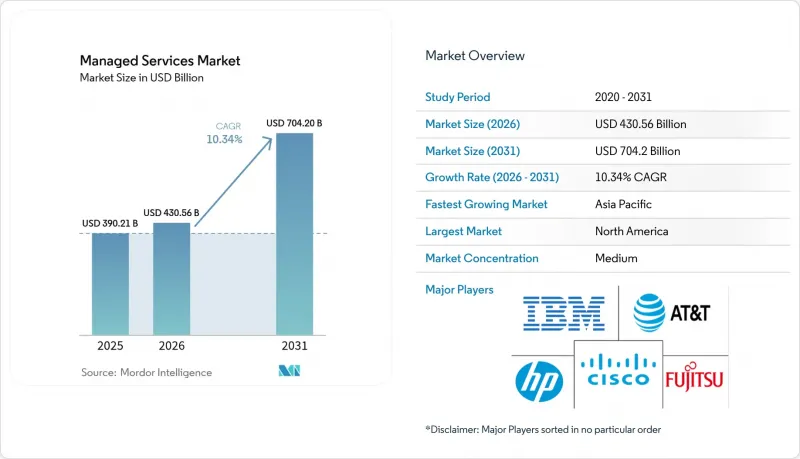
預計到 2026 年,託管服務市場價值將達到 4,305.6 億美元,從 2025 年的 3,902.1 億美元成長到 2031 年的 7,042 億美元。
預計 2026 年至 2031 年的複合年成長率為 10.34%。
本報告按部署類型(本地部署、雲端部署)、服務類型(託管資料中心、託管安全、託管通訊等)、企業規模(中小企業、大型企業)、最終用戶行業(銀行、金融服務和保險 (BFSI)、IT 和電信、製造業等)以及地區進行細分。市場預測以美元 (USD) 為單位。
全球託管服務市場趨勢與洞察
混合雲端的日益複雜化正在推動託管服務的普及。
混合雲端架構融合了本地部署、私有雲端和多個公共雲端,增加了維運的複雜性,使得企業內部團隊難以獨自管理。諸如微軟歐盟資料邊界等管理方案要求在地化資料處理,迫使企業遷移到能夠保證合規性、可攜性和統一安全策略的服務提供者。跨分散式環境的無縫工作負載遷移和即時策略執行,鞏固了企業對託管基礎設施和保全服務的長期需求。
降低成本的壓力正在加速企業選擇外包。
在維持利潤率的壓力下,企業正透過託管服務將固定IT成本轉化為變動成本。諸如Accenture與美國空軍簽訂的價值16億美元的「雲一號」(Cloud One)合約等大規模轉型項目表明,企業不再僅僅將外包視為一種戰術性措施,而是將其視為一種戰略舉措。服務提供者將自動化、人工智慧工具和認證人才庫打包出售,使買家能夠在避免前期資本支出的同時,利用新的能力。
有關資料主權的法規正在限制服務交付模式。
強製本地化處理的法規迫使服務提供者在每個司法管轄區建立冗餘基礎設施,這削弱了規模經濟效益,並使全球服務交付更加複雜。微軟的「歐盟資料邊界」清楚地展示了服務提供者為服務多個地區的客戶而必須承擔的額外資本和營運成本。
細分市場分析
到2025年,雲端採用將佔託管服務市場的52.35%,並且隨著混合雲端到2031年將以11.92%的複合年成長率成長,雲端的領先優勢將進一步擴大。按需推出資源、遵守資料法規以及整合邊緣工作負載的能力,正推動企業從本地部署模式遷移到雲端。與超大規模資料中心業者的合作,例如Accenture參與Cloud One項目,顯示了協作創新如何促成大規模多年合約的簽訂。
託管服務市場正受益於雲端運算的普及,服務供應商可以集中基礎設施、自動打補丁並大規模部署人工智慧驅動的成本最佳化方案。私有私有雲端在資料敏感型產業仍然至關重要,而本地部署服務則繼續用於難以重構的傳統工作負載。掌握了多重雲端編配和財務營運報告技術的服務提供者最有希望贏得新的支出。
到2025年,託管基礎設施服務將佔總收入的38.40%,這反映了維持異質環境運作的根本需求。然而,託管安全服務正以11.72%的複合年成長率推動成長,這反映了經營團隊對勒索軟體和違規罰款的擔憂。人工智慧驅動的威脅狩獵、零信任架構的實施以及自動化事件遏制,正成為市場上的佼佼者。
隨著網路保險公司收緊承保標準,安全相關託管服務市場預計將會擴張。服務提供者透過將安全營運中心即服務 (SOCaaS) 與合規報告和桌面演練相結合,獲得了高利潤的經常性收入。網路和通訊服務受益於 5G 的部署,而資料中心能源管理產品則因更嚴格的永續發展法規而推動。
區域分析
預計到2025年,北美將維持32.40%的收入佔有率,這主要得益於早期雲端遷移、網路安全法規以及高額的IT支出。聯邦政府項目,例如美國空軍的「雲端一號」(Cloud One)計劃,正在提升大規模託管服務合約的透明度。銀行、金融和保險(BFSI)以及醫療保健行業的客戶仍然是需求的主要來源,服務提供者正利用該地區作為人工智慧和邊緣運算試點部署的立足點。
亞太地區是成長最快的地區,預計到2031年將以11.28%的複合年成長率成長。中國製造業的現代化、印度數位公共基礎設施的進步以及日本老舊工廠的現代化改造,都在推動對能夠連接舊有系統和雲端工作負載的服務提供者增加的支出。超大規模資料中心業者正與本地主機服務供應商 (MSP) 合作,以滿足各國自主的雲端需求,而東南亞國協政府則正在採取「雲端優先」策略,縮短銷售週期。
在歐洲,儘管GDPR、《數位營運彈性法案》和永續性法規帶來的合規複雜性日益增加,但市場仍保持穩定成長。德國正在推廣「工業4.0」託管服務,英國在脫歐後的金融監管中依賴託管服務提供者(MSP),法國則專注於發展主權雲端框架。服務提供者正透過在地化資料中心和可再生能源採購來實現差異化,從而達成環境目標。中東和非洲雖然仍在發展中,但在智慧城市和電子政府計畫的推動下,正經歷快速成長。
其他好處:
- Excel格式的市場預測(ME)表
- 3個月的分析師支持
目錄
第1章:引言
- 研究假設和市場定義
- 調查範圍
第2章:調查方法
第3章執行摘要
第4章 市場狀況
- 市場概覽
- 市場促進因素
- 向混合雲端運營模式遷移
- 企業IT預算面臨成本最佳化壓力
- 網路威脅的增加和合規要求的日益嚴格。
- 邊緣運算的普及增加了對遠端管理服務的需求。
- 全天候託管偵測與回應 (MDR) 網路保險的先決條件
- 永續性和綠色IT法規正在推動電力/冷卻管理。
- 市場限制因素
- 資料主權和隱私法規的連續性
- 與多供應商整合和舊有系統之間的互通性相關的挑戰
- 長期 MSP 合約存在供應商鎖定風險和高昂的終止成本。
- MSP內部人員短缺限制了服務品質的擴充性。
- 供應鏈分析
- 監理情勢
- 技術展望
- 波特五力分析
- 對影響市場的宏觀經濟因素進行評估
第5章 市場規模與成長預測
- 不同的發展
- 現場
- 雲
- 公共雲端
- 私有雲端
- 混合雲端
- 按服務類型
- 託管資料中心
- 託管安全
- 管理溝通
- 主機網路
- 託管基礎設施
- 行動管理
- 其他
- 按公司規模
- 中小企業
- 大公司
- 按最終用戶行業分類
- BFSI
- 資訊科技/通訊
- 醫療保健和生命科學
- 製造業
- 零售與電子商務
- 政府/公共部門
- 能源公用事業
- 媒體與娛樂
- 其他(教育、非營利組織)
- 按地區
- 北美洲
- 美國
- 加拿大
- 墨西哥
- 南美洲
- 巴西
- 阿根廷
- 其他南美國家
- 歐洲
- 德國
- 英國
- 法國
- 義大利
- 西班牙
- 其他歐洲國家
- 亞太地區
- 中國
- 日本
- 印度
- 韓國
- 東南亞
- 其他亞太國家
- 中東和非洲
- 中東
- 沙烏地阿拉伯
- 阿拉伯聯合大公國
- 土耳其
- 其他中東國家
- 非洲
- 南非
- 奈及利亞
- 埃及
- 其他非洲國家
- 中東
- 北美洲
第6章 競爭情勢
- 市場集中度
- 策略趨勢
- 市佔率分析
- 公司簡介
- IBM Corporation
- Cisco Systems Inc.
- Fujitsu Ltd
- ATandT Inc.
- Hewlett Packard Enterprise(HPE)
- Microsoft Corporation
- Verizon Communications Inc.
- Dell Technologies Inc.
- Nokia Corporation
- Deutsche Telekom AG(T-Systems)
- Rackspace Technology Inc.
- Tata Consultancy Services Ltd
- Wipro Ltd
- Accenture plc
- Capgemini SE
- HCL Technologies Ltd
- Cognizant Technology Solutions
- NTT Data Corp.
- DXC Technology Co.
- Lumen Technologies Inc.
- Orange Business Services
第7章 市場機會與未來展望
According to Mordor Intelligence, managed services market size in 2026 is estimated at USD 430.56 billion, growing from 2025 value of USD 390.21 billion with 2031 projections showing USD 704.2 billion, growing at 10.34% CAGR over 2026-2031.
This report is Segmented by Deployment (On-Premises, Cloud), Service Type (Managed Data Center, Managed Security, Managed Communications, and More), Enterprise Size (Small and Medium Enterprises, Large Enterprises), End-User Vertical (BFSI, IT and Telecommunication, Manufacturing, and More), and by Geography. The Market Forecasts are Provided in Terms of Value (USD).
Global Managed Services Market Trends and Insights
Hybrid-cloud complexity drives managed services adoption
Hybrid-cloud architectures combine on-premises, private, and multiple public clouds, elevating operational complexity that internal teams struggle to master. Regulatory initiatives such as the Microsoft EU Data Boundary require localized data handling, pushing enterprises toward providers that can guarantee compliance, portability, and unified security policies.Seamless workload portability and real-time policy enforcement across distributed environments cement long-term demand for managed infrastructure and security offerings.
Cost optimization pressures accelerate outsourcing decisions
Persistent margin pressure turns fixed IT overhead into a variable line item through managed services. Large transformation deals such as Accenture's USD 1.6 billion Cloud One contract with the U.S. Air Force illustrate how enterprises view outsourcing as strategic, not merely tactical. Providers bundle automation, AI tooling, and certified talent pools, allowing buyers to avoid up-front capital outlays while still accessing emerging capabilities.
Data-sovereignty regulations constrain service delivery models
Mandates requiring localized processing force providers to duplicate infrastructure in each jurisdiction, reducing economies of scale and complicating global delivery. Microsoft's EU Data Boundary illustrates the additional capital and operational overhead that providers must absorb to serve multi-region clients.
Other drivers and restraints analyzed in the detailed report include:
- Cybersecurity threat evolution demands specialized response capabilities
- Edge computing expansion creates remote management requirements
- Vendor lock-in concerns limit long-term commitments
For complete list of drivers and restraints, kindly check the Table Of Contents.
Segment Analysis
Cloud deployment held 52.35% share of the managed services market in 2025 and is widening its lead as hybrid cloud posts a 11.92% CAGR through 2031. The ability to spin up resources on demand, comply with data regulations, and integrate edge workloads explains why enterprises migrate from on-premises models. Hyperscaler alliances, like Accenture's engagement on Cloud One, show how co-innovation can unlock large multiyear deals.
The managed services market benefits as cloud deployment allows providers to pool infrastructure, automate patches, and roll out AI-driven cost-optimization at scale. Private cloud remains relevant for data-sensitive sectors, while on-premises services persist for legacy workloads that cannot be refactored easily. Providers that master multi-cloud orchestration and FinOps reporting are best positioned to capture new spend.
Managed infrastructure services owned 38.40% revenue in 2025, reflecting the baseline need to keep heterogeneous estates running. Yet managed security services lead growth with an 11.72% CAGR, mirroring board-level concern over ransomware and compliance fines. AI-enabled threat hunting, zero-trust rollouts, and automated incident containment set market winners apart.
The managed services market size for security offerings is expected to accelerate as cyber-insurance carriers tighten underwriting criteria. Providers are bundling SOC-as-a-service with compliance reporting and tabletop exercises, creating high-margin recurring revenue. Network and communication services gain from 5G roll-outs, while data-center energy management products ride sustainability mandates.
Complete Report Scope:
- By Deployment
- On-premise
- Cloud
- Public Cloud
- Private Cloud
- Hybrid Cloud
- By Service Type
- Managed Data Center
- Managed Security
- Managed Communications
- Managed Network
- Managed Infrastructure
- Managed Mobility
- Others
- By Enterprise Size
- Small and Medium Enterprises (SMEs)
- Large Enterprises
- By End-user Vertical
- BFSI
- IT and Telecommunication
- Healthcare and Life Sciences
- Manufacturing
- Retail and E-commerce
- Government and Public Sector
- Energy and Utilities
- Media and Entertainment
- Others (Education, Non-Profit)
- By Geography
- North America
- United States
- Canada
- Mexico
- South America
- Brazil
- Argentina
- Rest of South America
- Europe
- Germany
- United Kingdom
- France
- Italy
- Spain
- Rest of Europe
- Asia-Pacific
- China
- Japan
- India
- South Korea
- Southeast Asia
- Rest of Asia-Pacific
- Middle East and Africa
- Middle East
- Saudi Arabia
- United Arab Emirates
- Turkey
- Rest of Middle East
- Africa
- South Africa
- Nigeria
- Egypt
- Rest of Africa
- Middle East
- North America
Geography Analysis
North America retained 32.40% revenue share in 2025, buoyed by early cloud migration, cyber regulations, and high IT spend. Federal programs such as the U.S. Air Force Cloud One create visibility for large managed services contracts. BFSI and healthcare customers continue to anchor demand, and providers use the region as a launchpad for AI and edge pilots.
Asia-Pacific is the fastest-growing region at 11.28% CAGR to 2031. China's manufacturing upgrades, India's digital-public-infrastructure push, and Japan's aging plant modernization funnel spend toward providers capable of bridging legacy and cloud workloads. Hyperscalers team with local MSPs to address sovereign-cloud requirements, while ASEAN governments adopt cloud-first mandates that shorten sales cycles.
Europe shows steady expansion as GDPR, Digital Operational Resilience Act, and sustainability rules heighten compliance complexity. Germany drives Industry 4.0 managed services, the United Kingdom leans on MSPs for post-Brexit financial regulation, and France emphasizes sovereign-cloud frameworks. Providers differentiate through localized data centers and green-energy sourcing to meet environmental targets. The Middle East and Africa remain nascent but grow quickly on smart-city and e-government projects.
- IBM Corporation
- Cisco Systems Inc.
- Fujitsu Ltd
- ATandT Inc.
- Hewlett Packard Enterprise (HPE)
- Microsoft Corporation
- Verizon Communications Inc.
- Dell Technologies Inc.
- Nokia Corporation
- Deutsche Telekom AG (T-Systems)
- Rackspace Technology Inc.
- Tata Consultancy Services Ltd
- Wipro Ltd
- Accenture plc
- Capgemini SE
- HCL Technologies Ltd
- Cognizant Technology Solutions
- NTT Data Corp.
- DXC Technology Co.
- Lumen Technologies Inc.
- Orange Business Services
Additional Benefits:
- The market estimate (ME) sheet in Excel format
- 3 months of analyst support
TABLE OF CONTENTS
1 INTRODUCTION
- 1.1 Study Assumptions and Market Definition
- 1.2 Scope of the Study
2 RESEARCH METHODOLOGY
3 EXECUTIVE SUMMARY
4 MARKET LANDSCAPE
- 4.1 Market Overview
- 4.2 Market Drivers
- 4.2.1 Shift to hybrid-cloud operating models
- 4.2.2 Cost-optimization pressure on enterprise IT budgets
- 4.2.3 Rising cyber-threat volume and compliance mandates
- 4.2.4 Edge-computing roll-outs demanding remote managed services
- 4.2.5 Cyber-insurance prerequisites for 24/7 managed detection and response
- 4.2.6 Sustainability and green-IT regulations driving managed power/cooling
- 4.3 Market Restraints
- 4.3.1 Persistent data-sovereignty and privacy regulations
- 4.3.2 Multi-vendor integration and legacy interoperability challenges
- 4.3.3 Vendor lock-in risk and high exit costs of long-term MSP contracts
- 4.3.4 Talent shortages within MSPs limiting service-quality scalability
- 4.4 Supply-Chain Analysis
- 4.5 Regulatory Landscape
- 4.6 Technological Outlook
- 4.7 Porter's Five Forces Analysis
- 4.7.1 Threat of New Entrants
- 4.7.2 Bargaining Power of Buyers
- 4.7.3 Bargaining Power of Suppliers
- 4.7.4 Threat of Substitutes
- 4.7.5 Competitive Rivalry
- 4.8 Assesment of Macroeconomic Factors on the market
5 MARKET SIZE AND GROWTH FORECASTS (VALUE)
- 5.1 By Deployment
- 5.1.1 On-premise
- 5.1.2 Cloud
- 5.1.2.1 Public Cloud
- 5.1.2.2 Private Cloud
- 5.1.2.3 Hybrid Cloud
- 5.2 By Service Type
- 5.2.1 Managed Data Center
- 5.2.2 Managed Security
- 5.2.3 Managed Communications
- 5.2.4 Managed Network
- 5.2.5 Managed Infrastructure
- 5.2.6 Managed Mobility
- 5.2.7 Others
- 5.3 By Enterprise Size
- 5.3.1 Small and Medium Enterprises (SMEs)
- 5.3.2 Large Enterprises
- 5.4 By End-user Vertical
- 5.4.1 BFSI
- 5.4.2 IT and Telecommunication
- 5.4.3 Healthcare and Life Sciences
- 5.4.4 Manufacturing
- 5.4.5 Retail and E-commerce
- 5.4.6 Government and Public Sector
- 5.4.7 Energy and Utilities
- 5.4.8 Media and Entertainment
- 5.4.9 Others (Education, Non-Profit)
- 5.5 By Geography
- 5.5.1 North America
- 5.5.1.1 United States
- 5.5.1.2 Canada
- 5.5.1.3 Mexico
- 5.5.2 South America
- 5.5.2.1 Brazil
- 5.5.2.2 Argentina
- 5.5.2.3 Rest of South America
- 5.5.3 Europe
- 5.5.3.1 Germany
- 5.5.3.2 United Kingdom
- 5.5.3.3 France
- 5.5.3.4 Italy
- 5.5.3.5 Spain
- 5.5.3.6 Rest of Europe
- 5.5.4 Asia-Pacific
- 5.5.4.1 China
- 5.5.4.2 Japan
- 5.5.4.3 India
- 5.5.4.4 South Korea
- 5.5.4.5 Southeast Asia
- 5.5.4.6 Rest of Asia-Pacific
- 5.5.5 Middle East and Africa
- 5.5.5.1 Middle East
- 5.5.5.1.1 Saudi Arabia
- 5.5.5.1.2 United Arab Emirates
- 5.5.5.1.3 Turkey
- 5.5.5.1.4 Rest of Middle East
- 5.5.5.2 Africa
- 5.5.5.2.1 South Africa
- 5.5.5.2.2 Nigeria
- 5.5.5.2.3 Egypt
- 5.5.5.2.4 Rest of Africa
- 5.5.5.1 Middle East
- 5.5.1 North America
6 COMPETITIVE LANDSCAPE
- 6.1 Market Concentration
- 6.2 Strategic Moves
- 6.3 Market Share Analysis
- 6.4 Company Profiles (includes Global level Overview, Market level overview, Core Segments, Financials as available, Strategic Information, Market Rank/Share for key companies, Products and Services, and Recent Developments)
- 6.4.1 IBM Corporation
- 6.4.2 Cisco Systems Inc.
- 6.4.3 Fujitsu Ltd
- 6.4.4 ATandT Inc.
- 6.4.5 Hewlett Packard Enterprise (HPE)
- 6.4.6 Microsoft Corporation
- 6.4.7 Verizon Communications Inc.
- 6.4.8 Dell Technologies Inc.
- 6.4.9 Nokia Corporation
- 6.4.10 Deutsche Telekom AG (T-Systems)
- 6.4.11 Rackspace Technology Inc.
- 6.4.12 Tata Consultancy Services Ltd
- 6.4.13 Wipro Ltd
- 6.4.14 Accenture plc
- 6.4.15 Capgemini SE
- 6.4.16 HCL Technologies Ltd
- 6.4.17 Cognizant Technology Solutions
- 6.4.18 NTT Data Corp.
- 6.4.19 DXC Technology Co.
- 6.4.20 Lumen Technologies Inc.
- 6.4.21 Orange Business Services
7 MARKET OPPORTUNITIES AND FUTURE OUTLOOK
- 7.1 White-space and Unmet-need Assessment

 北美託管服務:市場佔有率分析、產業趨勢與統計及成長預測(2026-2031 年)美國託管服務:市場佔有率分析、行業趨勢和統計數據、成長預測(2026-2031 年)非洲託管服務:市場佔有率分析、產業趨勢與統計及成長預測(2026-2031 年)
 DevOps外包服務市場規模、佔有率和成長分析:按服務類型、部署模式、企業規模、最終用戶和地區分類-2026-2033年產業預測
 託管服務市場-2026-2032年全球市場預測託管資訊服務:市場佔有率分析、行業趨勢和統計數據、成長預測(2026-2031 年)
 全球託管服務市場:按服務類型(資安管理服務、託管網路服務、託管IT基礎設施基礎設施和資料中心服務、託管通訊與協作服務、行動化運營服務、託管資訊服務)、部署類型、組織規模、行業和地區分類-預測至2031年
 2026-2030年全球託管服務市場
 2026年全球託管通訊服務市場報告
 託管服務市場:按服務類型、部署方式、最終用戶和地區分類