

 |
市場調查報告書
商品編碼
2124494
非洲託管服務:市場佔有率分析、產業趨勢與統計及成長預測(2026-2031 年)Africa Managed Services - Market Share Analysis, Industry Trends & Statistics, Growth Forecasts (2026 - 2031) |
||||||

※ 本網頁內容可能與最新版本有所差異。詳細情況請與我們聯繫。
據 Mordor Intelligence 稱,2025 年非洲託管服務市場價值為 49.5 億美元,預計到 2031 年將從 2026 年的 55.3 億美元成長至 96.2 億美元,預測期(2026-2031 年)複合年成長率為 11.72%。
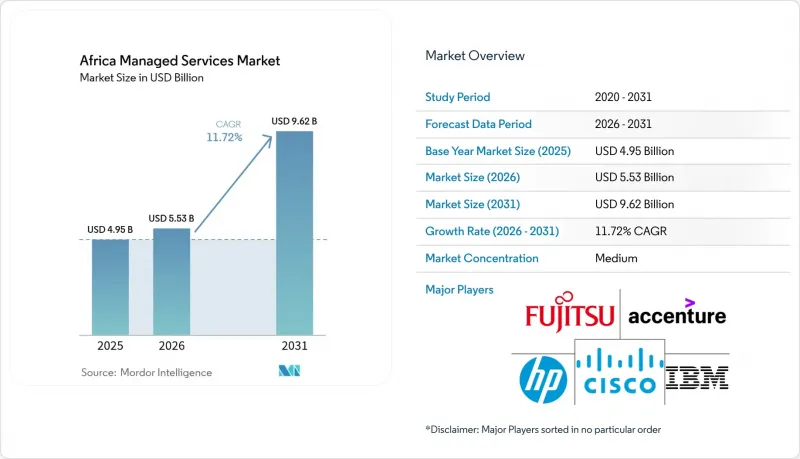
本報告按服務類型(託管網路服務、託管安全服務、託管行動服務等)、部署模式(私有雲端、公共雲端、混合雲端)、組織規模(大型企業、中小企業)、最終用戶行業(IT與電信、銀行、金融服務和保險、醫療保健等)以及國家/地區進行細分。市場預測以美元計價。
非洲託管服務市場的趨勢與洞察
中小企業主導託管雲端採用率激增
由於貨幣貶值導致本地硬體部署困難,中小企業在非洲託管服務市場中扮演著日益重要的角色。奈及利亞的中小企業現在選擇以奈拉計價的雲端服務套餐來對沖外匯波動風險,從而將整體擁有成本降低高達 40%。加納也出現了類似的轉變,強勢塞地使得企業能夠將節省下來的資金用於訂閱式分析平台。像 Nebula 和 Nobus 這樣的服務提供者正在利用批量折扣,為成千上萬的小規模客戶提供盈利服務,從而在非洲託管服務市場創造可預測且持續的收入。可擴展的多租戶架構使這些託管服務提供者即使在平均合約價值下降的情況下也能保持獲利能力。未來兩年,中小企業的需求仍將是能夠實現客戶註冊和支援功能自動化的服務提供者最迫切的成長動力。
國內數據主權政策正在推動本地MSP需求。
埃及、奈及利亞、南非和肯亞的國內資料居住法正在重新評估採購優先事項。埃及Petabyte的「政府資料雲端運算中心」為本地工作負載託管義務奠定了基礎,並吸引了與超大規模資料中心業者資料中心夥伴關係,從而增強了非洲的託管服務市場。同樣,奈及利亞的金融機構正在將工作負載遷移到本地供應商,以遵守2024年的資料保護法規,這為本地託管服務提供者(MSP)帶來了戰略優勢。 Liquid Intelligent Technologies透過為受監管客戶提供合規的雲端、連接和保全服務,實現了10.3%的收入成長。隨著越來越多的政府正式實施本地化,國內處理能力正成為競標中的一項要求,這將重塑供應商候選名單,並推動中期市場擴張。
長期電力供應不穩定導致營運成本上升。
頻繁的停電迫使奈及利亞的資料中心每天運作柴油發電機8-12小時,導致其電力成本比依賴電網的競爭對手高出60-80%,擠壓了整個非洲託管服務市場的利潤空間。在南非,計劃性停電仍然有效,迫使資料中心採用雙電源供電設計,從而推高了資本投資。雖然服務供應商正在採用電池儲能和微電網解決方案,但這些方案的高資本密集度阻礙了中小企業的進入。此外,隨著電信業者攤提其冗餘投資,連線費飆升,客戶承擔了隱性成本。儘管引入可再生能源有望帶來改善,但電力供應不穩定仍將是2027年之前營運成本面臨的最大阻力。
細分市場分析
即使到了2025年,託管資料中心和主機託管服務預計仍將維持37.02%的最大收入佔有率,凸顯其在基礎建設中的基礎性作用。同時,託管安全解決方案正以12.28%的複合年成長率成長,其在非洲託管服務市場的重要性日益凸顯。針對銀行和電信業者的攻擊日益頻繁,推動了對持續監控、事件回應和零信任架構的需求。此外,非洲託管服務產業也受惠於網路安全人才的長期短缺,這促使企業將先進的安全防護體系外包。
勒索軟體攻擊的增加加劇了監管審查,推動了合規託管偵測與回應 (MDR) 服務的支出成長。同時,多租戶安全營運中心 (SOC) 平台使服務提供者能夠將工具成本分攤到數十個客戶身上,從而提高了利潤率。非洲企業董事會對資料外洩處以日益嚴厲的罰款,使得安全訂閱期限從年度續訂延長至多年續訂,為非洲託管服務市場提供了穩定的現金流。
預計到2025年,公共雲端將佔總收入的76.65%,並以12.75%的複合年成長率成長,但有關數據主權的法規正在推動向混合雲框架的轉變。奈及利亞企業目前正將超大規模運算與本地節點結合,以滿足資料居住要求,同時又不影響系統的彈性。服務供應商正在整合邊緣設備和區域可用區,以保持消費者應用程式低於50毫秒的延遲,這展現了非洲託管服務市場的敏捷性。
私有雲端仍然廣泛應用於監管嚴格的銀行和政府機構的工作負載,在這些領域,直接控制至關重要。這促使微軟和VMware的混合雲編配工具得到更廣泛的應用,顯示部署決策不再是簡單的「公有雲或私有雲」二元選擇,而是針對每個工作負載進行最佳化。未來,儘管絕對規模將會擴大,但混合模式可望降低公共雲端的佔有率,從而重塑非洲託管服務市場的架構設計原則。
其他好處:
- Excel格式的市場預測(ME)表
- 3個月的分析師支持
目錄
第1章:引言
- 研究假設和市場定義
- 調查範圍
第2章:調查方法
第3章執行摘要
第4章 市場狀況
- 市場概覽
- 市場促進因素
- 巨量資料和分析領域的強勁發展趨勢,以及資訊通訊技術支出的成長。
- 中小企業主導了託管雲端服務採用率的快速成長。
- 泛非光纖網路的興起旨在降低延遲
- 國家資料主權政策正在推動該地區對託管服務提供者 (MSP) 的需求。
- 採礦和資源產業對營運技術(OT)和資訊科技(IT)整合的需求
- 需要IT外包的待開發區智慧城市專案(例如Conza、Eco Atlantic等)
- 市場限制因素
- 長期電力供應不穩定導致營運成本上升。
- 資料隱私和網路安全的技能差距
- 中非跨境頻寬的擴展進展落後。
- 該地貨幣貶值給資訊通訊技術預算帶來了壓力。
- 供應鏈分析
- 監理情勢
- 技術趨勢(AI運維、SASE、邊緣運算)
- 波特五力模型
- 對影響市場的宏觀經濟因素進行評估
第5章 市場規模與成長預測
- 按服務類型
- 主機服務
- 託管安全服務
- 行動管理服務
- 託管雲端服務
- 託管資料中心和主機服務
- 其他服務
- 按部署模式
- 私有雲端
- 公共雲端
- 混合雲端
- 按組織規模
- 大公司
- 中小企業
- 按最終用戶行業分類
- IT/通訊
- BFSI
- 零售與電子商務
- 衛生保健
- 政府/公共部門
- 製造業
- 其他行業
- 國家
- 南非
- 肯亞
- 奈及利亞
- 埃及
- 其他非洲國家
第6章 競爭情勢
- 市場集中度
- 策略性舉措(併購、合作)
- 市佔率分析
- 公司簡介
- Accenture PLC
- BCX(Telkom SA SOC)
- Castlerock Managed IT Services
- Cisco Systems Inc.
- CMC Networks
- Dimension Data(NTT Ltd.)
- Ericsson AB
- Fujitsu Ltd.
- Hewlett Packard Enterprise(HPE)
- Huawei Technologies Co.
- IBM Corporation
- Internet Solutions(IS)
- LanDynamix
- Liquid Intelligent Technologies
- MTN Business
- NEC Corporation
- Orange Business Services
- SEACOM Ltd.
- T-Systems South Africa
- Vodacom Business
第7章 市場機會與未來展望
According to Mordor Intelligence, the Africa managed services market size was valued at USD 4.95 billion in 2025 and estimated to grow from USD 5.53 billion in 2026 to reach USD 9.62 billion by 2031, at a CAGR of 11.72% during the forecast period (2026-2031).
This report is Segmented by Service Type (Managed Network Services, Managed Security Services, Managed Mobility Services, and More), Deployment Model (Private Cloud, Public Cloud, Hybrid Cloud), Organization Size (Large Enterprises, Smes), End-User Industry (IT and Telecom, BFSI, Healthcare, and More), and by Country. The Market Forecasts are Provided in Terms of Value (USD).
Africa Managed Services Market Trends and Insights
SME-led Surge in Managed Cloud Adoption
Small and medium enterprises increasingly anchor the Africa managed services market as currency depreciation makes on-premises hardware unaffordable. Nigerian SMEs now choose naira-denominated cloud bundles that avoid foreign-exchange shocks, lowering total cost of ownership by up to 40%. Similar shifts appear in Ghana where a stronger cedi lets firms channel savings into subscription-based analytics platforms. Providers such as Nebula and Nobus use volume pricing to profitably serve thousands of small customers, fuelling predictable recurring revenue across the Africa managed services market. Scalable multi-tenant architectures let these MSPs maintain margins even as average contract value falls. Over the next two years, SME demand remains the most immediate growth catalyst for providers that can automate onboarding and support functions.
National Data-sovereignty Policies Driving Local MSP Demand
Domestic data-residency laws in Egypt, Nigeria, South Africa and Kenya have re-ordered procurement priorities. Egypt's 120-petabyte Government Data and Cloud Computing Center anchors local workload hosting mandates and draws hyperscaler partnerships that reinforce the Africa managed services market.Financial institutions in Nigeria similarly divert workloads to local operators to comply with 2024 data-protection rules, granting indigenous MSPs strategic advantage. Liquid Intelligent Technologies posted 10.3% revenue growth after packaging compliance-ready cloud, connectivity and security services for regulated clients. As more governments formalise localisation, in-country capacity becomes a non-negotiable tender criterion, reshaping vendor shortlists and underwriting mid-term market expansion.
Chronic Power-supply Instability Increasing OPEX
Frequent outages mean Nigerian data centres operate diesel generators 8-12 hours daily, driving energy bills 60-80% higher than grid-reliant peers and compressing margins across the Africa managed services market. South Africa's scheduled load-shedding still forces dual-feed designs that raise capital outlays. Providers deploy battery storage and micro-grid solutions yet capital intensity limits entry for smaller firms. Clients also bear hidden costs through higher connectivity pricing as operators amortise redundancy investments. Although renewable deployments promise relief, unreliable power remains the single largest operational expense headwind through 2027.
Other drivers and restraints analyzed in the detailed report include:
- Rise of Pan-African Fibre Networks Lowering Latency
- Mining and Resource Sector's OT-IT Convergence Needs
- Depreciating Local Currencies Squeezing ICT Budgets
For complete list of drivers and restraints, kindly check the Table Of Contents.
Segment Analysis
Managed data-centre and hosting services retained the largest 37.02% revenue slice in 2025, underscoring infrastructure's foundational role. Managed security solutions, however, are growing at 12.28% CAGR, elevating their importance within the Africa managed services market. Heightened attack frequency against banks and telcos drives continuous monitoring, incident response and zero-trust architecture demand. The Africa managed services industry also benefits from chronic cybersecurity talent shortages, prompting enterprises to outsource advanced protection stacks.
Increasing ransomware claims spur regulatory scrutiny, bolstering spend on compliance-aligned managed detection and response. At the same time, multi-tenant SOC platforms allow providers to amortise tooling across dozens of clients, lifting margins. As African boards attach financial penalties to breaches, security retainer contracts lengthen from annual renewals to multi-year-plus extensions, embedding steady cash flow into the Africa managed services market.
Public cloud captured 76.65% of 2025 revenues and is projected to climb with a 12.75% CAGR, yet data-sovereignty rules catalyse a pivot toward hybrid frameworks. Nigerian firms now blend hyperscale compute with local nodes to comply with residency mandates without sacrificing elasticity. Providers integrate edge devices and regional availability zones to maintain sub-50 ms latency for consumer applications, demonstrating the Africa managed services market's agility.
Private cloud persists in heavily regulated banking and government workloads where direct control remains paramount. Hybrid orchestration tools from Microsoft and VMware thus experience rising adoption, indicating that deployment decisions are becoming workload-specific rather than binary. Over time, hybrid models are likely to narrow the public-cloud share even as absolute volumes expand, reshaping architecture design principles within the Africa managed services market.
Complete Report Scope:
- By Service Type
- Managed Network Services
- Managed Security Services
- Managed Mobility Services
- Managed Cloud Services
- Managed Data-centre and Hosting Services
- Other Services
- By Deployment Model
- Private Cloud
- Public Cloud
- Hybrid Cloud
- By Organization Size
- Large Enterprises
- Small and Medium-sized Enterprises (SMEs)
- By End-user Industry
- IT and Telecom
- BFSI
- Retail and E-commerce
- Healthcare
- Government and Public Sector
- Manufacturing
- Other Industries
- By Country
- South Africa
- Kenya
- Nigeria
- Egypt
- Rest of Africa
List of Companies Covered in this Report:
- Accenture PLC
- BCX (Telkom SA SOC)
- Castlerock Managed IT Services
- Cisco Systems Inc.
- CMC Networks
- Dimension Data (NTT Ltd.)
- Ericsson AB
- Fujitsu Ltd.
- Hewlett Packard Enterprise (HPE)
- Huawei Technologies Co.
- IBM Corporation
- Internet Solutions (IS)
- LanDynamix
- Liquid Intelligent Technologies
- MTN Business
- NEC Corporation
- Orange Business Services
- SEACOM Ltd.
- T-Systems South Africa
- Vodacom Business
Additional Benefits:
- The market estimate (ME) sheet in Excel format
- 3 months of analyst support
TABLE OF CONTENTS
1 INTRODUCTION
- 1.1 Study Assumptions and Market Definition
- 1.2 Scope of the Study
2 RESEARCH METHODOLOGY
3 EXECUTIVE SUMMARY
4 MARKET LANDSCAPE
- 4.1 Market Overview
- 4.2 Market Drivers
- 4.2.1 Favorable trends in big data and analytics and growing ICT spend
- 4.2.2 SME-led surge in managed cloud adoption
- 4.2.3 Rise of pan-African fibre networks lowering latency
- 4.2.4 National data-sovereignty policies driving local MSP demand
- 4.2.5 Mining and resource sector's OT-IT convergence needs
- 4.2.6 Greenfield smart-city projects (e.g., Konza, Eko Atlantic) requiring outsourced IT
- 4.3 Market Restraints
- 4.3.1 Chronic power-supply instability increasing OPEX
- 4.3.2 Data-privacy and cybersecurity skill gaps
- 4.3.3 Slow cross-border bandwidth upgrades in Central Africa
- 4.3.4 Depreciating local currencies squeezing ICT budgets
- 4.4 Supply-Chain Analysis
- 4.5 Regulatory Landscape
- 4.6 Technological Outlook (AI-ops, SASE, Edge)
- 4.7 Porter's Five Forces
- 4.7.1 Threat of New Entrants
- 4.7.2 Bargaining Power of Buyers
- 4.7.3 Bargaining Power of Suppliers
- 4.7.4 Threat of Substitutes
- 4.7.5 Intensity of Competitive Rivalry
- 4.8 Assesment of Macroeconomic Factors on the market
5 MARKET SIZE AND GROWTH FORECASTS (VALUE)
- 5.1 By Service Type
- 5.1.1 Managed Network Services
- 5.1.2 Managed Security Services
- 5.1.3 Managed Mobility Services
- 5.1.4 Managed Cloud Services
- 5.1.5 Managed Data-centre and Hosting Services
- 5.1.6 Other Services
- 5.2 By Deployment Model
- 5.2.1 Private Cloud
- 5.2.2 Public Cloud
- 5.2.3 Hybrid Cloud
- 5.3 By Organization Size
- 5.3.1 Large Enterprises
- 5.3.2 Small and Medium-sized Enterprises (SMEs)
- 5.4 By End-user Industry
- 5.4.1 IT and Telecom
- 5.4.2 BFSI
- 5.4.3 Retail and E-commerce
- 5.4.4 Healthcare
- 5.4.5 Government and Public Sector
- 5.4.6 Manufacturing
- 5.4.7 Other Industries
- 5.5 By Country
- 5.5.1 South Africa
- 5.5.2 Kenya
- 5.5.3 Nigeria
- 5.5.4 Egypt
- 5.5.5 Rest of Africa
6 COMPETITIVE LANDSCAPE
- 6.1 Market Concentration
- 6.2 Strategic Moves (MandA, Partnerships)
- 6.3 Market Share Analysis
- 6.4 Company Profiles {(includes Global level Overview, Market level overview, Core Segments, Financials as available, Strategic Information, Market Rank/Share for key companies, Products and Services, and Recent Developments)}
- 6.4.1 Accenture PLC
- 6.4.2 BCX (Telkom SA SOC)
- 6.4.3 Castlerock Managed IT Services
- 6.4.4 Cisco Systems Inc.
- 6.4.5 CMC Networks
- 6.4.6 Dimension Data (NTT Ltd.)
- 6.4.7 Ericsson AB
- 6.4.8 Fujitsu Ltd.
- 6.4.9 Hewlett Packard Enterprise (HPE)
- 6.4.10 Huawei Technologies Co.
- 6.4.11 IBM Corporation
- 6.4.12 Internet Solutions (IS)
- 6.4.13 LanDynamix
- 6.4.14 Liquid Intelligent Technologies
- 6.4.15 MTN Business
- 6.4.16 NEC Corporation
- 6.4.17 Orange Business Services
- 6.4.18 SEACOM Ltd.
- 6.4.19 T-Systems South Africa
- 6.4.20 Vodacom Business
7 MARKET OPPORTUNITIES AND FUTURE OUTLOOK
- 7.1 White-space and Unmet-Need Assessment

 北美託管服務:市場佔有率分析、產業趨勢與統計及成長預測(2026-2031 年)美國託管服務:市場佔有率分析、行業趨勢和統計數據、成長預測(2026-2031 年)
 DevOps外包服務市場規模、佔有率和成長分析:按服務類型、部署模式、企業規模、最終用戶和地區分類-2026-2033年產業預測託管服務:市場佔有率分析、行業趨勢和統計數據、成長預測(2026-2031 年)
 託管服務市場-2026-2032年全球市場預測託管資訊服務:市場佔有率分析、行業趨勢和統計數據、成長預測(2026-2031 年)
 全球託管服務市場:按服務類型(資安管理服務、託管網路服務、託管IT基礎設施基礎設施和資料中心服務、託管通訊與協作服務、行動化運營服務、託管資訊服務)、部署類型、組織規模、行業和地區分類-預測至2031年
 2026-2030年全球託管服務市場
 2026年全球託管通訊服務市場報告
 託管服務市場:按服務類型、部署方式、最終用戶和地區分類