

 |
市場調查報告書
商品編碼
2124748
北美託管服務:市場佔有率分析、產業趨勢與統計及成長預測(2026-2031 年)North America Managed Services - Market Share Analysis, Industry Trends & Statistics, Growth Forecasts (2026 - 2031) |
||||||

※ 本網頁內容可能與最新版本有所差異。詳細情況請與我們聯繫。
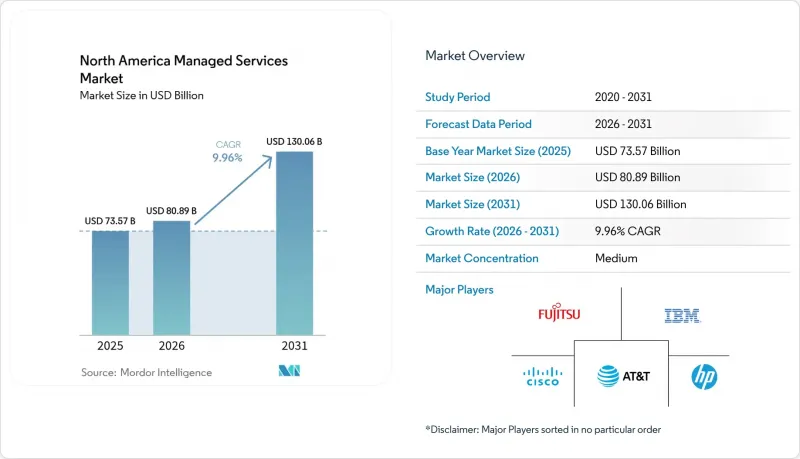
根據 Mordor Intelligence 預測,北美託管服務市場規模將從 2025 年的 735.7 億美元成長到 2026 年的 808.9 億美元,然後在 2031 年達到 1,300.6 億美元,2026 年至 2031 年的複合年成長率為 9.96%。
本報告按部署類型(例如本地部署)、服務類型(例如託管資料中心、託管安全服務等)、企業規模(中小企業和大型企業)、最終用戶行業(例如銀行、金融服務和保險 (BFSI)、IT 和電信、醫療保健和生命科學等)以及國家/地區進行細分。市場預測以美元 (USD) 計價。
北美託管服務市場的趨勢與洞察
企業正在向混合雲和多重雲端架構轉型。
目前,該地區約 75% 的企業將其工作負載分佈在多個公共雲端和本地基礎設施上,這推動了對託管編配和管治服務的需求。供應商不斷提高授權成本的定價策略,加速了企業考慮將工作負載遷移回本地環境並採用混合部署策略。儘管企業正在標準化容器平台以降低供應商鎖定風險並簡化可移植性,但它們仍需要外部專家來執行策略、最佳化財務營運 (FinOps) 和遷移工作負載。託管服務供應商正開始抓住這一機遇,將態勢感知、遷移和持續成本管理服務整合到基於結果的合約中,並將費用與實現的成本節約掛鉤。這些因素共同確保了北美託管服務市場仍是實現多重雲端卓越營運的重要管道。
網路威脅情勢日益惡化,推動了託管安全解決方案的普及。
目前,威脅行為者正利用人工智慧 (AI) 實現自動化偵察並創建多態惡意軟體,令內部安全營運中心不堪重負。美國證券交易委員會 (SEC) 的新事件報告規則要求上市公司在四個工作天內揭露重大安全漏洞,這促使董事會要求企業具備全天候 (24/7) 的偵測和回應能力。由於企業往往缺乏接受過威脅搜尋、取證和雲端原生安全措施培訓的人員,託管式偵測和回應服務正在填補這一空白。服務提供者正在投資人工智慧關聯分析引擎,以縮短入侵後的潛伏時間並滿足嚴格的報告期限。託管式安全服務已成為一項技術要求和一種財務風險對沖手段,因為網路保險承保人現在對沒有第三方監控的組織收取更高的保費。
資料主權和舊有系統整合的複雜性
目前,美國已有14個州頒布了全面的隱私法,對居住地和資料處理等方面的義務作出了明確規定,這使得跨境資料架構更加複雜,並延長了實施週期。許多大型企業仍擁有沿用數十年的專有系統,若要遷移到公共雲端則需要進行成本高昂的重構。因此,服務提供者被迫將本地支援與雲端原生工具整合。諸如NIST SP 800-171之類的合規框架以及醫療保健和金融行業的特定產業法規要求提供細粒度的審計追蹤,這增加了託管服務供應商的運營成本。這些因素導致專案推出延遲,並在某些情況下限制了原本能夠推動北美託管服務市場發展的獲利潛力。
細分市場分析
到2025年,雲端託管部署將佔北美託管服務市場收入的58.22%,但預計到2031年,混合環境的複合年成長率將達到11.03%。這一成長反映了超大規模資料中心業者大規模資料中心的穩健發展、合作夥伴提供的豐厚返利以及透過簡化訂閱條款的市場平台進行採購的優勢。嚴格的資料居住要求和邊緣運算的延遲目標正在推動混合環境的普及,因為某些工作負載正部署在更靠近使用者的位置。製造企業正在使用私有5G網路連接其工廠,並在MSP管理的區域雲中建立資料分析能力。因此,服務提供者正在從簡單的「遷移」操作轉向持續最佳化,以平衡不同基礎設施的成本、效能和合規性。容器管理附加元件能夠實現分散式叢集的自動修補和策略執行,這些外掛程式已被廣泛應用於北美託管服務市場。服務目錄現在包含一個FinOps儀表板,用於視覺化扣回爭議帳款和管治指標,進一步加強了MSP在成本管理中的參與度。
預計到2025年,託管安全服務將佔總收入的24.05%,這表明加強對人工智慧攻擊的防禦能力的重要性已在董事會層面得到認可。託管雲端和應用服務預計將以10.61%的複合年成長率(CAGR)實現最高成長,這主要得益於企業將客製化開發遷移到無伺服器和容器環境,同時仍需要外部監控。傳統資料中心服務對於需要本地部署的受監管工作負載仍然至關重要,但服務提供者正擴大採用自動化和遠端管理層來提高獲利能力。整合通訊、SD-WAN和託管網路將支援混合工作模式,這種模式將持續到2025年。在每個類別中,基於人工智慧的編配引擎都將減輕人工工作的負擔,使工程師能夠專注於產生更高計費率的諮詢工作。這種轉變將使企業即使在北美託管服務市場價格競爭加劇的情況下也能保持盈利。
其他好處:
- Excel格式的市場預測(ME)表
- 3個月的分析師支持
目錄
第1章:引言
- 研究假設和市場定義
- 調查範圍
第2章:調查方法
第3章執行摘要
第4章 市場狀況
- 市場概覽
- 市場促進因素
- 企業正在向混合雲和多重雲端架構轉型。
- 網路威脅日益加劇,推動了託管安全解決方案的普及。
- 缺乏IT技能和成本最佳化需求
- 加速中小企業數位轉型
- 各州的隱私法正在推動合規主導外包。
- 面向 5G 專用網路和工業 4.0 的邊緣運算管理服務
- 市場限制因素
- 資料主權與舊有系統整合的複雜性
- 認知到供應商鎖定和控制權喪失的問題
- 通貨膨脹導致的工資壓力正在對MSP利潤率造成壓力。
- 服務供應商永續發展的報告相關成本
- 監理情勢
- 技術展望
- 波特五力分析
- 宏觀經濟趨勢對市場的影響
第5章 市場規模與成長預測
- 不同的發展
- 現場
- 雲端託管
- 混合
- 按服務類型
- 託管資料中心
- 託管安全
- 託管通訊(UCaaS)
- 託管網路(區域網路/廣域網路、SD-WAN)
- 託管基礎架構和平台
- 行動辦公室和工作場所管理
- 託管應用程式和 DevOps
- 按公司規模
- 小型企業
- 大公司
- 按最終用戶行業分類
- BFSI
- IT/通訊
- 醫療保健和生命科學
- 媒體與娛樂
- 零售與電子商務
- 製造業和工業
- 政府/公共部門
- 能源公用事業
- 其他終端用戶產業
- 國家
- 美國
- 加拿大
- 墨西哥
第6章 競爭情勢
- 市場集中度
- 策略趨勢
- 市佔率分析
- 公司簡介
- Accenture plc
- AT&T Inc.
- Capgemini SE
- CDW Corporation
- Cisco Systems, Inc.
- Citrix Systems, Inc.
- Cognizant Technology Solutions Corp.
- Dell Technologies Inc.
- DXC Technology Company
- Fujitsu Limited
- Hewlett Packard Enterprise Company
- International Business Machines Corporation
- Infosys Limited
- Kyndryl Holdings, Inc.
- Lumen Technologies, Inc.
- Microsoft Corporation
- NTT DATA Corporation
- Rackspace Technology, Inc.
- Softchoice Corporation
- Tata Consultancy Services Ltd.
- Verizon Communications Inc.
- Wipro Limited
第7章 市場機會與未來展望
According to Mordor Intelligence, the North America managed services market size is expected to grow from USD 73.57 billion in 2025 to USD 80.89 billion in 2026 and is forecast to reach USD 130.06 billion by 2031 at 9.96% CAGR over 2026-2031.
This report is Segmented by Deployment (On-Premises, and More), Service Type (Managed Data Centre, Managed Security, and More), Enterprise Size (Small and Medium Enterprises and Large Enterprises), End-User Vertical (BFSI, IT and Telecom, Healthcare and Life Sciences, and More), and Country. The Market Forecasts are Provided in Terms of Value (USD).
North America Managed Services Market Trends and Insights
Enterprises Shifting to Hybrid and Multi-Cloud Architectures
Roughly 75% of regional organizations now distribute workloads across multiple public clouds and on-premises infrastructure, which intensifies demand for managed orchestration and governance services. Vendor pricing actions that raise licensing costs are accelerating repatriation assessments and hybrid adoption strategies. Enterprises are standardizing on container platforms to limit lock-in and simplify portability, yet they still require outside expertise for policy enforcement, FinOps optimization, and workload migration. Managed service providers are capitalizing by bundling discovery, migration, and ongoing cost-control services into outcome-based contracts that tie fees to savings delivered. These factors collectively sustain the North America managed services market as a critical channel for multicloud operational excellence.
Rising Cyber-Threat Landscape Driving Managed Security Adoption
Threat actors now deploy artificial intelligence to automate reconnaissance and build polymorphic malware, which overwhelms internal security operations centers. New U.S. Securities and Exchange Commission incident-reporting rules obligate public companies to disclose material breaches within four business days, pushing boards to demand 24 X 7 detection and response coverage. Managed detection and response services fill the gap because enterprises often lack staff trained in threat hunting, forensics, and cloud-native security controls. Providers are investing in AI correlation engines that shrink dwell time and meet the stringent reporting windows. As cyber insurance underwriters impose higher premiums for organizations without third-party monitoring, managed security becomes both a technical requirement and a financial hedge.
Data-Sovereignty and Legacy-Integration Complexity
Fourteen U.S. states now enforce comprehensive privacy statutes with varied residency and processing obligations, which complicates cross-border data architectures and lengthens implementation cycles. Many large enterprises retain decades-old proprietary systems that cannot move to public clouds without costly refactoring, forcing providers to blend on-premises support with cloud-native tooling. Compliance frameworks such as NIST SP 800-171 and sector-specific mandates in healthcare or finance require granular audit trails, adding overhead for managed service providers. These factors slow project kickoffs and in certain cases limit the revenue capture potential that otherwise fuels the North America managed services market.
Other drivers and restraints analyzed in the detailed report include:
- IT Talent Shortages and Need for Cost Optimization
- Accelerated Digital Transformation in SMEs
- Vendor Lock-in and Perceived Loss of Control
For complete list of drivers and restraints, kindly check the Table Of Contents.
Segment Analysis
Cloud-hosted deployments generated 58.22% of North America managed services market revenue in 2025, while hybrid environments are forecast for an 11.03% CAGR through 2031. The surge reflects hyperscaler resilience, generous partner rebates, and marketplace procurement that simplify subscription terms. Hybrid adoption gains momentum as strict data-residency rules and edge-compute latency targets push certain workloads closer to users. Industrial firms use private 5G networks to link factories, then anchor data analytics in regional clouds managed by MSPs. As a result, providers rebound from purely lift-and-shift work to ongoing optimization engagements that balance cost, performance, and compliance across diverse infrastructures. The North America managed services market frequently embeds container management add-ons that deliver automated patching and policy enforcement for distributed clusters. Service catalogs now include FinOps dashboards that visualize chargeback and governance metrics, further cementing MSP involvement in cost stewardship.
Managed security accounted for 24.05% of 2025 revenue, underscoring board-level urgency to harden defenses against AI-driven attacks. Managed cloud and application services claim the fastest forecast CAGR at 10.61%, propelled by enterprises that shift custom development into serverless and container environments yet still require external oversight. Legacy data-center services remain relevant for regulated workloads that must stay on-premises, but providers increasingly wrap them in automation and remote-management layers to improve margin profile. Unified communications, SD-WAN, and managed networks support hybrid work patterns that persist in 2025. Across categories, AI-based orchestration engines reduce manual effort, freeing engineers to move into consulting roles that drive higher bill rates. This pivot helps sustain profitability even as price competition intensifies across the North America managed services market.
Complete Report Scope:
- By Deployment
- On-premises
- Cloud-hosted
- Hybrid
- By Service Type
- Managed Data Centre
- Managed Security
- Managed Communications (UCaaS)
- Managed Network (LAN/WAN, SD-WAN)
- Managed Infrastructure and Platform
- Managed Mobility and Workplace
- Managed Application and DevOps
- By Enterprise Size
- Small and Medium Enterprises
- Large Enterprises
- By End-user Vertical
- BFSI
- IT and Telecom
- Healthcare and Life Sciences
- Media and Entertainment
- Retail and E-commerce
- Manufacturing and Industrial
- Government and Public Sector
- Energy and Utilities
- Other End-user Verticals
- By Country
- United States
- Canada
- Mexico
List of Companies Covered in this Report:
- Accenture plc
- AT&T Inc.
- Capgemini SE
- CDW Corporation
- Cisco Systems, Inc.
- Citrix Systems, Inc.
- Cognizant Technology Solutions Corp.
- Dell Technologies Inc.
- DXC Technology Company
- Fujitsu Limited
- Hewlett Packard Enterprise Company
- International Business Machines Corporation
- Infosys Limited
- Kyndryl Holdings, Inc.
- Lumen Technologies, Inc.
- Microsoft Corporation
- NTT DATA Corporation
- Rackspace Technology, Inc.
- Softchoice Corporation
- Tata Consultancy Services Ltd.
- Verizon Communications Inc.
- Wipro Limited
Additional Benefits:
- The market estimate (ME) sheet in Excel format
- 3 months of analyst support
TABLE OF CONTENTS
1 INTRODUCTION
- 1.1 Study Assumptions and Market Definition
- 1.2 Scope of the Study
2 RESEARCH METHODOLOGY
3 EXECUTIVE SUMMARY
4 MARKET LANDSCAPE
- 4.1 Market Overview
- 4.2 Market Drivers
- 4.2.1 Enterprises shifting to hybrid and multi-cloud architectures
- 4.2.2 Rising cyber-threat landscape driving managed security adoption
- 4.2.3 IT skill shortages and need for cost optimisation
- 4.2.4 Accelerated digital transformation in SMEs
- 4.2.5 State-level privacy laws spurring compliance-led outsourcing
- 4.2.6 Edge-compute managed services for 5G private networks and Industry 4.0
- 4.3 Market Restraints
- 4.3.1 Data-sovereignty and legacy-integration complexity
- 4.3.2 Vendor lock-in and perceived loss of control
- 4.3.3 Inflation-driven wage pressure eroding MSP margins
- 4.3.4 Sustainability-reporting costs for service providers
- 4.4 Regulatory Landscape
- 4.5 Technological Outlook
- 4.6 Porter's Five Forces Analysis
- 4.6.1 Bargaining Power of Suppliers
- 4.6.2 Bargaining Power of Buyers
- 4.6.3 Threat of New Entrants
- 4.6.4 Threat of Substitutes
- 4.6.5 Intensity of Competitive Rivalry
- 4.7 Impact of Macroeconomic Trends on the Market
5 MARKET SIZE AND GROWTH FORECASTS (VALUE)
- 5.1 By Deployment
- 5.1.1 On-premises
- 5.1.2 Cloud-hosted
- 5.1.3 Hybrid
- 5.2 By Service Type
- 5.2.1 Managed Data Centre
- 5.2.2 Managed Security
- 5.2.3 Managed Communications (UCaaS)
- 5.2.4 Managed Network (LAN/WAN, SD-WAN)
- 5.2.5 Managed Infrastructure and Platform
- 5.2.6 Managed Mobility and Workplace
- 5.2.7 Managed Application and DevOps
- 5.3 By Enterprise Size
- 5.3.1 Small and Medium Enterprises
- 5.3.2 Large Enterprises
- 5.4 By End-user Vertical
- 5.4.1 BFSI
- 5.4.2 IT and Telecom
- 5.4.3 Healthcare and Life Sciences
- 5.4.4 Media and Entertainment
- 5.4.5 Retail and E-commerce
- 5.4.6 Manufacturing and Industrial
- 5.4.7 Government and Public Sector
- 5.4.8 Energy and Utilities
- 5.4.9 Other End-user Verticals
- 5.5 By Country
- 5.5.1 United States
- 5.5.2 Canada
- 5.5.3 Mexico
6 COMPETITIVE LANDSCAPE
- 6.1 Market Concentration
- 6.2 Strategic Moves
- 6.3 Market Share Analysis
- 6.4 Company Profiles (includes Global-level Overview, Market-level Overview, Core Segments, Financials as available, Strategic Information, Market Rank/Share, Products and Services, Recent Developments)
- 6.4.1 Accenture plc
- 6.4.2 AT&T Inc.
- 6.4.3 Capgemini SE
- 6.4.4 CDW Corporation
- 6.4.5 Cisco Systems, Inc.
- 6.4.6 Citrix Systems, Inc.
- 6.4.7 Cognizant Technology Solutions Corp.
- 6.4.8 Dell Technologies Inc.
- 6.4.9 DXC Technology Company
- 6.4.10 Fujitsu Limited
- 6.4.11 Hewlett Packard Enterprise Company
- 6.4.12 International Business Machines Corporation
- 6.4.13 Infosys Limited
- 6.4.14 Kyndryl Holdings, Inc.
- 6.4.15 Lumen Technologies, Inc.
- 6.4.16 Microsoft Corporation
- 6.4.17 NTT DATA Corporation
- 6.4.18 Rackspace Technology, Inc.
- 6.4.19 Softchoice Corporation
- 6.4.20 Tata Consultancy Services Ltd.
- 6.4.21 Verizon Communications Inc.
- 6.4.22 Wipro Limited
7 MARKET OPPORTUNITIES AND FUTURE OUTLOOK
- 7.1 White-space and Unmet-Need Assessment

 美國託管服務:市場佔有率分析、行業趨勢和統計數據、成長預測(2026-2031 年)非洲託管服務:市場佔有率分析、產業趨勢與統計及成長預測(2026-2031 年)
 DevOps外包服務市場規模、佔有率和成長分析:按服務類型、部署模式、企業規模、最終用戶和地區分類-2026-2033年產業預測託管服務:市場佔有率分析、行業趨勢和統計數據、成長預測(2026-2031 年)
 託管服務市場-2026-2032年全球市場預測託管資訊服務:市場佔有率分析、行業趨勢和統計數據、成長預測(2026-2031 年)
 全球託管服務市場:按服務類型(資安管理服務、託管網路服務、託管IT基礎設施基礎設施和資料中心服務、託管通訊與協作服務、行動化運營服務、託管資訊服務)、部署類型、組織規模、行業和地區分類-預測至2031年
 2026-2030年全球託管服務市場
 2026年全球託管通訊服務市場報告
 託管服務市場:按服務類型、部署方式、最終用戶和地區分類