


 |
市場調查報告書
商品編碼
2121408
柴油發電機:市場佔有率分析、產業趨勢與統計、成長預測(2026-2031)Diesel Generator - Market Share Analysis, Industry Trends & Statistics, Growth Forecasts (2026 - 2031) |
||||||

※ 本網頁內容可能與最新版本有所差異。詳細情況請與我們聯繫。
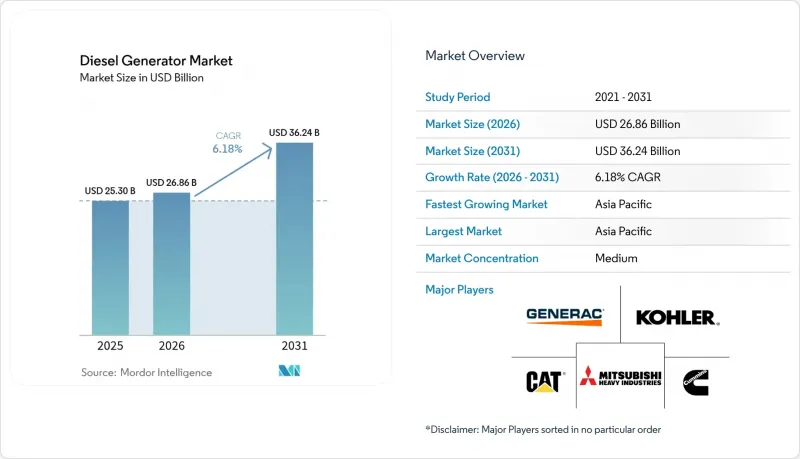
根據 Mordor Intelligence 預測,柴油發電機市場規模將從 2025 年的 253 億美元成長到 2026 年的 268.6 億美元,然後在 2031 年達到 362.4 億美元,2026 年至 2031 年的複合年成長率為 6.18%。
本報告按容量(小於 75kVA、75-375kVA、375-750kVA、750-2,000kVA、大於 2,000kVA)、應用(備用/緊急電源、主電源/連續電源、尖峰用電調節/負載管理)、最終用戶(住宅、商業、工業分類和地區(北美、歐洲、亞太地區)。
全球柴油發電機市場趨勢及洞察
關鍵基礎設施對不斷電系統的需求日益成長
如今,醫院、金融交易所和半導體製造廠都將停電視為與網路攻擊同等重要的業務永續營運風險。位於加州的沃爾什資料中心部署了一套96兆瓦的柴油備用電源,以保護雲端工作負載。這項投資表明,營運商將發電機容量視為收入保障。控制器韌體中內建的預測分析功能可根據運作中安排維護計劃,從而降低生命週期成本,並確保發電機作為設施的有效資產得到充分利用。對於許多數位公司而言,平均停機成本超過每小時10萬美元,因此採購團隊越來越重視柴油發電機久經考驗的可靠性,而不是削減資本支出。這一趨勢支撐了符合Tier 4 Final認證的發電機組的溢價,這些發電機組結合了遠距離診斷,並可減少99%的顆粒物排放,即使在法規日益嚴格的情況下,也能保持柴油發電機行業的價值提案。
亞太地區和非洲的快速工業化和基礎設施發展。
東南亞和非洲的工廠生產成長速度超過了電力公司加強電網建設的速度。工業園區經常安裝10-20兆瓦的現場發電設施,以便在脆弱的電網中同步運作,或在停電期間作為獨立單元運行。 Aggreco和康明斯提供的承包租賃服務,使撒哈拉以南非洲的新礦山得以在永久性輸電線路建成之前維持運營,從而將項目工期縮短了數年。柴油發電機交付、試運行和運作測試,而電網擴建則需要數年時間。這種速度優勢正在形成一個良性循環:工業成長需要更多的發電能力,這反過來又促進了進一步的擴張,使新興經濟體的柴油發電機產業保持穩定上升的勢頭。
更嚴格的排放氣體法規正在推動燃氣混合動力發電裝置的發展。
加州空氣資源委員會正力推進一步降低柴油顆粒物和氮氧化物閾值,使其低於Tier 4 Final標準,這促使一些車主轉而使用天然氣發電機或混合微電網。歐洲第五階段排放法規強制要求功率超過19千瓦的引擎使用選擇性催化還原(SCR)顆粒過濾器,這增加了安裝成本並使維護計畫更加複雜。儘管這些標準帶來了挑戰,但引擎製造商透過實施冷卻式廢氣再循環燃燒、先進的燃油噴射技術以及可再生柴油燃料相容性等策略,在滿足監管要求的同時,並未犧牲性能。柴油能量密度在關鍵任務設施中仍然至關重要,因此,柴油發電機產業在高階市場仍保持著重要地位。
細分市場分析
2025年,75千伏安以下的柴油發電機組仍將佔據柴油發電機市場43.25%的最大佔有率。這反映出住宅、小規模商業和電信設施等低負載應用場景對緊湊型機組的需求強勁。同時,375-750千伏安的頻寬正以7.55%的複合年成長率成長,到2031年將超過其他所有頻寬,因為工廠、數據處理中心和大型零售設施都在尋求兼顧成本和容錯性的解決方案。中等功率的機型現在標配了Tier 4-Final後後處理、混合動力控制系統和雲端遙測功能,這些功能以前只有在兆瓦級機組中才有。
Caterpillar的緊湊型架構在完全符合美國環保署 (EPA) 法規的前提下,將安裝空間減少了 31%。這代表著設計上的飛躍,降低了整體安裝成本,並加快了在現有設施中的部署。頂級機型功率範圍從 750 kVA 到 2,000 kVA 以及超過 2,000 kVA,可為礦山和超大規模資料中心提供動力,這些場所需要具備公用事業級電壓調節能力,並能長期穩定運作。入門級機型和高性能機型之間性能差距的不斷擴大表明,柴油發電機行業正步入成熟階段。在這個行業中,應用特定需求以及價格共同決定了採購標準,這為原始設備製造商 (OEM) 提供了高階定位的機會。
區域分析
預計亞太地區將引領柴油發電機產業,到2025年將佔據48.55%的市場佔有率,並預計在2031年之前以7.12%的複合年成長率持續成長。強勁的工廠生產、新型交通網路的建設以及雲端運算支出的激增,正推動遠超區域電網升級需求的強勁成長。中國和印度佔據了大部分的安裝量,因為製造商依賴現場安裝的發電機組來保護生產免受電壓波動的影響。目前,全部區域的資料中心總容量為12,206兆瓦,另有14,338兆瓦正在興建中。每1兆瓦的IT負載大約需要1兆瓦的備用電源。新加坡凍結新建伺服器機房的計劃,正促使投資轉向柔佛州和雅加達大都會圈,從而擴大發電機銷售的地理分佈。 5G的快速部署將需要新增數千座通訊塔,這需要緊湊可靠的發電裝置。同時,在澳洲和東南亞的偏遠礦區,正在使用更大的柴油-太陽能混合系統,以避免代價高昂的電網擴建。
北美是全球第二大柴油發電機市場,隨著電力公司加強電網建設以減少天氣造成的停電,該地區的住宅發電機銷售量正穩定成長。預計到2027年,住宅用柴油發電機的年複合成長率將達到5.82%,因為住宅購買發電機是為了應對颶風、野火和冰暴等造成的長時間停電。加州嚴格的排放氣體法規促使人們選擇符合Tier 4 Final標準的引擎和可再生柴油混合燃料,從而催生了一個高階細分市場,在這個市場中,法規遵循與價格同等重要。維吉尼亞、德克薩斯州和北加州不斷成長的需求也使柴油發電機行業受益。這些地區聚集了大量超大規模資料中心,即使是像96兆瓦的沃爾什資料中心這樣的小型園區,也可能需要訂購數十台中速發電機,以確保雲端服務的運作。在歐洲,減碳目標正促使買家選擇混合動力機組和符合第五階段排放標準的後處理系統,以減少粒狀物和氮氧化物的排放。
在中東和非洲,各國政府正投資建設遠離可靠電網的機場、鐵路走廊和礦山,推動了中等個位數的高速成長。開發商通常將柴油發電機與太陽能板和儲能電池結合,以降低燃料成本並簡化沙漠和高原地區的物流。南美洲也出現了類似的趨勢。智利、秘魯和阿根廷的銅礦和鋰礦商正在部署貨櫃式額定功率機組,因為電網連接往往落後於專案進度。巴西和阿根廷的柴油發電機產業也在擴大其在食品加工和石化產業的產能,從而將基本客群擴展到資源開採之外。國際能源總署(IEA)在2025年報告中指出,全球柴油供應前景穩定,這支撐了全部區域的發電機供應和定價。這些因素共同創造了多元化的需求環境,使得將柴油的可靠性與可再生能源的採用相結合的綜合解決方案越來越受歡迎。
其他好處:
- Excel格式的市場預測(ME)表
- 3個月的分析師支持
目錄
第1章:引言
- 研究假設和市場定義
- 調查範圍
第2章:調查方法
第3章執行摘要
第4章 市場狀況
- 市場概覽
- 市場促進因素
- 關鍵基礎設施對不斷電系統的需求日益成長
- 亞太地區和非洲的快速工業化和基礎設施發展。
- 極端天氣導致電網不穩定。
- 在二線城市部署邊緣資料中心
- 5G通訊基地台的安裝正在迅速增加。
- 在離網礦山引進柴油混合動力微電網
- 市場限制因素
- 更嚴格的排放氣體法規有利於汽油混合動力汽車。
- 電池供電式UPS系統的應用正逐漸普及。
- 四級引擎稀土元素供應瓶頸
- 由於柴油廢氣排放帶來的風險,都市區保險費上漲。
- 供應鏈分析
- 監理情勢
- 技術展望
- 波特五力分析
第5章 市場規模與成長預測
- 按容量(千伏安)
- 小於75千伏安
- 75~375kVA
- 375~750kVA
- 750~2000kVA
- 超過2000千伏安
- 透過使用
- 備用電源/緊急電源
- 主電源/持續電源
- 尖峰用電調節/負載管理
- 最終用戶
- 住宅
- 商業
- 產業
- 區域分析
- 北美洲
- 美國
- 加拿大
- 墨西哥
- 歐洲
- 德國
- 英國
- 法國
- 義大利
- 北歐國家
- 俄羅斯
- 其他歐洲國家
- 亞太地區
- 中國
- 印度
- 日本
- 韓國
- 東南亞國協
- 其他亞太國家
- 南美洲
- 巴西
- 阿根廷
- 其他南美國家
- 中東和非洲
- 沙烏地阿拉伯
- 阿拉伯聯合大公國
- 南非
- 埃及
- 其他中東和非洲國家
- 北美洲
第6章 競爭情勢
- 市場集中度
- 策略趨勢(併購、聯盟、購電協議)
- 市場佔有率分析(主要公司的市場排名和佔有率)
- 公司簡介
- Caterpillar Inc.
- Cummins Inc.
- Generac Holdings Inc.
- Kohler Co.
- Mitsubishi Heavy Industries Ltd.
- Rolls-Royce Holdings plc(MTU)
- Atlas Copco AB
- Doosan Corp.
- Kirloskar Oil Engines Ltd
- Aggreko plc
- FG Wilson(Caterpillar)
- Perkins Engines Co. Ltd
- MAN Energy Solutions
- Wartsila Oyj Abp
- Yanmar Holdings Co. Ltd
- MTU Onsite Energy
- SDMO Industries(KOHLER-SDMO)
- Weichai Power Co. Ltd
- Baudouin Engines
- Mahindra Powerol
第7章 市場機會與未來展望
According to Mordor Intelligence, the diesel generator market size is expected to grow from USD 25.30 billion in 2025 to USD 26.86 billion in 2026 and is forecast to reach USD 36.24 billion by 2031 at 6.18% CAGR over 2026-2031.
This report is Segmented by Capacity (Below 75 KVA, 75 To 375 KVA, 375 To 750 KVA, 750 To 2, 000 KVA, and Above 2, 000 KVA), Application (Stand-by/Backup Power, Prime/Continuous Power, and Peak-shaving/Load Management), End User (Residential, Commercial, and Industrial), and Geography (North America, Europe, Asia-Pacific, South America, and Middle East and Africa).
Global Diesel Generator Market Trends and Insights
Rising Demand for Uninterrupted Power in Critical Infrastructure
Hospitals, financial exchanges, and semiconductor fabs now categorise power loss as a business-continuity risk on par with cyberattacks. The Walsh Data Center in California installed 96 MW of diesel backup to protect cloud workloads, an investment illustrating how operators equate generator capacity with revenue protection. Predictive analytics embedded in controller firmware schedule maintenance around live loads, lowering lifecycle costs and turning generators into active facility assets. As average downtime costs exceed USD 100,000 per hour for many digital businesses, procurement teams increasingly prioritize proven diesel reliability over capital expenditure savings. This trend supports premium pricing for Tier 4 Final sets that combine remote diagnostics with 99% lower particulate emissions, preserving the diesel generator industry's value proposition even under stricter regulations.
Rapid Industrialisation and Infrastructure Build-out in APAC & Africa
Factory output in Southeast Asia and Africa rises faster than utilities can reinforce transmission. Industrial parks frequently integrate 10-20 MW of on-site generation that synchronises with weak grids or runs islanded during outages. Turnkey rental fleets supplied by Aggreko and Cummins keep green-field mines in Sub-Saharan Africa operational until permanent lines arrive, shortening project schedules by several years. Diesel generators are delivered, commissioned, and load-tested in months, compared with multi-year grid-extension timelines. This speed advantage fuels a virtuous cycle where industrial growth demands more generation capacity, enabling further expansion and keeping the diesel generator industry on a steady upward trajectory in emerging economies.
Stricter Emission Norms Favouring Gas & Hybrid Sets
California's Air Resources Board is pushing diesel particulate and NOx thresholds below Tier 4 Final, motivating some fleet owners to switch to natural-gas units or hybrid microgrids. The European Stage V rule set mandates the use of selective catalytic reduction and particulate filters on engines exceeding 19 kW, thereby increasing acquisition costs and complicating maintenance schedules. While these standards pose a headwind, engine manufacturers have responded with cooled-EGR combustion strategies, advanced fuel injection, and renewable diesel compatibility that meet compliance without eroding performance. Facilities with mission-critical loads continue to value diesel's energy density, thereby preserving the diesel generator industry's relevance in premium segments.
Other drivers and restraints analyzed in the detailed report include:
- Grid Instability Caused by Extreme Weather Events
- Edge Data-Centre Roll-outs in Tier-2 Cities
- Growing Penetration of Battery-Storage-Backed UPS
For complete list of drivers and restraints, kindly check the Table Of Contents.
Segment Analysis
The below-75 kVA class retained the largest 43.25% slice of the diesel generator industry share in 2025, reflecting strong uptake in residential, small commercial, and telecom sites where modest loads warrant compact sets. Yet the 375-750 kVA band is advancing at a 7.55% CAGR to 2031, outpacing every other bracket as factories, data-processing hubs, and large retail footprints migrate to solutions that balance cost and resiliency. Mid-range models now ship with Tier 4-Final aftertreatment, hybrid-ready controls, and cloud telemetry once reserved for multi-megawatt units.
Caterpillar's compact architecture reduces installation space by 31% while maintaining full EPA compliance, a design leap that lowers total installed costs and accelerates adoption in brownfield facilities. At the top end, 750-2,000 kVA and >2,000 kVA sets power mines and hyperscale data centers, which require extended runtime with utility-grade voltage regulation. The widening performance gap between entry-level and feature-rich models signals a maturing diesel generator industry, in which application demands, rather than price alone, dictate buying criteria and open premium positioning for OEMs.
Complete Report Scope:
- By Capacity (kVA)
- Below 75 kVA
- 75 to 375 kVA
- 375 to 750 kVA
- 750 to 2000 kVA
- Above 2000 kVA
- By Application
- Stand-by/Backup Power
- Prime/Continuous Power
- Peak-shaving/Load Management
- By End User
- Residential
- Commercial
- Industrial
- Geographic Analysis
- North America
- United States
- Canada
- Mexico
- Europe
- Germany
- United Kingdom
- France
- Italy
- NORDIC Countries
- Russia
- Rest of Europe
- Asia-Pacific
- China
- India
- Japan
- South Korea
- ASEAN Countries
- Rest of Asia-Pacific
- South America
- Brazil
- Argentina
- Rest of South America
- Middle East and Africa
- Saudi Arabia
- United Arab Emirates
- South Africa
- Egypt
- Rest of Middle East and Africa
- North America
Geography Analysis
The Asia-Pacific region holds a leading 48.55% share of the diesel generator industry in 2025 and is projected to expand at a 7.12% CAGR through 2031. Strong factory output, new transport links, and a sharp rise in cloud spending keep demand well ahead of local grid upgrades. China and India account for the majority of installations, as manufacturers rely on on-site sets to protect production from voltage fluctuations. Regional data-center capacity now totals 12,206 MW, with another 14,338 MW under construction, each megawatt of IT load matched by roughly one megawatt of standby power. Singapore's moratorium on new server farms has redirected investment to Johor and Greater Jakarta, widening the geographic spread of generator sales. A rapid 5G rollout requires the addition of thousands of telecom towers, which necessitate small but reliable units. Meanwhile, remote mine sites in Australia and Southeast Asia specify larger hybrid diesel-solar packages to avoid costly grid extensions.
North America is the second-largest region by revenue and exhibits steady growth as utilities enhance their networks to mitigate weather-driven outages. Residential shipments rise 5.82% CAGR to 2027 because homeowners buy protection from longer blackouts caused by hurricanes, wildfires, and ice storms. California's strict emission rules favor Tier 4 Final engines and renewable diesel blends, creating premium sub-segments that value compliance as much as price. The diesel generator industry also benefits from rising demand in Virginia, Texas, and Northern California. They host clusters of hyperscale data centers, and a single campus, such as the 96 MW Walsh facility, can order dozens of medium-speed generators to guarantee uptime for cloud services. In Europe, carbon-reduction goals are prompting buyers to opt for hybrid sets and Stage V-compliant aftertreatment systems that reduce particulate matter and NOx emissions.
The Middle East and Africa are experiencing high single-digit growth as governments invest in building airports, rail corridors, and mines that are far from reliable grids. Developers often pair diesel with solar arrays and batteries to trim fuel costs and simplify logistics in desert or high-altitude terrain. South America mirrors this pattern: copper and lithium miners in Chile, Peru, and Argentina deploy containerized, prime-rated units because grid connections often lag behind project timelines. The diesel generator industry in Brazil and Argentina also adds capacity for food processing and petrochemicals, widening the customer base beyond extractive industries. A stable outlook for global diesel supply, outlined in the International Energy Agency's 2025 report, supports generator availability and pricing across emerging regions. Together, these factors create a diverse demand landscape where integrated solutions that combine diesel reliability with renewable inputs gain traction.
- Caterpillar Inc.
- Cummins Inc.
- Generac Holdings Inc.
- Kohler Co.
- Mitsubishi Heavy Industries Ltd.
- Rolls-Royce Holdings plc (MTU)
- Atlas Copco AB
- Doosan Corp.
- Kirloskar Oil Engines Ltd
- Aggreko plc
- FG Wilson (Caterpillar)
- Perkins Engines Co. Ltd
- MAN Energy Solutions
- Wartsila Oyj Abp
- Yanmar Holdings Co. Ltd
- MTU Onsite Energy
- SDMO Industries (KOHLER-SDMO)
- Weichai Power Co. Ltd
- Baudouin Engines
- Mahindra Powerol
Additional Benefits:
- The market estimate (ME) sheet in Excel format
- 3 months of analyst support
TABLE OF CONTENTS
1 Introduction
- 1.1 Study Assumptions & Market Definition
- 1.2 Scope of the Study
2 Research Methodology
3 Executive Summary
4 Market Landscape
- 4.1 Market Overview
- 4.2 Market Drivers
- 4.2.1 Rising demand for uninterrupted power in critical infrastructure
- 4.2.2 Rapid industrialisation & infrastructure build-out in APAC & Africa
- 4.2.3 Grid instability caused by extreme weather events
- 4.2.4 Edge-data-centre roll-outs in Tier-2 cities
- 4.2.5 Surge in telecom tower deployments for 5G
- 4.2.6 Diesel-hybrid micro-grid adoption in off-grid mining
- 4.3 Market Restraints
- 4.3.1 Stricter emission norms favouring gas & hybrid sets
- 4.3.2 Growing penetration of battery-storage backed UPS
- 4.3.3 Rare-earth supply bottlenecks for Tier-4 engines
- 4.3.4 Higher urban insurance premiums for diesel exhaust risks
- 4.4 Supply-Chain Analysis
- 4.5 Regulatory Landscape
- 4.6 Technological Outlook
- 4.7 Porter's Five Forces Analysis
- 4.7.1 Bargaining Power of Suppliers
- 4.7.2 Bargaining Power of Consumers
- 4.7.3 Threat of New Entrants
- 4.7.4 Threat of Substitutes
- 4.7.5 Competitive Rivalry
5 Market Size & Growth Forecasts
- 5.1 By Capacity (kVA)
- 5.1.1 Below 75 kVA
- 5.1.2 75 to 375 kVA
- 5.1.3 375 to 750 kVA
- 5.1.4 750 to 2000 kVA
- 5.1.5 Above 2000 kVA
- 5.2 By Application
- 5.2.1 Stand-by/Backup Power
- 5.2.2 Prime/Continuous Power
- 5.2.3 Peak-shaving/Load Management
- 5.3 By End User
- 5.3.1 Residential
- 5.3.2 Commercial
- 5.3.3 Industrial
- 5.4 Geographic Analysis
- 5.4.1 North America
- 5.4.1.1 United States
- 5.4.1.2 Canada
- 5.4.1.3 Mexico
- 5.4.2 Europe
- 5.4.2.1 Germany
- 5.4.2.2 United Kingdom
- 5.4.2.3 France
- 5.4.2.4 Italy
- 5.4.2.5 NORDIC Countries
- 5.4.2.6 Russia
- 5.4.2.7 Rest of Europe
- 5.4.3 Asia-Pacific
- 5.4.3.1 China
- 5.4.3.2 India
- 5.4.3.3 Japan
- 5.4.3.4 South Korea
- 5.4.3.5 ASEAN Countries
- 5.4.3.6 Rest of Asia-Pacific
- 5.4.4 South America
- 5.4.4.1 Brazil
- 5.4.4.2 Argentina
- 5.4.4.3 Rest of South America
- 5.4.5 Middle East and Africa
- 5.4.5.1 Saudi Arabia
- 5.4.5.2 United Arab Emirates
- 5.4.5.3 South Africa
- 5.4.5.4 Egypt
- 5.4.5.5 Rest of Middle East and Africa
- 5.4.1 North America
6 Competitive Landscape
- 6.1 Market Concentration
- 6.2 Strategic Moves (M&A, Partnerships, PPAs)
- 6.3 Market Share Analysis (Market Rank/Share for key companies)
- 6.4 Company Profiles (includes Global level Overview, Market level overview, Core Segments, Financials as available, Strategic Information, Products & Services, and Recent Developments)
- 6.4.1 Caterpillar Inc.
- 6.4.2 Cummins Inc.
- 6.4.3 Generac Holdings Inc.
- 6.4.4 Kohler Co.
- 6.4.5 Mitsubishi Heavy Industries Ltd.
- 6.4.6 Rolls-Royce Holdings plc (MTU)
- 6.4.7 Atlas Copco AB
- 6.4.8 Doosan Corp.
- 6.4.9 Kirloskar Oil Engines Ltd
- 6.4.10 Aggreko plc
- 6.4.11 FG Wilson (Caterpillar)
- 6.4.12 Perkins Engines Co. Ltd
- 6.4.13 MAN Energy Solutions
- 6.4.14 Wartsila Oyj Abp
- 6.4.15 Yanmar Holdings Co. Ltd
- 6.4.16 MTU Onsite Energy
- 6.4.17 SDMO Industries (KOHLER-SDMO)
- 6.4.18 Weichai Power Co. Ltd
- 6.4.19 Baudouin Engines
- 6.4.20 Mahindra Powerol
7 Market Opportunities & Future Outlook
- 7.1 White-space & Unmet-Need Assessment

 印度柴油發電機:市場佔有率分析、產業趨勢與統計及成長預測(2026-2031)歐洲柴油發電機:市場佔有率分析、產業趨勢與統計及成長預測(2026-2031 年)非洲柴油發電機:市場佔有率分析、產業趨勢與統計及成長預測(2026-2031 年)
 柴油發電機市場-2026-2032年全球市場預測
 柴油發電機市場預測至2034年—按便攜性、額定功率、應用、最終用戶和地區分類的全球分析亞太地區柴油發電機:市場佔有率分析、產業趨勢與統計及成長預測(2026-2031)
 全球柴油發電機市場(至2031年):按設計(固定式和可攜式)、應用(備用、抑低尖峰負載、主用和連續用)、最終用戶(工業、商業和住宅)、額定功率和地區分類
 柴油發電機市場報告:按容量、應用、便攜性、最終用戶和地區分類(2026-2034 年)
 柴油發電機市場:按應用、功率輸出、最終用戶和地區分類
 全球柴油發電機市場規模、佔有率、趨勢和成長分析報告(2026-2034年)