


 |
市場調查報告書
商品編碼
2124281
歐洲柴油發電機:市場佔有率分析、產業趨勢與統計及成長預測(2026-2031 年)Europe Diesel Generator - Market Share Analysis, Industry Trends & Statistics, Growth Forecasts (2026 - 2031) |
||||||

※ 本網頁內容可能與最新版本有所差異。詳細情況請與我們聯繫。
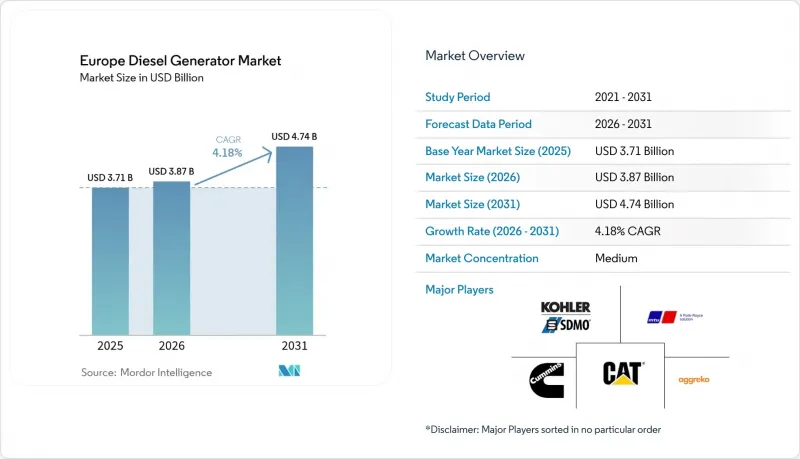
根據 Mordor Intelligence 預測,歐洲柴油發電機市場規模將從 2025 年的 37.1 億美元成長到 2026 年的 38.7 億美元,然後在 2031 年達到 47.4 億美元,2026 年至 2031 年的複合年成長率為 4.18%。
本報告按容量(小於 75 kVA、75–375 kVA、375–750 kVA、750–2,000 kVA 和大於 2,000 kVA)、應用(備用/後備電源、市電/連續電源、抑低尖峰負載/負載管理)、最終用戶(住宅、商業、工業分類)和地區(德國、俄羅斯、俄羅斯國家)和歐洲國家。
歐洲柴油發電機市場趨勢與洞察
由於停電,備用電源需求激增。
鑑於2024-2025年冬季,14個成員國面臨發電能力短缺,醫院、資料中心和通訊塔等場所正積極部署新的備用發電機組。光是在英國,2024年就安裝了1,200台醫院備用發電機組,以滿足72小時自主運作的需求。波羅的海海底電纜遭到破壞後,行動發電機組被部署到先前完全依賴行動電話基地台。這凸顯了安全威脅如何迅速轉化為設備訂單。製造商正在積極應對,開發可在10秒內啟動的自動傳輸開關,以保護關鍵負載。這種需求的激增使歐洲柴油發電機市場在整個歐洲大陸的緊急電力規劃中處於領先地位。
工業和商業領域的產能擴張
新建的半導體製造廠、多功能大樓和物流樞紐需要數兆瓦的緊急電力,而傳統電網無法隨時保證這項需求。潔淨室每次運作價值數百萬美元,電壓下降是不可接受的,因此開發商在設計階段就指定了冗餘柴油發電機組。同樣,巴黎和米蘭的高層建築也預先安裝了200-500千伏安的發電機組,以確保電梯和空調系統的運作。這些項目確保了長期需求,即使營運模式向混合動力模式轉變,也能確保歐洲柴油發電機市場的永續收入來源。
以可再生能源和儲能取代
到2024年,電瓶儲能系統的部署量將達到9.2吉瓦,在許多市場,能夠持續放電四小時的系統成本將低於柴油發電機的變動成本。法蘭克福和阿姆斯特丹的資料中心透過在短時停電期間切換到鋰離子電池組,將發電機組的運作縮短了高達70%。在容量小於200千伏安的住宅和小規模商業建築中,屋頂太陽能發電和電池儲能的組合方案正在被採用,從而降低了對可攜式柴油發電機的需求。價格已降至每兆瓦時150歐元以下,進一步加劇了傳統緊急發電機的壓力。然而,對於持續數天的停電,柴油發電機仍然是唯一經濟的選擇,這支撐著歐洲柴油發電機市場。
細分市場分析
2025年,75-375千伏安(kVA)頻寬的發電機組佔總銷售額的45.12%,主要得益於零售連鎖店和市政處理設施的強勁需求。租賃公司也青睞這一頻寬,因為它兼顧了運輸重量和燃油效率。 75千伏安以下的發電機組在建築工地和其他類似場所仍然很常見,但在補貼市場中,它們正逐漸被太陽能和電池組合所取代。超過750千伏安的機組則用於煉油廠和礦山等缺乏經濟型電網的地區,例如Waltzila的貨櫃式模組就向北極地區供應20兆瓦的電力。
混合動力需求主要集中在150-300千伏安功率範圍內,該功率範圍內的電池可平滑負載峰值,並將油耗降低約三分之一。第五階段排放法規正在加速200-500千伏安級引擎的更新換代,由於改造成本高昂,2019年以前的引擎已不再實用。這些因素共同支撐了歐洲柴油發電機市場這一核心細分市場的持續銷售成長。
其他好處:
- Excel格式的市場預測(ME)表
- 3個月的分析師支持
目錄
第1章:引言
- 研究假設和市場定義
- 調查範圍
第2章:調查方法
第3章執行摘要
第4章 市場狀況
- 市場概覽
- 市場促進因素
- 停電導致備用電源需求激增
- 工業和商業部門生產能力的擴張
- 發電機租賃生態系的發展
- 安裝住宅備用電源系統(小於 75 kVA)
- 第五階段相容改裝熱潮(2027-2029 年)
- 北約能源安全儲備
- 市場限制因素
- 可再生能源和儲能的替代效應
- 更嚴格的歐盟第五/第六階段排放標準
- 轉型
- 城市噪音條例(超過 90 分貝)的相關規定
- 供應鏈分析
- 監理情勢
- 技術展望
- 波特五力分析
第5章 市場規模與成長預測
- 按容量(千伏安)
- 小於75千伏安
- 75~375 kVA
- 375~750 kVA
- 750~2,000 kVA
- 2000千伏安或以上
- 透過使用
- 備用電源
- 主電源/持續電源
- 尖峰用電調節/負載管理
- 最終用戶
- 住宅
- 商業的
- 產業
- 按地區
- 德國
- 英國
- 法國
- 義大利
- 西班牙
- 北歐國家
- 俄羅斯
- 其他歐洲國家
第6章 競爭情勢
- 市場集中度
- 策略趨勢(併購、聯盟、購電協議)
- 市場佔有率分析(主要公司的市場排名和佔有率)
- 公司簡介
- Caterpillar Inc.
- Cummins Inc.
- Rolls-Royce Power Systems(MTU)
- Kohler-SDMO
- Aggreko PLC
- Mitsubishi Heavy Industries Engine & Turbocharger Ltd
- FG Wilson
- Yanmar Holdings Co. Ltd/Himoinsa
- Generac Power Systems
- Doosan Corporation
- Atlas Copco AB
- Wartsila Corporation
- Deutz AG
- Volvo Penta AB
- AKSA Power Generation
- Perkins Engines Company
- Pramac Group
- Grupel SA
- Wacker Neuson SE
- JCB Power Products
第7章 市場機會與未來展望
According to Mordor Intelligence, the Europe diesel generator market size is expected to grow from USD 3.71 billion in 2025 to USD 3.87 billion in 2026 and is forecast to reach USD 4.74 billion by 2031 at 4.18% CAGR over 2026-2031.
This report is Segmented by Capacity (below 75 KVA, 75 To 375 KVA, 375 To 750 KVA, 750 To 2, 000 KVA, and Above 2, 000 KVA), Application (Stand-by/Backup Power, Prime/Continuous Power, and Peak-shaving/Load Management), End User (Residential, Commercial, and Industrial), and Geography (Germany, Russia, United Kingdom, France, Italy, Spain, NORDIC Countries, Russia, and the Rest of Europe).
Europe Diesel Generator Market Trends and Insights
Grid-Outage Driven Standby Demand Surge
Fourteen member states face capacity shortfalls in the 2024-2025 winter outlook, prompting hospitals, data centers, and telecom towers to secure new standby sets. The United Kingdom alone installed 1,200 hospital backup units in 2024 to satisfy a 72-hour autonomy rule. After the Baltic Sea cable sabotage, mobile gensets were dispatched to remote cell sites once fed only by the grid, underscoring how security threats convert into immediate equipment orders. Manufacturers have responded with automatic transfer switches that start within ten seconds to protect critical loads. This surge keeps the European diesel generator market at the forefront of emergency-power planning across the continent.
Industrial and Commercial Capacity Expansion
New semiconductor fabs, mixed-use towers, and logistics hubs require multi-megawatt contingencies that conventional grids cannot always guarantee. With every cleanroom spin valued in the millions, voltage dips are intolerable, so developers specify redundant diesel arrays during design. Paris and Milan high-rises are similarly pre-installing 200 to 500 kVA sets to secure lift and HVAC uptime. Because these projects lock in long-run demand, the European diesel generator market gains durable revenue streams even as operating profiles evolve toward hybrid duty.
Renewables plus Storage Displacement
Battery energy-storage installations hit 9.2 GW in 2024, with 4-hour discharge systems now beating diesel variable costs in many markets. Data centers in Frankfurt and Amsterdam cut genset runtime by up to 70% by shifting short outages to lithium-ion banks. Residential and small commercial users with capacities below 200 kVA are adopting rooftop solar plus batteries, reducing demand for portable diesel. Price declines below EUR 150 per megawatt-hour put further pressure on traditional standby sets. Nonetheless, diesel remains the only economical choice for multi-day outages, which preserves a baseline for the European diesel generator market.
Other drivers and restraints analyzed in the detailed report include:
- Growth in Generator-Rental Ecosystem
- Stage-V Retrofit Boom
- Stricter EU Stage V/VI Emission Caps
For complete list of drivers and restraints, kindly check the Table Of Contents.
Segment Analysis
The 75-to-375 kVA band accounted for 45.12% of 2025 revenue, thanks to strong uptake in retail chains and municipal treatment plants. Rental fleets also favor this range because it strikes a balance between transport weight and fuel efficiency. Sub-75 kVA sets remain common on job sites, yet they face substitution from solar-battery combinations in subsidized markets. Above-750 kVA units serve oil refineries and mines that lack economical grid feeders, with Wartsila containerized modules delivering 20-MW blocks to Arctic locales.
Hybrid demand converges on 150-to-300 kVA, where batteries smooth load spikes and reduce fuel burn by roughly one-third. Stage-V rules accelerate turnover in the 200 to 500 kVA cohort, as pre-2019 engines prove cost-prohibitive to retrofit. Together, these mechanics underpin sustained volume in this core tranche of the European diesel generator market.
Complete Report Scope:
- By Capacity (kVA)
- Below 75 kVA
- 75 to 375 kVA
- 375 to 750 kVA
- 750 to 2,000 kVA
- Above 2,000 kVA
- By Application
- Stand-by/Backup Power
- Prime/Continuous Power
- Peak-shaving/Load Management
- By End User
- Residential
- Commercial
- Industrial
- By Geography
- Germany
- United Kingdom
- France
- Italy
- Spain
- NORDIC Countries
- Russia
- Rest of Europe
List of Companies Covered in this Report:
- Caterpillar Inc.
- Cummins Inc.
- Rolls-Royce Power Systems (MTU)
- Kohler-SDMO
- Aggreko PLC
- Mitsubishi Heavy Industries Engine & Turbocharger Ltd
- FG Wilson
- Yanmar Holdings Co. Ltd / Himoinsa
- Generac Power Systems
- Doosan Corporation
- Atlas Copco AB
- Wartsila Corporation
- Deutz AG
- Volvo Penta AB
- AKSA Power Generation
- Perkins Engines Company
- Pramac Group
- Grupel S.A.
- Wacker Neuson SE
- JCB Power Products
Additional Benefits:
- The market estimate (ME) sheet in Excel format
- 3 months of analyst support
TABLE OF CONTENTS
1 Introduction
- 1.1 Study Assumptions & Market Definition
- 1.2 Scope of the Study
2 Research Methodology
3 Executive Summary
4 Market Landscape
- 4.1 Market Overview
- 4.2 Market Drivers
- 4.2.1 Grid-outage driven standby demand surge
- 4.2.2 Industrial & commercial capacity expansion
- 4.2.3 Growth in generator-rental ecosystem
- 4.2.4 Residential back-up adoption (sub-75 kVA)
- 4.2.5 Stage-V retrofit boom (2027-2029)
- 4.2.6 NATO energy-security stockpiles
- 4.3 Market Restraints
- 4.3.1 Renewables + storage displacement
- 4.3.2 Stricter EU Stage V/VI emission caps
- 4.3.3 Bio-/eFuel & hybrid microgrid shift
- 4.3.4 Urban noise-ordinance bans (>90 dB)
- 4.4 Supply-Chain Analysis
- 4.5 Regulatory Landscape
- 4.6 Technological Outlook
- 4.7 Porter's Five Forces Analysis
- 4.7.1 Bargaining Power of Suppliers
- 4.7.2 Bargaining Power of Buyers
- 4.7.3 Threat of New Entrants
- 4.7.4 Threat of Substitutes
- 4.7.5 Intensity of Competitive Rivalry
5 Market Size & Growth Forecasts
- 5.1 By Capacity (kVA)
- 5.1.1 Below 75 kVA
- 5.1.2 75 to 375 kVA
- 5.1.3 375 to 750 kVA
- 5.1.4 750 to 2,000 kVA
- 5.1.5 Above 2,000 kVA
- 5.2 By Application
- 5.2.1 Stand-by/Backup Power
- 5.2.2 Prime/Continuous Power
- 5.2.3 Peak-shaving/Load Management
- 5.3 By End User
- 5.3.1 Residential
- 5.3.2 Commercial
- 5.3.3 Industrial
- 5.4 By Geography
- 5.4.1 Germany
- 5.4.2 United Kingdom
- 5.4.3 France
- 5.4.4 Italy
- 5.4.5 Spain
- 5.4.6 NORDIC Countries
- 5.4.7 Russia
- 5.4.8 Rest of Europe
6 Competitive Landscape
- 6.1 Market Concentration
- 6.2 Strategic Moves (M&A, Partnerships, PPAs)
- 6.3 Market Share Analysis (Market Rank/Share for key companies)
- 6.4 Company Profiles (includes Global level Overview, Market level overview, Core Segments, Financials as available, Strategic Information, Products & Services, and Recent Developments)
- 6.4.1 Caterpillar Inc.
- 6.4.2 Cummins Inc.
- 6.4.3 Rolls-Royce Power Systems (MTU)
- 6.4.4 Kohler-SDMO
- 6.4.5 Aggreko PLC
- 6.4.6 Mitsubishi Heavy Industries Engine & Turbocharger Ltd
- 6.4.7 FG Wilson
- 6.4.8 Yanmar Holdings Co. Ltd / Himoinsa
- 6.4.9 Generac Power Systems
- 6.4.10 Doosan Corporation
- 6.4.11 Atlas Copco AB
- 6.4.12 Wartsila Corporation
- 6.4.13 Deutz AG
- 6.4.14 Volvo Penta AB
- 6.4.15 AKSA Power Generation
- 6.4.16 Perkins Engines Company
- 6.4.17 Pramac Group
- 6.4.18 Grupel S.A.
- 6.4.19 Wacker Neuson SE
- 6.4.20 JCB Power Products
7 Market Opportunities & Future Outlook
- 7.1 White-space & Unmet-need Assessment
- 7.2 Increasing Demand for Hybrid Diesel Generators

 印度柴油發電機:市場佔有率分析、產業趨勢與統計及成長預測(2026-2031)非洲柴油發電機:市場佔有率分析、產業趨勢與統計及成長預測(2026-2031 年)柴油發電機:市場佔有率分析、產業趨勢與統計、成長預測(2026-2031)
 柴油發電機市場-2026-2032年全球市場預測
 柴油發電機市場預測至2034年—按便攜性、額定功率、應用、最終用戶和地區分類的全球分析亞太地區柴油發電機:市場佔有率分析、產業趨勢與統計及成長預測(2026-2031)
 全球柴油發電機市場(至2031年):按設計(固定式和可攜式)、應用(備用、抑低尖峰負載、主用和連續用)、最終用戶(工業、商業和住宅)、額定功率和地區分類
 柴油發電機市場報告:按容量、應用、便攜性、最終用戶和地區分類(2026-2034 年)
 柴油發電機市場:按應用、功率輸出、最終用戶和地區分類
 全球柴油發電機市場規模、佔有率、趨勢和成長分析報告(2026-2034年)