


 |
市場調查報告書
商品編碼
2124340
印度柴油發電機:市場佔有率分析、產業趨勢與統計及成長預測(2026-2031)India Diesel Generator - Market Share Analysis, Industry Trends & Statistics, Growth Forecasts (2026 - 2031) |
||||||

※ 本網頁內容可能與最新版本有所差異。詳細情況請與我們聯繫。
據 Mordor Intelligence 稱,2025 年印度柴油發電機市場價值 12.4 億美元,預計到 2031 年將從 2026 年的 13.3 億美元成長至 18.8 億美元,預測期(2026-2031 年)複合年成長率為 7.18%。
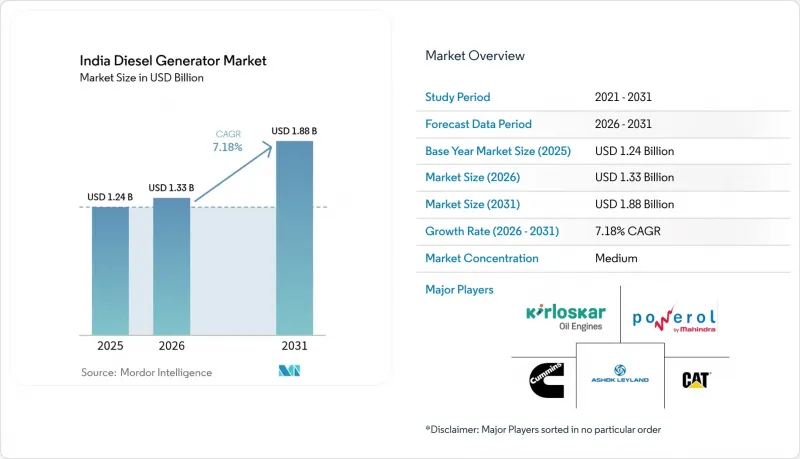
本報告按容量(小於 75 kVA、75–375 kVA、375–750 kVA、750–2,000 kVA 和大於 2,000 kVA)、應用(備用/儲備電源、主用/連續電源、尖峰用電調節/負載管理)和最終用戶(住宅、商業、工業)進行分類。
印度柴油發電機市場趨勢與分析
二線和三線城市停電次數增加
由於印度各地電力可靠性存在差異,除大都會圈外,柴油發電機市場在印度仍然至關重要。一項調查顯示,儘管全國電力短缺率已降至0.1%,但小規模城市中仍有85%的家庭每天遭受2-4小時的停電。由於商業連鎖店、診斷檢查室和冷庫等場所無法承受電壓下降,發電機仍然是預算中的核心營運成本。雖然「電力分配部門改革計畫」撥款360億美元用於饋線和智慧電錶升級,但財政基礎較弱的邦進展緩慢,對發電機的依賴依然存在。即使都市區的平均供電時間已改善至23.4小時,剩餘的停電時間仍經常與晚高峰時段重合,導致買家選擇能夠滿載運轉的發電機組。因此,在二線和三線城市,75千伏安以下的發電機組仍運作5-7年的更換週期。
建築和房地產行業的基礎建設熱潮
印度的建築業規模達1.4兆美元,目前約佔全國GDP的9%,並僱用了約7,100萬名工人。根據「總理建築力量」(PM Gati Shakti)計劃,政府在2025會計年度(FY25)的1,340億美元資本支出將用於公路、地鐵、機場和工業走廊的建設。在土木工程建設的早期階段,由於電力分配連接尚未到位,因此通常使用375至750千伏安的租賃發電機作為電源。 2023年第三季13.3%的實質成長以及新增8,000萬噸水泥產能表明,未來幾年電力需求將激增。德里-孟買工業走廊和古吉拉特邦國際金融科技城(GIFT City)等大型項目需要數兆瓦的備用發電機,用於起重機、水泵和焊接設備等設備。此外,根據總理住房計劃(PM Awas Yojana)在郊區發展經濟適用住宅建設,進一步刺激了對中型發電機組的需求。
屋頂太陽能發電和儲能系統的快速普及。
截至2024年3月,住宅屋頂裝置容量已達3.2吉瓦。在「總理陽光家庭簡易電力計畫」(PM Surya Ghar Muft Bijli Yojana)的推動下,透過簡化核准程序和資本補貼,六個月內新增裝置容量1.8吉瓦。商業用戶已部署約4吉瓦,並且隨著資金籌措投入將獨立式電池能源儲存系統(BESS)的價格降至盈虧平衡點以下,與電池儲能相結合的裝置容量正在增加。 2025年第一季,總計6.1吉瓦的儲能系統競標正在進行,這表明電力公司將電池視為替代尖峰時段柴油發電設備的經濟之選。電信業者目前正在部分基地台部署太陽能混合動力系統,從而減少高達58%的二氧化碳排放。儘管這些趨勢對併網小規模商業和住宅市場的需求構成壓力,但離網基荷電力這一細分市場仍因可再生能源的間歇性而受到保護。
細分市場分析
預計到2031年,375-750 kVA功率等級的柴油發電機組年均成長率將達到8.75%,顯著高於7.18%的基準。這主要歸因於市場對能夠無縫並行運行以實現N+1冗餘的機組的需求不斷成長,這些機組可用於託管設施和大規模建築工地。儘管屋頂太陽能發電在新裝置容量中正逐漸普及,但75 kVA以下的機組仍佔據印度柴油發電機組市場34.86%的佔有率,主要應用於二線城市的封閉式社區和街角商舖。 75-375 kVA功率等級的機組主要服務於中型工廠、零售連鎖店和醫院,這些機構必須用符合CPCB IV+標準的機組替換老舊設備,因為2024年之前生產的機組將達到使用壽命終點。容量為750-2000 kVA的大型機組則供應給製造工廠、礦場和需要兆瓦級叢集的公共部門電力營運商。優質化趨勢在中等排氣量等級最為顯著,買家要求具備物聯網監控功能、五年保固以及快速的備件供應。基洛斯卡石油引擎公司透過訂單一套燃料無關型引擎和雲端控制面板來應對這一需求,從而減少意外停機時間,並鞏固了其作為高價值客戶的地位。
推動中端市場需求成長的第二個因素是多個邦/州的資料中心政策中強制規定的備用電源要求。每1兆瓦的IT負載需要高達1.5兆瓦的備用柴油發電機容量,這促使企業部署500-750千伏安的同步叢集,並具備10秒黑啟動能力。受這些訂單的推動,康明斯在2025會計年度第二季的銷售額成長了30.8%。三年前,這一細分市場幾乎不存在。因此,擁有成熟的SCR和DPF服務能力的OEM廠商能夠獲得可觀的價格溢價。同時,由於買家轉向擁有全面保固的品牌產品,小規模組裝製造商的利潤率面臨壓力。因此,印度柴油發電機市場正向375-750千伏安這一「黃金區間」的大型、組織化的製造商傾斜。然而,在75千伏安以下的細分市場,儘管裝機量龐大,但利潤率仍然很低。
其他好處:
- Excel格式的市場預測(ME)表
- 3個月的分析師支持
目錄
第1章:引言
- 研究假設和市場定義
- 調查範圍
第2章:調查方法
第3章執行摘要
第4章 市場狀況
- 市場概覽
- 市場促進因素
- 二類和三類城市停電次數增加
- 建築和房地產行業的基礎建設熱潮
- 印度農村地區電信塔數量增加
- 發電機效率的提高和遠端監控技術的進步
- 新建資料中心託管設施強制備份(IT政策2025)
- 消費稅進項稅稅額扣抵規則實施後,中小微型企業發電機租賃模式蓬勃發展
- 市場限制因素
- 屋頂太陽能發電和儲能系統的快速普及。
- CPCB IV+排放標準的收緊導致資本投資增加。
- 非銀行金融公司收緊貸款保單限制了承包商的採購。
- 節慶和選舉期間柴油燃料供應中斷。
- 供應鏈分析
- 監理情勢
- 技術展望
- 波特五力分析
- PESTLE分析
第5章 市場規模與成長預測
- 按容量(千伏安)
- 小於75千伏安
- 75~375 kVA
- 375~750 kVA
- 750~2,000 kVA
- 2000千伏安或以上
- 透過使用
- 備用電源
- 主電源/持續電源
- 尖峰用電調節/負載管理
- 最終用戶
- 住宅
- 商業的
- 產業
第6章 競爭情勢
- 市場集中度
- 策略趨勢(併購、聯盟、購電協議)
- 市場佔有率分析(主要公司的市場排名和佔有率)
- 公司簡介
- Cummins India Ltd.
- Kirloskar Oil Engines Ltd.
- Caterpillar Inc.(FG Wilson)
- Mahindra Powerol Ltd.
- Ashok Leyland Ltd.
- Mitsubishi Heavy Industries Ltd.
- Greaves Cotton Ltd.
- Cooper Corporation Pvt. Ltd.
- Atlas Copco AB
- Sterling & Wilson Powergen Pvt. Ltd.
- Generac Power Systems
- Kohler-SDMO
- Volvo Penta India
- Doosan Portable Power
- TAFE Motors & Tractors(Eicher)
- Jakson Group
- Sudhir Power Ltd.
- Wartsila India Pvt. Ltd.
- Yanmar Holdings(India)
第7章 市場機會與未來展望
According to Mordor Intelligence, the India diesel generator market size was valued at USD 1.24 billion in 2025 and estimated to grow from USD 1.33 billion in 2026 to reach USD 1.88 billion by 2031, at a CAGR of 7.18% during the forecast period (2026-2031).
This report is Segmented by Capacity (below 75 KVA, 75 To 375 KVA, 375 To 750 KVA, 750 To 2, 000 KVA, and Above 2, 000 KVA), Application (Stand-by/Backup Power, Prime/Continuous Power, and Peak-shaving/Load Management), and End User (Residential, Commercial, and Industrial).
India Diesel Generator Market Trends and Insights
Rising Power Outages in Tier-II & Tier-III Cities
Localized reliability gaps keep the India diesel generator market indispensable outside the metros. A survey showed that 85% of households in smaller cities still suffer from 2- to 4-hour daily outages, despite the national deficit falling to 0.1%. Commercial chains, diagnostic labs, and cold-storage outlets cannot tolerate voltage sags, so gensets remain budgeted as core operating costs. The Revamped Distribution Sector Scheme allocates USD 36 billion for feeder and smart-meter upgrades; however, fiscally weaker states lag, perpetuating reliance on gensets. Even after average urban supply improved to 23.4 hours, the residual downtime often coincides with evening peaks, prompting buyers to size units for full-load duty. Consequently, sets below 75 kVA continue to rotate on a five- to seven-year replacement cycle across Tier II and Tier III clusters.
Infrastructure Boom in Construction & Real Estate
India's construction sector, valued at USD 1.4 trillion, now accounts for approximately 9% of the country's GDP and employs around 71 million workers. Government capex of USD 134 billion in FY25 under the PM Gati Shakti plan channels funds into expressways, metros, airports, and industrial corridors. Early-stage civil works are powered by rented 375 to 750 kVA generators because distribution connections are not available until structural milestones are reached. Real growth of 13.3% year-over-year in Q3 2023 and 80 million tonnes of new cement capacity signal a multi-year surge in power demand. Flagship projects such as the Delhi-Mumbai Industrial Corridor or GIFT City each require multi-megawatt standby fleets for cranes, pumps, and welders. The rollout of affordable housing under PM Awas Yojana across peri-urban zones adds further depth to mid-range genset demand.
Rapid Adoption of Rooftop Solar + Storage Systems
Residential rooftop installations reached 3.2 GW by March 2024, and the PM Surya Ghar Muft Bijli Yojana added another 1.8 GW in six months through simplified approvals and capital subsidies. Commercial users have deployed roughly 4 GW, increasingly paired with battery storage, as tariffs for stand-alone BESS fell through the viability gap due to funding. Storage tenders totaling 6.1 GW in Q1 2025 reveal that utilities view batteries as an economic substitute for peaking diesel fleets. Telecom operators now run photovoltaic hybrids at select towers, slashing CO2 output by up to 58%. These trends compress demand in grid-connected light-commercial and residential segments, although off-grid prime-power niches remain protected by renewable intermittency.
Other drivers and restraints analyzed in the detailed report include:
- Telecom-Tower Proliferation in Rural India
- Advancements in Generator Efficiency & Remote Monitoring
- Stricter CPCB IV+ Emission Norms Inflating Capex
For complete list of drivers and restraints, kindly check the Table Of Contents.
Segment Analysis
The 375-750 kVA class is projected to grow at an annual rate of 8.75% to 2031, significantly outpacing the 7.18% baseline, as colocation halls and large construction sites increasingly favor units that can parallel seamlessly for N+1 redundancy. Below 75 kVA sets still command 34.86% of India's diesel generator market share, anchored in gated communities and corner stores across Tier-II cities, yet rooftop solar cuts into fresh installations. The 75 to 375 kVA range services mid-sized factories, retail chains, and hospitals that must replace aging fleets with CPCB IV+ models, as pre-2024 units reach the end of their life. Larger machines, with capacities of 750 to 2,000 kVA, supply manufacturing plants, mining sites, and public-sector utilities that require multi-megawatt clusters. Premiumization is most visible in mid-range orders, where buyers request IoT-enabled monitoring, five-year warranties, and expedited spare parts fulfillment. Kirloskar Oil Engines has responded by bundling fuel-agnostic engines and cloud dashboards that reduce unplanned downtime, thereby cementing its hold on high-value accounts.
A second driver for mid-range uptake is the mandatory backup requirement embedded in several state data-center policies. Each 1 MW of IT load requires up to 1.5 MW of standby diesel, resulting in clusters of synchronized 500 to 750 kVA units rated for a 10-second black-start capability. Cummins reported a 30.8% revenue surge in Q2 FY25, driven by such orders, a segment that was negligible three years ago. OEMs with proven SCR and DPF service capacity thus command healthy price premiums. Smaller assemblers, meanwhile, face margin compression as buyers pivot to warranty-rich branded sets. The India diesel generator market consequently tilts toward organized players within the 375 to 750 kVA sweet spot, even as the sub-75 kVA category maintains a broad but low-margin installed base.
Complete Report Scope:
- By Capacity (kVA)
- Below 75 kVA
- 75 to 375 kVA
- 375 to 750 kVA
- 750 to 2,000 kVA
- Above 2,000 kVA
- By Application
- Stand-by/Backup Power
- Prime/Continuous Power
- Peak-shaving/Load Management
- By End User
- Residential
- Commercial
- Industrial
List of Companies Covered in this Report:
- Cummins India Ltd.
- Kirloskar Oil Engines Ltd.
- Caterpillar Inc. (FG Wilson)
- Mahindra Powerol Ltd.
- Ashok Leyland Ltd.
- Mitsubishi Heavy Industries Ltd.
- Greaves Cotton Ltd.
- Cooper Corporation Pvt. Ltd.
- Atlas Copco AB
- Sterling & Wilson Powergen Pvt. Ltd.
- Generac Power Systems
- Kohler-SDMO
- Volvo Penta India
- Doosan Portable Power
- TAFE Motors & Tractors (Eicher)
- Jakson Group
- Sudhir Power Ltd.
- Wartsila India Pvt. Ltd.
- Yanmar Holdings (India)
Additional Benefits:
- The market estimate (ME) sheet in Excel format
- 3 months of analyst support
TABLE OF CONTENTS
1 Introduction
- 1.1 Study Assumptions & Market Definition
- 1.2 Scope of the Study
2 Research Methodology
3 Executive Summary
4 Market Landscape
- 4.1 Market Overview
- 4.2 Market Drivers
- 4.2.1 Rising power outages in Tier-II & Tier-III cities
- 4.2.2 Infrastructure boom in construction & real estate
- 4.2.3 Telecom-tower proliferation in rural India
- 4.2.4 Advancements in generator efficiency & remote monitoring
- 4.2.5 Mandatory back-up for new data-centre colocation facilities (IT Policy 2025)
- 4.2.6 Growth of genset-leasing models for MSMEs post-GST input-credit rules
- 4.3 Market Restraints
- 4.3.1 Rapid adoption of rooftop solar + storage systems
- 4.3.2 Stricter CPCB IV+ emission norms inflating capex
- 4.3.3 NBFC credit-tightening limiting contractor purchases
- 4.3.4 Diesel-supply disruptions during festival/election seasons
- 4.4 Supply-Chain Analysis
- 4.5 Regulatory Landscape
- 4.6 Technological Outlook
- 4.7 Porter's Five Forces Analysis
- 4.7.1 Threat of New Entrants
- 4.7.2 Bargaining Power of Suppliers
- 4.7.3 Bargaining Power of Buyers
- 4.7.4 Threat of Substitutes
- 4.7.5 Competitive Rivalry
- 4.8 PESTLE Analysis
5 Market Size & Growth Forecasts
- 5.1 By Capacity (kVA)
- 5.1.1 Below 75 kVA
- 5.1.2 75 to 375 kVA
- 5.1.3 375 to 750 kVA
- 5.1.4 750 to 2,000 kVA
- 5.1.5 Above 2,000 kVA
- 5.2 By Application
- 5.2.1 Stand-by/Backup Power
- 5.2.2 Prime/Continuous Power
- 5.2.3 Peak-shaving/Load Management
- 5.3 By End User
- 5.3.1 Residential
- 5.3.2 Commercial
- 5.3.3 Industrial
6 Competitive Landscape
- 6.1 Market Concentration
- 6.2 Strategic Moves (M&A, Partnerships, PPAs)
- 6.3 Market Share Analysis (Market Rank/Share for key companies)
- 6.4 Company Profiles (includes Global level Overview, Market level overview, Core Segments, Financials as available, Strategic Information, Products & Services, and Recent Developments)
- 6.4.1 Cummins India Ltd.
- 6.4.2 Kirloskar Oil Engines Ltd.
- 6.4.3 Caterpillar Inc. (FG Wilson)
- 6.4.4 Mahindra Powerol Ltd.
- 6.4.5 Ashok Leyland Ltd.
- 6.4.6 Mitsubishi Heavy Industries Ltd.
- 6.4.7 Greaves Cotton Ltd.
- 6.4.8 Cooper Corporation Pvt. Ltd.
- 6.4.9 Atlas Copco AB
- 6.4.10 Sterling & Wilson Powergen Pvt. Ltd.
- 6.4.11 Generac Power Systems
- 6.4.12 Kohler-SDMO
- 6.4.13 Volvo Penta India
- 6.4.14 Doosan Portable Power
- 6.4.15 TAFE Motors & Tractors (Eicher)
- 6.4.16 Jakson Group
- 6.4.17 Sudhir Power Ltd.
- 6.4.18 Wartsila India Pvt. Ltd.
- 6.4.19 Yanmar Holdings (India)
7 Market Opportunities & Future Outlook
- 7.1 White-space & Unmet-need Assessment

 歐洲柴油發電機:市場佔有率分析、產業趨勢與統計及成長預測(2026-2031 年)非洲柴油發電機:市場佔有率分析、產業趨勢與統計及成長預測(2026-2031 年)柴油發電機:市場佔有率分析、產業趨勢與統計、成長預測(2026-2031)
 柴油發電機市場-2026-2032年全球市場預測
 柴油發電機市場預測至2034年—按便攜性、額定功率、應用、最終用戶和地區分類的全球分析亞太地區柴油發電機:市場佔有率分析、產業趨勢與統計及成長預測(2026-2031)
 全球柴油發電機市場(至2031年):按設計(固定式和可攜式)、應用(備用、抑低尖峰負載、主用和連續用)、最終用戶(工業、商業和住宅)、額定功率和地區分類
 柴油發電機市場報告:按容量、應用、便攜性、最終用戶和地區分類(2026-2034 年)
 柴油發電機市場:按應用、功率輸出、最終用戶和地區分類
 全球柴油發電機市場規模、佔有率、趨勢和成長分析報告(2026-2034年)