


 |
市場調查報告書
商品編碼
2120842
泰國下游油氣市場:市場佔有率分析、產業趨勢與統計及成長預測(2026-2031年)Thailand Oil And Gas Downstream - Market Share Analysis, Industry Trends & Statistics, Growth Forecasts (2026 - 2031) |
||||||

※ 本網頁內容可能與最新版本有所差異。詳細情況請與我們聯繫。
根據 Mordor Intelligence 預測,泰國下游油氣市場規模預計將從 2025 年的 7.2 億美元成長到 2026 年的 7.517 億美元,然後從 2026 年到 2031 年以 4.41% 的複合年成長率成長,到 20312 年達到 9.322 億美元。
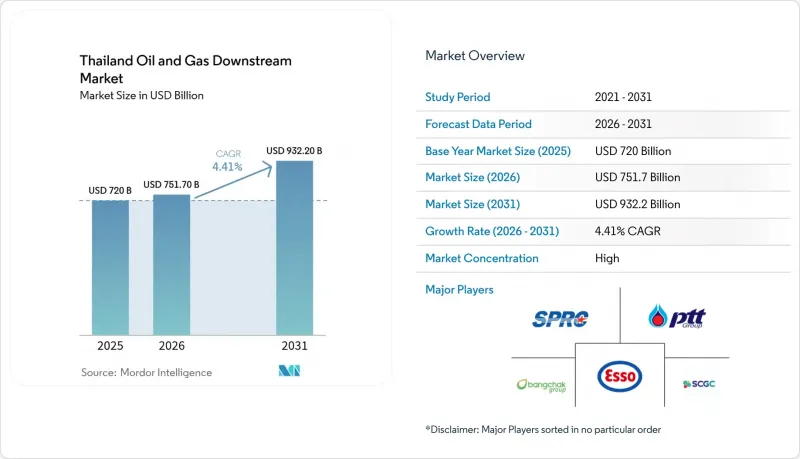
本報告按類型(煉油廠和石化廠)、產品類型(成品油、石化產品、潤滑油)和分銷管道(直銷/批發、分銷商/商業、零售)進行細分。市場規模和預測以美元計價。
泰國下游油氣市場的趨勢與洞察
旅遊業的復甦帶動了精煉產品需求的復甦。
隨著國際入境人數逼近4000萬大關,噴射機燃料出貨量正逐步恢復至疫情前水平,並透過住宿和物流服務帶動汽油和柴油需求的復甦。隨著城市擴張延伸至曼谷以外地區,最後一公里電商車輛的普及也推高了長途運輸的柴油需求,延長了中等複雜程度煉油廠的運作。疫情期間縮減營運規模的業者正在加快計畫內的檢修,以期在2025-2026年的旅遊旺季實現運轉率最大化。與其他入境旅遊復甦緩慢的國家相比,泰國下游油氣市場的需求復甦領先,支撐了裂解價差。目前泰國電動車的普及率僅為10%,在2027年之前不足以對整體液體燃料需求成長產生顯著影響,這為煉油廠提供了數年時間來收回設備升級的資本投資。
歐盟5標準為擴大利潤空間鋪平了道路。
隨著2027年1月強制使用歐5標準汽油和柴油,預計合規產品與不合規產品之間的價格差異將擴大5%至15%。配備新型殘渣油重整生產線和高產能脫硫裝置的綜合煉油廠可以享受這項溢價,同時減輕碳排放稅負擔。來自東南亞國協不符合標準的進口中間餾分油的需求將提供更多市場,使泰國成為無污染燃料出口中心。諸如日產40萬桶的「無污染燃料專案」等專案的進度正在調整,以便在法規實施前提高產量,從而增強規模經濟效益。規模小規模的獨立煉油廠面臨設備升級難題,加速了向能夠回收氫氣並以更低邊際成本加工重質原油的綜合煉油廠和石化超級工廠的轉型。
中國石化產業產能過剩正在給區域利潤率帶來壓力。
中國新增乙烯產能超過3,000萬噸/年,將於2024年運作,將使乙烯單體現貨價格跌至全球成本曲線的下四分之一,東南亞裂解裝置的利潤率也已縮減至每噸150美元。泰國以石腦油為原料的生產商尤其面臨壓力,因為中國擁有採用廉價煤基烯烴和乙烷基工藝的化學裝置,並得到地方政府的激勵措施支持。利潤率的壓縮正在加速企業向特種化學品、工程塑膠和下游產業的策略轉型,這些產業價格彈性較低,盈利更強。雖然臨時反傾銷稅提供了一定的緩解,但長期競爭力取決於能源效率的維修和原料供應的柔軟性,而這些已在2023-2027年國家石化發展藍圖中列為優先事項。
細分市場分析
到2025年,煉油廠在泰國下游油氣市場中佔據65.25%的佔有率。這主要得益於日產124萬桶的蒸餾產能滿足了不斷復甦的交通燃料需求。預計到2031年,泰國下游油氣市場的煉油廠將以3.68%的複合年成長率成長,這主要得益於符合歐5排放標準帶來的溢價以及區域噴射機燃料供不應求推高了煉油廠的運轉率。石化工廠的複合年成長率為4.85%,這主要得益於對下游聚氨酯和可生物分解聚乳酸(PLA)生產線的投資,例如PTT Global Chemical公司投資44億美元的「三步驟升級」計畫。一體化工廠正在利用共享公用設施和氫氣網路來降低5-7%的營運成本,並進一步明確其策略重點,即應對力混合原料。儘管中國的產能過剩仍然是最大的不利因素,但泰國的塑膠工業正在透過生物乙烯和高純度ABS等利基特種產品來應對這一挑戰,這些產品可以保持較高的溢價。
同時,區分碳排放強度的努力也在不斷推進。新安裝的加氫裂解裝置與燃氣熱電汽電共生設施相結合,與十年前的加氫分離器相比,每桶原油的二氧化碳排放量減少了12%至15%,減輕了碳排放稅負擔。結合餘熱回收和廢氣海水淡化的維修工程進一步降低了合規成本,並以低於倫敦銀行間同業拆借利率(LIBOR)的利差吸引了綠色金融相關的貸款。這些努力共同作用,有助於維護泰國下游油氣市場煉油業務的基礎,即便石化產品的利潤超過了燃料銷售利潤。
其他好處:
- Excel格式的市場預測(ME)表
- 3個月的分析師支持
目錄
第1章:引言
- 研究假設和市場定義
- 調查範圍
第2章:調查方法
第3章執行摘要
第4章 市場狀況
- 市場概覽
- 市場促進因素
- 隨著旅遊業的復甦和電子商務物流的擴張,國內對精煉產品的需求正逐漸恢復。
- 透過遵守歐盟5無污染燃料,我們預計從2026年起將實現更高的利潤率。
- 《國家石油計劃 2025》:分階段引入碳排放稅正在加速煉油廠效率提升專案。
- 加油站網路(電動車充電樁和零售平台)的快速數位化正在提升下游產業的盈利。
- 為因應石腦油價格的突然波動,啟動了一個柔軟性的計畫。
- 一個被忽視的領域:對永續航空燃料 (SAF) 的投資正在創造一系列新的高價值產品。
- 市場限制因素
- 以中國主導的石油化學產品過剩,給裂解/聚合物價格上漲帶來了壓力。
- 單池天然氣原料成本上漲,給液化石油氣和天然氣加氣產品的利潤率帶來了壓力。
- 碳邊境調節措施(歐盟碳邊境調節機制、國際碳減量計畫)威脅高二氧化碳燃料的出口獲利能力。
- 一個被忽視的趨勢:電動車的加速普及導致汽油需求下降速度超乎預期。
- 供應鏈分析
- 監理情勢
- 技術展望
- 淨化能力分析
- 波特五力模型
- PESTLE分析
第5章 市場規模與成長預測
- 按類型
- 煉油廠
- 石化廠
- 依產品類型
- 石油精煉產品
- 石油化學產品
- 潤滑劑
- 透過分銷管道
- 直銷/批發
- 銷售代理商/商業
- 零售
第6章 競爭情勢
- 市場集中度
- 策略趨勢(併購、聯盟、購電協議)
- 市場佔有率分析(主要公司的市場排名和佔有率)
- 公司簡介
- PTT Public Company Limited
- Thai Oil Public Company Limited
- Bangchak Corporation PCL
- Esso(Thailand)Public Company Limited
- Star Petroleum Refining PCL
- IRPC Public Company Limited
- PTT Global Chemical PCL
- SCG Chemicals Co. Ltd
- Caltex(Chevron)
- Royal Dutch Shell PLC
- TotalEnergies Marketing(Thailand)
- PTG Energy PCL
- Indorama Ventures PCL
- BAFS PCL
- OR(PTT Oil & Retail Business)
第7章 市場機會與未來展望
According to Mordor Intelligence, the Thailand oil and gas downstream market size is expected to grow from USD 720 million in 2025 to USD 751.7 million in 2026 and is forecast to reach USD 932.2 million by 2031 at 4.41% CAGR over 2026-2031.
This report is Segmented by Type (Refineries and Petrochemical Plants), Product Type (Refined Petroleum Products, Petrochemicals, and Lubricants), and Distribution Channel (Direct Sales/Wholesale, Distributors/Commercial, and Retail). The Market Sizes and Forecasts are Provided in Terms of Value (USD).
Thailand Oil And Gas Downstream Market Trends and Insights
Tourism Recovery Drives Refined Product Demand Resurgence
Jet fuel liftings are nearing pre-pandemic run-rates as international arrivals climb toward the 40 million mark, reviving gasoline and diesel pull through hospitality and logistics services. Last-mile e-commerce fleets add incremental diesel line-haul demand across Bangkok's peri-urban sprawl, extending the utilization window for mid-complexity refineries. Operators that throttled throughput during the pandemic are now executing planned turnarounds early to maximize availability during the 2025-2026 high season. Compared with peers where inbound travel lags, the Thailand oil and gas downstream market enjoys a first-mover demand recovery that supports crack spreads. The country's current 10% EV penetration remains too low to significantly impact aggregate liquid-fuel growth before 2027, creating a multi-year cushion for refiners to recoup upgrade capital expenditures.
Euro-5 Standards Create Margin Expansion Pathway
Mandatory Euro-5 gasoline and diesel specifications, effective January 2027, will widen the pricing gap between compliant and non-compliant supplies by an estimated 5-15%. Complex refineries equipped with new resid-upgrading trains and high-capacity desulfurizers can capture this premium while also reducing carbon tax liabilities. Imported middle-distillate demand from non-compliant ASEAN peers offers an additional outlet, positioning Thailand as a clean-fuel export hub. Project timelines, such as the 400,000 barrels-per-day Clean Fuel Project, are aligned to ramp ahead of enforcement, thereby reinforcing economies of scale. Smaller standalone units face upgrade hurdles, accelerating the shift toward integrated refining and petrochemical super-sites that can recycle hydrogen and process heavier crudes at a lower marginal cost.
China's Petrochemical Overcapacity Pressures Regional Margins
More than 30 million tonnes per annum (mta) of new Chinese ethylene capacity commissioned since 2024 has pulled spot monomer prices toward the bottom quartile of the global cost curve, shrinking Southeast Asian cracker margins to USD 150 per tonne. Thai operators reliant on naphtha feedstock see disproportionate pressure because Chinese complexes run inexpensive coal-to-olefin or ethane-based routes backed by provincial incentives. Margin compression accelerates the strategic pivot toward specialty chemicals, engineering plastics, and downstream integration, where price elasticity is lower, thereby enhancing profitability. While temporary anti-dumping duties offer limited respite, long-run competitiveness hinges on energy-efficiency retrofits and feedstock flexibility-investments already prioritized under the 2023-2027 national petrochemical roadmap.
Other drivers and restraints analyzed in the detailed report include:
- State Oil Plan 2025 Accelerates Efficiency Investments
- Digital Transformation Enhances Retail Profitability
- Carbon Border Measures Threaten Export Competitiveness
For complete list of drivers and restraints, kindly check the Table Of Contents.
Segment Analysis
Refineries captured 65.25% of the Thai oil and gas downstream market share in 2025, as 1.24 million barrels per day of installed distillation capacity met resurging mobility fuel demand. The Thailand oil and gas downstream market size for refineries is projected to increase at a 3.68% CAGR through 2031, as Euro-5 compliance premiums and regional jet-fuel deficits support utilization. Petrochemical plants, growing at a 4.85% CAGR, are underpinned by investments such as PTT Global Chemical's USD 4.4 billion "3 Steps Plus" program that adds downstream polyurethane and biodegradable PLA lines. Integrated sites leverage shared utilities and hydrogen networks, trimming operating costs by 5-7% and sharpening their strategic focus toward mixed-feed flexibility. Chinese overcapacity remains the chief headwind; however, Thai complexes counter with specialty niches, including bio-ethylene and high-purity ABS, which command resilient premiums.
A parallel differentiation track is unfolding around carbon intensity. New-build hydrocrackers paired with gas-fired cogeneration units emit 12-15% less CO2 per barrel than decade-old hydroskimmers, thereby cushioning carbon-tax exposure. Retrofits bundling waste-heat recovery and flue-gas desalination further lower compliance costs, attracting green-finance-linked loans at sub-LIBOR spreads. Collectively, these moves help sustain the Thai oil and gas downstream market's refinery core, even as petrochemical earnings outgrow fuel sales.
Complete Report Scope:
- By Type
- Refineries
- Petrochemical Plants
- By Product Type
- Refined Petroleum Products
- Petrochemicals
- Lubricants
- By Distribution Channel
- Direct Sales/Wholesale
- Distributors/Commercial
- Retail
List of Companies Covered in this Report:
- PTT Public Company Limited
- Thai Oil Public Company Limited
- Bangchak Corporation PCL
- Esso (Thailand) Public Company Limited
- Star Petroleum Refining PCL
- IRPC Public Company Limited
- PTT Global Chemical PCL
- SCG Chemicals Co. Ltd
- Caltex (Chevron)
- Royal Dutch Shell PLC
- TotalEnergies Marketing (Thailand)
- PTG Energy PCL
- Indorama Ventures PCL
- BAFS PCL
- OR (PTT Oil & Retail Business)
Additional Benefits:
- The market estimate (ME) sheet in Excel format
- 3 months of analyst support
TABLE OF CONTENTS
1 Introduction
- 1.1 Study Assumptions & Market Definition
- 1.2 Scope of the Study
2 Research Methodology
3 Executive Summary
4 Market Landscape
- 4.1 Market Overview
- 4.2 Market Drivers
- 4.2.1 Gradual recovery in domestic refined-product demand as tourism returns and e-commerce logistics expand
- 4.2.2 Euro-5/clean-fuel upgrades unlocking higher margins post-2026
- 4.2.3 State Oil Plan 2025: carbon-tax phase-in accelerating refinery efficiency projects
- 4.2.4 Rapid service-station network digitalization (EV chargers & retail platforms) boosting downstream profitability
- 4.2.5 Petrochemical feedstock flexibility projects (propane/ethane) mitigating naphtha price shocks
- 4.2.6 Under-the-radar: Sustainable-aviation-fuel (SAF) investments creating a new high-value product pool
- 4.3 Market Restraints
- 4.3.1 China-led petrochemical over-capacity compressing cracker / polymer spreads
- 4.3.2 Rising Single-Pool-Gas feedstock costs squeezing LPG & GSP margins
- 4.3.3 Carbon-border measures (EU CBAM, CORSIA) threatening export economics for high-CO? fuels
- 4.3.4 Under-the-radar: Accelerating EV adoption eroding gasoline demand earlier than forecasts
- 4.4 Supply-Chain Analysis
- 4.5 Regulatory Landscape
- 4.6 Technological Outlook
- 4.7 Refining Capacity Analysis
- 4.8 Porter's Five Forces
- 4.8.1 Threat of New Entrants
- 4.8.2 Bargaining Power of Suppliers
- 4.8.3 Bargaining Power of Buyers
- 4.8.4 Threat of Substitutes
- 4.8.5 Competitive Rivalry
- 4.9 PESTLE Analysis
5 Market Size & Growth Forecasts
- 5.1 By Type
- 5.1.1 Refineries
- 5.1.2 Petrochemical Plants
- 5.2 By Product Type
- 5.2.1 Refined Petroleum Products
- 5.2.2 Petrochemicals
- 5.2.3 Lubricants
- 5.3 By Distribution Channel
- 5.3.1 Direct Sales/Wholesale
- 5.3.2 Distributors/Commercial
- 5.3.3 Retail
6 Competitive Landscape
- 6.1 Market Concentration
- 6.2 Strategic Moves (M&A, Partnerships, PPAs)
- 6.3 Market Share Analysis (Market Rank/Share for key companies)
- 6.4 Company Profiles (includes Global level Overview, Market level overview, Core Segments, Financials as available, Strategic Information, Products & Services, and Recent Developments)
- 6.4.1 PTT Public Company Limited
- 6.4.2 Thai Oil Public Company Limited
- 6.4.3 Bangchak Corporation PCL
- 6.4.4 Esso (Thailand) Public Company Limited
- 6.4.5 Star Petroleum Refining PCL
- 6.4.6 IRPC Public Company Limited
- 6.4.7 PTT Global Chemical PCL
- 6.4.8 SCG Chemicals Co. Ltd
- 6.4.9 Caltex (Chevron)
- 6.4.10 Royal Dutch Shell PLC
- 6.4.11 TotalEnergies Marketing (Thailand)
- 6.4.12 PTG Energy PCL
- 6.4.13 Indorama Ventures PCL
- 6.4.14 BAFS PCL
- 6.4.15 OR (PTT Oil & Retail Business)
7 Market Opportunities & Future Outlook
- 7.1 White-Space & Unmet-Need Assessment

 2026-2030年石油天然氣幕後市場
 石油天然氣產業下游領域:市場佔有率分析、產業趨勢與統計資料、成長預測(2026-2031 年)東南亞下游油氣市場:市場佔有率分析、產業趨勢與統計及成長預測(2026-2031年)美國下游油氣加工製程:市場佔有率分析、產業趨勢與統計、成長預測(2026-2031)印度油氣下游產業:市場佔有率分析、產業趨勢與統計及成長預測(2026-2031年)印尼下游油氣市場:市場佔有率分析、產業趨勢與統計及成長預測(2026-2031年)
 2026年全球下游石油產品市場報告
 油氣下游市場-全球產業規模、佔有率、趨勢、機會和預測,按類型(煉油廠、石化廠)、地區和競爭格局分類,2020-2030年預測
 全球下游石油與天然氣市場南美石油天然氣下游:市場佔有率分析、產業趨勢、統計、成長趨勢預測(2025-2030)