


 |
市場調查報告書
商品編碼
2120804
棉花:市場佔有率分析、行業趨勢和統計數據、成長預測(2026-2031 年)Cotton - Market Share Analysis, Industry Trends & Statistics, Growth Forecasts (2026 - 2031) |
||||||

※ 本網頁內容可能與最新版本有所差異。詳細情況請與我們聯繫。
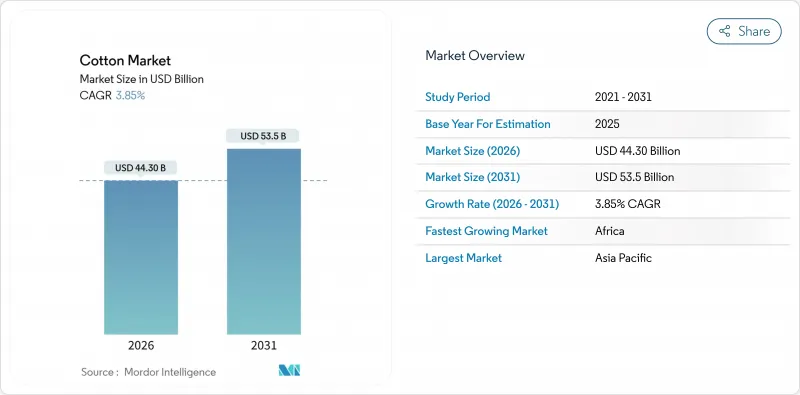
根據 Mordor Intelligence 預測,棉花市場規模預計將在 2026 年達到 443 億美元,到 2031 年達到 535 億美元,在預測期內以 3.85% 的複合年成長率成長。
本報告按地區(北美、歐洲、亞太、南美等)分類,內容包括生產分析(數量)、消費分析(價值和數量)、進口分析(價值和數量)、出口分析(價值和數量)、批發價格趨勢分析以及主要公司清單。市場預測以價值(美元)和數量(公噸)兩種單位呈現。
全球棉花市場趨勢及洞察
透過生物技術提高產量
目前,基改棉花佔全球種植面積的78.4%,與傳統品種相比,平均產量增加了15%至25%。印度的棉花產量從2002年的每公頃460公斤增加到2024年的每公頃510公斤。同時,美國農民透過結合抗蟲害和抗除草劑性狀,將產量維持在接近每公頃950公斤的水平。德克薩斯農工大學的基因編輯計畫開發了一種耐旱品種,該品種在2025年的田間試驗中,即使灌溉用水量減少40%,也能維持90%的灌溉產量。雖然美國農業部(USDA)正在快速批准某些基因編輯作物,但歐盟監管機構仍將其視為基因改造生物,導致其在歐盟的推廣速度較慢。每公頃 50 至 80 美元的許可費繼續限制撒哈拉以南非洲小規模農戶的採用,凸顯了調整補貼的必要性。
再生農業的溢價
品牌措施正在改變採購方式。 H&M(Hennes & Mauritz AB)承諾在2030年,其所有棉花都將來自回收或永續來源,其中20%將符合再生農業標準。 Levi's Strauss & Co.計劃到2025年,將其在印度和巴基斯坦的1萬公頃土地納入再生農業協議,為此支付10-15%的溢價,並實現每公頃土壤碳年增產0.5公頃的目標。美國棉花信託協議已將2500個農場連接到數位化平台,使品牌能夠獲得檢驗的土壤、水和碳排放指標。儘管每公頃30-100美元的認證費用仍然是一個障礙,但合作社的整合正在降低每個生產者的成本。
水資源短缺法規
加州的《永續地下水管理法案》將於2025年全面實施,屆時將導致1.5萬公頃農地無法耕種。巴基斯坦印度河流域管理局計劃在2024年哈里發雨季期間,將旁遮普省和信德省的灌溉渠流量減少25%,導致面積減少8%。在烏茲別克斯坦,由於鹹海乾涸,到2024年,面積將減少至98萬公頃。印度馬哈拉斯特拉邦拉邦強制要求從2024年起使用滴灌系統,這將使小規模農戶每公頃的資本投資負擔增加480美元(4萬印度盧比)。如今,各大品牌紛紛要求進行基於ISO 14046標準的水足跡審計,這進一步推高了合規成本。
區域分析
到2025年,亞太地區將佔全球棉花市場規模的60.4%,主要得益於中國600萬噸的產量和印度580萬噸的收成。中國擁有1.1億錠的紡織生產網路,預計2024年進口260萬噸棉花,主要來自美國、巴西和澳大利亞,此外還有國內生產的棉絮。在最低支持價格(MSP)等價格穩定措施的推動下,印度預計2024年將向孟加拉、越南和中國出口120萬噸棉花。澳洲在2024年受惠於有利的降雨量,棉花產量將95.0%用於出口。由於歐盟《森林砍伐條例》(EUDR)的合規要求,東南亞紡織廠加快了採購步伐,提升了該地區的戰略優勢。然而,亞太地區,特別是馬哈拉斯特拉邦、古吉拉突邦和新疆維吾爾自治區,水資源分配面臨的壓力日益增大,可能會阻礙擴張。
預計到2031年,非洲將以4.0%的複合年成長率保持最高成長率。貝南、布吉納法索和馬利共和國預計在2023年至2025年間透過種子分發、化肥補貼和運輸走廊建設,擴大12%的種植面積。貝南在2024-2025年度收穫了72萬噸棉花,其中90%的產量透過科托努港出口。埃及每年平均生產18萬噸特長絨棉,溢價40-50%,但面臨來自尼羅河Delta地區利潤更高的蔬菜的競爭。在南非,Bt技術於2024年全面實施,產量穩定在18,000公噸,但由於鄰國基礎設施發展緩慢,進展受到阻礙,軋棉製程的延誤導致交貨價格下降5-8%。
北美和南美的情況有所不同。在美國,2024-2025年度棉花產量為300萬噸,較上年同期下降6%,主要原因是德克薩斯州的乾旱。根據最新的農業法案,85%的種植面積都受到作物保險的保護。在巴西的塞拉多地區,棉花種植面積加倍,達到280萬噸。雙季種植的推廣也擴大了棉花在中國進口結構中的比例。在阿根廷,由於國際需求成長以及諸如取消部分出口面積等穩定經濟政策的實施,棉花生產的盈利有所提高,2024年棉花種植面積擴大到62.2萬公頃。在歐洲和中東,土耳其2024年供應了25萬噸棉花,其中大部分用於國內加工。歐盟的森林砍伐法規降低了相當於離岸價2%至3%的合規成本,這為擁有完善可追溯體系的出口商創造了有利條件。
其他好處:
- Excel格式的市場預測(ME)表
- 3個月的分析師支持
目錄
第1章:引言
- 研究假設和市場定義
- 調查範圍
第2章:調查方法
第3章執行摘要
第4章 市場動態
- 市場概覽
- 市場促進因素
- 透過生物技術提高產量
- 再生農業的溢價
- 有機棉需求激增
- 政府最低支持價格體系
- 數位化供應鏈可追溯性
- 抗氣候變遷的種子品種
- 市場限制因素
- 水資源短缺法規
- 農業投入成本不斷上漲
- 不穩定的貿易政策轉變
- 害蟲抗藥性的增強
- 機會
- 任務
- 價值鏈分析
- 人工智慧技術及其在產業的應用
- 原物料市場分析
- 種子
- 肥料
- 殺蟲劑
- 分銷通路分析
- 市場情緒分析
- PESTLE分析
第5章 市場規模與成長預測
- 按地區
- 北美洲
- 美國
- 生產分析(種植面積、產量、產量)
- 消費分析(消費量和消費體積)
- 進口市場分析(進口額、進口量、主要供應市場)
- 出口市場分析(出口額、出口量、主要出口目的地市場)
- 批發價格趨勢分析與預測。
- 法律規範
- 主要公司列表
- 物流和基礎設施
- 季節性分析
- 加拿大
- 生產分析(種植面積、產量、產量)
- 消費分析(消費量和消費體積)
- 進口市場分析(進口額、進口量、主要供應市場)
- 出口市場分析(出口額、出口量、主要出口目的地市場)
- 批發價格趨勢分析與預測。
- 法律規範
- 主要公司列表
- 物流和基礎設施
- 季節性分析
- 美國
- 南美洲
- 巴西
- 生產分析(種植面積、產量、產量)
- 消費分析(消費量和消費體積)
- 進口市場分析(進口額、進口量、主要供應市場)
- 出口市場分析(出口額、出口量、主要出口目的地市場)
- 批發價格趨勢分析與預測
- 法律規範
- 主要公司列表
- 物流和基礎設施
- 季節性分析
- 阿根廷
- 生產分析(種植面積、產量、產量)
- 消費分析(消費量和消費體積)
- 進口市場分析(進口額、進口量、主要供應市場)
- 出口市場分析(出口額、出口量、主要出口目的地市場)
- 批發價格趨勢分析與預測
- 法律規範
- 主要公司列表
- 物流和基礎設施
- 季節性分析
- 巴西
- 歐洲
- 俄羅斯
- 生產分析(種植面積、產量、產量)
- 消費分析(消費量和消費體積)
- 進口市場分析(進口額、進口量、主要供應市場)
- 出口市場分析(出口額、出口量、主要出口目的地市場)
- 批發價格趨勢分析與預測。
- 法律規範
- 主要公司列表
- 物流和基礎設施
- 季節性分析
- 德國
- 生產分析(種植面積、產量、產量)
- 消費分析(消費量和消費體積)
- 進口市場分析(進口額、進口量、主要供應市場)
- 出口市場分析(出口額、出口量、主要出口目的地市場)
- 批發價格趨勢分析與預測
- 法律規範
- 主要公司列表
- 物流和基礎設施
- 季節性分析
- 俄羅斯
- 亞太地區
- 中國
- 生產分析(種植面積、產量、產量)
- 消費分析(消費量和消費體積)
- 進口市場分析(進口額、進口量、主要供應市場)
- 出口市場分析(出口額、出口量、主要出口目的地市場)
- 批發價格趨勢分析與預測
- 法律規範
- 主要公司列表
- 物流和基礎設施
- 季節性分析
- 印度
- 生產分析(種植面積、產量、產量)
- 消費分析(消費量和消費體積)
- 進口市場分析(進口額、進口量、主要供應市場)
- 出口市場分析(出口額、出口量、主要出口目的地市場)
- 批發價格趨勢分析與預測
- 法律規範
- 主要公司列表
- 物流和基礎設施
- 季節性分析
- 澳洲
- 生產分析(種植面積、產量、產量)
- 消費分析(消費量和消費體積)
- 進口市場分析(進口額、進口量、主要供應市場)
- 出口市場分析(出口額、出口量、主要出口目的地市場)
- 批發價格趨勢分析與預測
- 法律規範
- 主要公司列表
- 物流和基礎設施
- 季節性分析
- 巴基斯坦
- 生產分析(種植面積、產量、產量)
- 消費分析(消費量和消費體積)
- 進口市場分析(進口額、進口量、主要供應市場)
- 出口市場分析(出口額、出口量、主要出口目的地市場)
- 批發價格趨勢分析與預測
- 法律規範
- 主要公司列表
- 物流和基礎設施
- 季節性分析
- 中國
- 中東
- 土耳其
- 生產分析(種植面積、產量、產量)
- 消費分析(消費量和消費體積)
- 進口市場分析(進口額、進口量、主要供應市場)
- 出口市場分析(出口額、出口量、主要出口目的地市場)
- 批發價格趨勢分析與預測
- 法律規範
- 主要公司列表
- 物流和基礎設施
- 季節性分析
- 沙烏地阿拉伯
- 生產分析(種植面積、產量、產量)
- 消費分析(消費量和消費體積)
- 進口市場分析(進口額、進口量、主要供應市場)
- 出口市場分析(出口額、出口量、主要出口目的地市場)
- 批發價格趨勢分析與預測
- 法律規範
- 主要公司列表
- 物流和基礎設施
- 季節性分析
- 土耳其
- 非洲
- 埃及
- 生產分析(種植面積、產量、產量)
- 消費分析(消費量和消費體積)
- 進口市場分析(進口額、進口量、主要供應市場)
- 出口市場分析(出口額、出口量、主要出口目的地市場)
- 批發價格趨勢分析與預測
- 法律規範
- 主要公司列表
- 物流和基礎設施
- 季節性分析
- 南非
- 生產分析(種植面積、產量、產量)
- 消費分析(消費量和消費體積)
- 進口市場分析(進口額、進口量、主要供應市場)
- 出口市場分析(出口額、出口量、主要出口目的地市場)
- 批發價格趨勢分析與預測
- 法律規範
- 主要公司列表
- 物流和基礎設施
- 季節性分析
- 埃及
- 北美洲
第6章 最終用途和行業
- 主要應用和新興應用
- 產業特定消費細分
第7章 競爭情勢
- 競爭格局概述
- 市場集中度分析
第8章 市場機會與未來展望
According to Mordor Intelligence, the cotton market size is USD 44.3 billion in 2026 and is projected to reach USD 53.5 billion by 2031, advancing at a 3.85% CAGR over the forecast period.
This report is Segmented by Geography (North America, Europe, Asia-Pacific, South America, and More). The Report Includes Production Analysis (Volume), Consumption Analysis (Value and Volume), Import Analysis (Value and Volume), Export Analysis (Value and Volume), Wholesale Price Trend Analysis, List of Key Players, and More. The Market Forecasts are Provided in Terms of Value (USD) and Volume (Metric Tons).
Global Cotton Market Trends and Insights
Biotech-Enabled Yield Gains
Genetically modified cotton now covers 78.4% of global acreage, pushing average yields up by 15%-25% compared with conventional cultivars. Indian lint yields increased from 460 kg/ha in 2002 to 510 kg/ha in 2024, while United States farmers maintained levels close to 950 kg/ha by stacking insect- and herbicide-tolerance traits. Gene-editing programs at Texas A&M University delivered drought-tolerant lines that preserved 90% of irrigated yield under 40% water cuts during 2025 field trials. The United States Department of Agriculture (USDA) has fast-tracked the approval of certain gene-edited crops, while the European Union's oversight continues to treat them as genetically modified organisms, thereby delaying regional rollouts. Licensing fees of USD 50-80/ha still limit adoption among sub-Saharan smallholders, underscoring the need for subsidy alignment.
Regenerative Farming Premiums
Brand commitments are reshaping procurement habits. H&M Hennes & Mauritz AB has committed to ensuring that all cotton will be either recycled or sustainably sourced by 2030, with 20.0% meeting regenerative criteria. Levi Strauss and Company enrolled 10,000 ha under regenerative protocols across India and Pakistan in 2025, paying a 10%-15% premium and delivering soil-carbon gains of 0.5 metric tons/ha annually. The United States Cotton Trust Protocol linked 2,500 farms to a digital dashboard that brands query for verified soil, water, and carbon metrics. Certification outlays of USD 30-USD 100/ha remain a hurdle, but cooperative aggregation is helping to ease the cost per grower.
Water-Scarcity Regulations
California's Sustainable Groundwater Management Act displaced 15,000 ha of land after full enforcement in 2025. Pakistan's Indus River System Authority lowered Punjab and Sindh canal flows by 25% in the 2024 kharif season, trimming the area by 8%. Uzbekistan's acreage slid to 980,000 ha in 2024 amid the Aral Sea's collapse. The state of Maharashtra in India mandated the use of drip systems from 2024, adding USD 480/ha (INR 40,000/ha) in capital outlays for smallholders. Brands now request ISO 14046 water-footprint audits, pushing compliance costs higher.
Other drivers and restraints analyzed in the detailed report include:
- Surge in Organic-Cotton Demand
- Government Minimum-Support-Price Programs
- Volatile Trade-Policy Shifts
For complete list of drivers and restraints, kindly check the Table Of Contents.
Complete Report Scope:
- By Geography
- North America
- United States
- Production Analysis (Area Harvested, Yield, and Production Volume)
- Consumption Analysis (Consumption Value and Volume)
- Import Market Analysis (Import Value, Volume, and Key Supplying Markets)
- Export Market Analysis (Export Value, Volume, and Key Destination Markets)
- Wholesale Price Trend Analysis and Forecast
- Regulatory Framework
- List of Key Players
- Logistics and Infrastructure
- Seasonality Analysis
- Canada
- Production Analysis (Area Harvested, Yield, and Production Volume)
- Consumption Analysis (Consumption Value and Volume)
- Import Market Analysis (Import Value, Volume, and Key Supplying Markets)
- Export Market Analysis (Export Value, Volume, and Key Destination Markets)
- Wholesale Price Trend Analysis and Forecast
- Regulatory Framework
- List of Key Players
- Logistics and Infrastructure
- Seasonality Analysis
- United States
- South America
- Brazil
- Production Analysis (Area Harvested, Yield, and Production Volume)
- Consumption Analysis (Consumption Value and Volume)
- Import Market Analysis (Import Value, Volume, and Key Supplying Markets)
- Export Market Analysis (Export Value, Volume, and Key Destination Markets)
- Wholesale Price Trend Analysis and Forecast
- Regulatory Framework
- List of Key Players
- Logistics and Infrastructure
- Seasonality Analysis
- Argentina
- Production Analysis (Area Harvested, Yield, and Production Volume)
- Consumption Analysis (Consumption Value and Volume)
- Import Market Analysis (Import Value, Volume, and Key Supplying Markets)
- Export Market Analysis (Export Value, Volume, and Key Destination Markets)
- Wholesale Price Trend Analysis and Forecast
- Regulatory Framework
- List of Key Players
- Logistics and Infrastructure
- Seasonality Analysis
- Brazil
- Europe
- Russia
- Production Analysis (Area Harvested, Yield, and Production Volume)
- Consumption Analysis (Consumption Value and Volume)
- Import Market Analysis (Import Value, Volume, and Key Supplying Markets)
- Export Market Analysis (Export Value, Volume, and Key Destination Markets)
- Wholesale Price Trend Analysis and Forecast
- Regulatory Framework
- List of Key Players
- Logistics and Infrastructure
- Seasonality Analysis
- Germany
- Production Analysis (Area Harvested, Yield, and Production Volume)
- Consumption Analysis (Consumption Value and Volume)
- Import Market Analysis (Import Value, Volume, and Key Supplying Markets)
- Export Market Analysis (Export Value, Volume, and Key Destination Markets)
- Wholesale Price Trend Analysis and Forecast
- Regulatory Framework
- List of Key Players
- Logistics and Infrastructure
- Seasonality Analysis
- Russia
- Asia-Pacific
- China
- Production Analysis (Area Harvested, Yield, and Production Volume)
- Consumption Analysis (Consumption Value and Volume)
- Import Market Analysis (Import Value, Volume, and Key Supplying Markets)
- Export Market Analysis (Export Value, Volume, and Key Destination Markets)
- Wholesale Price Trend Analysis and Forecast
- Regulatory Framework
- List of Key Players
- Logistics and Infrastructure
- Seasonality Analysis
- India
- Production Analysis (Area Harvested, Yield, and Production Volume)
- Consumption Analysis (Consumption Value and Volume)
- Import Market Analysis (Import Value, Volume, and Key Supplying Markets)
- Export Market Analysis (Export Value, Volume, and Key Destination Markets)
- Wholesale Price Trend Analysis and Forecast
- Regulatory Framework
- List of Key Players
- Logistics and Infrastructure
- Seasonality Analysis
- Australia
- Production Analysis (Area Harvested, Yield, and Production Volume)
- Consumption Analysis (Consumption Value and Volume)
- Import Market Analysis (Import Value, Volume, and Key Supplying Markets)
- Export Market Analysis (Export Value, Volume, and Key Destination Markets)
- Wholesale Price Trend Analysis and Forecast
- Regulatory Framework
- List of Key Players
- Logistics and Infrastructure
- Seasonality Analysis
- Pakistan
- Production Analysis (Area Harvested, Yield, and Production Volume)
- Consumption Analysis (Consumption Value and Volume)
- Import Market Analysis (Import Value, Volume, and Key Supplying Markets)
- Export Market Analysis (Export Value, Volume, and Key Destination Markets)
- Wholesale Price Trend Analysis and Forecast
- Regulatory Framework
- List of Key Players
- Logistics and Infrastructure
- Seasonality Analysis
- China
- Middle East
- Turkey
- Production Analysis (Area Harvested, Yield, and Production Volume)
- Consumption Analysis (Consumption Value and Volume)
- Import Market Analysis (Import Value, Volume, and Key Supplying Markets)
- Export Market Analysis (Export Value, Volume, and Key Destination Markets)
- Wholesale Price Trend Analysis and Forecast
- Regulatory Framework
- List of Key Players
- Logistics and Infrastructure
- Seasonality Analysis
- Saudi Arabia
- Production Analysis (Area Harvested, Yield, and Production Volume)
- Consumption Analysis (Consumption Value and Volume)
- Import Market Analysis (Import Value, Volume, and Key Supplying Markets)
- Export Market Analysis (Export Value, Volume, and Key Destination Markets)
- Wholesale Price Trend Analysis and Forecast
- Regulatory Framework
- List of Key Players
- Logistics and Infrastructure
- Seasonality Analysis
- Turkey
- Africa
- Egypt
- Production Analysis (Area Harvested, Yield, and Production Volume)
- Consumption Analysis (Consumption Value and Volume)
- Import Market Analysis (Import Value, Volume, and Key Supplying Markets)
- Export Market Analysis (Export Value, Volume, and Key Destination Markets)
- Wholesale Price Trend Analysis and Forecast
- Regulatory Framework
- List of Key Players
- Logistics and Infrastructure
- Seasonality Analysis
- South Africa
- Production Analysis (Area Harvested, Yield, and Production Volume)
- Consumption Analysis (Consumption Value and Volume)
- Import Market Analysis (Import Value, Volume, and Key Supplying Markets)
- Export Market Analysis (Export Value, Volume, and Key Destination Markets)
- Wholesale Price Trend Analysis and Forecast
- Regulatory Framework
- List of Key Players
- Logistics and Infrastructure
- Seasonality Analysis
- Egypt
- North America
Geography Analysis
Asia-Pacific generated 60.4% of the cotton market size in 2025, buoyed by China's 6.0 million metric tons output and India's 5.8 million metric tons harvest. China's 110 million-spindle network consumed domestic lint alongside 2.6 million metric tons of imports in 2024, mostly from the United States, Brazil, and Australia. India shipped 1.2 million metric tons in 2024 to Bangladesh, Vietnam, and China under MSP-buffered pricing. Australia bounced back in 2024, following helpful rainfall, and exported 95.0% of its output. Southeast Asian mills accelerated purchases due to the European Union Deforestation Regulation (EUDR) compliance requirements, thereby lifting the region's strategic edge. Asia-Pacific, however, faces mounting water-allocation pressure in Maharashtra, Gujarat, and Xinjiang that could cap expansion.
Africa exhibits the fastest 4.0% CAGR through 2031, with Benin, Burkina Faso, and Mali expanding the seeded area by 12% between 2023 and 2025 through seed distribution, fertilizer subsidies, and corridor upgrades. Benin harvested 720,000 metric tons in the 2024-25 season, exporting 90% of the production through the port of Cotonou. Egypt maintains an average of 180,000 metric tons of extra-long-staple lint annually, which earns premiums of 40%-50%, but competes with higher-margin vegetables in the Nile Delta. South Africa stabilized at 18,000 metric tons in 2024 with full Bt adoption, yet progress is hindered by infrastructure gaps in neighboring countries, where ginning delays shave 5%-8% off prices at delivery.
North America and South America diverge. The United States harvested 3.0 million metric tons in 2024-25, down 6% due to the Texas drought, with 85% of acreage carrying crop insurance cushions under the latest farm bill. Brazil's Cerrado doubled cropping, touching 2.8 million metric tons and gaining share in China's import mix due to second-crop sequences. Argentina's land area has increased to 622,000 ha in 2024, as high international demand and stabilizing economic policies, such as the removal of certain export restrictions, have made cotton more profitable for Argentine producers. In Europe and the Middle East, Turkey supplied 250,000 metric tons in 2024, mainly for domestic conversion. The European Union's Deforestation Regulation reduced compliance costs by 2%-3% of the free-on-board value, favoring exporters that are traceability-ready.
- Overview of the Competition
- Recent Developments
- Market Concentration Analysis
Additional Benefits:
- The market estimate (ME) sheet in Excel format
- 3 months of analyst support
TABLE OF CONTENTS
1 Introduction
- 1.1 Study Assumptions and Market Definition
- 1.2 Scope of the Study
2 Research Methodology
3 Executive Summary
4 Market Dynamics
- 4.1 Market Overview
- 4.2 Market Drivers
- 4.2.1 Biotech-enabled yield gains
- 4.2.2 Regenerative farming premiums
- 4.2.3 Surge in organic cotton demand
- 4.2.4 Government minimum-support-price programs
- 4.2.5 Digitized supply-chain traceability
- 4.2.6 Climate-resilient seed varieties
- 4.3 Market Restraints
- 4.3.1 Water-scarcity regulations
- 4.3.2 Escalating farm-input costs
- 4.3.3 Volatile trade-policy shifts
- 4.3.4 Pest-resistance proliferation
- 4.4 Opportunities
- 4.5 Challenges
- 4.6 Value Chain Analysis
- 4.7 Technologies and Usage of AI in the Industry
- 4.8 Input Market Analysis
- 4.8.1 Seeds
- 4.8.2 Fertilizers
- 4.8.3 Crop Protection Chemicals
- 4.9 Distribution Channel Analysis
- 4.10 Market Sentiment Analysis
- 4.11 PESTLE Analysis
5 Market Size and Growth Forecasts (Value and Volume)
- 5.1 By Geography
- 5.1.1 North America
- 5.1.1.1 United States
- 5.1.1.1.1 Production Analysis (Area Harvested, Yield, and Production Volume)
- 5.1.1.1.2 Consumption Analysis (Consumption Value and Volume)
- 5.1.1.1.3 Import Market Analysis (Import Value, Volume, and Key Supplying Markets)
- 5.1.1.1.4 Export Market Analysis (Export Value, Volume, and Key Destination Markets)
- 5.1.1.1.5 Wholesale Price Trend Analysis and Forecast
- 5.1.1.1.6 Regulatory Framework
- 5.1.1.1.7 List of Key Players
- 5.1.1.1.8 Logistics and Infrastructure
- 5.1.1.1.9 Seasonality Analysis
- 5.1.1.2 Canada
- 5.1.1.2.1 Production Analysis (Area Harvested, Yield, and Production Volume)
- 5.1.1.2.2 Consumption Analysis (Consumption Value and Volume)
- 5.1.1.2.3 Import Market Analysis (Import Value, Volume, and Key Supplying Markets)
- 5.1.1.2.4 Export Market Analysis (Export Value, Volume, and Key Destination Markets)
- 5.1.1.2.5 Wholesale Price Trend Analysis and Forecast
- 5.1.1.2.6 Regulatory Framework
- 5.1.1.2.7 List of Key Players
- 5.1.1.2.8 Logistics and Infrastructure
- 5.1.1.2.9 Seasonality Analysis
- 5.1.1.1 United States
- 5.1.2 South America
- 5.1.2.1 Brazil
- 5.1.2.1.1 Production Analysis (Area Harvested, Yield, and Production Volume)
- 5.1.2.1.2 Consumption Analysis (Consumption Value and Volume)
- 5.1.2.1.3 Import Market Analysis (Import Value, Volume, and Key Supplying Markets)
- 5.1.2.1.4 Export Market Analysis (Export Value, Volume, and Key Destination Markets)
- 5.1.2.1.5 Wholesale Price Trend Analysis and Forecast
- 5.1.2.1.6 Regulatory Framework
- 5.1.2.1.7 List of Key Players
- 5.1.2.1.8 Logistics and Infrastructure
- 5.1.2.1.9 Seasonality Analysis
- 5.1.2.2 Argentina
- 5.1.2.2.1 Production Analysis (Area Harvested, Yield, and Production Volume)
- 5.1.2.2.2 Consumption Analysis (Consumption Value and Volume)
- 5.1.2.2.3 Import Market Analysis (Import Value, Volume, and Key Supplying Markets)
- 5.1.2.2.4 Export Market Analysis (Export Value, Volume, and Key Destination Markets)
- 5.1.2.2.5 Wholesale Price Trend Analysis and Forecast
- 5.1.2.2.6 Regulatory Framework
- 5.1.2.2.7 List of Key Players
- 5.1.2.2.8 Logistics and Infrastructure
- 5.1.2.2.9 Seasonality Analysis
- 5.1.2.1 Brazil
- 5.1.3 Europe
- 5.1.3.1 Russia
- 5.1.3.1.1 Production Analysis (Area Harvested, Yield, and Production Volume)
- 5.1.3.1.2 Consumption Analysis (Consumption Value and Volume)
- 5.1.3.1.3 Import Market Analysis (Import Value, Volume, and Key Supplying Markets)
- 5.1.3.1.4 Export Market Analysis (Export Value, Volume, and Key Destination Markets)
- 5.1.3.1.5 Wholesale Price Trend Analysis and Forecast
- 5.1.3.1.6 Regulatory Framework
- 5.1.3.1.7 List of Key Players
- 5.1.3.1.8 Logistics and Infrastructure
- 5.1.3.1.9 Seasonality Analysis
- 5.1.3.2 Germany
- 5.1.3.2.1 Production Analysis (Area Harvested, Yield, and Production Volume)
- 5.1.3.2.2 Consumption Analysis (Consumption Value and Volume)
- 5.1.3.2.3 Import Market Analysis (Import Value, Volume, and Key Supplying Markets)
- 5.1.3.2.4 Export Market Analysis (Export Value, Volume, and Key Destination Markets)
- 5.1.3.2.5 Wholesale Price Trend Analysis and Forecast
- 5.1.3.2.6 Regulatory Framework
- 5.1.3.2.7 List of Key Players
- 5.1.3.2.8 Logistics and Infrastructure
- 5.1.3.2.9 Seasonality Analysis
- 5.1.3.1 Russia
- 5.1.4 Asia-Pacific
- 5.1.4.1 China
- 5.1.4.1.1 Production Analysis (Area Harvested, Yield, and Production Volume)
- 5.1.4.1.2 Consumption Analysis (Consumption Value and Volume)
- 5.1.4.1.3 Import Market Analysis (Import Value, Volume, and Key Supplying Markets)
- 5.1.4.1.4 Export Market Analysis (Export Value, Volume, and Key Destination Markets)
- 5.1.4.1.5 Wholesale Price Trend Analysis and Forecast
- 5.1.4.1.6 Regulatory Framework
- 5.1.4.1.7 List of Key Players
- 5.1.4.1.8 Logistics and Infrastructure
- 5.1.4.1.9 Seasonality Analysis
- 5.1.4.2 India
- 5.1.4.2.1 Production Analysis (Area Harvested, Yield, and Production Volume)
- 5.1.4.2.2 Consumption Analysis (Consumption Value and Volume)
- 5.1.4.2.3 Import Market Analysis (Import Value, Volume, and Key Supplying Markets)
- 5.1.4.2.4 Export Market Analysis (Export Value, Volume, and Key Destination Markets)
- 5.1.4.2.5 Wholesale Price Trend Analysis and Forecast
- 5.1.4.2.6 Regulatory Framework
- 5.1.4.2.7 List of Key Players
- 5.1.4.2.8 Logistics and Infrastructure
- 5.1.4.2.9 Seasonality Analysis
- 5.1.4.3 Australia
- 5.1.4.3.1 Production Analysis (Area Harvested, Yield, and Production Volume)
- 5.1.4.3.2 Consumption Analysis (Consumption Value and Volume)
- 5.1.4.3.3 Import Market Analysis (Import Value, Volume, and Key Supplying Markets)
- 5.1.4.3.4 Export Market Analysis (Export Value, Volume, and Key Destination Markets)
- 5.1.4.3.5 Wholesale Price Trend Analysis and Forecast
- 5.1.4.3.6 Regulatory Framework
- 5.1.4.3.7 List of Key Players
- 5.1.4.3.8 Logistics and Infrastructure
- 5.1.4.3.9 Seasonality Analysis
- 5.1.4.4 Pakistan
- 5.1.4.4.1 Production Analysis (Area Harvested, Yield, and Production Volume)
- 5.1.4.4.2 Consumption Analysis (Consumption Value and Volume)
- 5.1.4.4.3 Import Market Analysis (Import Value, Volume, and Key Supplying Markets)
- 5.1.4.4.4 Export Market Analysis (Export Value, Volume, and Key Destination Markets)
- 5.1.4.4.5 Wholesale Price Trend Analysis and Forecast
- 5.1.4.4.6 Regulatory Framework
- 5.1.4.4.7 List of Key Players
- 5.1.4.4.8 Logistics and Infrastructure
- 5.1.4.4.9 Seasonality Analysis
- 5.1.4.1 China
- 5.1.5 Middle East
- 5.1.5.1 Turkey
- 5.1.5.1.1 Production Analysis (Area Harvested, Yield, and Production Volume)
- 5.1.5.1.2 Consumption Analysis (Consumption Value and Volume)
- 5.1.5.1.3 Import Market Analysis (Import Value, Volume, and Key Supplying Markets)
- 5.1.5.1.4 Export Market Analysis (Export Value, Volume, and Key Destination Markets)
- 5.1.5.1.5 Wholesale Price Trend Analysis and Forecast
- 5.1.5.1.6 Regulatory Framework
- 5.1.5.1.7 List of Key Players
- 5.1.5.1.8 Logistics and Infrastructure
- 5.1.5.1.9 Seasonality Analysis
- 5.1.5.2 Saudi Arabia
- 5.1.5.2.1 Production Analysis (Area Harvested, Yield, and Production Volume)
- 5.1.5.2.2 Consumption Analysis (Consumption Value and Volume)
- 5.1.5.2.3 Import Market Analysis (Import Value, Volume, and Key Supplying Markets)
- 5.1.5.2.4 Export Market Analysis (Export Value, Volume, and Key Destination Markets)
- 5.1.5.2.5 Wholesale Price Trend Analysis and Forecast
- 5.1.5.2.6 Regulatory Framework
- 5.1.5.2.7 List of Key Players
- 5.1.5.2.8 Logistics and Infrastructure
- 5.1.5.2.9 Seasonality Analysis
- 5.1.5.1 Turkey
- 5.1.6 Africa
- 5.1.6.1 Egypt
- 5.1.6.1.1 Production Analysis (Area Harvested, Yield, and Production Volume)
- 5.1.6.1.2 Consumption Analysis (Consumption Value and Volume)
- 5.1.6.1.3 Import Market Analysis (Import Value, Volume, and Key Supplying Markets)
- 5.1.6.1.4 Export Market Analysis (Export Value, Volume, and Key Destination Markets)
- 5.1.6.1.5 Wholesale Price Trend Analysis and Forecast
- 5.1.6.1.6 Regulatory Framework
- 5.1.6.1.7 List of Key Players
- 5.1.6.1.8 Logistics and Infrastructure
- 5.1.6.1.9 Seasonality Analysis
- 5.1.6.2 South Africa
- 5.1.6.2.1 Production Analysis (Area Harvested, Yield, and Production Volume)
- 5.1.6.2.2 Consumption Analysis (Consumption Value and Volume)
- 5.1.6.2.3 Import Market Analysis (Import Value, Volume, and Key Supplying Markets)
- 5.1.6.2.4 Export Market Analysis (Export Value, Volume, and Key Destination Markets)
- 5.1.6.2.5 Wholesale Price Trend Analysis and Forecast
- 5.1.6.2.6 Regulatory Framework
- 5.1.6.2.7 List of Key Players
- 5.1.6.2.8 Logistics and Infrastructure
- 5.1.6.2.9 Seasonality Analysis
- 5.1.6.1 Egypt
- 5.1.1 North America
6 End Use Applications and Industries
- 6.1 Primary Applications and Emerging Applications
- 6.2 Consumption Breakdown by Industries
7 Competitive Landscape
- 7.1 Overview of the Competition
- 7.2 Recent Developments
- 7.3 Market Concentration Analysis
8 Market Opportunities and Future Outlook

 有機棉壁掛市場:規模、佔有率、成長、全球產業分析、區域洞察及2026年至2034年預測
 北美棉花:市場佔有率分析、產業趨勢與統計、成長預測(2026-2031)歐洲棉花:市場佔有率分析、行業趨勢和統計數據、成長預測(2026-2031)南美棉花市場:市場佔有率分析、產業趨勢與統計、成長預測(2026-2031年)非洲棉花:市場佔有率分析、行業趨勢和統計數據、成長預測(2026-2031)
 棉花市場預測至2034年-按產品、產品類型、最終用戶和地區分類的全球分析
 棉短絨紙漿市場:按產品類型、最終用途行業、應用和地區分類棉纖維市場:依纖維等級、應用和地區分類
 2026-2030年全球棉花市場
 棉漿市場:依產品類型、形態、加工方法、等級、應用和銷售管道分類-2026-2032年全球預測