


 |
市場調查報告書
商品編碼
2120382
非洲棉花:市場佔有率分析、行業趨勢和統計數據、成長預測(2026-2031)Africa Cotton - Market Share Analysis, Industry Trends & Statistics, Growth Forecasts (2026 - 2031) |
||||||

※ 本網頁內容可能與最新版本有所差異。詳細情況請與我們聯繫。
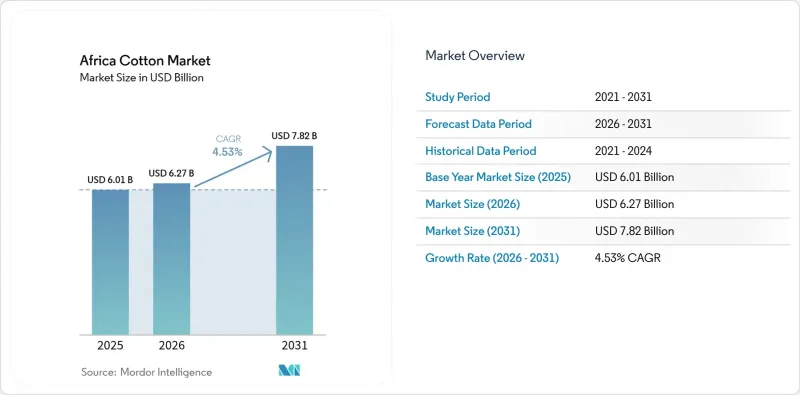
據 Mordor Intelligence 稱,2025 年非洲棉花市場價值 60.1 億美元,預計到 2031 年將從 2026 年的 62.7 億美元成長至 78.2 億美元,預測期(2026-2031 年)複合年成長率為 4.53%。
本報告按地區(布吉納法索、馬利共和國、貝南等)分類,內容包括生產分析(數量)、消費分析(價值和數量)、進口分析(價值和數量)、出口分析(價值和數量)、批發價格趨勢分析和預測,以及主要公司清單。市場預測以價值(美元)和數量(公噸)兩種單位呈現。
非洲棉花市場的趨勢與洞察
棉花種植面積擴大
棉花種植面積的擴大持續推動非洲棉花市場的成長,尤其是在西非,棉花仍然是當地重要的經濟作物。各國政府和農民合作社積極推廣棉花種植,將其作為可靠的出口收入和農村收入來源,鼓勵農民將更多面積用於種植棉花,而不是用於種植自給自足的作物。貝南、馬利共和國和布吉納法索的政府補貼計畫預計將在2023年至2025年間使棉花種植面積增加18萬公頃,從而增加原棉供應,並使軋棉廠能夠獲得運費折扣。到2025年,貝南將向28.5萬小規模農戶提供價值4,000萬美元的化肥補貼。這些措施共同鞏固了該地區在全球棉花市場中的地位。
中國對西非棉絮的需求日益成長
亞洲紡織製造商對棉花的需求不斷成長,是推動非洲棉花出口的關鍵因素。預計到2025年,中國紡紗廠將進口120萬噸非洲棉絨,比2024年的進口量增加19%。西非棉花因其纖維品質優良和價格優勢而備受青睞,成為尋求採購多元化的紡紗廠的理想選擇。與亞洲買家的貿易夥伴關係有助於穩定需求,即使當地消費量仍然較低。例如,以出口為導向的棉花生產商正受益於長期採購合約。這有助於緩解價格波動,確保生產穩定,最終鞏固非洲作為全球棉花貿易主要供應國的地位。
農村地區物流不發達
農村地區交通和倉儲基礎設施不足,推高了棉花成本,加劇了收穫後損失,對棉花市場帶來了巨大挑戰。許多棉花產區依賴未鋪設的道路、不足的倉儲設施和分散的交通網路,阻礙了原棉從農場到精煉廠的高效運輸。連接象牙海岸共和國、奈及利亞、加納、多哥和貝南的阿比讓-拉各斯沿海公路全長1028公里,計畫於2025年建成,旨在加強西非的交通網路。該項目預計投資156億美元,計劃於2026年動工建設,2030年完工。非洲開發銀行資助了該項目的可行性研究,並建立了資金籌措和體制框架以支持該項目,但在項目建成之前,物流瓶頸仍然限制非洲棉花市場的發展。
其他好處:
- Excel格式的市場預測(ME)表
- 3個月的分析師支持
目錄
第1章:引言
- 研究假設和市場定義
- 調查範圍
第2章:調查方法
第3章執行摘要
第4章 市場狀況
- 市場概覽
- 市場促進因素
- 棉花種植面積增加
- 中國對西非棉花的需求不斷成長
- 灌溉走廊的擴建
- 引進基因改造棉種子
- 數位化增強平台
- 重視環境、社會和管治(ESG) 因素的品牌,其可追溯性溢價較高。
- 市場限制因素
- 與競爭對手相比,脫粒率較低。
- 低度開發的農村物流
- 老化的小農戶
- 外匯短缺限制了可用材料的數量。
- 機會
- 任務
- 價值鏈分析
- 人工智慧技術及其在產業的應用
- 原物料市場分析
- 種子
- 肥料
- 殺蟲劑
- 分銷通路分析
- 市場情緒分析
- PESTLE分析
第5章 市場規模與成長預測
- 按地區
- 布吉納法索
- 生產分析(種植面積、產量、產量)
- 消費分析(消費量和消費體積)
- 進口市場分析(進口額、進口量、主要供應市場)
- 出口市場分析(出口額、出口量、主要出口目的地市場)
- 批發價格趨勢分析與預測。
- 法律規範
- 主要公司列表
- 物流和基礎設施
- 季節性分析
- 馬利共和國
- 生產分析(種植面積、產量、產量)
- 消費分析(消費量和消費體積)
- 進口市場分析(進口額、進口量、主要供應市場)
- 出口市場分析(出口額、出口量、主要出口目的地市場)
- 批發價格趨勢分析與預測。
- 法律規範
- 主要公司列表
- 物流和基礎設施
- 季節性分析
- 貝南
- 生產分析(種植面積、產量、產量)
- 消費分析(消費量和消費體積)
- 進口市場分析(進口額、進口量、主要供應市場)
- 出口市場分析(出口額、出口量、主要出口目的地市場)
- 批發價格趨勢分析與預測。
- 法律規範
- 主要公司列表
- 物流和基礎設施
- 季節性分析
- 肯亞
- 生產分析(種植面積、產量、產量)
- 消費分析(消費量和消費體積)
- 進口市場分析(進口額、進口量、主要供應市場)
- 出口市場分析(出口額、出口量、主要出口目的地市場)
- 批發價格趨勢分析與預測。
- 法律規範
- 主要公司列表
- 物流和基礎設施
- 季節性分析
- 喀麥隆
- 生產分析(種植面積、產量、產量)
- 消費分析(消費量和消費體積)
- 進口市場分析(進口額、進口量、主要供應市場)
- 出口市場分析(出口額、出口量、主要出口目的地市場)
- 批發價格趨勢分析與預測。
- 法律規範
- 主要公司列表
- 物流和基礎設施
- 季節性分析
- 奈及利亞
- 生產分析(種植面積、產量、產量)
- 消費分析(消費量和消費體積)
- 進口市場分析(進口額、進口量、主要供應市場)
- 出口市場分析(出口額、出口量、主要出口目的地市場)
- 批發價格趨勢分析與預測。
- 法律規範
- 主要公司列表
- 物流和基礎設施
- 季節性分析
- 布吉納法索
第6章 最終用途和行業
- 主要應用和新興應用
- 產業特定消費細分
第7章 競爭情勢
- 競爭格局概述
- 市場集中度分析
- 主要公司列表
- Olam International Limited
- Louis Dreyfus Company BV
- Cargill, Incorporated
- Plexus Cotton Limited(RCMA Group)
- Paul Reinhart AG
- Compagnie Malienne pour le Developpement des Textiles SA
- Societe Burkinabe des Fibres Textiles(SOFITEX)
- Ivoire Coton SA
- Societe de Developpement du Coton(SODECOTON)
- Devcot SA
- West African Cotton Company Limited(WACOT)
- Branson Commodities
- ETG Commodities(ETC Group)
- Cotton Company of Zimbabwe Limited(COTTCO)
- Alliance Ginneries Limited
第8章 市場機會與未來展望
According to Mordor Intelligence, the Africa cotton market size was valued at USD 6.01 billion in 2025 and estimated to grow from USD 6.27 billion in 2026 to reach USD 7.82 billion by 2031, at a CAGR of 4.53% during the forecast period (2026-2031).
This report is Segmented by Geography (Burkina Faso, Mali, Benin, and More). The Report Includes Production Analysis (Volume), Consumption Analysis (Value and Volume), Import Analysis (Value and Volume), Export Analysis (Value and Volume), Wholesale Price Trend Analysis and Forecast, List of Key Players, and More. The Market Forecasts are Provided in Terms of Value (USD) and Volume (Metric Tons).
Africa Cotton Market Trends and Insights
Rising Area Under Cotton Cultivation
The expansion of land allocated to cotton farming continues to drive growth in the African cotton market, particularly in West Africa, where cotton remains a key cash crop. Governments and farmer cooperatives actively promote cotton cultivation as a dependable source of export revenue and rural income, encouraging farmers to dedicate more acreage to cotton instead of subsistence crops. Government subsidy programs in Benin, Mali, and Burkina Faso added 180,000 hectares during the 2023-2025 period, increasing raw fiber availability and enabling ginners to secure freight discounts. In 2025, Benin provided USD 40 million in subsidized fertilizer to 285,000 smallholder farmers. These efforts collectively strengthen the region's position in the global cotton market.
Growing Chinese Demand for West-African Lint
The growing demand of cotton from Asian textile manufacturers is a significant factor driving African cotton exports. Chinese mills imported 1.2 million metric tons of African lint in 2025, 19% above 2024 volumes. West African cotton is particularly valued for its fiber quality and competitive pricing, making it appealing to spinning mills seeking to diversify their sourcing. Trade partnerships with Asian buyers help stabilize demand, even when local consumption remains low. For instance, export-focused cotton producers benefit from long-term procurement agreements, which help mitigate price fluctuations and support consistent production, thereby strengthening Africa's position as a key supplier in global cotton trade.
Under-Developed Rural Logistics
Inadequate rural transport and storage infrastructure pose significant challenges to the cotton market by driving up costs and increasing post-harvest losses. Many cotton-producing regions rely on unpaved roads, insufficient warehousing, and fragmented transport networks, hindering the efficient movement of seed cotton from farms to gins. In 2025, the 1,028-kilometer Abidjan-Lagos coastal motorway, linking Cote d'Ivoire, Nigeria, Ghana, Togo, and Benin, was set to boost West African connectivity. With USD 15.6 billion in investment interest, construction is slated to start in 2026 and finish by 2030. The African Development Bank funded feasibility studies and developed financing and institutional frameworks to support, the project, yet until the projects finish, logistics bottlenecks continue to restrain the Africa cotton market .
Other drivers and restraints analyzed in the detailed report include:
- Expansion of Irrigation Corridors
- Adoption of Genetically Modified Cotton Seeds
- Aging Smallholder Farmer Base
For complete list of drivers and restraints, kindly check the Table Of Contents.
Complete Report Scope:
- By Geography
- Burkina Faso
- Production Analysis (Area Harvested, Yield, and Production Volume)
- Consumption Analysis (Consumption Value and Volume)
- Import Market Analysis (Import Value, Volume, and Key Supplying Markets)
- Export Market Analysis (Export Value, Volume, and Key Destination Markets)
- Wholesale Price Trend Analysis and Forecast
- Regulatory Framework
- List of Key Players
- Logistics and Infrastructure
- Seasonality Analysis
- Mali
- Production Analysis (Area Harvested, Yield, and Production Volume)
- Consumption Analysis (Consumption Value and Volume)
- Import Market Analysis (Import Value, Volume, and Key Supplying Markets)
- Export Market Analysis (Export Value, Volume, and Key Destination Markets)
- Wholesale Price Trend Analysis and Forecast
- Regulatory Framework
- List of Key Players
- Logistics and Infrastructure
- Seasonality Analysis
- Benin
- Production Analysis (Area Harvested, Yield, and Production Volume)
- Consumption Analysis (Consumption Value and Volume)
- Import Market Analysis (Import Value, Volume, and Key Supplying Markets)
- Export Market Analysis (Export Value, Volume, and Key Destination Markets)
- Wholesale Price Trend Analysis and Forecast
- Regulatory Framework
- List of Key Players
- Logistics and Infrastructure
- Seasonality Analysis
- Kenya
- Production Analysis (Area Harvested, Yield, and Production Volume)
- Consumption Analysis (Consumption Value and Volume)
- Import Market Analysis (Import Value, Volume, and Key Supplying Markets)
- Export Market Analysis (Export Value, Volume, and Key Destination Markets)
- Wholesale Price Trend Analysis and Forecast
- Regulatory Framework
- List of Key Players
- Logistics and Infrastructure
- Seasonality Analysis
- Cameroon
- Production Analysis (Area Harvested, Yield, and Production Volume)
- Consumption Analysis (Consumption Value and Volume)
- Import Market Analysis (Import Value, Volume, and Key Supplying Markets)
- Export Market Analysis (Export Value, Volume, and Key Destination Markets)
- Wholesale Price Trend Analysis and Forecast
- Regulatory Framework
- List of Key Players
- Logistics and Infrastructure
- Seasonality Analysis
- Nigeria
- Production Analysis (Area Harvested, Yield, and Production Volume)
- Consumption Analysis (Consumption Value and Volume)
- Import Market Analysis (Import Value, Volume, and Key Supplying Markets)
- Export Market Analysis (Export Value, Volume, and Key Destination Markets)
- Wholesale Price Trend Analysis and Forecast
- Regulatory Framework
- List of Key Players
- Logistics and Infrastructure
- Seasonality Analysis
- Burkina Faso
Additional Benefits:
- The market estimate (ME) sheet in Excel format
- 3 months of analyst support
TABLE OF CONTENTS
1 Introduction
- 1.1 Study Assumptions and Market Definition
- 1.2 Scope of the Study
2 Research Methodology
3 Executive Summary
4 Market Landscape
- 4.1 Market Overview
- 4.2 Market Drivers
- 4.2.1 Rising area under cotton cultivation
- 4.2.2 Growing chinese demand for West-African lint
- 4.2.3 Expansion of irrigation corridors
- 4.2.4 Adoption of genetically modified cotton seeds
- 4.2.5 Digitized extension platforms
- 4.2.6 Traceability premiums from Environmental, Social, and Governance (ESG)-oriented brands
- 4.3 Market Restraints
- 4.3.1 Low ginning out-turn ratios versus peers
- 4.3.2 Under-developed rural logistics
- 4.3.3 Aging smallholder farmer base
- 4.3.4 Foreign exchange shortages limiting inputs
- 4.4 Opportunities
- 4.5 Challenges
- 4.6 Value Chain Analysis
- 4.7 Technologies and usage of AI in the Industry
- 4.8 Input Market Analysis
- 4.8.1 Seeds
- 4.8.2 Fertilizers
- 4.8.3 Crop Protection Chemicals
- 4.9 Distribution Channel Analysis
- 4.10 Market Sentiment Analysis
- 4.11 PESTLE Analysis
5 Market Size and Growth Forecasts (Value and Volume)
- 5.1 By Geography
- 5.1.1 Burkina Faso
- 5.1.1.1 Production Analysis (Area Harvested, Yield, and Production Volume)
- 5.1.1.2 Consumption Analysis (Consumption Value and Volume)
- 5.1.1.3 Import Market Analysis (Import Value, Volume, and Key Supplying Markets)
- 5.1.1.4 Export Market Analysis (Export Value, Volume, and Key Destination Markets)
- 5.1.1.5 Wholesale Price Trend Analysis and Forecast
- 5.1.1.6 Regulatory Framework
- 5.1.1.7 List of Key Players
- 5.1.1.8 Logistics and Infrastructure
- 5.1.1.9 Seasonality Analysis
- 5.1.2 Mali
- 5.1.2.1 Production Analysis (Area Harvested, Yield, and Production Volume)
- 5.1.2.2 Consumption Analysis (Consumption Value and Volume)
- 5.1.2.3 Import Market Analysis (Import Value, Volume, and Key Supplying Markets)
- 5.1.2.4 Export Market Analysis (Export Value, Volume, and Key Destination Markets)
- 5.1.2.5 Wholesale Price Trend Analysis and Forecast
- 5.1.2.6 Regulatory Framework
- 5.1.2.7 List of Key Players
- 5.1.2.8 Logistics and Infrastructure
- 5.1.2.9 Seasonality Analysis
- 5.1.3 Benin
- 5.1.3.1 Production Analysis (Area Harvested, Yield, and Production Volume)
- 5.1.3.2 Consumption Analysis (Consumption Value and Volume)
- 5.1.3.3 Import Market Analysis (Import Value, Volume, and Key Supplying Markets)
- 5.1.3.4 Export Market Analysis (Export Value, Volume, and Key Destination Markets)
- 5.1.3.5 Wholesale Price Trend Analysis and Forecast
- 5.1.3.6 Regulatory Framework
- 5.1.3.7 List of Key Players
- 5.1.3.8 Logistics and Infrastructure
- 5.1.3.9 Seasonality Analysis
- 5.1.4 Kenya
- 5.1.4.1 Production Analysis (Area Harvested, Yield, and Production Volume)
- 5.1.4.2 Consumption Analysis (Consumption Value and Volume)
- 5.1.4.3 Import Market Analysis (Import Value, Volume, and Key Supplying Markets)
- 5.1.4.4 Export Market Analysis (Export Value, Volume, and Key Destination Markets)
- 5.1.4.5 Wholesale Price Trend Analysis and Forecast
- 5.1.4.6 Regulatory Framework
- 5.1.4.7 List of Key Players
- 5.1.4.8 Logistics and Infrastructure
- 5.1.4.9 Seasonality Analysis
- 5.1.5 Cameroon
- 5.1.5.1 Production Analysis (Area Harvested, Yield, and Production Volume)
- 5.1.5.2 Consumption Analysis (Consumption Value and Volume)
- 5.1.5.3 Import Market Analysis (Import Value, Volume, and Key Supplying Markets)
- 5.1.5.4 Export Market Analysis (Export Value, Volume, and Key Destination Markets)
- 5.1.5.5 Wholesale Price Trend Analysis and Forecast
- 5.1.5.6 Regulatory Framework
- 5.1.5.7 List of Key Players
- 5.1.5.8 Logistics and Infrastructure
- 5.1.5.9 Seasonality Analysis
- 5.1.6 Nigeria
- 5.1.6.1 Production Analysis (Area Harvested, Yield, and Production Volume)
- 5.1.6.2 Consumption Analysis (Consumption Value and Volume)
- 5.1.6.3 Import Market Analysis (Import Value, Volume, and Key Supplying Markets)
- 5.1.6.4 Export Market Analysis (Export Value, Volume, and Key Destination Markets)
- 5.1.6.5 Wholesale Price Trend Analysis and Forecast
- 5.1.6.6 Regulatory Framework
- 5.1.6.7 List of Key Players
- 5.1.6.8 Logistics and Infrastructure
- 5.1.6.9 Seasonality Analysis
- 5.1.1 Burkina Faso
6 End Use Applications and Industries
- 6.1 Primary Applications and Emerging Applications
- 6.2 Consumption Breakdown by Indsutries
7 Competitive Landscape
- 7.1 Overview of the Competition
- 7.2 Recent Developments
- 7.3 Market Concentration Analysis
- 7.4 List of Key Players
- 7.4.1 Olam International Limited
- 7.4.2 Louis Dreyfus Company B.V.
- 7.4.3 Cargill, Incorporated
- 7.4.4 Plexus Cotton Limited (RCMA Group)
- 7.4.5 Paul Reinhart AG
- 7.4.6 Compagnie Malienne pour le Developpement des Textiles SA
- 7.4.7 Societe Burkinabe des Fibres Textiles (SOFITEX)
- 7.4.8 Ivoire Coton SA
- 7.4.9 Societe de Developpement du Coton (SODECOTON)
- 7.4.10 Devcot SA
- 7.4.11 West African Cotton Company Limited (WACOT)
- 7.4.12 Branson Commodities
- 7.4.13 ETG Commodities (ETC Group)
- 7.4.14 Cotton Company of Zimbabwe Limited (COTTCO)
- 7.4.15 Alliance Ginneries Limited
8 Market Opportunities and Future Outlook

 有機棉壁掛市場:規模、佔有率、成長、全球產業分析、區域洞察及2026年至2034年預測
 北美棉花:市場佔有率分析、產業趨勢與統計、成長預測(2026-2031)棉花:市場佔有率分析、行業趨勢和統計數據、成長預測(2026-2031 年)歐洲棉花:市場佔有率分析、行業趨勢和統計數據、成長預測(2026-2031)南美棉花市場:市場佔有率分析、產業趨勢與統計、成長預測(2026-2031年)
 棉花市場預測至2034年-按產品、產品類型、最終用戶和地區分類的全球分析
 棉短絨紙漿市場:按產品類型、最終用途行業、應用和地區分類棉纖維市場:依纖維等級、應用和地區分類
 2026-2030年全球棉花市場
 棉漿市場:依產品類型、形態、加工方法、等級、應用和銷售管道分類-2026-2032年全球預測