


 |
市場調查報告書
商品編碼
2113364
北美棉花:市場佔有率分析、產業趨勢與統計、成長預測(2026-2031)North America Cotton - Market Share Analysis, Industry Trends & Statistics, Growth Forecasts (2026 - 2031) |
||||||

※ 本網頁內容可能與最新版本有所差異。詳細情況請與我們聯繫。
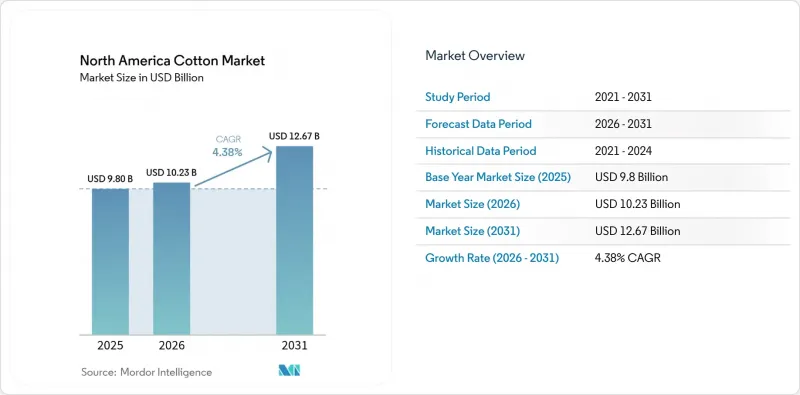
據 Mordor Intelligence 稱,北美棉花市場預計到 2026 年價值將達到 102.3 億美元,高於 2025 年的 98 億美元,預計到 2031 年將達到 126.7 億美元。
預計從 2026 年到 2031 年,其複合年成長率將達到 4.38%。
本報告按地區(美國、加拿大、墨西哥)分類。研究內容包括生產分析(數量)、消費分析(價值和數量)、出口分析(價值和數量)、進口分析(價值和數量)以及價格趨勢分析。市場預測以價值(美元)和數量(公噸)呈現。
北美棉花市場的趨勢與洞察
美國農業部(USDA)的穩定支持計劃
價格下跌補償、農業風險補償和津貼作物保險確保了可預測收益的最低限度,並保護生產者免受洲際交易所(ICE)期貨市場波動的影響。每磅76.3美分的基準價格保證了全國約70%種植面積的損益平衡。每英畝84.70美元的緊急保護援助(ECA)鼓勵種植覆蓋作物和進行精準投入管理。這項財政安全網每年支持1,100萬至1,200萬英畝的種植面積,並有助於防止棉花價格下跌時大規模改種大豆和高粱。
全球對永續天然纖維的需求日益成長
亨內斯和莫里茲(H&M)和Inditex等服飾品牌已承諾在2030年前淘汰原生滌綸,轉而採購經認證的棉花。美國棉花信託協議的參與率在一年內從國內種植面積的18%上升至25%,使孟加拉和越南的紡紗廠能夠滿足歐盟的盡職調查要求。經認證的棉花交易價格比認證棉花高出5-8%,這不僅獎勵了經銷商處於不利地位。
期貨投機導致商品價格波動
期貨市場的市場動態放大了價格波動,使其超出供需基本面,從而擾亂了種植決策。根據美國商品期貨交易委員會(CFTC)的數據,在2024銷售年度,紐約洲際交易所(ICE)的棉花期貨價格波動幅度高達16美分,其中商品交易顧問(CTA)的投機部位佔未平倉合約的40%。國際棉花諮詢委員會(ICAC)2024年3月的一份報告指出,這12美分的價格飆升是由於算法交易策略誤讀了中國公佈的棉花庫存信息,導致空頭回補推動價格上漲,而這與紡紗廠的實際需求脫節。這種價格波動縮短了期貨合約的期限,迫使生產者要麼接受基差風險,要麼徹底放棄價格發現機制。
其他好處:
- Excel格式的市場預測(ME)表
- 3個月的分析師支持
目錄
第1章:引言
- 研究假設和市場定義
- 調查範圍
第2章:調查方法
第3章執行摘要
第4章 市場狀況
- 市場概覽
- 市場促進因素
- 美國農業部(USDA)的穩定支持計劃
- 全球對永續天然纖維的需求日益成長
- 擴大再生農業種植面積
- 紡織品回收工作的擴大,促進了混紡布料中原生棉的使用。
- 擴大節水滴灌系統的應用
- 農場層級碳權貨幣化的機會激增。
- 市場限制因素
- 期貨投機導致商品價格波動
- 害蟲對Bt性狀的抗性增強
- 品牌正在收緊對勞動力可追溯性的要求。
- 在工業紡織領域,大麻纖維正逐漸被其他材料所取代。
- 價值供應鏈分析
- 監理情勢
- 技術展望
- PESTLE分析
第5章 市場規模與成長預測
- 區域分析(生產分析、消費分析(數量和價值)、進口分析(數量和價值)、出口分析(數量和價值)、價格趨勢分析)
- 美國
- 加拿大
- 墨西哥
第6章 競爭情勢
- List of Key Stakeholders
- Cargill, Incorporated
- Louis Dreyfus Company BV
- Olam Agri Holdings Pte. Ltd.
- ECOM Agroindustrial Corp. Ltd.
- Paul Reinhart AG
- Dunavant Enterprises, Inc.
- Staple Cotton Cooperative Association(Staplcotn)
- Plains Cotton Cooperative Association(PCCA)
- Toyo Cotton Co., Ltd.
- Viterra Limited
- Noble Group Holdings Limited
- Gunvor Group Ltd.
- WAF Cotton Group GmbH
- Plexus Cotton Ltd.
- Calcot, Ltd.
- Weil Brothers Cotton, Inc.
第7章 市場機會與未來展望
According to Mordor Intelligence, North America cotton market size in 2026 is estimated at USD 10.23 billion, growing from 2025 value of USD 9.8 billion with 2031 projections showing USD 12.67 billion, growing at 4.38% CAGR over 2026-2031.
This report is Segmented by Geography (United States, Canada, and Mexico). The Study Includes Production Analysis (Volume), Consumption Analysis (Value and Volume), Export Analysis (Value and Volume), Import Analysis (Value and Volume), and Price Trend Analysis. The Market Forecasts are Provided in Terms of Value (USD) and Volume (Metric Tons).
North America Cotton Market Trends and Insights
Stable United States Department of Agriculture (USDA) Support Programs
Price loss coverage, agriculture risk coverage, and subsidized crop insurance provide predictable revenue floors, insulating growers from volatile ICE futures swings. Reference prices fixed at 76.3 cents per pound guarantee breakeven returns on roughly 70% of national acreage. Emergency Conservation Assistance of USD 84.7 per acre encourages the adoption of cover crops and precision input management. This financial safety net underpins annual plantings between 11 million and 12 million acres, preventing a mass switch to soybeans or sorghum when cotton prices dip.
Rising Global Demand for Sustainable Natural Fibers
Apparel brands such as Hennes and Mauritz (H&M) and Inditex have committed to eliminating virgin polyester by 2030, redirecting procurement toward certified cotton. United States Cotton Trust Protocol enrollment rose from 18% to 25% of national acreage in one year, enabling mills in Bangladesh and Vietnam to meet European Union due diligence mandates. Certified lint trades at a 5-8% premium, rewarding growers who implement full traceability systems and disadvantaging conventional sellers.
Volatile Commodity Pricing Tied to Futures Speculation
Futures market dynamics amplify price swings beyond fundamental supply-and-demand signals, destabilizing planting decisions. New York ICE cotton futures traded in a 16-cent range during the 2024 marketing year, with speculative positioning by commodity trading advisors accounting for 40% of open interest according to Commodity Futures Trading Commission data. A March 2024 International Cotton Advisory Committee report attributed a 12-cent price surge to algorithmic trading strategies that misinterpreted Chinese reserve-release announcements, triggering a short-covering rally disconnected from physical mill demand. This volatility compresses forward-contracting windows, forcing producers to accept basis risk or forgo price discovery entirely.
Other drivers and restraints analyzed in the detailed report include:
- Expansion of Regenerative-Agriculture Acreage
- Growth in Textile-Recycling Initiatives Driving Virgin-Cotton Blending
- Escalating Pest-Resistance to Bt Traits
For complete list of drivers and restraints, kindly check the Table Of Contents.
Complete Report Scope:
- By Geography (Production Analysis (Volume), Consumption Analysis (Volume and Value), Import Analysis (Volume and Value), Export Analysis (Volume and Value), and Price Trend Analysis)
- United States
- Canada
- Mexico
Additional Benefits:
- The market estimate (ME) sheet in Excel format
- 3 months of analyst support
TABLE OF CONTENTS
1 Introduction
- 1.1 Study Assumptions and Market Definition
- 1.2 Scope of the Study
2 Research Methodology
3 Executive Summary
4 Market Landscape
- 4.1 Market Overview
- 4.2 Market Drivers
- 4.2.1 Stable United States Department of Agriuclture (USDA) support programs
- 4.2.2 Rising global demand for sustainable natural fibers
- 4.2.3 Expansion of regenerative-agriculture acreage
- 4.2.4 Growth in textile recycling initiatives driving virgin-cotton blending
- 4.2.5 Increasing water-efficient drip-irrigation adoption
- 4.2.6 Surge in farm-level carbon-credit monetization opportunities
- 4.3 Market Restraints
- 4.3.1 Volatile commodity pricing tied to futures speculation
- 4.3.2 Escalating pest-resistance to Bt traits
- 4.3.3 Stricter labor-traceability requirements from brands
- 4.3.4 Growing hemp fiber substitution in technical textiles
- 4.4 Value / Supply-Chain Analysis
- 4.5 Regulatory Landscape
- 4.6 Technological Outlook
- 4.7 PESTLE Analysis
5 Market Size and Growth Forecasts (Value and Volume)
- 5.1 By Geography (Production Analysis (Volume), Consumption Analysis (Volume and Value), Import Analysis (Volume and Value), Export Analysis (Volume and Value), and Price Trend Analysis)
- 5.1.1 United States
- 5.1.2 Canada
- 5.1.3 Mexico
6 Competitive Landscape
- 6.1 List of Key Stakeholders
- 6.1.1 Cargill, Incorporated
- 6.1.2 Louis Dreyfus Company B.V.
- 6.1.3 Olam Agri Holdings Pte. Ltd.
- 6.1.4 ECOM Agroindustrial Corp. Ltd.
- 6.1.5 Paul Reinhart AG
- 6.1.6 Dunavant Enterprises, Inc.
- 6.1.7 Staple Cotton Cooperative Association (Staplcotn)
- 6.1.8 Plains Cotton Cooperative Association (PCCA)
- 6.1.9 Toyo Cotton Co., Ltd.
- 6.1.10 Viterra Limited
- 6.1.11 Noble Group Holdings Limited
- 6.1.12 Gunvor Group Ltd.
- 6.1.13 WAF Cotton Group GmbH
- 6.1.14 Plexus Cotton Ltd.
- 6.1.15 Calcot, Ltd.
- 6.1.16 Weil Brothers Cotton, Inc.
7 Market Opportunities and Future Outlook

 有機棉壁掛市場:規模、佔有率、成長、全球產業分析、區域洞察及2026年至2034年預測
 棉花:市場佔有率分析、行業趨勢和統計數據、成長預測(2026-2031 年)歐洲棉花:市場佔有率分析、行業趨勢和統計數據、成長預測(2026-2031)南美棉花市場:市場佔有率分析、產業趨勢與統計、成長預測(2026-2031年)非洲棉花:市場佔有率分析、行業趨勢和統計數據、成長預測(2026-2031)
 棉花市場預測至2034年-按產品、產品類型、最終用戶和地區分類的全球分析
 棉短絨紙漿市場:按產品類型、最終用途行業、應用和地區分類棉纖維市場:依纖維等級、應用和地區分類
 2026-2030年全球棉花市場
 棉漿市場:依產品類型、形態、加工方法、等級、應用和銷售管道分類-2026-2032年全球預測