


 |
市場調查報告書
商品編碼
2113243
南美棉花市場:市場佔有率分析、產業趨勢與統計、成長預測(2026-2031年)South America Cotton - Market Share Analysis, Industry Trends & Statistics, Growth Forecasts (2026 - 2031) |
||||||

※ 本網頁內容可能與最新版本有所差異。詳細情況請與我們聯繫。
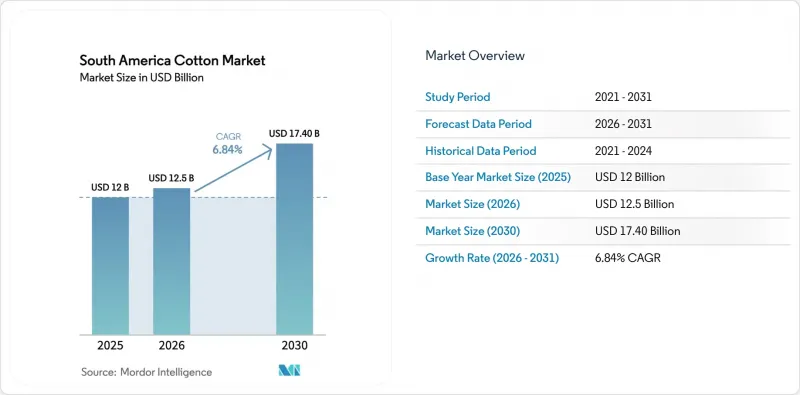
根據 Mordor Intelligence 預測,南美棉花市場規模將從 2025 年的 120 億美元成長到 2026 年的 125 億美元,到 2031 年將達到 174 億美元,2026 年至 2031 年的複合年成長率為 6.84%。
本報告按地區(阿根廷、巴西、哥倫比亞、秘魯等)分類,內容包括生產分析(數量)、消費分析(價值和數量)、進口分析(價值和數量)、出口分析(價值和數量)、批發價格趨勢分析和預測,以及主要參與者名單。市場預測以價值(美元)和數量(公噸)表示。
南美洲棉花市場的趨勢與洞察
紡織品製造和出口需求不斷成長
2024年,巴西出口了270萬噸棉絨,超過美國,確立了其作為南美棉花市場可追溯纖維主要來源國的地位。巴西國內紡紗產能從2024年到2025年成長了12%,達到120萬噸,吸收了更多農民的棉花產量,穩定了當地價格。儘管阿根廷維森廷公司進行了業務重組,但2025年阿根廷對智利和烏拉圭的紗線出口仍成長了9%,這表明南方共同市場優惠待遇的吸引力。巴拉圭正利用巴拉圭-巴拉那水道將運費降低高達20%,並已與亞洲的紡紗廠簽訂了新的提貨合約。預計到2028年,北美品牌的近岸外包將使該地區的棉花需求增加18萬噸,進一步鞏固南美棉花市場的成長動能。
棉花收割和脫粒作業的技術機械化
自2024年以來,馬托格羅索州和巴伊亞州引入移動式模組化採摘機,使棉花採摘所需的勞動力減少了60%。滾筒式軋棉廠的處理能力從2022年的每小時80包提高到每小時120包,從而加快了高階合約的交貨速度,並提高了纖維的新鮮度。與2020年相比,產量提高了20%,這得益於衛星引導的可變施肥和水分感測器對灌溉的最佳化。阿根廷和巴拉圭的棉花生產進度比巴西落後最多兩個季度,但租賃模式和多邊融資正在加速技術的應用。機械化提高了棉花的可追溯性,使南美棉花市場對永續性發展的買家保持了吸引力。
塞拉多草原的氣候相關水分脅迫
2024年至2025年的拉尼娜現象導致降雨量減少200毫米,使得巴伊亞州西部和皮奧伊州南部的棉花二茬產量下降高達12%。塞拉多地區供應巴西68%的棉花產量,過去十年間降雨量波動幅度從22%上升至31%,使得種植決策變得困難。種植者已投資4.2億美元用於中心樞軸式灌溉,但柴油價格上漲24%導致每公頃利潤減少高達52美元。氣候模型預測,到2035年,降雨量將減少10%至15%,這可能導致棉花生產向東轉移至托坎廷斯州和馬拉尼昂州。
其他好處:
- Excel格式的市場預測(ME)表
- 3個月的分析師支持
目錄
第1章:引言
- 研究假設和市場定義
- 調查範圍
第2章:調查方法
第3章執行摘要
第4章 市場狀況
- 市場概覽
- 市場促進因素
- 紡織製造業的擴張和出口需求的成長
- 棉花脫粒和收割的技術機械化
- 政府為中型棉花農場提供的貸款計劃
- 服裝供應鏈近岸外包至南方共同市場
- 小規模農戶作物保險普及率
- 可再生棉花排碳權溢價
- 市場限制因素
- 塞拉多草原的氣候相關水分脅迫
- 對抗Glyphosate蘇力菌(Bt)品種的抗性增強。
- 北方舟地區港口的物流瓶頸
- 疫情後農業勞動力短缺
- 機會
- 任務
- 價值鏈分析
- 人工智慧技術及其在產業的應用
- 原物料市場分析
- 種子
- 肥料
- 殺蟲劑
- 分銷通路分析
- 市場情緒分析
- PESTLE分析
第5章 市場規模與成長預測
- 按地區
- 阿根廷
- 生產分析(種植面積、產量、產量)
- 消費分析(消費量和消費體積)
- 進口市場分析(進口額、進口量、主要供應市場)
- 出口市場分析(出口額、出口量、主要出口目的地市場)
- 批發價格趨勢分析與預測。
- 法律規範
- 主要公司列表
- 物流和基礎設施
- 季節性分析
- 巴西
- 生產分析(種植面積、產量、產量)
- 消費分析(消費量和消費體積)
- 進口市場分析(進口額、進口量、主要供應市場)
- 出口市場分析(出口額、出口量、主要出口目的地市場)
- 批發價格趨勢分析與預測
- 法律規範
- 主要公司列表
- 物流和基礎設施
- 季節性分析
- 智利
- 生產分析(種植面積、產量、產量)
- 消費分析(消費量和消費體積)
- 進口市場分析(進口額、進口量、主要供應市場)
- 出口市場分析(出口額、出口量、主要出口目的地市場)
- 批發價格趨勢分析與預測
- 法律規範
- 主要公司列表
- 物流和基礎設施
- 季節性分析
- 哥倫比亞
- 生產分析(種植面積、產量、產量)
- 消費分析(消費量和消費體積)
- 進口市場分析(進口額、進口量、主要供應市場)
- 出口市場分析(出口額、出口量、主要出口目的地市場)
- 批發價格趨勢分析與預測。
- 法律規範
- 主要公司列表
- 物流和基礎設施
- 季節性分析
- 秘魯
- 生產分析(種植面積、產量、產量)
- 消費分析(消費量和消費體積)
- 進口市場分析(進口額、進口量、主要供應市場)
- 出口市場分析(出口額、出口量、主要出口目的地市場)
- 批發價格趨勢分析與預測。
- 法律規範
- 主要公司列表
- 物流和基礎設施
- 季節性分析
- 阿根廷
第6章 最終用途和行業
- 主要應用和新興應用
- 產業特定消費細分
第7章 競爭情勢
- 競爭格局概述
- 市場集中度分析
第8章 市場機會與未來展望
According to Mordor Intelligence, the South America cotton market size is anticipated to grow from USD 12 billion in 2025 to USD 12.5 billion in 2026 and is forecasted to reach USD 17.4 billion by 2031, at a CAGR of 6.84% (2026-2031).
This report is Segmented by Geography (Argentina, Brazil, Colombia, Peru, and More). The Report Includes Production Analysis (Volume), Consumption Analysis (Value and Volume), Import Analysis (Value and Volume), Export Analysis (Value and Volume), Wholesale Price Trend Analysis and Forecast, List of Key Players, and More. The Market Forecasts are Provided in Terms of Value (USD) and Volume (Metric Tons).
South America Cotton Market Trends and Insights
Expanding Textile Manufacturing and Export Demand
Brazil shipped 2.7 million metric tons of lint in 2024, surpassing the United States and positioning the South America cotton market as a leading source of traceable fiber . Domestic spinning capacity in Brazil rose 12% between 2024 and 2025 to 1.2 million metric tons, absorbing more farm output and stabilizing local prices. Argentina's yarn exports to Chile and Uruguay climbed 9% in 2025, even as Vicentin restructured operations, showing the pull of Mercosur preferences. Paraguay leverages the Paraguay-Parana waterway to cut freight costs by up to 20%, securing new offtake contracts from Asian mills. Near-shoring by North American brands is forecast to add 180,000 metric tons of regional lint demand by 2028, reinforcing the growth path of the South America cotton market
Technological Mechanization in Ginning and Harvesting
Adoption of on-board module pickers lowered harvest labor needs by 60% in Mato Grosso and Bahia since 2024 . Roller-gin complexes now process 120 bales per hour, up from 80 bales in 2022, enabling quicker shipment and fresher fiber quality for high-end contracts. Yield gains of 20% against 2020 levels stem from satellite-guided variable-rate fertilization and moisture sensors that optimize irrigation. Argentina and Paraguay lag Brazil by up to two seasons, but leasing models and multilateral loans accelerate technology diffusion. Mechanization increases traceability, keeping the South America cotton market attractive to sustainability-driven buyers.
Climate-Linked Water Stress in the Cerrado
La Nina conditions in 2024-2025 cut second-crop yields by up to 12% in western Bahia and southern Piaui, where rainfall deficits reached 200 millimeters. The Cerrado supplies 68% of Brazilian lint, so rising rainfall variability from 22% to 31% over the past decade complicates sowing decisions. Growers invested USD 420 million in center-pivot irrigation, yet diesel price gains of 24% erode margins by as much as USD 52 per hectare. Climate models project a 10-15% precipitation decline by 2035, potentially shifting cotton east into Tocantins and Maranhao.
Other drivers and restraints analyzed in the detailed report include:
- Government Credit Lines for Medium-Scale Cotton Farms
- Near-Shoring of Apparel Supply Chains into Mercosur
- Rising Resistance to Glyphosate-Tolerant Bacillus thuringiensis (Bt) Varieties
For complete list of drivers and restraints, kindly check the Table Of Contents.
Complete Report Scope:
- By Geography
- Argentina
- Production Analysis (Area Harvested, Yield, and Production Volume)
- Consumption Analysis (Consumption Value and Volume)
- Import Market Analysis (Import Value, Volume, and Key Supplying Markets)
- Export Market Analysis (Export Value, Volume, and Key Destination Markets)
- Wholesale Price Trend Analysis and Forecast
- Regulatory Framework
- List of Key Players
- Logistics and Infrastructure
- Seasonality Analysis
- Brazil
- Production Analysis (Area Harvested, Yield, and Production Volume)
- Consumption Analysis (Consumption Value and Volume)
- Import Market Analysis (Import Value, Volume, and Key Supplying Markets)
- Export Market Analysis (Export Value, Volume, and Key Destination Markets)
- Wholesale Price Trend Analysis and Forecast
- Regulatory Framework
- List of Key Players
- Logistics and Infrastructure
- Seasonality Analysis
- Chile
- Production Analysis (Area Harvested, Yield, and Production Volume)
- Consumption Analysis (Consumption Value and Volume)
- Import Market Analysis (Import Value, Volume, and Key Supplying Markets)
- Export Market Analysis (Export Value, Volume, and Key Destination Markets)
- Wholesale Price Trend Analysis and Forecast
- Regulatory Framework
- List of Key Players
- Logistics and Infrastructure
- Seasonality Analysis
- Colombia
- Production Analysis (Area Harvested, Yield, and Production Volume)
- Consumption Analysis (Consumption Value and Volume)
- Import Market Analysis (Import Value, Volume, and Key Supplying Markets)
- Export Market Analysis (Export Value, Volume, and Key Destination Markets)
- Wholesale Price Trend Analysis and Forecast
- Regulatory Framework
- List of Key Players
- Logistics and Infrastructure
- Seasonality Analysis
- Peru
- Production Analysis (Area Harvested, Yield, and Production Volume)
- Consumption Analysis (Consumption Value and Volume)
- Import Market Analysis (Import Value, Volume, and Key Supplying Markets)
- Export Market Analysis (Export Value, Volume, and Key Destination Markets)
- Wholesale Price Trend Analysis and Forecast
- Regulatory Framework
- List of Key Players
- Logistics and Infrastructure
- Seasonality Analysis
- Argentina
Additional Benefits:
- The market estimate (ME) sheet in Excel format
- 3 months of analyst support
TABLE OF CONTENTS
1 Introduction
- 1.1 Study Assumptions and Market Definition
- 1.2 Scope of the Study
2 Research Methodology
3 Executive Summary
4 Market Landscape
- 4.1 Market Overview
- 4.2 Market Drivers
- 4.2.1 Expanding textile manufacturing and export demand
- 4.2.2 Technological mechanization in ginning and harvesting
- 4.2.3 Government credit lines for medium-scale cotton farms
- 4.2.4 Near-shoring of apparel supply chains into Mercosur
- 4.2.5 Crop-insurance penetration among smallholders
- 4.2.6 Carbon-credit premiums for regenerative cotton
- 4.3 Market Restraints
- 4.3.1 Climate-linked water stress in the Cerrado
- 4.3.2 Rising resistance to glyphosate-tolerant Bacillus thuringiensis (Bt) varieties
- 4.3.3 Logistics bottlenecks at Northern Arc ports
- 4.3.4 Tight on-farm labor pool post-pandemic
- 4.4 Opportunities
- 4.5 Challenges
- 4.6 Value Chain Analysis
- 4.7 Technologies and usage of AI in the Industry
- 4.8 Input Market Analysis
- 4.8.1 Seeds
- 4.8.2 Fertilizers
- 4.8.3 Crop Protection Chemicals
- 4.9 Distribution Channel Analysis
- 4.10 Market Sentiment Analysis
- 4.11 PESTLE Analysis
5 Market Size and Growth Forecasts (Value and Volume)
- 5.1 By Geography
- 5.1.1 Argentina
- 5.1.1.1 Production Analysis (Area Harvested, Yield, and Production Volume)
- 5.1.1.2 Consumption Analysis (Consumption Value and Volume)
- 5.1.1.3 Import Market Analysis (Import Value, Volume, and Key Supplying Markets)
- 5.1.1.4 Export Market Analysis (Export Value, Volume, and Key Destination Markets)
- 5.1.1.5 Wholesale Price Trend Analysis and Forecast
- 5.1.1.6 Regulatory Framework
- 5.1.1.7 List of Key Players
- 5.1.1.8 Logistics and Infrastructure
- 5.1.1.9 Seasonality Analysis
- 5.1.2 Brazil
- 5.1.2.1 Production Analysis (Area Harvested, Yield, and Production Volume)
- 5.1.2.2 Consumption Analysis (Consumption Value and Volume)
- 5.1.2.3 Import Market Analysis (Import Value, Volume, and Key Supplying Markets)
- 5.1.2.4 Export Market Analysis (Export Value, Volume, and Key Destination Markets)
- 5.1.2.5 Wholesale Price Trend Analysis and Forecast
- 5.1.2.6 Regulatory Framework
- 5.1.2.7 List of Key Players
- 5.1.2.8 Logistics and Infrastructure
- 5.1.2.9 Seasonality Analysis
- 5.1.3 Chile
- 5.1.3.1 Production Analysis (Area Harvested, Yield, and Production Volume)
- 5.1.3.2 Consumption Analysis (Consumption Value and Volume)
- 5.1.3.3 Import Market Analysis (Import Value, Volume, and Key Supplying Markets)
- 5.1.3.4 Export Market Analysis (Export Value, Volume, and Key Destination Markets)
- 5.1.3.5 Wholesale Price Trend Analysis and Forecast
- 5.1.3.6 Regulatory Framework
- 5.1.3.7 List of Key Players
- 5.1.3.8 Logistics and Infrastructure
- 5.1.3.9 Seasonality Analysis
- 5.1.4 Colombia
- 5.1.4.1 Production Analysis (Area Harvested, Yield, and Production Volume)
- 5.1.4.2 Consumption Analysis (Consumption Value and Volume)
- 5.1.4.3 Import Market Analysis (Import Value, Volume, and Key Supplying Markets)
- 5.1.4.4 Export Market Analysis (Export Value, Volume, and Key Destination Markets)
- 5.1.4.5 Wholesale Price Trend Analysis and Forecast
- 5.1.4.6 Regulatory Framework
- 5.1.4.7 List of Key Players
- 5.1.4.8 Logistics and Infrastructure
- 5.1.4.9 Seasonality Analysis
- 5.1.5 Peru
- 5.1.5.1 Production Analysis (Area Harvested, Yield, and Production Volume)
- 5.1.5.2 Consumption Analysis (Consumption Value and Volume)
- 5.1.5.3 Import Market Analysis (Import Value, Volume, and Key Supplying Markets)
- 5.1.5.4 Export Market Analysis (Export Value, Volume, and Key Destination Markets)
- 5.1.5.5 Wholesale Price Trend Analysis and Forecast
- 5.1.5.6 Regulatory Framework
- 5.1.5.7 List of Key Players
- 5.1.5.8 Logistics and Infrastructure
- 5.1.5.9 Seasonality Analysis
- 5.1.1 Argentina
6 End Use Applications and Industries
- 6.1 Primary Applications and Emerging Applications
- 6.2 Consumption Breakdown by Industries
7 Competitive Landscape
- 7.1 Overview of the Competition
- 7.2 Recent Developments
- 7.3 Market Concentration Analysis
8 Market Opportunities and Future Outlook

 有機棉壁掛市場:規模、佔有率、成長、全球產業分析、區域洞察及2026年至2034年預測
 北美棉花:市場佔有率分析、產業趨勢與統計、成長預測(2026-2031)棉花:市場佔有率分析、行業趨勢和統計數據、成長預測(2026-2031 年)歐洲棉花:市場佔有率分析、行業趨勢和統計數據、成長預測(2026-2031)非洲棉花:市場佔有率分析、行業趨勢和統計數據、成長預測(2026-2031)
 棉花市場預測至2034年-按產品、產品類型、最終用戶和地區分類的全球分析
 棉短絨紙漿市場:按產品類型、最終用途行業、應用和地區分類棉纖維市場:依纖維等級、應用和地區分類
 2026-2030年全球棉花市場
 棉漿市場:依產品類型、形態、加工方法、等級、應用和銷售管道分類-2026-2032年全球預測